Posts tagged as:

whale

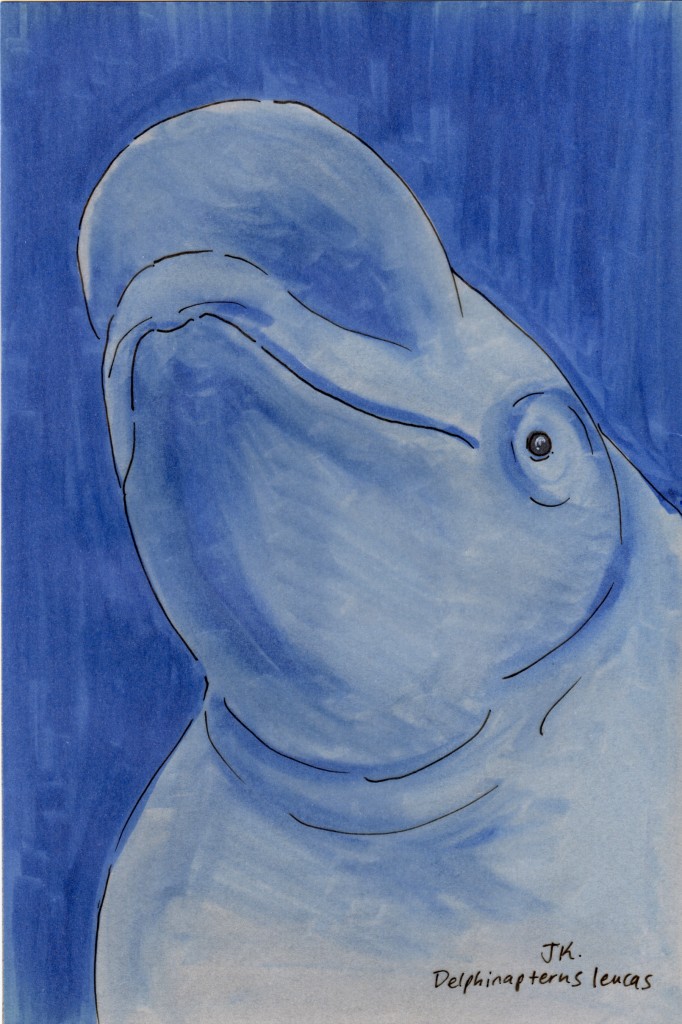
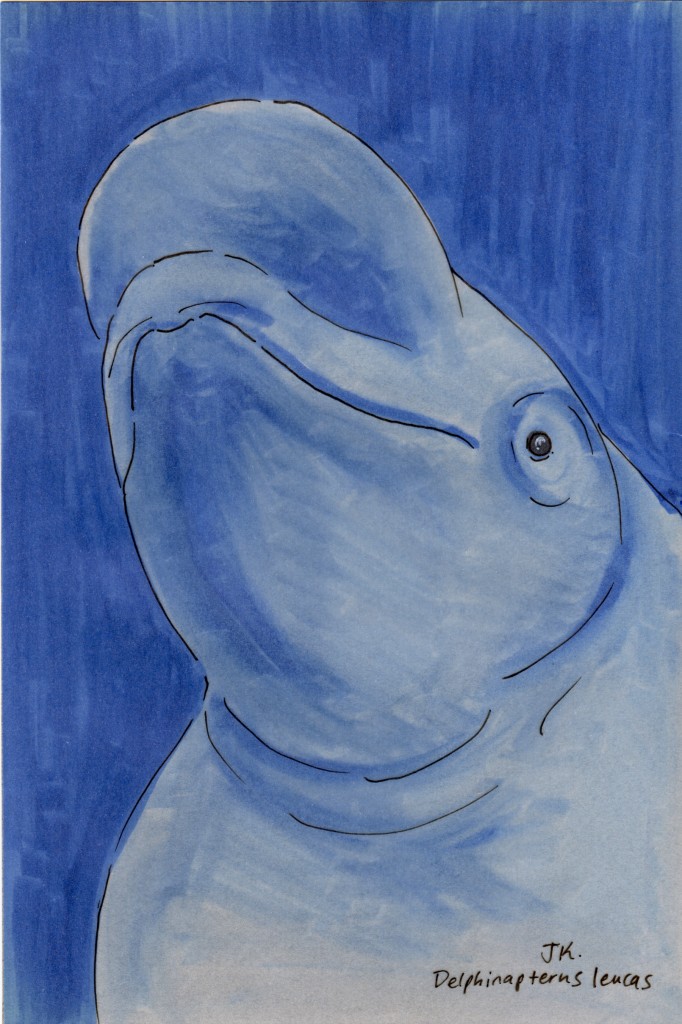
Beluga whale (click image to enlarge)

Beluga whale (click image to enlarge)


0264

The beluga whale lives throughout the arctic waters of the world. It’s gray when it’s born and gets lighter until it’s five or six, at which point it’s completely white. Belugas have been called sea canaries because of their elaborate echolocations and vocalizations. Overall, they’re doing pretty well, population-wise, but some subpopulations are threatened, generally by hunting, climate change, habitat loss, or sea traffic.

The melon-like bulge on the top of the beluga whale’s head is called a melon! According to the American Cetacean Society, “The rounded melon on its head contains oil, and the whale can change the shape of the melon. Scientists believe that the melon plays a part in the beluga’s echolocation system.”

You can listen to the beluga whale’s many different sounds at this page on the National Geographic website, and you can listen to Raffi’s wonderful song “Baby Beluga” on his MySpace page (highly recommended!). “Baby beluga in the deep blue sea, swim so wild and you swim so free. Heaven above you and the sea below, and a little white whale on the go…”

{ 4 comments }

click image to enlarge

0214

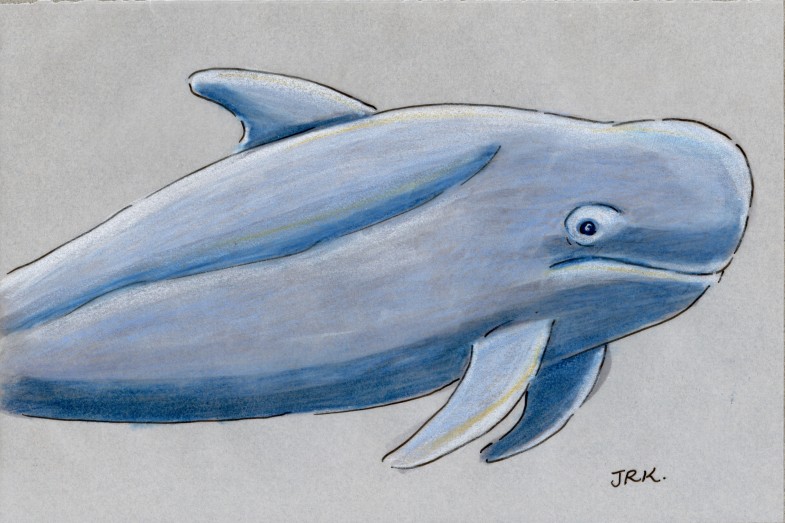
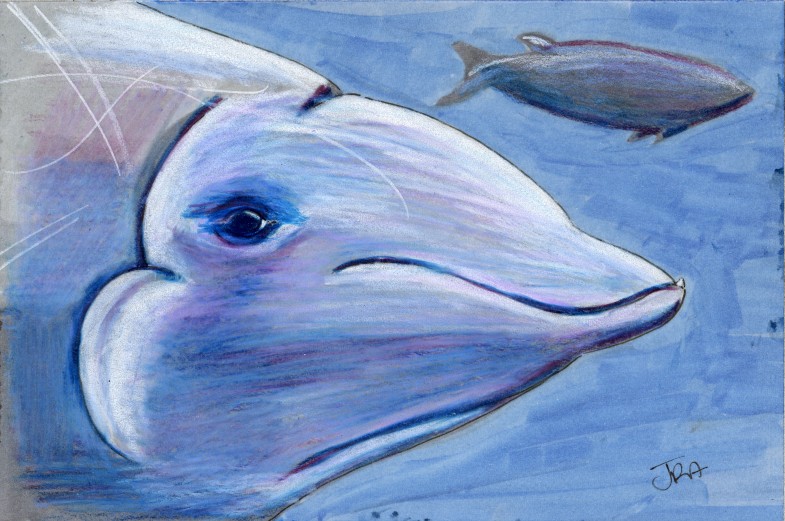
Happy Inauguration Day! Today is the last day of our visit to President Obama’s (!!) home state. This funny guy is a Cuvier’s beaked whale, also called a goose-beaked whale. Even though Cuvier’s beaked whales are believed to be quite abundant, and even though they have an impressively large range, very little is known about them. They’re difficult to study because they seldom come to the surface. We do know, though, that they can dive deeper than any other air-breathing animal and that they hear through their throats (the sound travels to their ears through “a unique fatty channel”).

We also know that beaked whales seem especially susceptible to being harmed by naval sonar experiments and exercises. In 2000, several Cuvier’s beaked whales beached in the Bahamas, bleeding around their brains and ears, during naval exercises. Naval sonar has also been linked to mass strandings in the Mediterranean, the Madeira Islands, the Canary Islands, Japan, and the Gulf of California. The bad news for Hawaii’s beaked whales, reported last week, is that the U.S. Navy has been given a permit for a year of sonar and bomb training off the coast of Hawaii. The Navy is supposed to try not to harm marine mammals, but since no one knows exactly how sonar hurts the whales, how can we prevent it?

{ 0 comments }

Mammal News Roundup

by J.R. Atkins on June 26, 2008

in Mammal News

Well, I was going to post a new mammal drawing today, which would have brought us to six consecutive days! But alas, I decided to pick tonight to try out a new paper (I was going to try to find a more archival replacement for my usual tracing paper) and, well, it’s just not working out for me. So instead, here’s an installment of the Mammal News Roundup.

May 28, 2008, The Guardian: Jane Goodall, a hero to mammals including me and my friend Tynan, is proposing that the Nobel Prize committee add a new prize, “for advancing medical knowledge without experimentation on animals.” I absolutely agree that, at the very least, we could drastically cut back on how often we experiment on animals now that we have amazing scientific technology and that we should actively recognize and reward new ways of doing science that don’t involve harming animals, but a Nobel Prize for such a niche seems like it would not quite fit in with the others.

June 23, 2008, CNN.com: The U.S. Supreme Court will hear a case regarding whether or not it’s okay for the Navy to disregard the welfare of whales when it’s performing sonar tests. Despite evidence showing, apparently, that whales, dolphins, and other marine mammals can be injured or killed by military sonar, President Bush tried to create an exemption that would allow the tests to be conducted without an environmental impact assessment. Courts up to the Supreme Court have sided with the whales.

On the other hand, the court isn’t going to hear a case about the proposed fence along the U.S.-Mexican border, meaning that the law that gives “the secretary of homeland security the power to bypass laws or regulations prohibiting the fence’s construction” stands. A law that gives someone the power to break the law is an interesting law indeed. This is an issue I feel very strongly about, but I’m not going to start ranting about it right now.

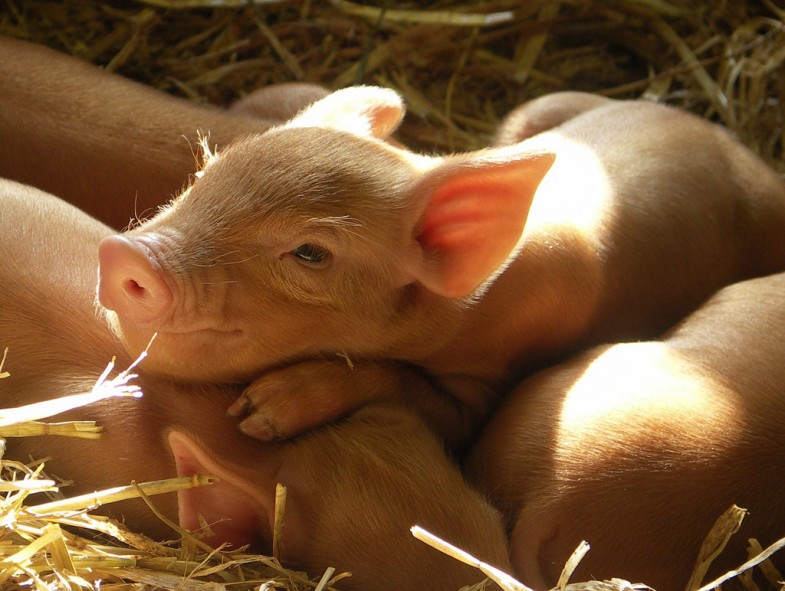
June 24, 2008, NewScientist.com: A study suggests that piglets—being raised for their meat—who get to listen to music and play in their own rec room are less stressed. The piglets in the study listened to music by Bach and Elgar, chosen for its resemblance to porcine grunts! Less stress for pigs means better pork for humans.

June 20, 2008, The Guardian: The demilitarized zone between North and South Korea was once farmland. Now that it’s been left to its own devices, endangered animals have been quite successfully making their homes there. But the DMZ isn’t likely to stay natural and wild for long, since development and industry are encroaching, so a group wants to have the zone declared an official nature reserve: the most dangerous nature reserve in the world, according to this article. The article is accompanied by a slide show about the wildlife of Korea’s DMZ.

Photograph by Scott Bauer, United States Department of Agriculture

{ 2 comments }

click image to enlarge

0113

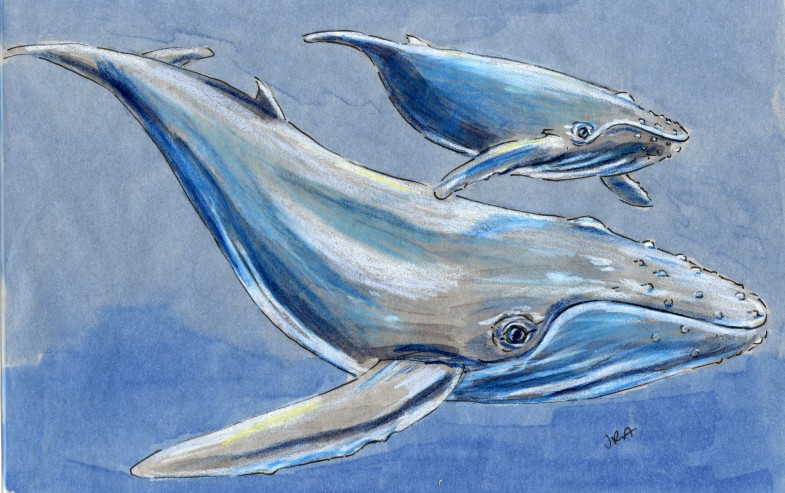
It’s North Carolina Week at the Daily Mammal, and in fact, next time you’re in Raleigh, you really should visit the North Carolina Museum of Natural Sciences, where, in the Coastal Carolina area, you can see gigantic gorgeous skeletons of several whale species, including this one.

The humpback whale’s Latin name means giant wing of New England. Isn’t that beautiful? The “giant wing” part refers to the whale’s pectoral fins, which are huge. Everything about the humpback whale is huge, actually. They get to about 50 feet long and weigh around 50 tons. They’re known for the beauty and mystery of their songs, which researchers have recently discovered have a complexity we didn’t understand before. In fact, the whales’ vocalizations share some basic elements with human languages. One neat thing is that whales in different parts of the world have completely different songs, and the songs in a given area develop and evolve collaboratively.

At one time, we had hunted humpbacks almost to extinction. In the ’60s, the world adopted an international whaling ban that brought them back from the edge. Now, some countries have begun whaling again, and it was only because of the critical outcry of dismay that Japan last month postponed its plans to kill dozens of humpback whales for “research.”

Take this mammal home with you!

{ 18 comments }


0081

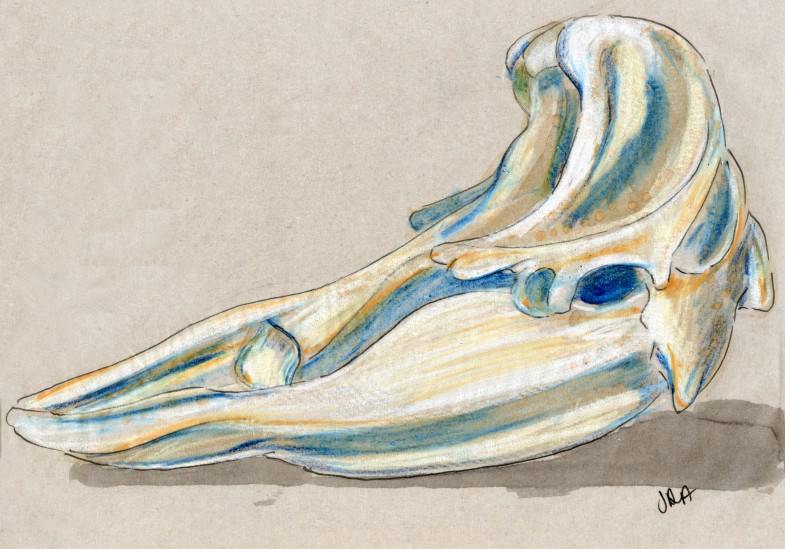
Whale, whale, whale, what have we here? It’s a whale skull! Neil requested this spade-toothed whale, giving me its Latin name and apology. Turns out, no one’s ever seen this animal. All we know of it is what we can gather from three skull parts that have washed up over the past 130 years or so. It’s pretty amazing that there are still so many mammals—big ones!—that we’ve never seen, even though we think we’ve seen it all and know it all.

So Neil, I’m sorry your mammal has no skin, but I think this drawing is in the spirit of your request.

If you want to learn more about this mysterious whale, you can start with Wikipedia.

{ 4 comments }

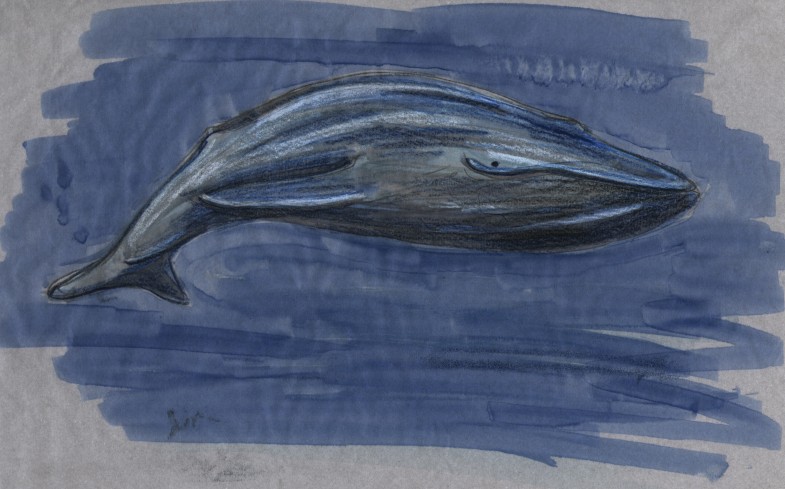
Blue Whale (Balaenoptera musculus)

by J.R. Atkins on June 9, 2007

in Marine Mammals

bluewhale720008

You probably already know that the blue whale is the largest animal known to have ever existed on Earth. According to the American Cetacean Society, from 1868, when technology allowed whalers to kill the blue whale, until 1966, when the hunting of blue whales was banned internationally, up to 99 percent of the blue whale population was killed. In 1931 alone, whalers killed 29,000 of the giant creatures. Whereas there once were some 350,000 blue whales in the world, now there are 8,000-14,000 or so. (Ted requested the blue whale drawing.)

{ 1 comment }