Posts tagged as:

vole

World Cup: Four Swiss Voles

by JR Kinyak on July 10, 2010

in Rodents, Theme Weeks

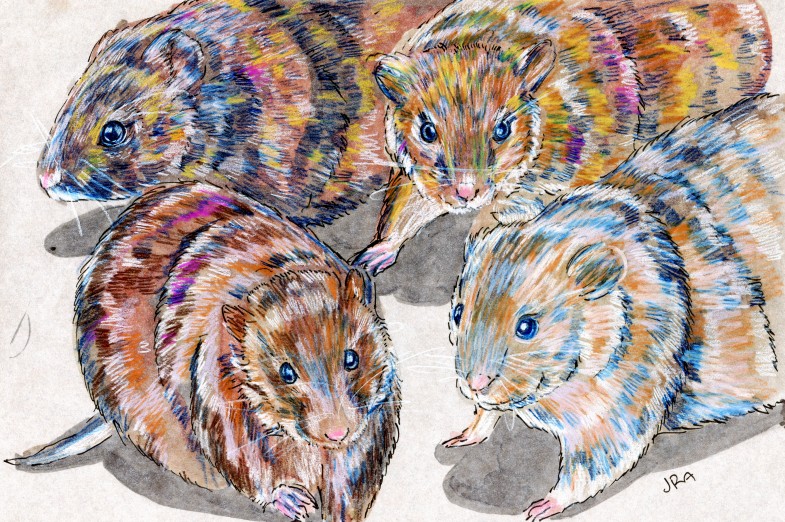
Four voles of Switzerland (click image to enlarge)

0346
0345
0344
0343

Our last competitors in the mammalian World Cup are these four fellows from Switzerland. Clockwise from the top right, we have the European water vole (Arvicola aquatica), the European snow vole (Chionomys nivalis), the European pine vole (Microtus subterraneus), and the bank vole (Myodes glareolus). Some good news about these guys: they are all widespread throughout their ranges with no major threats, and IUCN classifies them as Least Concern. Yay for the voles!

Switzerland’s soccer team has made it to the World Cup several times, reaching the quarterfinals twice in the 1930s and again in 1954. In 2006, the Swiss team set two World Cup records: they were the first team to be bumped out of the competition without anyone ever scoring a goal against them, and they were the first team to not make a single penalty kick in a shootout. (Ukraine made three against them in the Round of 16, which is how Switzerland was eliminated.) This year, they didn’t make it out of the group stage, although they did shock everyone by beating favorites Spain in their first game of the tournament.

Tomorrow is the final match of the World Cup, and I may miss it because I’ll be traveling, but I won’t miss giving you the results of the Mammals of the World Cup competition! First, we need to wrap up the group results.

Group H Results

Group H was the tayra from Honduras, the pudú from Chile, the Spanish ibex, and today’s four voles (that seems unfair, now that I think about it). The voles might run around underfoot, but they’ll hardly pose a threat. The pudú is tiny. The tayra is the closest thing we have to a carnivore in this group, and the ibex has some mighty horns. So the two mammals continuing on to the Round of 16 from this group are:

Tayra (Honduras)
and
Spanish Ibex (Spain)

{ 0 comments }

Various Voles (Macrotus spp.)

by JR Kinyak on June 22, 2008

in Rodents

click image to enlarge

0183
0182
0181
0180

Clockwise from the top left, say hello to a California vole (Microtus californicus), a Mediterranean pine vole (Microtus duodecimcostatus), a Japanese grass vole (Microtus montebelli), and a Mexican vole (Microtus mexicanus).

Voles are little mouselike rodents that burrow around in many kinds of environments. The four shown here have nothing in common, as far as I know, other than the fact that they each have a place name in their common name. Walker’s Mammals of the World has a couple of interesting things to say about the voles of the Microtus genus:

In general the social life of Microtus is something of an enigma. A number of species are known to live in what appear to be colonies of hundreds of individuals. The animals therein, however, may be totally uncooperative and extremely aggressive toward one another.

That reminds me a bit of some Homo sapiens families I know. Walker’s also says:

…Microtus appears to be slow-moving, docile, and easily trapped and tamed. When upset these voles may emit a high-pitched squeak, gnash their teeth, and either flee or freeze depending upon their location and previous activity.

Poor upset voles! Here on YouTube you can see a not-noticeably-distressed captive Japanese grass vole working on his nest.

Consecutive days of mammals: 3
Record: 16

{ 1 comment }

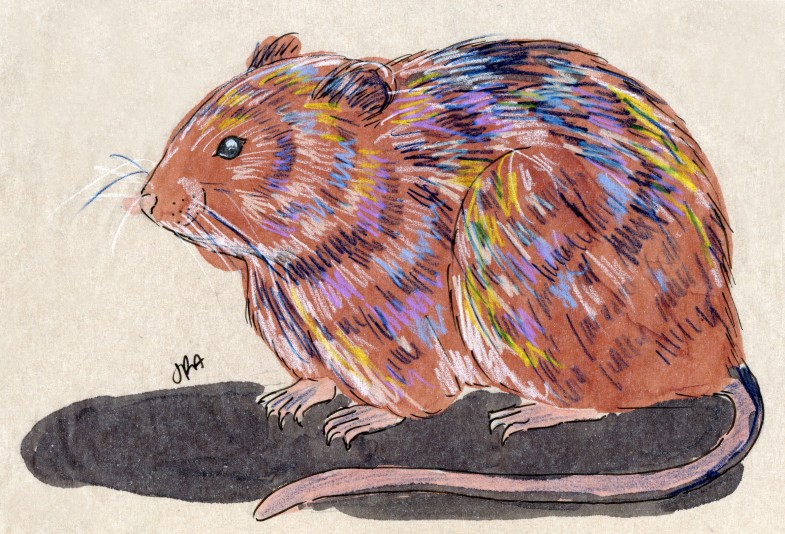
Meadow Vole (Field Mouse) (Microtus pennsylvanicus)

by JR Kinyak on December 18, 2007

in Rodents

Please consider contributing at least $25 to Defenders of Wildlife to get your own original Daily Mammal art! Read more about 24 Mammals in 24 Hours! There are only five four three spots left!


0075

The meadow vole, meadow mouse, field mouse, or field vole is among the most populous mammals in the northeastern United States. Female meadow voles have to start reproducing when they’re three weeks old, and then they have litters about every three weeks thereafter, presumably until they die. (Males wait until they’re around six weeks old to start reproducing.) Can you imagine?

{ 0 comments }