Posts tagged as:

threats

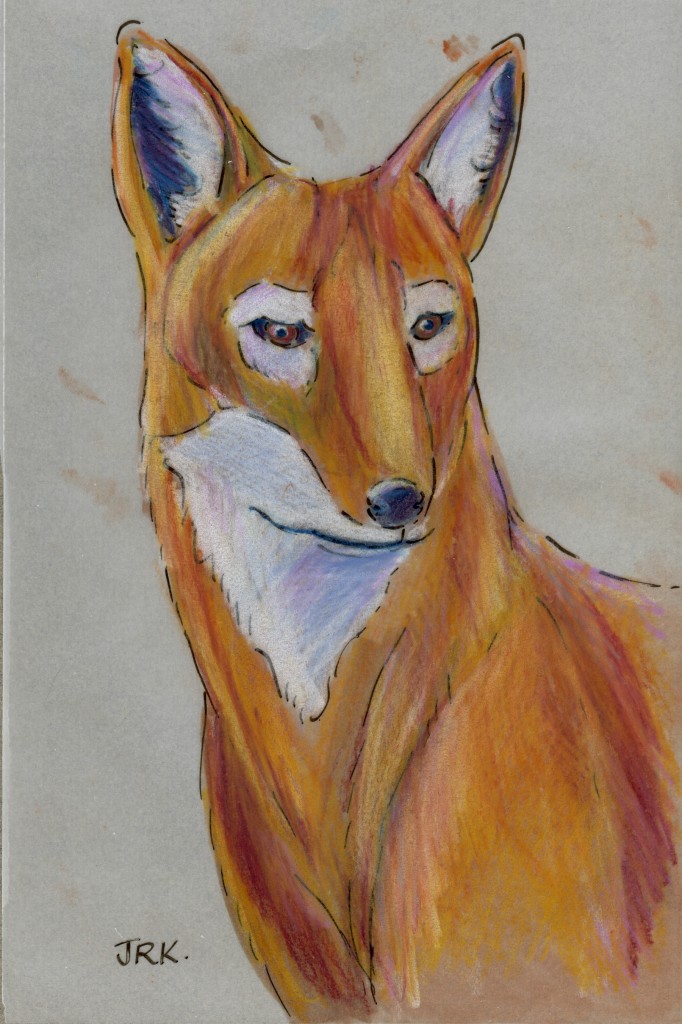
Ethiopian Wolf (Canis simensis)

by JR Kinyak on April 9, 2010

in Carnivores

Ethiopian wolf (click image to enlarge)

0290

Why not stay in Ethiopia’s mountains a while? The Ethiopian wolves live there, too—all 500 of them. Like the gelada monkeys, these wolves are being killed off by climate change as less and less habitat is available to them and more and more people start farming higher and higher in the mountains. Perhaps I haven’t stressed this enough: we are killing off our fellow mammals because we just don’t care. I, for instance, “care” very deeply; Ted will tell you how impassioned I get. But do I trade in my pickup for a hybrid? Do I move to a city where I can bike everywhere instead of driving? Do I even unplug my appliances at night? No. Why? Part of it is that I feel completely helpless and it seems so futile. Part of it is just pure not caring.

Maybe instead of a Daily Mammal book club, or in addition to the next one, we could start a Daily Mammal Do Something club. What do you think?

Anyway, I guess the good news is that there are 500 Ethiopian wolves left. According to my Princeton Encyclopedia of Mammals, the Ethiopians call them ky kebero (red jackal), jedalla farda (horse’s jackal), or walgie (trickster). That last one is interesting to me because the Ethiopian wolf is closely related to the coyote, another trickster of lore, only here in North America.

You may note that the wolf has fox-like features. That’s because like the fox, it’s adapted to eat mostly rodents: rats, moles, and the like. (And speaking of eating rodents, I bought the coolest product in Taos yesterday: synthetic owl puke, which contains a complete synthetic mole skeleton!) The Ethiopian wolves look for rodents alone, but they will occasionally hunt in packs when they’re in the mood for larger prey.

They live in packs, too, in which there’s a dominant female who gets to breed. But interestingly, the breeding female doesn’t always mate with the male members of her own pack, to whom she may be related. Instead, she mates with males from neighboring packs. And when she does mate with her own menfolk, she only mates with the dominant ones, but when she mates with the neighbors, their status doesn’t matter.

Here’s Theo’s great drawing of the Ethiopian wolf.

Ethiopian wolf by Theo, age 13 (click image to enlarge)

{ 3 comments }

Spinner Dolphin (Stenella longirostris)

by JR Kinyak on April 8, 2010

in Marine Mammals

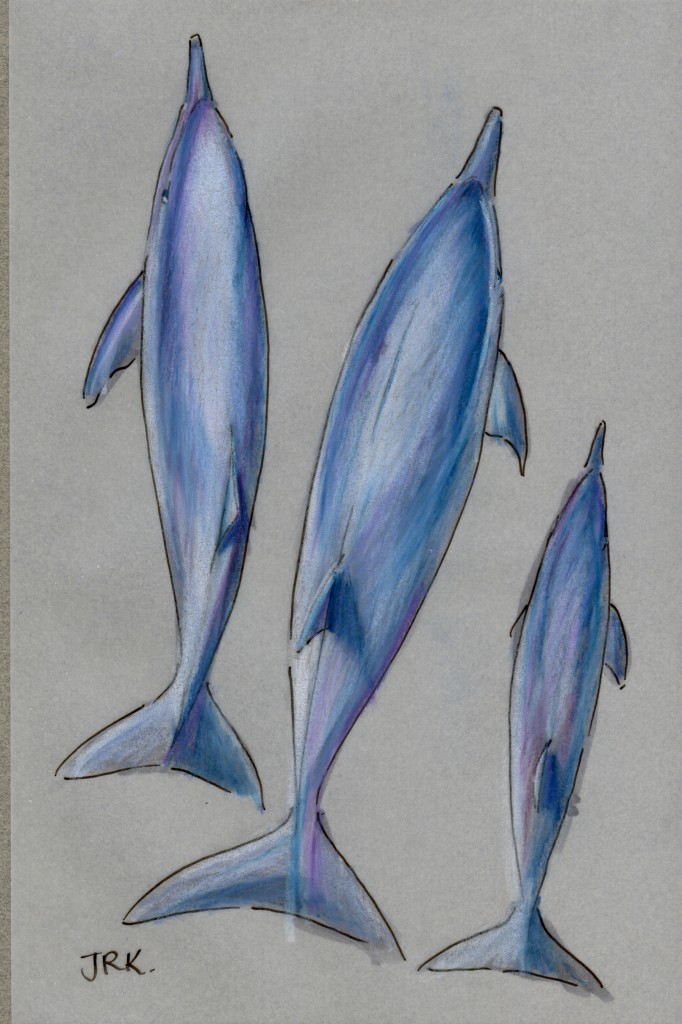
Spinner dolphins (click image to enlarge)

0289

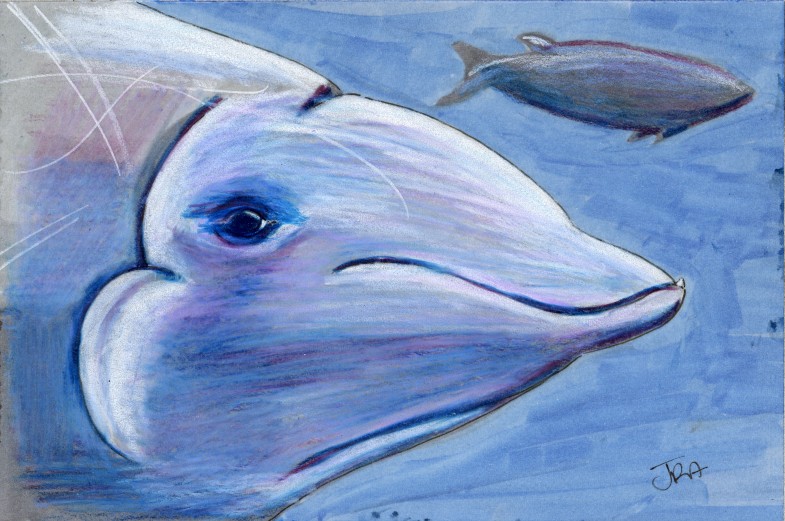
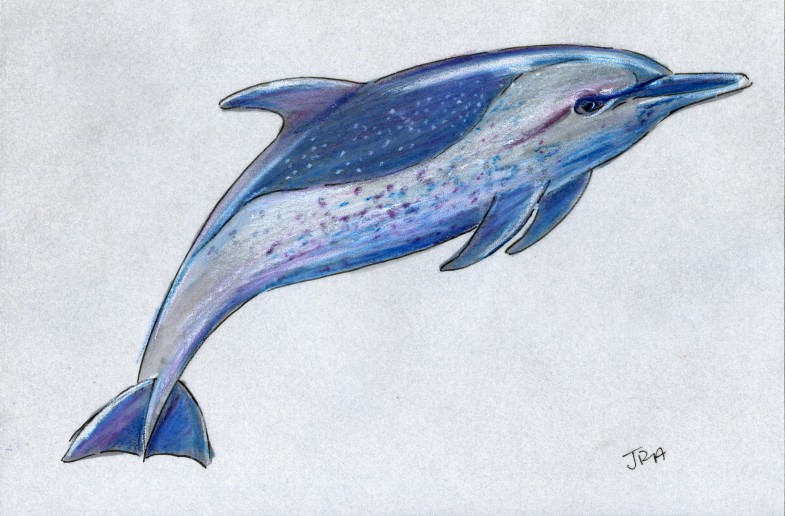
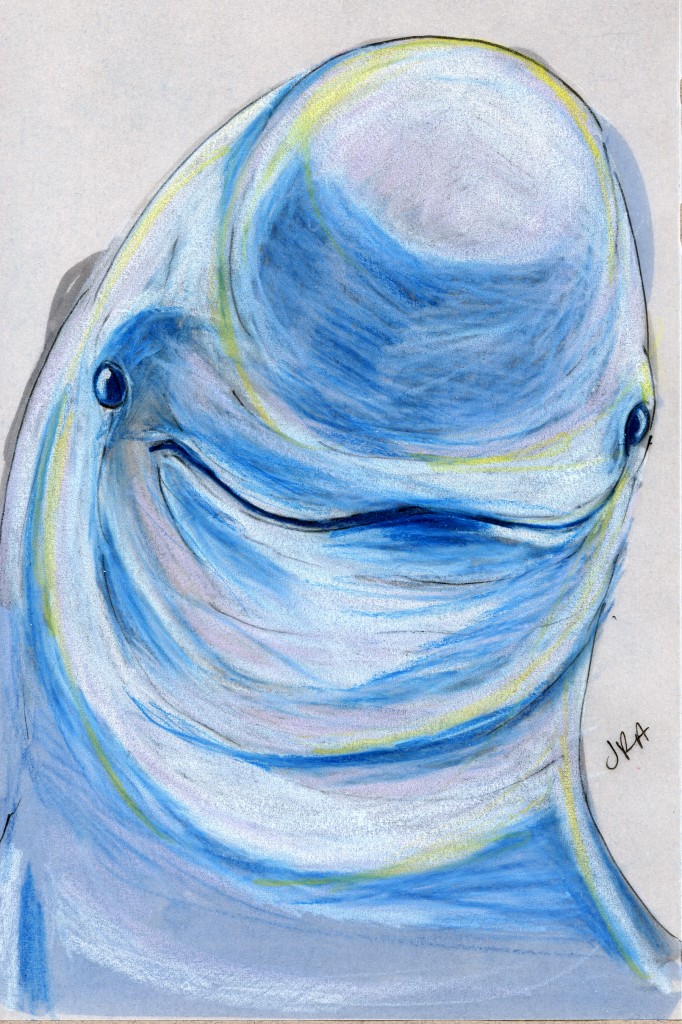
Spinner dolphins, who live in a great big swath of the world’s oceans (right around the middle of the earth like a belt), get their name from their acrobatic twists and rotations. They spin as part of their social interaction and probably as a way to communicate, or maybe to dislodge parasites, which is of course a much less romantic thing to think about when watching their graceful feats. Their society is a fission-fusion one, in which they feed in large groups at night and split off into smaller bunches to hang out during the day.

Spinner dolphins are one of the species most affected by tuna fishing, and although fewer of them are killed by the fishing industry these days, the species is not recovering nearly as quickly as one would hope. And some quick research I’ve just done indicates that the “dolphin-safe” labels that have so assuaged our worries and guilt may not be particularly reliable. And even tuna catches that are dolphin-safe are not safe to the other marine life, like sea turtles, sharks, and other fish, that are caught in tuna nets and discarded. So another day, another Daily Mammal post that ends on a futilely depressing note. Here’s Theo’s beautiful dolphin drawing to add some grace.

Spinner dolphin by Theo, age 13 (click image to enlarge)

{ 0 comments }

Gelada Monkey (Theropithecus gelada)

by JR Kinyak on April 7, 2010

in Primates

gelada monkey

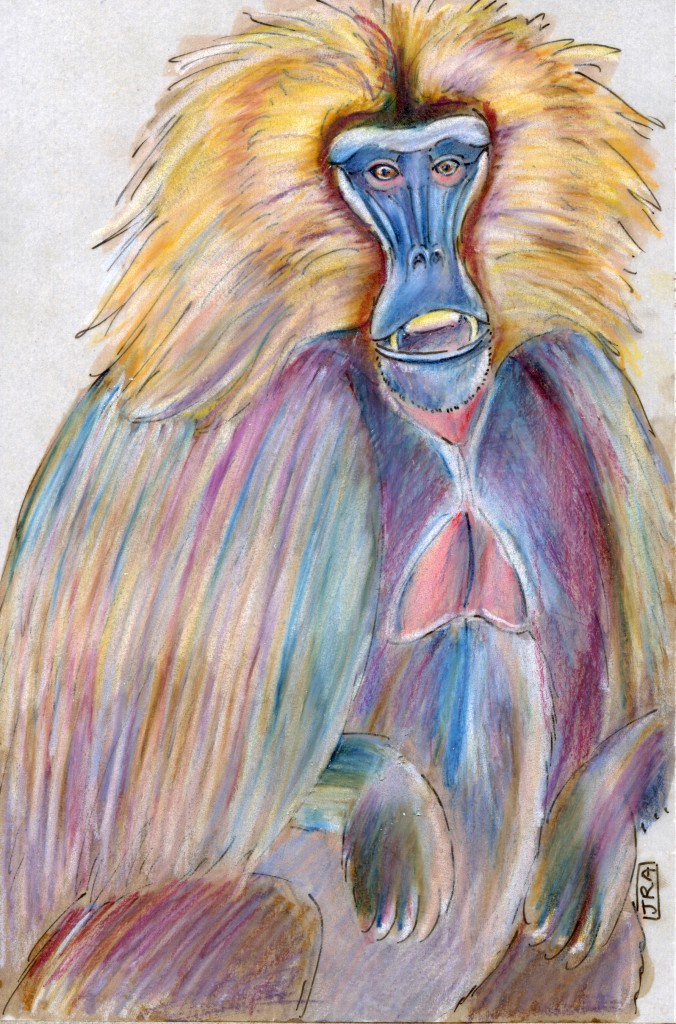
Gelada monkey (click image to enlarge)

0288

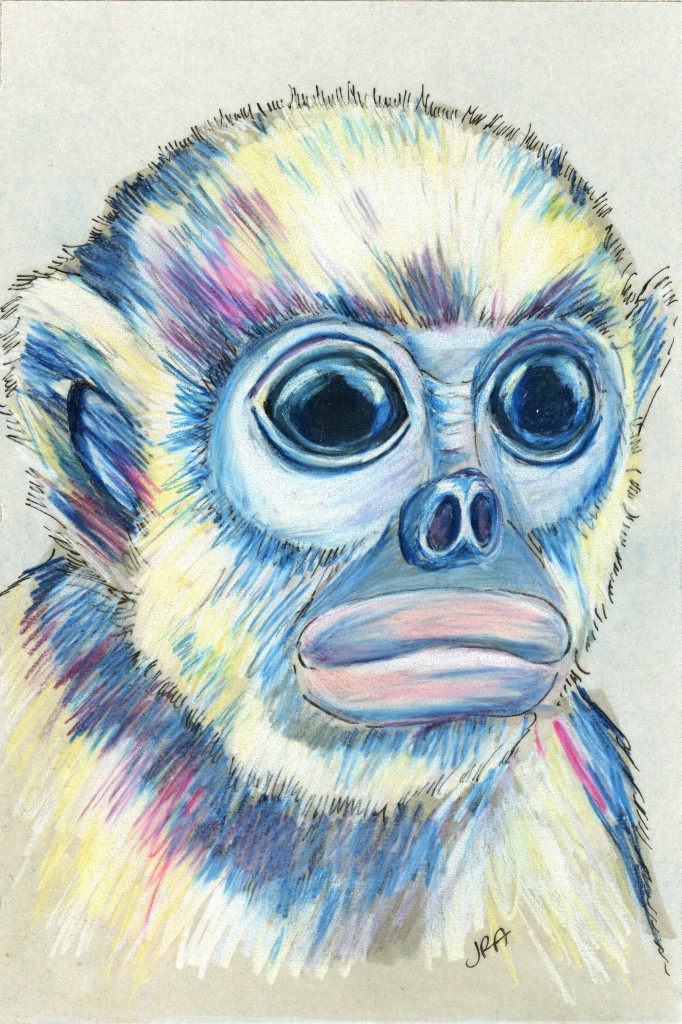
High in the mountains of Ethiopia live large groups of monkeys, the geladas, who spend their days grazing on grass, mating, socializing, and making a variety of interesting sounds that some people speculate could reveal something about the evolution of human language and music. Also known as bleeding-heart baboons and lion baboons (although they aren’t actually baboons), the geladas are the only remaining grazing primate. (In Coco’s drawing, below, you can see a gelada with his upper lip drawn back, showing the grass he’s been eating.) They organize themselves in large troops that consist of “harem” groups as well as nonbreeding males. In the harem groups, each of which comprises a handful of females and a breeding male, the females are in charge of the family’s movements, and they decide when it’s time to trade in their male for a new one.

Gelada by Coco, age 11 (10 when she drew it). Click image to enlarge.

In most baboons and monkeys, swellings on the females’ rear ends indicate their reproductive ability. Because geladas spend so much time sitting on their rumps, though, this would be an impractical way for them to signal to potential mates. The red patches on their chests provide these swelling signs instead. In the female, the color and and size of the patch indicate where she is in her reproductive cycle; in the male, the patch shows his status.

Once, the geladas were targeted for their beautiful fur. Then came the Ethiopian civil war, which brought gunfire to their mountain home and made it impossible for scientists to study the monkeys. Now, they face their biggest threat ever: climate change. As the mountains where the monkeys live get warmer, scientists say, the geladas will almost certainly become extinct. Not only does the warmer climate threaten the grasses that the monkeys depend on for nutrition, it also means that humans will be able to farm at ever-higher altitudes, and where there are farms, there cannot be geladas. These strange and beautiful monkeys are in serious danger of becoming just one more victim of our neglect and apathy toward the planet. It’s too bad the other animals have to share Earth with us.

Gelada by Theo, age 13. Click image to enlarge.

{ 4 comments }

Black-handed Spider Monkey (Ateles geoffroyi)

by JR Kinyak on September 15, 2009

in Primates

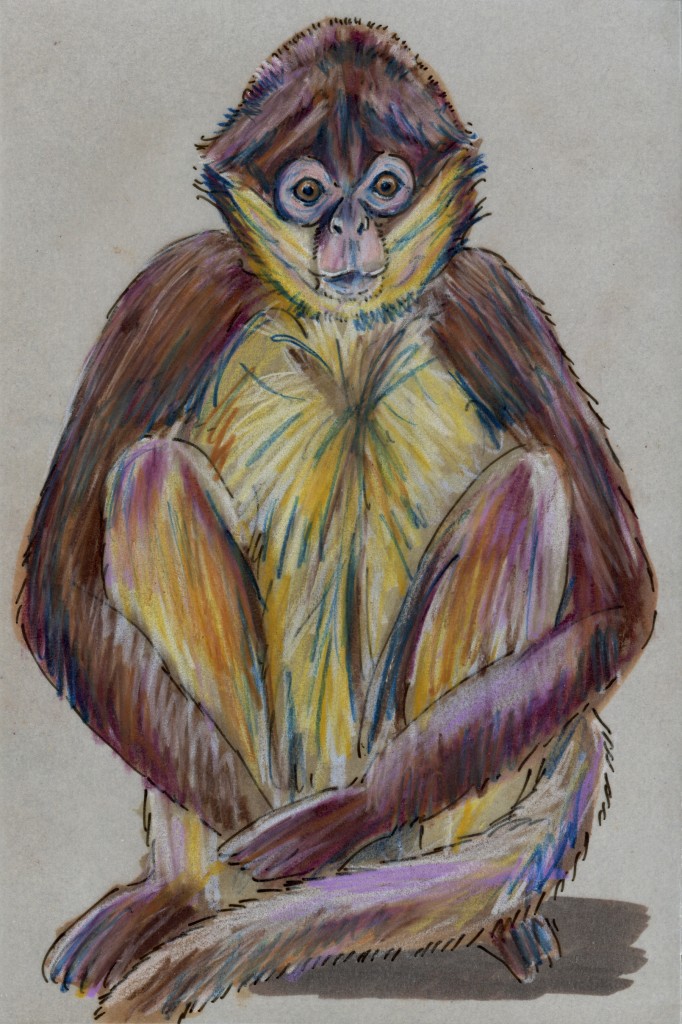
Black-handed spider monkey (click image to enlarge)

Black-handed spider monkey (click image to enlarge)


0287

These incredibly agile monkeys live throughout Central America. They’re very social, swinging through the treetops in groups of 20 or 30, munching on fruit, leaves, and flowers. They’re important distributors of fruit seeds, dispersing them through their digestive system. Unfortunately, the black-handed spider monkey is endangered due to habitat loss.

{ 0 comments }

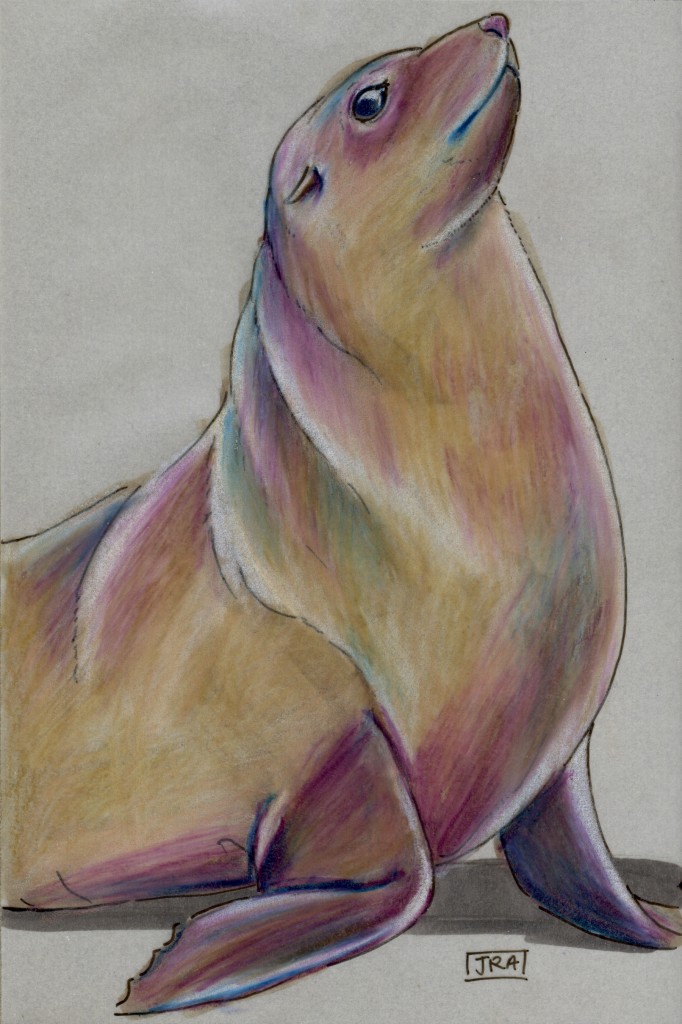
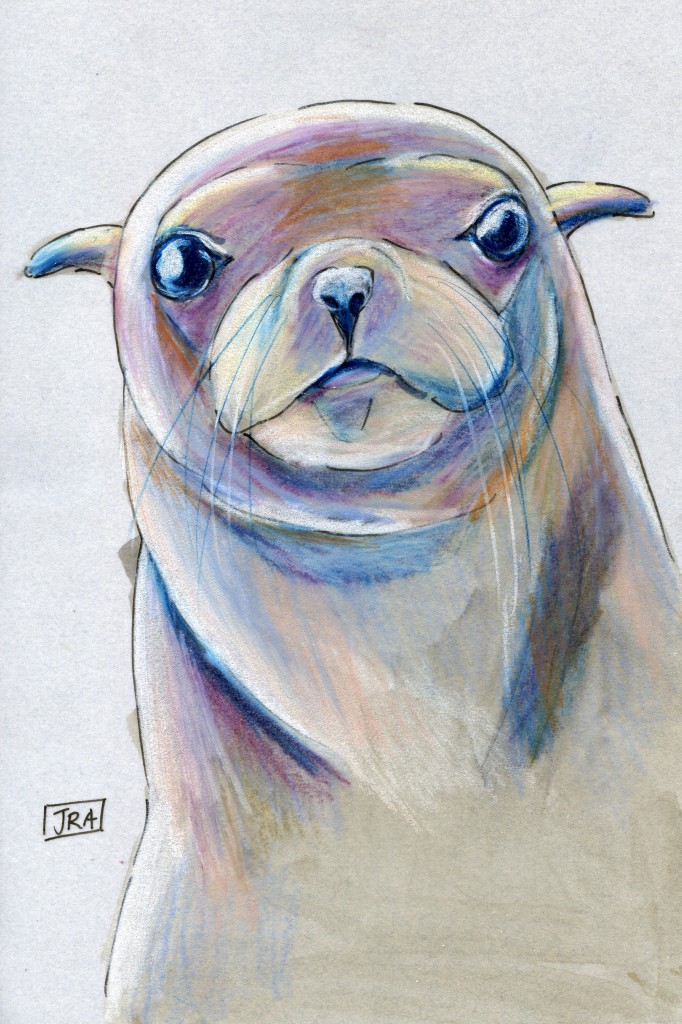
Cape fur seal (click image to enlarge)

Cape fur seal (click image to enlarge)


0271

Daily Mammal Now is an occasional Daily Mammal feature in which we meet a topically newsy mammal that I hadn’t previously drawn. Now, let’s meet the Cape fur seal, or more precisely, the Afro-Australian fur seal, of which the Cape fur seal is a subspecies. Afro-Australian seals live, unsurprisingly, off the coasts of Africa and Australia, specifically southwestern Africa and southern Australia. They’re called fur seals because their fur has been used to make coats and such. Baby fur seals have especially prized fur. The genitalia of male seals is sometimes used as an aphrodisiac in traditional medicine.

The largest Cape fur seal colony is on the coast of Namibia. Every year, the Namibian government allows seal hunts. This year the seal season runs from July 1 until November 15. The government is allowing hunters to club 85,000 baby seals and 5,000 adult males. The hunt takes place in relative secrecy so as not to attract attention or scare people.

Namibia is one of only five countries that still allow seal hunts. There is some disagreement among experts about the humaneness of clubbing seals; some maintain that done correctly, it’s more humane than shooting. But because of the perceived cruelty, seal products have long been banned in the United States and other countries, and beginning in 2010, they’ll be illegal in the European Union, too (with the exception of those created by subsistence hunting on the part of native populations).

This year’s Namibian seal hunt has been in the news the past couple of weeks because a South African organization, Seal Alert-SA, has been trying to buy out the only company that deals in Namibian seal pelts. (Coats made by the company supposedly fetch up to US$110,000.) With animal welfare activists claiming that the seal hunt hasn’t started because of the pending deal and the Namibian government saying that it has, it’s unclear what exactly is going on.

The National: “$14m deal to end Namibia’s Seal Cull”

The AP: “Namibian seal hunt to go on, 90,000 to be clubbed”

African Conservation Foundation: “Seal Cull NOT Started, Hang-in There Baby Seals, Help Coming”

Seal Alert-SA’s blog

{ 7 comments }

Iberian Lynx (Lynx pardinus)

by JR Kinyak on July 8, 2009

in Carnivores

Iberian lynx (click image to enlarge)

Iberian lynx (click image to enlarge)


0270

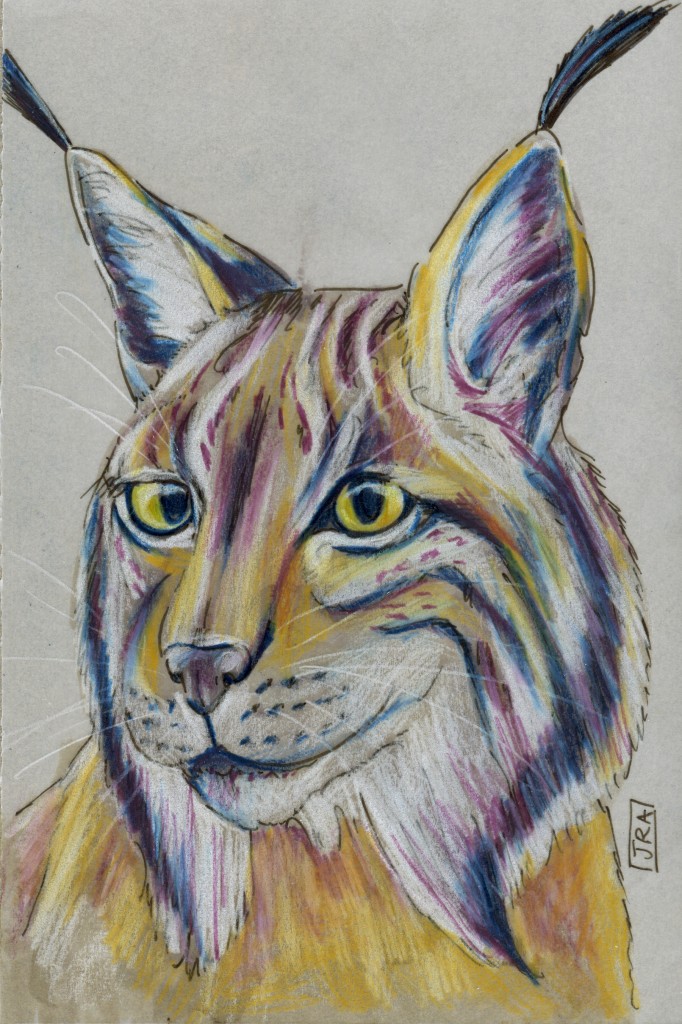
The Iberian lynx is the most endangered cat species in the world. In fact, it’s in imminent danger of being the first cat to become extinct since the saber-toothed tiger. While the cats once lived in both Spain and Portugal, there’s no sign of them in Portugal anymore, and they’re confined to only two small regions in Spain now. Fewer than 150 Iberian lynx live in the wild. Fewer than 150.

The good news is that a captive-breeding program has been fairly successful; it’s preparing to release its first kittens two years ahead of schedule. Scientists have also made an important, if sad, discovery about the Iberian lynx. Most Iberian lynx litters are made up of three kittens. It turns out that it’s not uncommon for the kittens to fight to the death when they’re between 30 and 60 days old. In most litters, one kitten doesn’t survive, having been killed by a littermate. With fewer than 150 wild lynx in existence, losing one third of them while they’re still babies is particularly poignant.

Why is the Iberian lynx in so much trouble? One of the biggest reasons is that it eats almost nothing but rabbits, and depending on only one food source is never the best strategy. In the latter half of the 20th century, the rabbit population on the Iberian peninsula declined drastically not only because of deforestation, real estate development, and hunting, but also because one French doctor, in 1952, decided to control the rabbits in his garden by introducing myxomatosis, a rabbit disease. By 1954, myxomatosis had killed 90 percent of French rabbits and had spread throughout Europe, where it eventually killed off a significant portion of the Iberian lynx’s all-you-can-eat-as-long-as-it’s-rabbits food supply. Deforestation and other forms of habitat destruction affect the lynx directly, as well.

El Programa de Conservación Ex-Situ del Lince Ibérico (it’s in Spanish)
SOS Lynx, a Portugal-based organization working to save the Iberian lynx

{ 3 comments }

Fisher (click image to enlarge)

Fisher (click image to enlarge)


0269

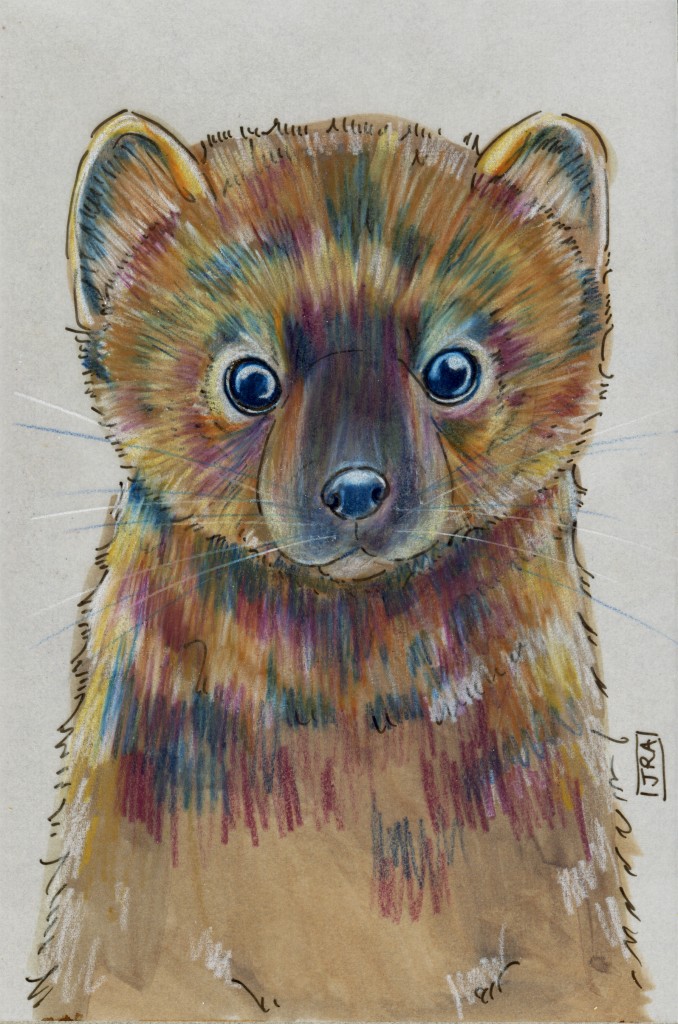
Fishers live only in North America, and currently only in northern North America, from Alaska and Canada down to the Sierra Nevadas and the Appalachians. At one time, they ranged as far south as Tennessee and North Carolina, but they’ve disappeared from much of their historic range because of excessive trapping and habitat loss from logging.

Fishers don’t get their name because they eat fish. They mainly eat birds, small mammals, and carrion. It’s possible that they’re called fishers because at one point they raided some fisherman’s fish traps, but it’s most likely that the name comes from the Dutch word fitchet, or polecat—an animal the fishers resemble. (Incidentally, fitchet comes from the root visse, which means “nasty.”)

The fisher is one of the only animals that can kill a porcupine. It sounds quite horrific, really. The fisher will circle the porcupine, taking every opportunity to bite the porcupine’s face, where it doesn’t have quills. The porcupine circles, too, trying to keep its back to the fisher. Sometimes the porcupine will seek protection by pressing its face against a tree; the fisher might climb the tree and attack from above, forcing the porcupine away. When the porcupine has sustained enough injuries to the face to wear it out and stop it from protecting itself, it dies, often from shock, blood loss, or injuries to the top of the head! Then the fisher starts eating, beginning with the heart, liver, and lungs, and leaving behind only the feet, skin, and bones of the porcupine.

{ 4 comments }