Posts tagged as:

threats

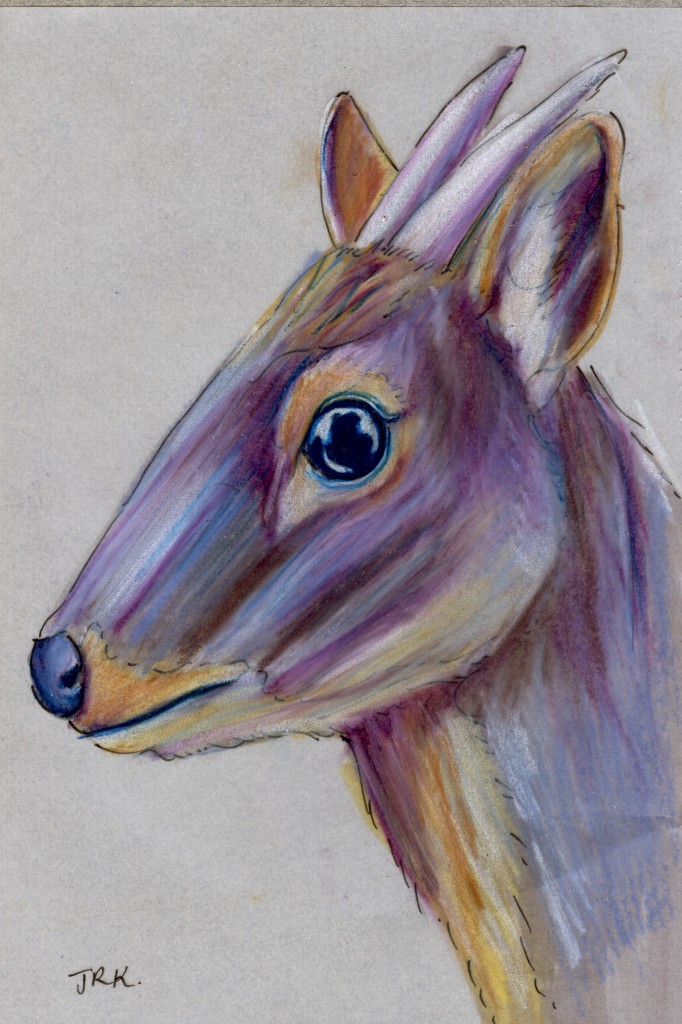
Pudú (click image to enlarge)


0341

The Mammals of the World Cup series is almost finished! Just two more countries after today’s representative from Chile, the Chilean or southern pudú, which is the second smallest deer in the world, the first being the northern pudú, this guy’s cousin. The Chilean pudú is less than a foot and a half tall and is vulnerable to becoming endangered because of habitat loss (join the club, little pudú) in its forest home, poaching, and domestic dogs.

There’s a Chilean metal band called Power of the Pudú, and they have a song called “Oda al Pudú,” or “Ode to the Pudú.” Check out the video below, which has translated subtitles (seemingly translated by a computer). It’s pretty good!

As for Chile’s soccer team, they have a long and sometimes disgraceful World Cup history. They’ve made it to the big tournament eight times, earning third place in 1962, when they hosted, and making it to the Round of 16 this year. But in 1990, the team was banned from that year’s tournament and the next one, too (1994), because of something that happened at a 1989 qualifying game against Brazil. Chile was behind 1–0 when a Brazilian fan threw a firework onto the pitch. The goalie, Roberto Rojas (nicknamed Cóndor) fell to the ground, his head bleeding, and the team doctor came out to have a look at him. They took him off on a stretcher, and then the Chilean team captain came out and said the team would not be returning to the game because conditions were unsafe.

Well, it turned out that the firework did not hit Rojas, but that he had cut himself deliberately in order to stop the game. It also came out that the team doctor had submitted a “fraudulent medical certificate” and that the coach had ordered Rojas and the doctor, by walkie-talkie, to stay on the ground. In the end, Rojas, the doctor, and the coach were all banned from soccer for life, the team captain who kept the team from returning to play was banned for five years, and the team was banned from the following two World Cups. In 2001, FIFA lifted the ban against Rojas.

YouTube has several videos about the incident, but they’re all in Spanish or Portuguese. Here’s one, marking the game’s 20th anniversary. You may or may not be able to understand the words, but the footage of the firework and the injury say a lot on their own.

{ 0 comments }

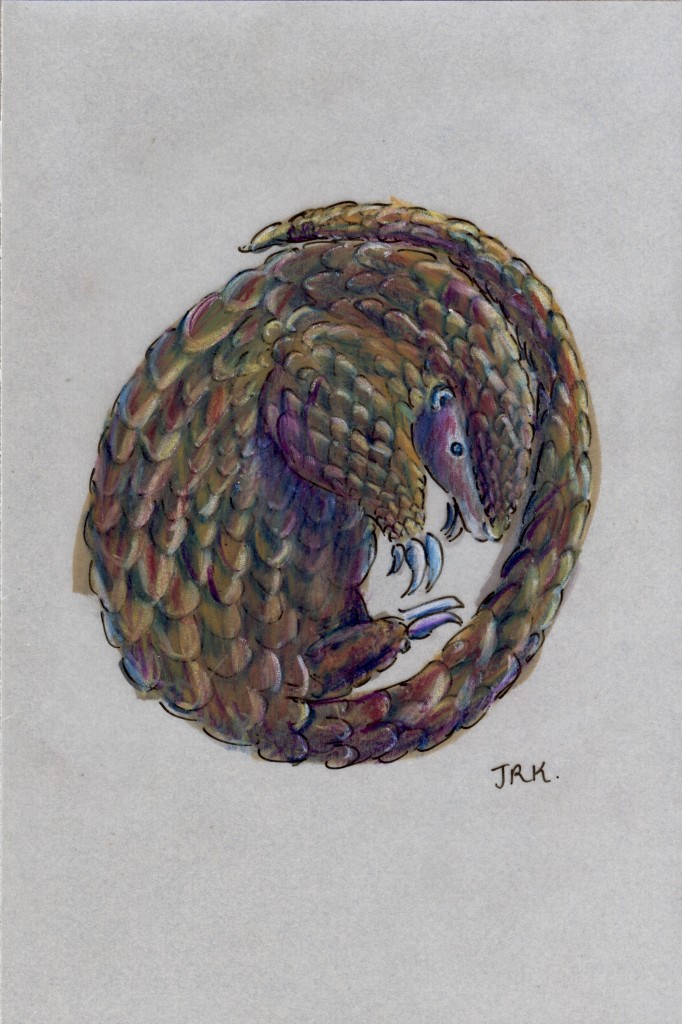
Tree pangolin (click image to enlarge)

0336

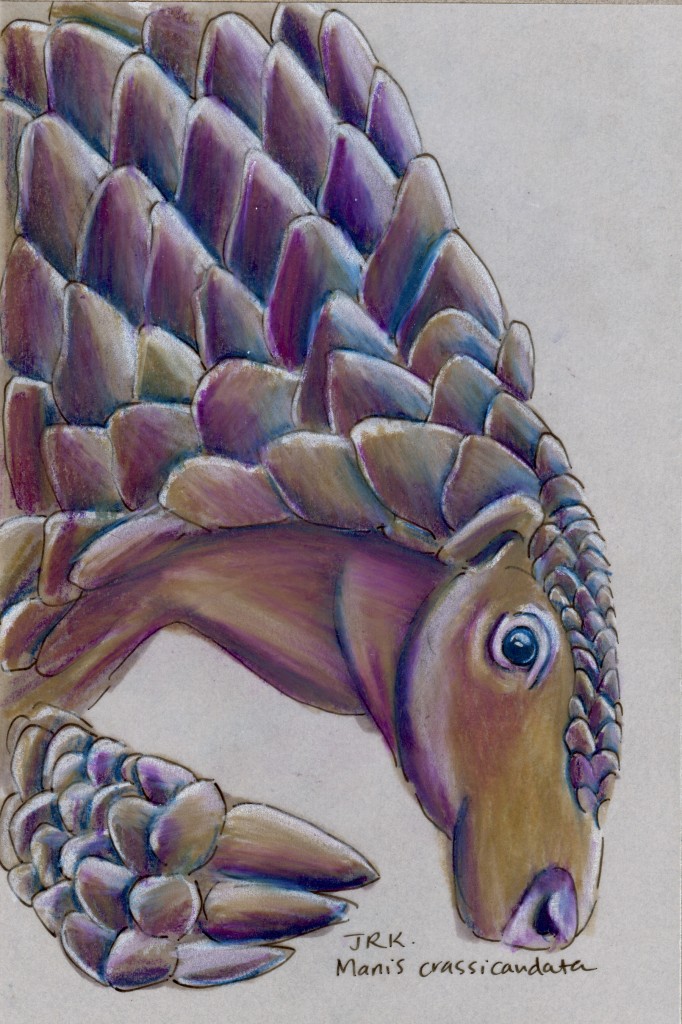
Representing the Ivory Coast in the mammalian World Cup is this scaly, piny fellow, the tree pangolin. Like the anteaters of South America, the pangolin has evolved to have a long tongue and no teeth, adaptations that let it concentrate on eating ants. And like the armadillo, it has evolved a protective armor, in this case sharp scales that stick out of its thick skin. When threatened, the pangolin curls up in a tight ball that looks like a particularly round pinecone. Tree pangolins, like this one, have long, prehensile tails with a bare patch of skin at the end so they can use them to get a good grip on tree branches and swing upside down.

Sadly, the tree pangolin’s numbers are declining because of hunting for bushmeat and traditional medicine (its scales, of course, are considered an aphrodisiac, because someone considers every unusual part of any animal an aphrodisiac, it seems to me). The IUCN currently lists the species as near threatened; endangered is the next rung down the ladder to extinction.

The tree pangolin’s genus name, Manis, comes from the word manes, which is the ancient Roman word for spirits of the dead. The species name, tricuspis, does not denote teeth, as I had reckoned, but means “three points” and refers to the shape of the scales. Our bicuspid teeth, I guess, must have two points.

The Ivory Coast gives us a good chance to talk about an aspect of soccer we haven’t discussed: faking, diving, acting, flopping. In soccer, as in none of the major American sports as far as I know, players will pretend to be far more injured than they are in order to persuade the referees to call a foul against another player. One such foul, unless it’s especially egregious, will draw a yellow card, which is a sort of warning. Two yellow cards equal a red card, and a player who gets a red card is sent off the pitch, leaving his team down a man for the rest of the game, and is not allowed to play in his team’s next game.

In the Ivory Coast game against Brazil in this World Cup, there was a spectacular instance of diving, which is what this injury-faking is called. Brazil’s star, Kaká, gently jostled an Ivorian player named Kader Keita somewhere in the abdomen, and Keita fell to the ground clutching his eye, writhing in agony. Kaká had previously drawn a yellow card, and Keita’s lousy acting somehow convinced the ref to give Kaká the red card now, meaning Kaká was sent off and Brazil had to play with 10 players. It didn’t make the difference for Ivory Coast, though: they still lost 3-1 and did not advance past the group stage of the tournament. If you watch this video of highlights from the game, you can zip up to about 1:30 (after a 10-second ad) and see the star of the Ivory Coast team, Didier Drogba, make a really neat goal with his head, immediately followed by the Kader Keita-Kaká fracas.

Coco also drew a tree pangolin for us.

Tree pangolin by Coco, age 11

Group F Results

The tree pangolin is the first mammal from Group G, but I forgot to do the Group F results in the last post, so let’s do it now. Group F was the Alpine ibex from Italy, the black-and-gold howler monkey from Paraguay, the New Zealand lesser short-tailed bat, and Slovakia’s Tatra chamois.

When another group had a bat, I speculated that the bat would just fly away from the pitch, earning it either a draw or a forfeit. But the fact that this bat is evolving into being a ground mammal means it has the kind of adaptability that wins games. I think it could beat these other mammals. Of the others, the Alpine ibex’s horns are bigger and more threatening than the chamois’, and I think either of their sharp hooves could defeat the monkey. So the two teams from Group F that will continue on to the Round of 16 are:

New Zealand lesser short-tailed bat (New Zealand)
and
Alpine ibex (Italy)

{ 4 comments }

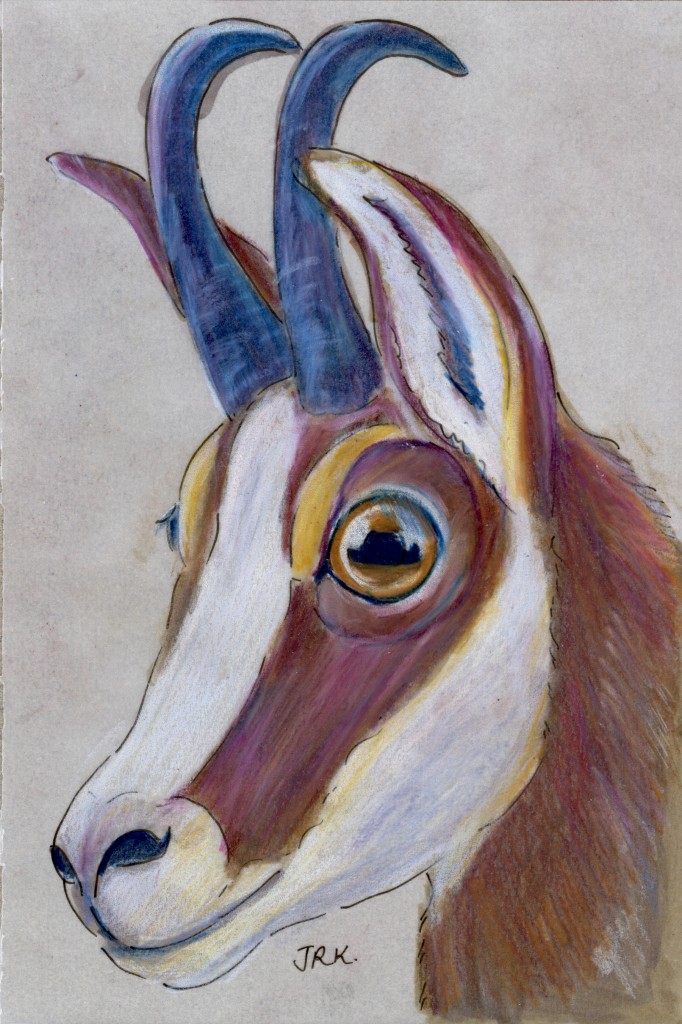
Tatra chamois (click image to enlarge)


0335

I don’t usually highlight a particular subspecies, but when it comes to picking a representative for Slovakia, my father-in-law’s ancestral home and the source of the yak in my name, I wanted to do it up right. Meet the Tatra chamois, a subspecies of the regular chamois, which lives only in the Tatra mountains of Slovakia and Poland and numbers fewer than 200 individuals. (The chamois species in general, Rubicapra rubicapra, counts more than 400,000 members, but all but one of the subspecies are declining in number.) The threats to the Tatra chamois are poaching, habitat loss, and both interbreeding—with other introduced subspecies—and inbreeding, since there’s not enough genetic diversity in a group of 200 to sustain a healthy population. They live in rocky parts of the mountains, and they nimbly make their way through their days, munching on leaves and grass.

Slovakia’s national soccer team got its start in 1993, after Czechoslovakia split into the Czech Republic and the Slovak Republic. (There was also a Slovak national team before World War II, but after the war it was combined with the Czechoslovakian team. I’m reading an article in The New Yorker about the Eurovision Song Contest, and it mentions that several of the nations competing in the 2010 contest didn’t exist as independent countries when the contest started in 1956. That’s true of a couple of the countries in the World Cup, too.) This is the first time the team has qualified for the World Cup as Slovakia. The team’s nickname is Repre, which, according to The Guardian, is short for “reprezentacny tim” or “representative team.” (That article is really snarky. I think someone got quite bored having to write up profiles of every team.)

This year, Slovakia got to the Round of 16, where they lost to Holland, who went on to beat favorites Brazil in the quarterfinals yesterday. Coco drew a chamois, too, and here it is.

Chamois by Coco, age 11

{ 5 comments }

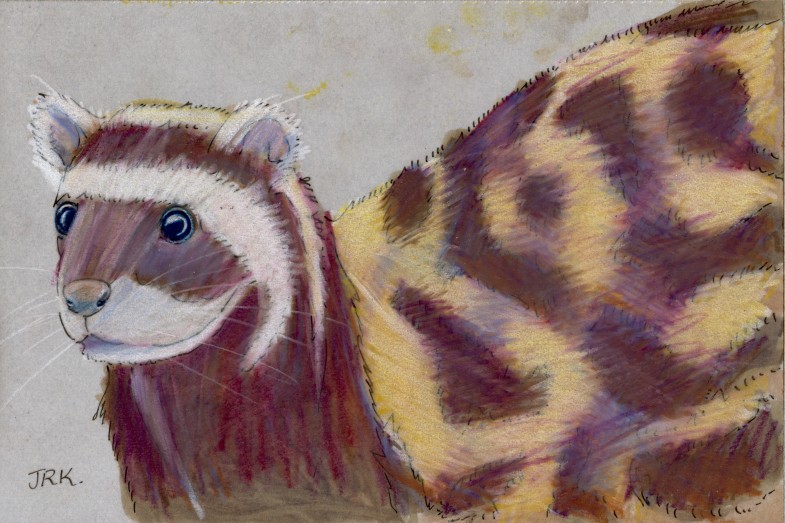
Marbled polecat (click image to enlarge)

0324

Today marked the end of the first stage of play in the World Cup, and the Round of 16 is set. Unfortunately, today’s country, Serbia, did not make it through, but no matter. The marbled polecat (our second mustelid in a row, by the way) still has a chance in the World Cup of Mammals!

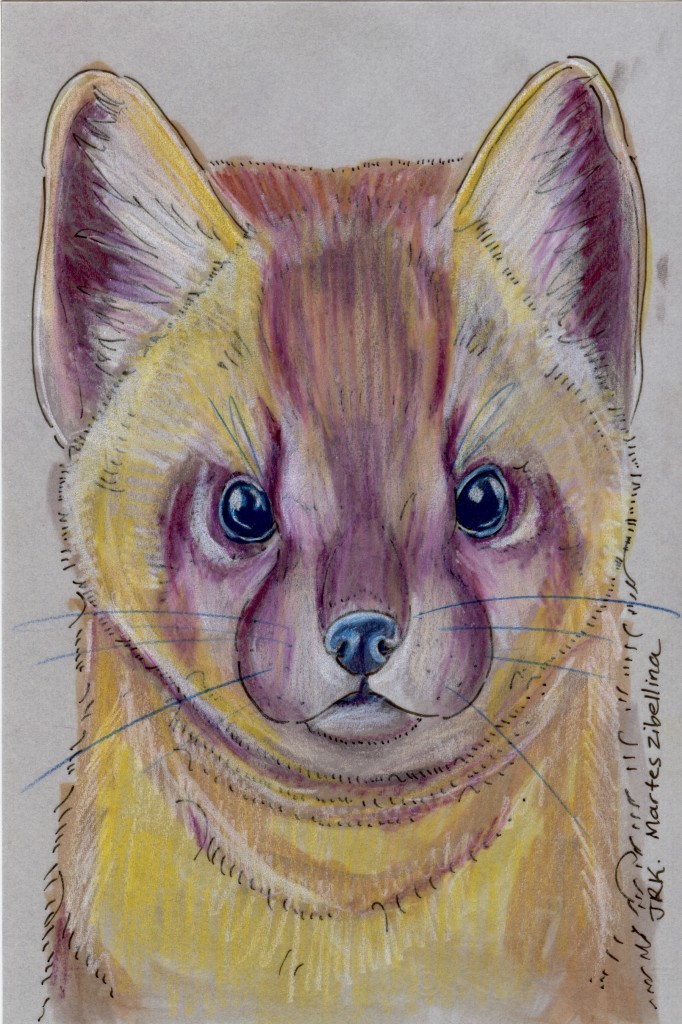
Marbled polecats (who make me hungry with the way their fur evokes marble cake) live in Europe and Asia, but their numbers are decreasing, and the IUCN Red List classifies them as vulnerable, the last step before endangered. That is due to habitat loss, completely unsurprisingly. Polecats like steppes, brushland, and sometimes forests, and between climate change and humans being humanny, those kinds of habitats are going away.

Perhaps we should think twice before crossing them, though. The species account in Mammalian Species number 779, December 20, 2005, has the following chilling details to report:

“[Marbled polecats] have a repertoire of alternative methods to kill prey. They have 2 kinds of killing bites: the 1st is the penetration of the prey’s body by the canines, and the 2nd is crushing the prey without canine penetration (Ben-David et al. 1991). To kill small vertebrate prey, marbled polecats crush the thorax. If the prey struggles, they may pin the prey down with the forepaws and deliver head shakes or follow-up by a bite to the head or neck (Ben-David et al. 1991). On larger, more nondefensive prey (guinea pigs, Cavia porcellus), the polecat bites the nape of the neck and eventually severs the spinal column from the base of the skull. To kill large defensive prey such as rats, the marbled polecat bites the throat. Fleeing prey were bitten dorsally, but defending prey were bitten on the head or neck. Additional details on the killing methods of the marbled polecat are available (Ben-David et al. 1991).”

So let’s be careful around them, shall we? And so should the other mammals of Group D!

And what of Serbia’s national soccer team? Their showing in this World Cup was kind of confusing, apparently, with them beating a team no one thought they should have (Germany) and losing to teams everyone thought they should have beaten (Ghana, Australia). This is actually Serbia’s first World Cup under the name Serbia. The team is considered the continuation of both the Serbia and Montenegro team (after Montenegro seceded from Serbia and Montenegro, they got their own team) and the Yugoslavia team (which broke up when Yugoslavia did), so any records that the Serbia and Montenegro or Yugoslavia teams earned now belong to the Serbia team.

{ 3 comments }

Chacoan Peccary (Catagonus wagneri)

by JR Kinyak on June 7, 2010

in Ungulates

Chacoan peccary (click image to enlarge)


0302

This peccary species lives in the Gran Chaco of South America, a region that overlaps Argentina, Bolivia, and Paraguay. It lives in the driest, hottest parts of the area, and its main food is cacti. The Chacoan peccary is endangered, mainly because of hunting but also because of habitat destruction. Oddly, this peccary was first described by scientists in the 1930s based on fossil evidence and was thought to be extinct (by scientists, not by people who lived in the Gran Chaco and saw the peccary all the time) until 1975.

Below, see Coco’s cute Chacoan peccary and the prelimary sketch I did for mine.

Chacoan peccary by Coco, age 11


Chacoan peccary sketch

{ 2 comments }

Aye-aye (Daubentonia madagascariensis)

by JR Kinyak on June 1, 2010

in Primates

Aye-aye (click image to enlarge)

0293

The aye-aye is the only mammal I can think of that is primarily known for being ugly. Anytime someone writes a think-piece about the primacy of “charismatic megafauna” in conservation efforts, the poor aye-aye comes up as an example of an uncharismatic animal that is nevertheless in need of protection and aid. (People seem to want to donate money to help animals when the animals are cute or otherwise iconic, like pandas, tigers, and polar bears. Those three are classic examples of charismatic megafauna. I think it would be a good name for a band, too.)

The good (or at least goodish) news for the aye-aye is that it’s not as endangered as we once thought, and in 2008, the International Union for Conservation of Nature downgraded its status from Endangered to Near Threatened—two steps back on the road to extinction. It seems to be both more widespread and more adaptable than we feared. But still, the aye-aye is threatened by the ubiquitous specter of habitat destruction in its native Madagascar. And apparently, a traditional Malagasy superstition holds that the aye-aye is an evil omen that must be killed on sight. This superstition is repeated so often in the aye-aye literature, and in such similar words, that I thought it must be a rampant scientific urban legend, but even my most reliable sources (in other words, not just Ivan T. Sanderson) report it as fact. Poor aye-aye! I love the nocturnal guy just the way he looks tonight.

Now, the aye-aye is not just strange but unique. It is the only surviving member of its family and one of only two mammals (the other being the long-fingered triok of Indonesia and Papua New Guinea) that occupies the evolutionary niche that the woodpecker holds elsewhere. The aye-aye tap-tap-taps its looooooong middle finger on dead wood to locate insect larvae inside. Then it uses that same looooooong middle finger to extract the delicious bugs from the wood. Sometimes it uses its finger to tap on coconuts, perhaps to assess their ripeness or the amount of milk they contain, before using the finger to get the pulp and milk out.

Theo drew an aye-aye, too. See?

Aye-aye by Theo, age 13

{ 3 comments }

Spectacled Bear (Tremarctos ornatus)

by JR Kinyak on April 12, 2010

in Carnivores

Spectacled bear (click image to enlarge)

0292

The only bear from South America, the spectacled bear lives in Venezuela, Ecuador, Colombia, Peru, and Bolivia. It gets its name, of course, from its professorial appearance, and it’s also known as the Andean bear, or ucumari in a native Andean language. The bear is a small one, as bears go, with males weighing up to 340 pounds and females only up to 180. There may be only a few thousand spectacled bears left in the wild. They are threatened by poaching, by habitat destruction (of course), and by farmers whose crops they try to eat. They are also used in traditional medicine and sometimes eaten. The bears themselves like to eat plants and fruit, especially bromeliads, but they’ll occasionally eat small animals.

Theo, without knowing that the bear is sometimes known, in Spanish, as oso real, drew a spectacled bear with a crown.

Spectacled bear by Theo, age 13 (click image to enlarge)

Coco drew a wonderful spectacled bear, too.

Spectacled bear by Coco, age 11 (click image to enlarge)

{ 4 comments }