Posts tagged as:

theo

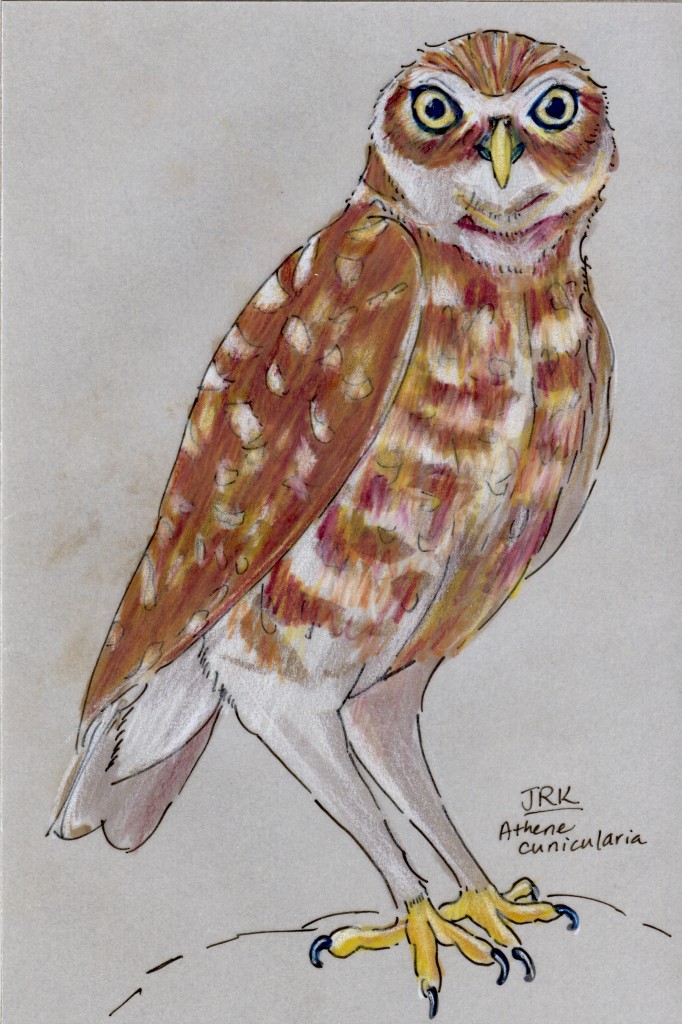
Burrowing owl (click image to enlarge)

A few years ago, I bought a copy of Mammal Tracks and Sign, which includes a sidebar about the importance of having a basic comfort with and knowledge of the natural world before you can start to track. The book recommended a program called Kamana, an at-your-own-pace naturalist training program. I asked my husband Ted for the program for Christmas and got it, and then I did nothing with it for a couple of years.

Then we adopted our kids, Theo and Coco, and then we realized that the best bet for them was homeschooling. We homeschooled Theo last year, and this year his sister joined up. I brought out my Kamana book and all four of us started working through it as a major part of our homeschool curriculum.

And it’s amazing! The first book is divided into two “trails.” The first, which we’ve completed, is about becoming more aware of your surroundings. The exercises in it have been so helpful and fun to us. We’ve just started the second trail, which involves learning about the different life forms in our area. (We are stalled on the mammal chapter at the moment, strangely enough.)

In part of the book, you practice using your senses in a new way, and you look to various animals as inspiration. The kids and I drew the animals we were learning from, and I thought I’d share them with you as a special series on the Daily Mammal. (I don’t know where Theo’s drawings are so I haven’t scanned them, but if he gives them to me, maybe you’ll be able to see them in some of these posts. In the meantime, enjoy Coco’s beautiful work.)

The first tool we practiced using was our Owl Eyes. Because of their shape, owls’ eyes are fixed in place: owls move their heads instead of their eyes. When we practiced Owl Eyes, we literally perched, on a wall, a rock, or the couch, and kept our eyes still, relaxing until we could make full use of our peripheral vision, which let us see the sky, the ground, and all around without moving. When we did want to look somewhere else, we moved our head instead of our eyes. You can take in more than you think using just the “corners” of your eyes if you practice. This can be useful out in the field if you catch some movement and don’t want to startle an animal by suddenly turning your head. Owl Eyes was the first step toward broadening our awareness in general: we’re learning to notice not just what’s directly in front of us, but the bigger picture.

Below is Coco’s barn owl. I’m not sure I’ve ever seen a more beautiful drawing, honestly.

Barn owl by Coco, age 12

{ 4 comments }

Mexican Free-tailed Bat (Tadarida brasiliensis)

by JR Kinyak on October 5, 2011

in Bats

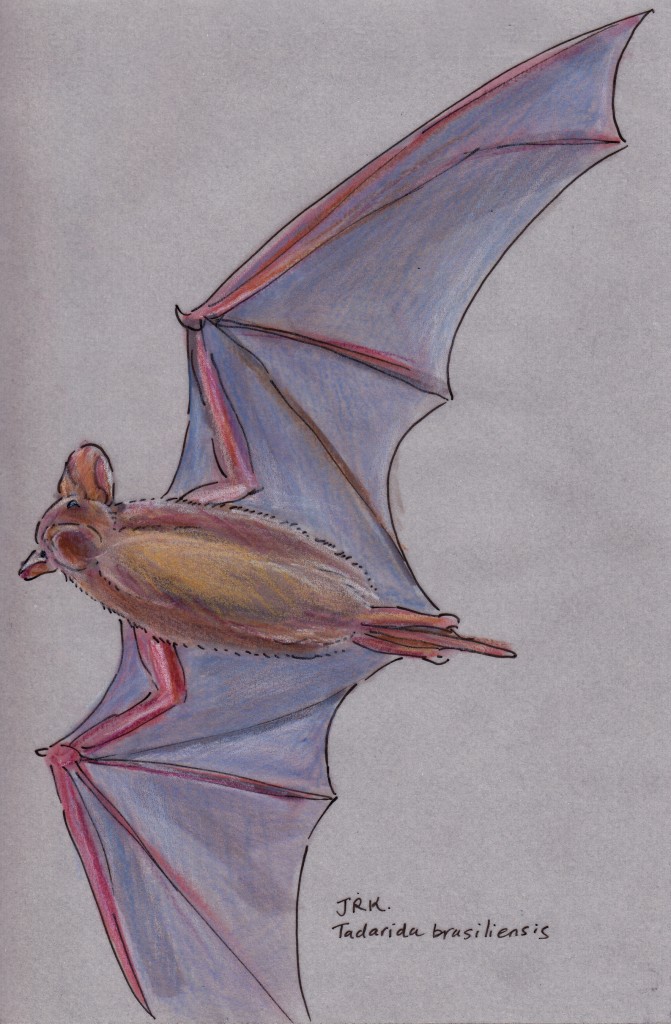
Mexican free-tailed bat (click image to enlarge)


Mexican free-tailed bat by Theo, age 15


Mexican free-tailed bat by Coco, age 12


0395

The kids and I are reading a book called Hanging with Bats, which starts with a chapter about the Mexican free-tailed bats at Carlsbad Caverns here in New Mexico. We decided to draw the bats, and then my son Theo wrote a poem to post on the Daily Mammal.

I think I may have mentioned, on this site, Thomas Nagel’s famous essay “What is it like to be a bat?” in which he explains that it is difficult (impossible?) for us to even imagine it, using the human-bat disconnection as an example of the inherent shortcomings of subjective experience in understanding objective truth. (I think that’s what it’s about.) As Nagel says, “In so far as I can imagine this (which is not very far), it tells me only what it would be like for me to behave as a bat behaves. But that is not the question. I want to know what it is like for a bat to be a bat. Yet if I try to imagine this, I am restricted to the resources of my own mind, and those resources are inadequate to the task.”

Theo’s poem, though, tries to help our imaginations, and it’s absolutely beautiful.

Through Tiny Eyes

Imagine
Screeches coming back at you, directing you
Imagine
Air flowing through your fur while slicing through air
Imagine
Air holding you airborne
Imagine
Hanging upside down,
huddling in the warmth of thousands of you
Imagine
Using your hands to cover your entire body
Imagine
Making an image of a black tornado
coming out of the black depths of a cave
Imagine
Being a bat

{ 6 comments }

Verreaux’s Sifaka (Propithecus verreauxi)

by JR Kinyak on June 6, 2010

in Primates

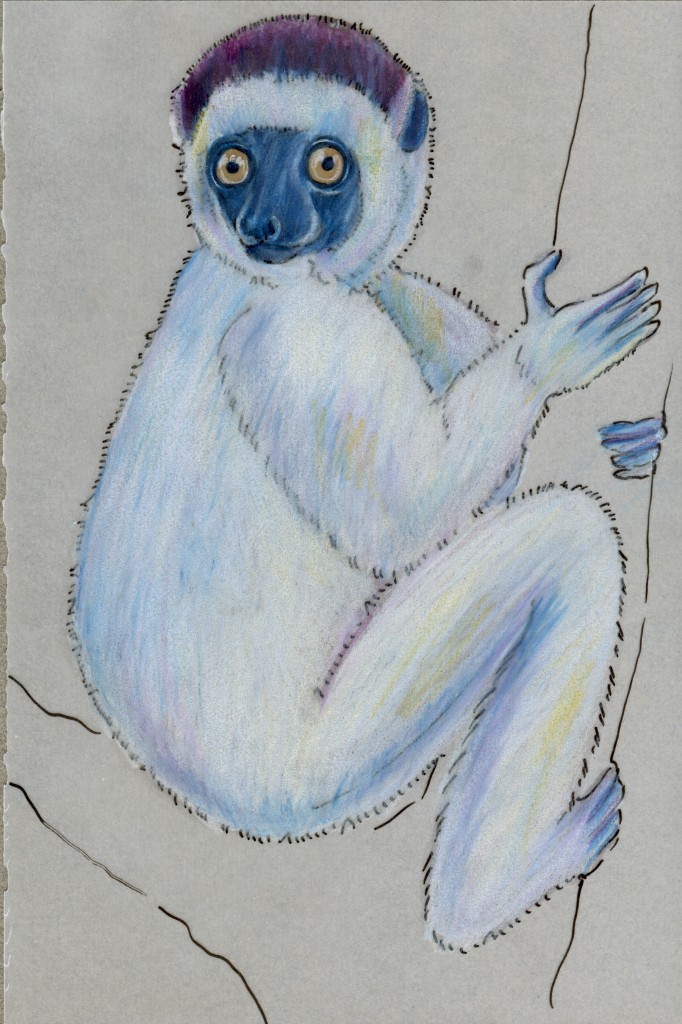
Verreaux's sifaka (click image to enlarge)

0301

Oh, Madgascar, oh lemurs. Here is another, the magnificent Verreaux’s sifaka, who performs the most powerful of leaps through the air and the most comical of leaps on the ground. Theo drew one, too, and his shows their incredible speed, but all in all, we’ll let Attenborough do the talking for us. Please watch the video below Theo’s drawing. It’s amazing!

Verreaux's sifaka by Theo, age 13

{ 3 comments }

Yak (Bos grunniens)

by JR Kinyak on June 4, 2010

in Ungulates

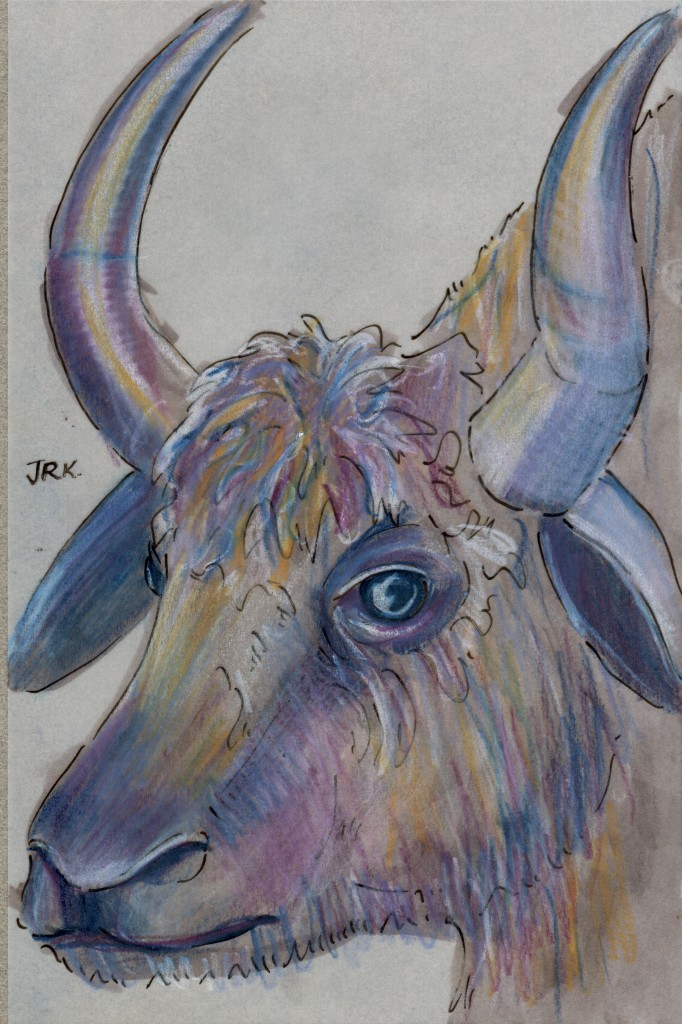
Yak (click image to enlarge)


0299

In honor of our adoption finalization and name change to Kinyak, Theo and I drew yaks! The powerful, shaggy animals are native to Tibet and produce delicious butter, which Tibetans use in their tea.

Yak by Theo, age 13

{ 2 comments }

Jirds Four Ways (Meriones spp.)

by JR Kinyak on June 2, 2010

in Rodents

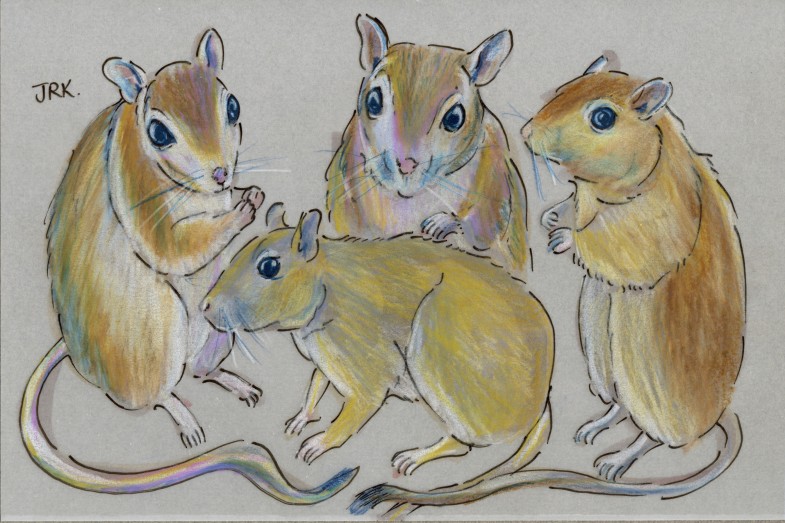
Jirds (click image to enlarge)

0297
0296
0295
0294

These fellows represent four different jird species. Left to right: Meriones crassus or Sundevall’s jird, M. hurrianae or Indian desert jird (on all fours), M. shawi or Shaw’s jird, and M. unguiculatus or Mongolian jird. (You may know that last one, the Mongolian jird, as the domesticated gerbil.) Jirds generally live in burrows in the desert, and most of them are nocturnal (not the Mongolian jird). They get nearly all of their water from the moisture in the food they eat and the nighttime dew that’s on it, and they use their long, tufted tails to swish sand over their burrow entrances so no one else can find them and help them balance when they’re running around.

Theo drew his jird (the Mongolian one) in the style of a Yu-Gi-Oh! card.

Jird by Theo, age 13

{ 8 comments }

Aye-aye (Daubentonia madagascariensis)

by JR Kinyak on June 1, 2010

in Primates

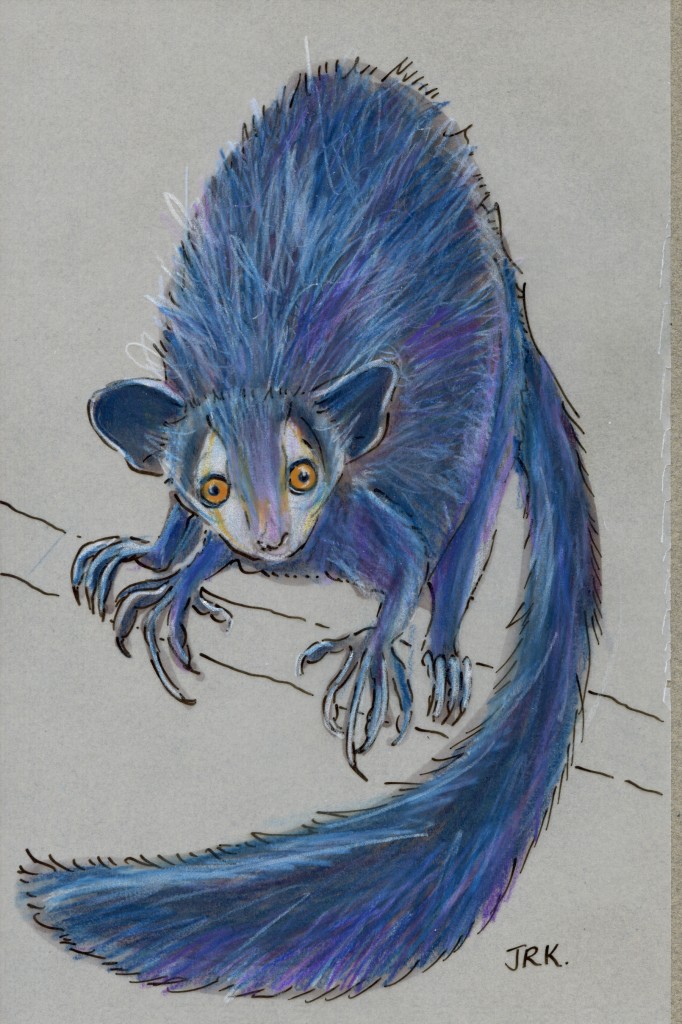
Aye-aye (click image to enlarge)

0293

The aye-aye is the only mammal I can think of that is primarily known for being ugly. Anytime someone writes a think-piece about the primacy of “charismatic megafauna” in conservation efforts, the poor aye-aye comes up as an example of an uncharismatic animal that is nevertheless in need of protection and aid. (People seem to want to donate money to help animals when the animals are cute or otherwise iconic, like pandas, tigers, and polar bears. Those three are classic examples of charismatic megafauna. I think it would be a good name for a band, too.)

The good (or at least goodish) news for the aye-aye is that it’s not as endangered as we once thought, and in 2008, the International Union for Conservation of Nature downgraded its status from Endangered to Near Threatened—two steps back on the road to extinction. It seems to be both more widespread and more adaptable than we feared. But still, the aye-aye is threatened by the ubiquitous specter of habitat destruction in its native Madagascar. And apparently, a traditional Malagasy superstition holds that the aye-aye is an evil omen that must be killed on sight. This superstition is repeated so often in the aye-aye literature, and in such similar words, that I thought it must be a rampant scientific urban legend, but even my most reliable sources (in other words, not just Ivan T. Sanderson) report it as fact. Poor aye-aye! I love the nocturnal guy just the way he looks tonight.

Now, the aye-aye is not just strange but unique. It is the only surviving member of its family and one of only two mammals (the other being the long-fingered triok of Indonesia and Papua New Guinea) that occupies the evolutionary niche that the woodpecker holds elsewhere. The aye-aye tap-tap-taps its looooooong middle finger on dead wood to locate insect larvae inside. Then it uses that same looooooong middle finger to extract the delicious bugs from the wood. Sometimes it uses its finger to tap on coconuts, perhaps to assess their ripeness or the amount of milk they contain, before using the finger to get the pulp and milk out.

Theo drew an aye-aye, too. See?

Aye-aye by Theo, age 13

{ 3 comments }

Gelada Monkey (Theropithecus gelada)

by JR Kinyak on April 7, 2010

in Primates

gelada monkey

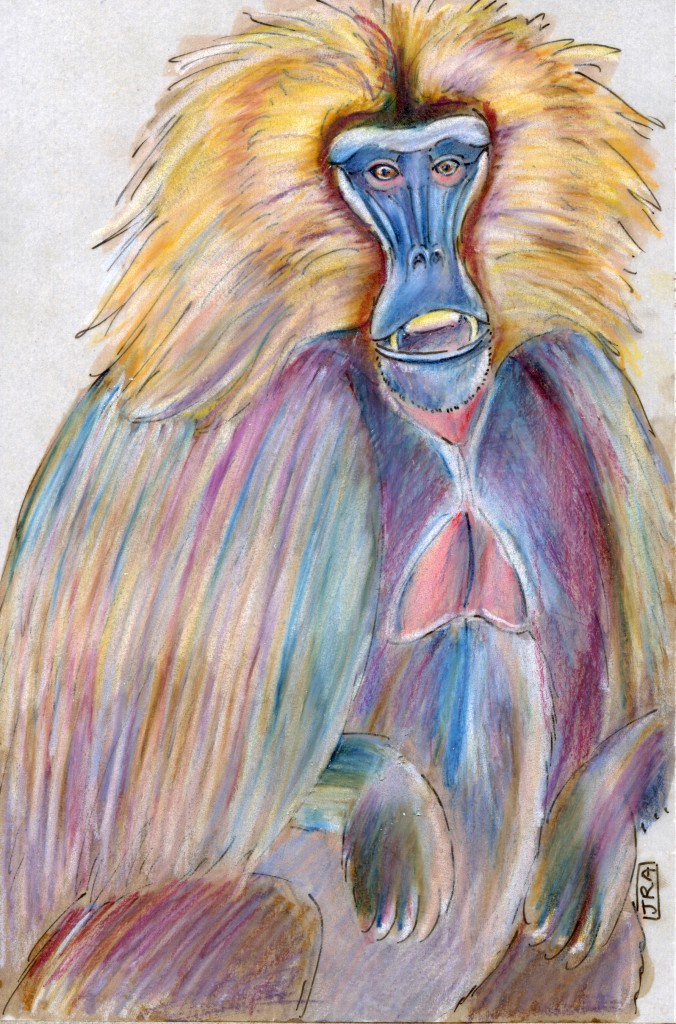
Gelada monkey (click image to enlarge)

0288

High in the mountains of Ethiopia live large groups of monkeys, the geladas, who spend their days grazing on grass, mating, socializing, and making a variety of interesting sounds that some people speculate could reveal something about the evolution of human language and music. Also known as bleeding-heart baboons and lion baboons (although they aren’t actually baboons), the geladas are the only remaining grazing primate. (In Coco’s drawing, below, you can see a gelada with his upper lip drawn back, showing the grass he’s been eating.) They organize themselves in large troops that consist of “harem” groups as well as nonbreeding males. In the harem groups, each of which comprises a handful of females and a breeding male, the females are in charge of the family’s movements, and they decide when it’s time to trade in their male for a new one.

Gelada by Coco, age 11 (10 when she drew it). Click image to enlarge.

In most baboons and monkeys, swellings on the females’ rear ends indicate their reproductive ability. Because geladas spend so much time sitting on their rumps, though, this would be an impractical way for them to signal to potential mates. The red patches on their chests provide these swelling signs instead. In the female, the color and and size of the patch indicate where she is in her reproductive cycle; in the male, the patch shows his status.

Once, the geladas were targeted for their beautiful fur. Then came the Ethiopian civil war, which brought gunfire to their mountain home and made it impossible for scientists to study the monkeys. Now, they face their biggest threat ever: climate change. As the mountains where the monkeys live get warmer, scientists say, the geladas will almost certainly become extinct. Not only does the warmer climate threaten the grasses that the monkeys depend on for nutrition, it also means that humans will be able to farm at ever-higher altitudes, and where there are farms, there cannot be geladas. These strange and beautiful monkeys are in serious danger of becoming just one more victim of our neglect and apathy toward the planet. It’s too bad the other animals have to share Earth with us.

Gelada by Theo, age 13. Click image to enlarge.

{ 4 comments }