Posts tagged as:

taxonomy

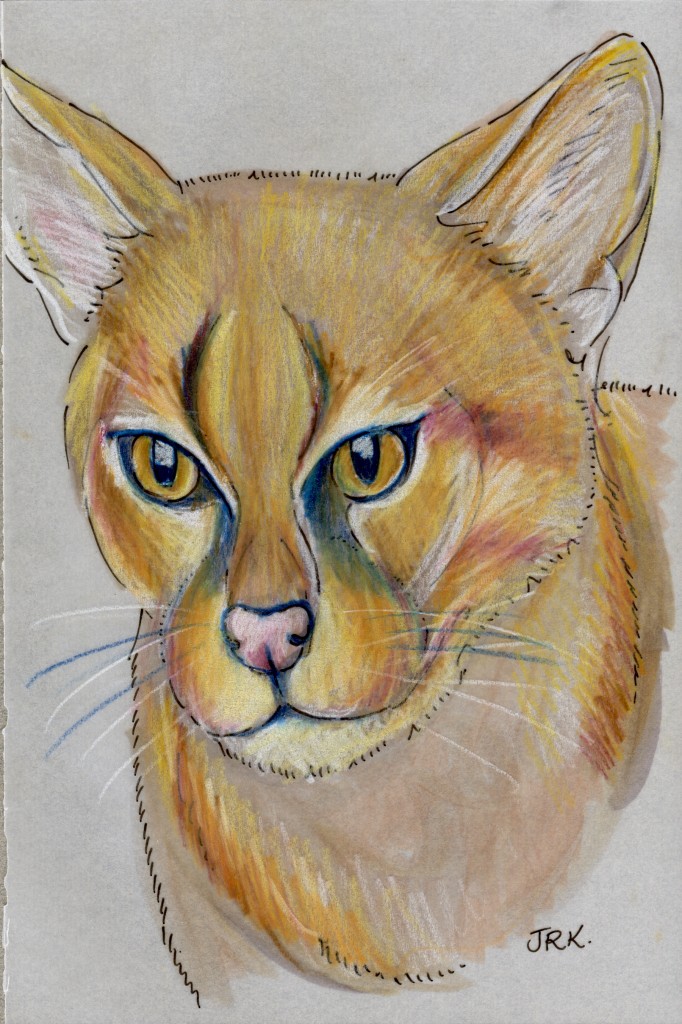
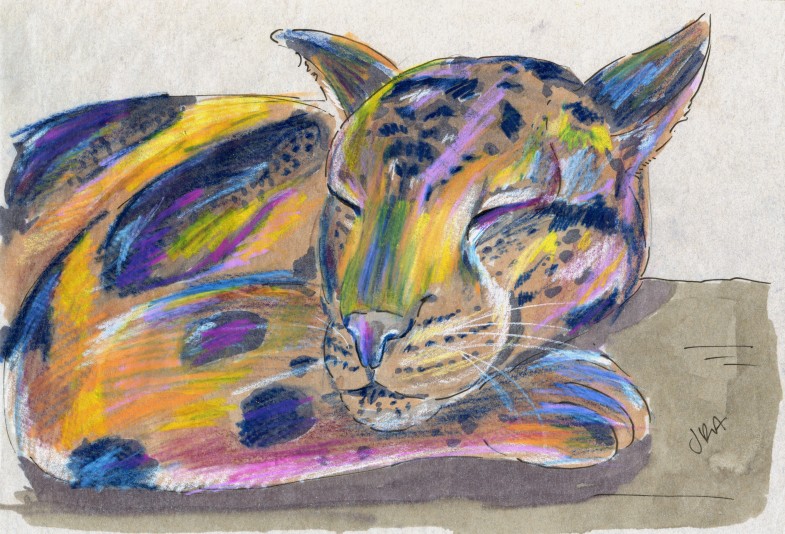
Colocolo (Leopardus colocolo)

by JR Kinyak on June 9, 2010

in Carnivores

Colocolo (click image to enlarge)

0308

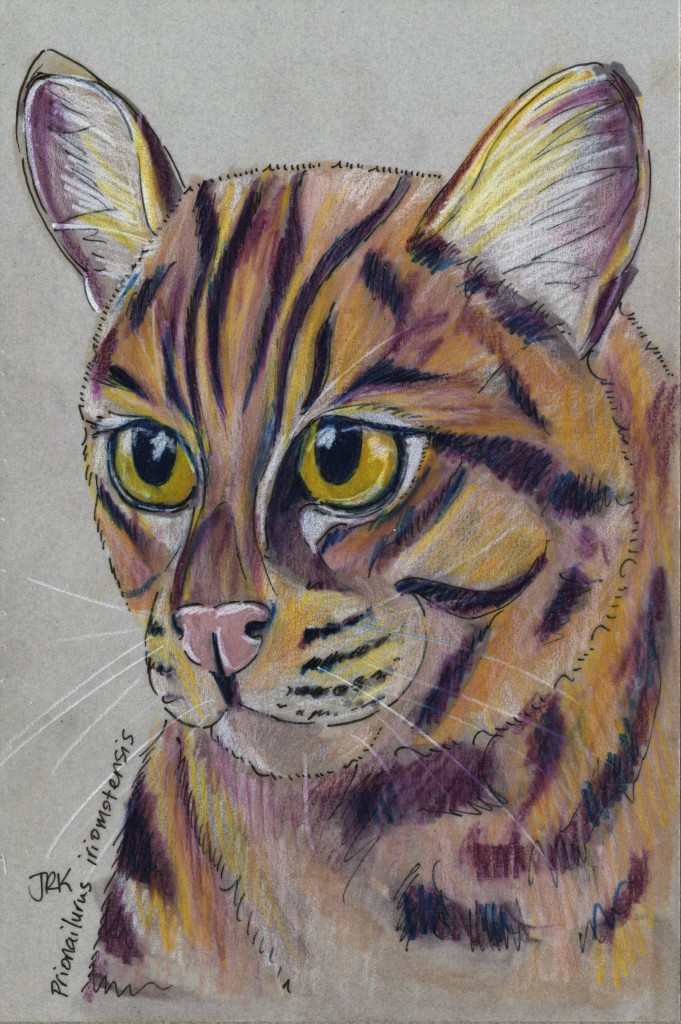
There are far more cat species than I realized. My Princeton Encyclopedia of Mammals lists 29 small cats, plus seven big cats. The domestic cat is a subspecies of one of the wildcat, Felis silvestris. Or it might be its own species, F. catus. The neat thing about taxonomy is that it has room for differing opinions, and it’s always changing. Today’s colocolo, also known as the pampas cat, is another example. Some scientists are thinking that it’s actually two or three species—Leopardus colocolo, L. braccatus, and L. pajeros—which would bring the Princeton Encyclopedia of Mammals’ list up to 31 small cats. But others argue that they should remain subspecies. If you consider the three species to be one, the colocolo lives in the grasslands of South America; if you think L. colocolo is separate from the other two species, this one lives in the Chilean cloud forests and  where it eats rodents, birds, lizards, and insects.

{ 0 comments }

Black-backed Jackal (Canis mesomelas)

by JR Kinyak on July 1, 2009

in Carnivores

canis_mesomelas_72

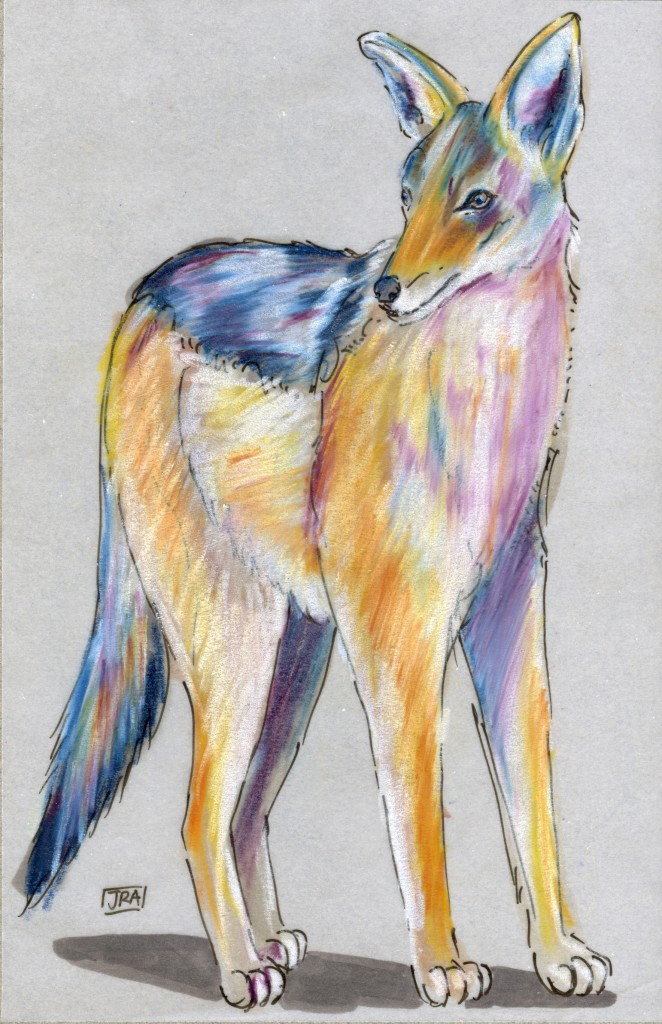
Black-backed jackal (click image to enlarge)

0263

Hello, mammals, and thanks for your patience through the long hiatus I seem to have taken from drawing and posting! We’re back in the swing of things now with this black-backed jackal, who lives in two separate parts of Africa, one in the east and one in the south. There is some controversy about who’s a jackal and who isn’t, but my copy of Walker’s indicates that there are four jackal species. This is the second featured on the Daily Mammal. (Here’s the golden jackal, which I drew a while back.) We’re halfway through with the jackals!

The black-backed jackal is both a scavenger and a predator. It will eat nearly anything: other mammals, birds, reptiles, insects, plants, whatever. It can band with other jackals to bring down a gazelle or antelope, or it can follow lions around and eat their leftovers. Black-backed jackals have been known to work cooperatively with cheetahs to bring down a tasty dinner. Ivan T. Sanderson, in Living Mammals of the World, says, “Their name has come to be applied to all forms of unpleasant hangers-on—a result of their habit of following the large cats, making a special noise when doing so, and then eating up most of the feast as soon as the cat’s back is turned.” I say it’s the cats’ own fault: if someone’s following you and making a special noise that indicates he wants your food, don’t turn your back!

Black-backed jackals live in groups of up to eight or so, at the core of which is a mated pair. A pair may stay together for several years. Adolescent jackals stick around to help their parents raise new babies. In some desert parts of their habitat, black-backed jackals can apparently go up to nine months without drinking water.

{ 1 comment }

Click image to enlarge.

Click image to enlarge.

0251

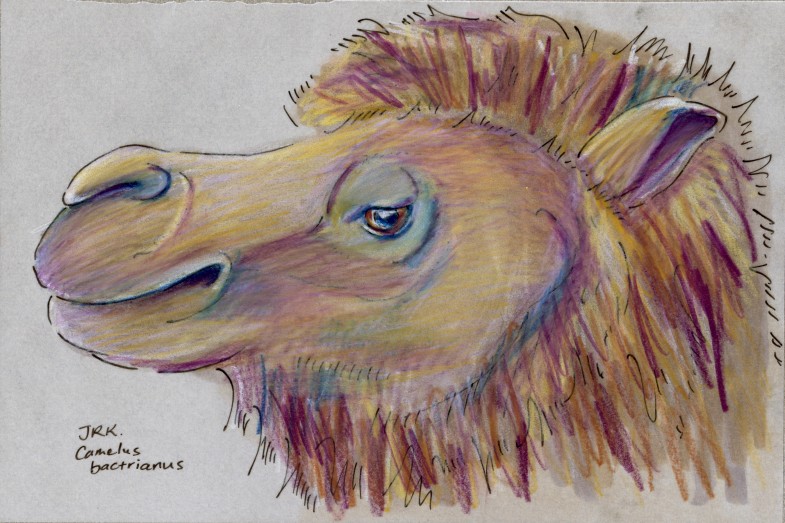
Our current system of naming animals and plants is based on the system that Carl Linnaeus published in 1758. While others, including Aristotle, had previously attempted to organize the world’s living things into various arrangements, Linnaeus gave us an important innovation: the binomial system. Each animal (or plant or whatever) is known by a unique pair of names; no other creature has the same name. We’re the only Homo sapiens; the cotton-top tamarin is the only Saguinus oedipus. (Of course, there can be other members of the genus Homo and the genus Saguinus, but they have to have distinctive second, or species, names.)

The organization that keeps track of and codifies the system of naming animals is the International Commission on Zoological Nomenclature. The rules are quite extensive. My favorite guidelines are those that require namers to make every effort to ensure that their names are euphonious (pleasing to the ear) and that they don’t give offense.

Linnaeus was Swedish, but he wrote in Latin, as did pretty much everyone else writing about scientific matters at the time. The scientific names of animals are often referred to, casually, as their Latin names, and the rules governing naming do require the Latinization of some words. But there’s also a lot of classical Greek in the names, and many names derive from local words for the animals.

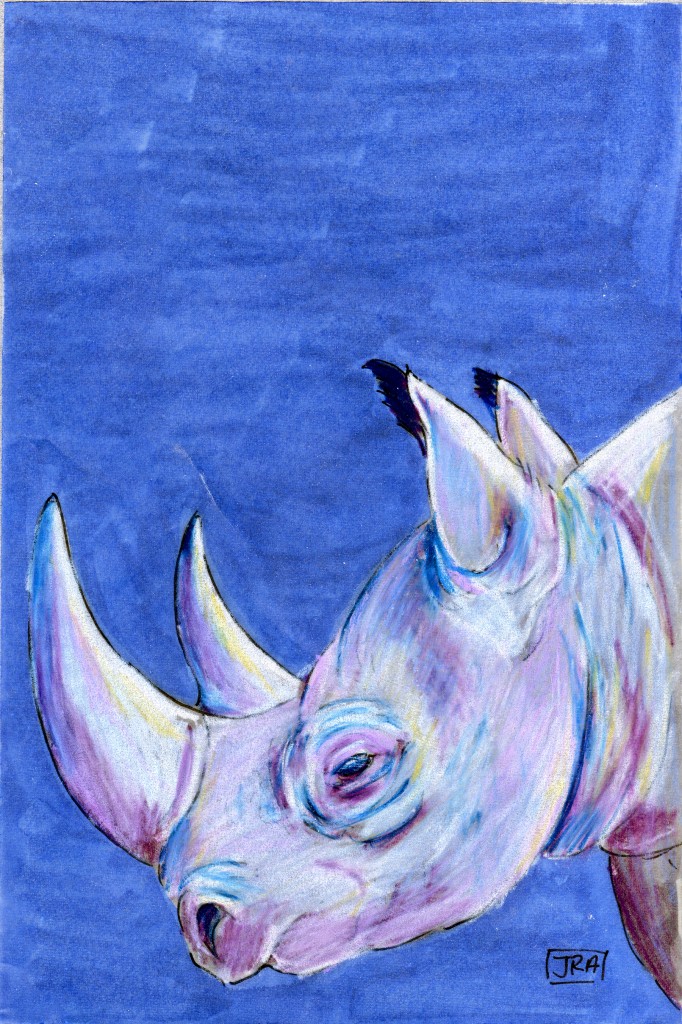
Many animals have redundant names (tautonyms, to use the official terminology), like Gorilla gorilla, Dama dama, and Uncia uncia. Usually, this happens when the name of the animal’s genus (the first name in the binomial system) changes, but the species name can’t. I like the black rhinoceros’s name because it’s redundant in two languages: diceros means two horns in Greek and bicornis means two horns in Latin.

The black rhinoceros’s common name is odd, too. The rhino is not black; it’s gray. Apparently, it was named the black rhinoceros to distinguish it from the white rhinoceros, which is also gray, not white. That animal’s common name comes from the Dutch word weit, which means wide, like the rhino’s muzzle. (My source for all this is A.F. Gotch’s book Mammals: Their Latin Names Explained.)

The black rhino is classified as critically endangered, the last step before extinction. It’s so bad, in fact, that the IUCN, which assesses the status of the world’s species, obscures the rhino’s range on its map “for security reasons.” While the black rhino was pretty numerous at the start of the 20th century, poaching caused a 96 percent decrease in the species’ population between 1970 and 1992. Black rhino horns are carved to create decorative handles for weapons and used in traditional medicine. Traditional medicine is going to be the death of a lot of mammal species.

{ 2 comments }

saguinus_oedipus_72

0250

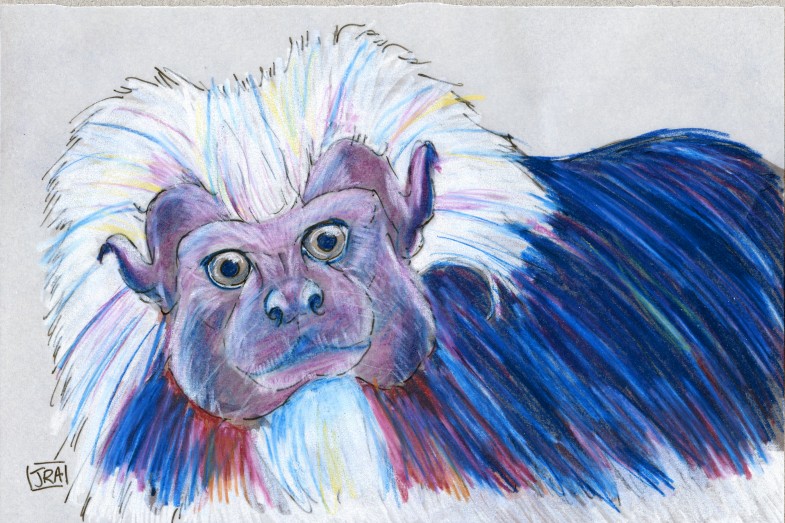
I love words and names for things, and I’ve enjoyed learning a little Latin and Greek as I draw these mammals. Let’s spend a few days meeting some mammals with interesting scientific names, starting with this wild-and-woolly tamarin. The cotton-top part of his common name is apt, but what about Saguinus oedipus? Saguinus means “like a squirrel monkey,” which is straightforward. The oedipus part is interesting, though. Literally, it means “swollen-footed,” and these monkeys were probably named for their big feet. But of course we think of Oedipus, too, and the complex named after him, and it seems that after the fact, at least one research study has found that the name Saguinus oedipus was appropriately oedipal in the oedipus-complex sense, too: in 2004, A.J. Ginther and C.T. Snowdon presented “The Oedipal Conflict in Saguinus oedipus” at the American Society of Primatologists’ yearly conference.

I would have named this monkey Madmaxus tinaturnerus, for that resemblance is, I feel, obvious. The German name for the cotton-top tamarin is Lisztäffchen, a diminutive form of the name Liszt, and that seems appropriate, too. Which of these famous musicians do you think the tamarin most resembles?
tamarin_tina
tamarin_liszt

(Tamarin photos by Nuno Barretto and Dan Jordan; used under Creative Commons licenses.)

{ 4 comments }

click image to enlarge

0235
0234
0233
0232
0237
0236

The day after tomorrow, February 12, 2009, is Charles Darwin’s 200th birthday. (It’s also Abraham Lincoln’s.) I’ve recently begun reading Darwin’s The Origin of Species, and I’ve decided to try to do a little something in celebration of Darwin’s immense contribution. I’m going to be highlighting a few mammals that Darwin discusses in The Origin of Species, and I’ll try to tell you something of what Darwin says about them. Since I haven’t read the whole book, I’m going to be reading the sections that mention these mammals out of order and a bit out of context, but I’ll do my best, and maybe my more Darwin-literate readers can help out where needed. I also am pretty clueless as to where Darwin’s ideas have been expanded or improved upon. Incidentally, the book is actually quite accessible, and I’m sorry I didn’t read it earlier. You can read it online or download a PDF at Google Books.

Chapter Five of The Origin of Species is titled “Laws of Variation.” In a section called “Effects of Use and Disuse,” Darwin posits that the shrunken state of the wings of some birds on islands where they have no predators results from disuse. There’s nothing to fly away from, so generations of birds stopped flying and used their legs more, and through natural selection their legs were strengthened and their wings, eventually, made useless. As another example, Darwin discusses animals that live in underground burrows and caves and have small, furred-over, or absent eyes, thanks to disuse. It’s dark down there, so eyes aren’t very helpful, and gradually, they are selected out, while things like longer whiskers and antennae, which are helpful underground, are favored.

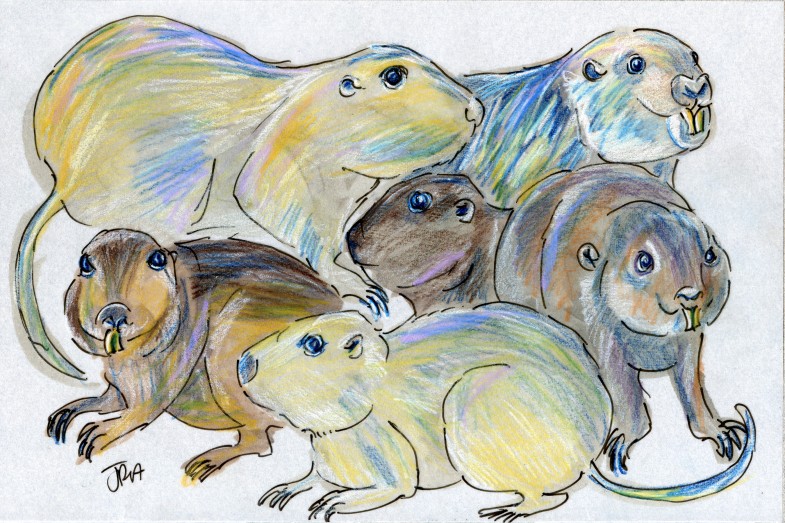
The tuco-tucos, of which there are some 50 different species, live in burrows in South America. Although they spend a lot of time underground, they do occasionally peer out of their homes, and their small but useful eyes allow them to do that without necessarily having to actually exit the premises. It’s easy for them to duck back under if need be. (The amount of time they spend outside their burrows varies from species to species.)

Darwin says that he was told by someone who caught a lot of tuco-tucos that they are often blind. A tuco-tuco that Darwin kept in captivity was blind, he says, thanks to an inflammation of the eye. As Darwin points out, animals that live primarily underground don’t really need their eyes, and eyes are just another thing that can get infected, so why not do away with them? (Eventually. Over generations.)

Genetic analysis of one tuco-tuco species, the colonial tuco-tuco (C. sociabilis) yielded surprising results a few years back. For the past three millennia, the colonial tuco-tuco has had almost no genetic diversity. Usually, a lack of genetic variation means doom for a species, but the colonial t-t has survived pretty well. The reason, researchers think, is that it has evolved a very social way of life, unlike the other tuco-tuco species. If everyone is related, there’s no reason to compete; instead, you can help your cousins breed, since they’re passing on your genes, as well as their own. (In a practical sense, I think I would be more likely to get along with everyone if they were more or less my clones, too, but personality clashes are probably not a significant factor in the colonial t-t’s survival.)

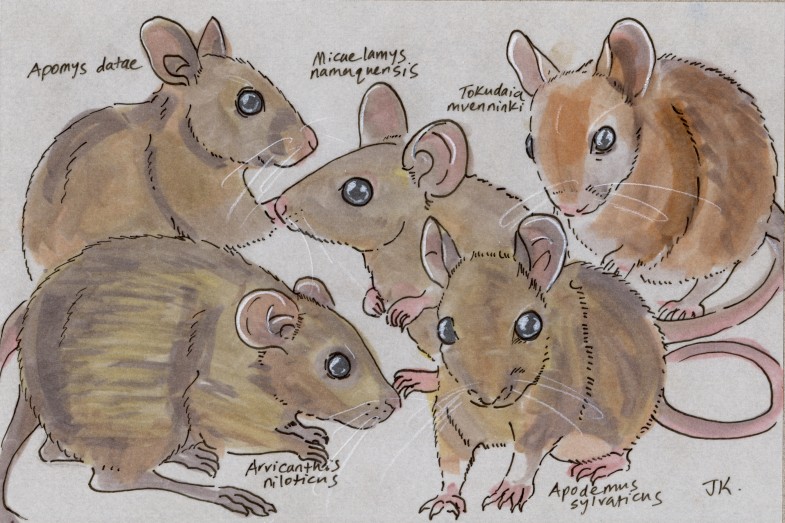
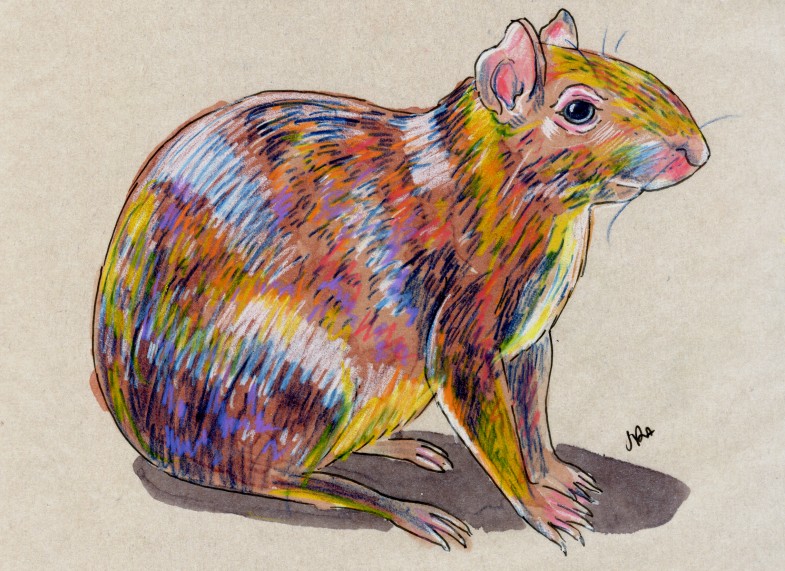
According to Walker’s Mammals of the World, “Systematic understanding of this complex genus is in a state of flux, and it is likely that there will be much change in the number and relationships of species…” In this drawing of the goofy-looking guys, clockwise from the upper right are C. fulvus, C. sociabilis, C. flamarioni, C. talarum, C. peruanus, and in the middle, C. haigi.

{ 8 comments }

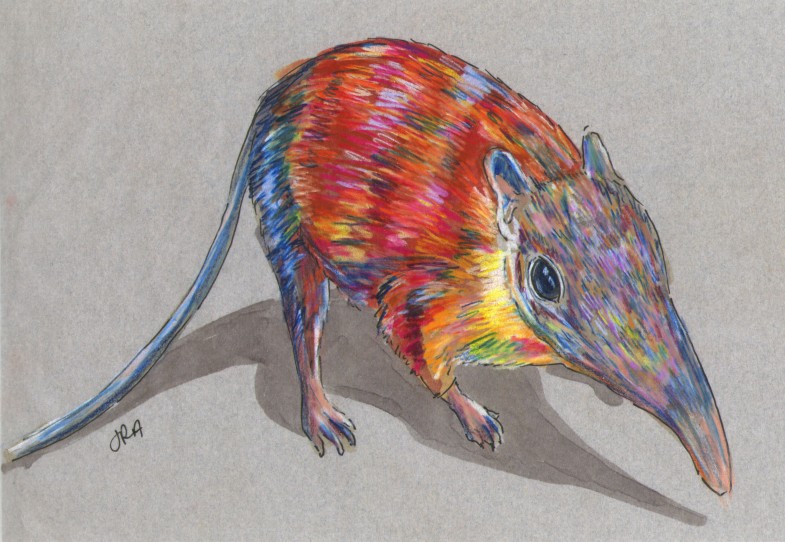
Desert Shrew (Notiosorex crawfordi)

by JR Kinyak on January 26, 2009

in Other Orders

click image to enlarge

0216

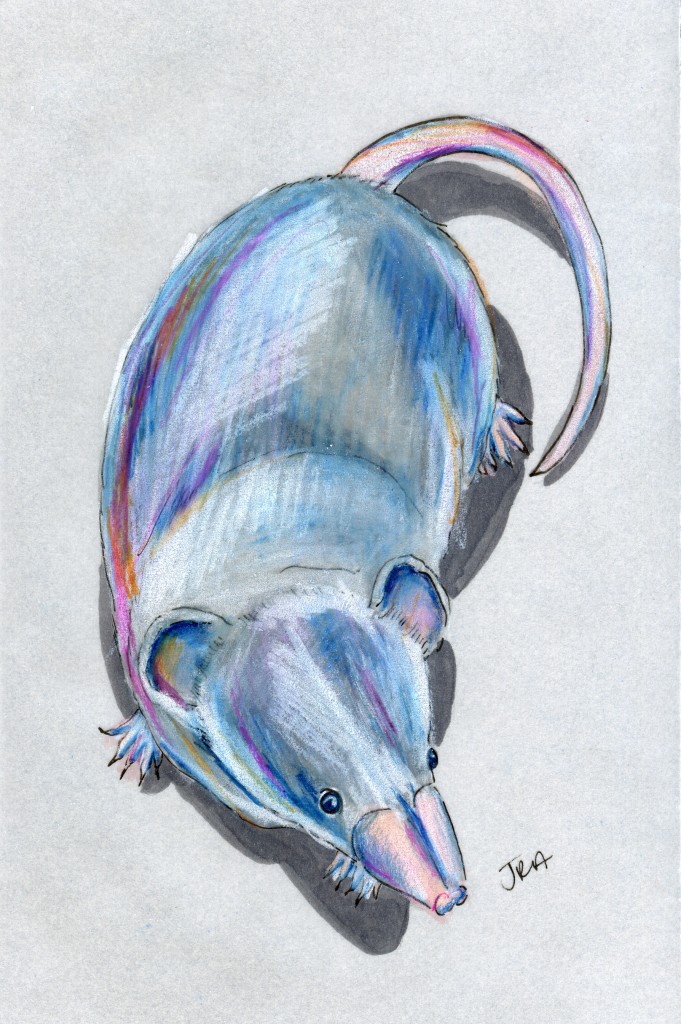
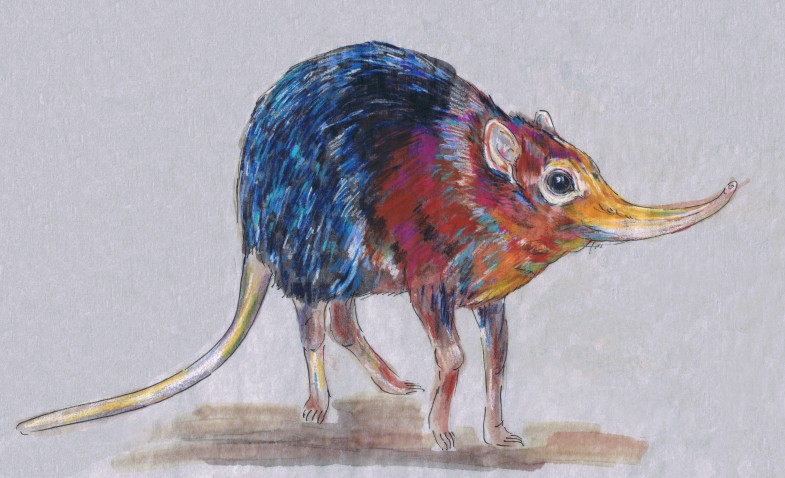
Well, haven’t I learned something today. I use Walker’s Mammals of the World, sixth edition, as a general reference for this project. It’s a huge two-volume work, the most comprehensive in existence, and invaluable to me for sorting out taxonomic questions and getting basic information about species’ habitats and habits. This edition came out in 1999, and the previous editions came out in 1991, 1983, 1975, 1968, and 1964. Looks like we’re about due for a new one, right? And good thing, too! I picked this little shrew out of my Walker’s the other day. It was listed as the only member of the genus Notiosorex. First thing I learn online is that now the consensus seems to be that there are actually four Notiosorex species, not one. Okay, that’s nothing new around here, I can deal with that.

But then I go to look at the Wikipedia pie chart of the distribution of mammalian orders, remembering—I thought—that members of the order Insectivora constituted the third-largest group. Insectivora is one of the 28 orders in Walker’s. It includes shrews, hedgehogs, and moles, shrews being in the family Soricidae. But the Wikipedia pie chart doesn’t even list insectivores. Instead, the third-largest group, behind rodents and bats, is Soricomorpha, shrew-bodies.

It turns out that taxonomically-minded people are coming to a consensus that Insectivora, which Wikipedia calls “a scrapbasket,” is in fact several separate orders—colugos in one, elephant shrews in another, hedgehogs and gymnures over there, etc., etc. Lord have mercy, but this has exploded my mammal-loving world. It’s one of the most interesting things about this project, and biology and actually, I guess, science in general, the way no one even knows how many mammals there are, people can disagree on whether this species is really the same as that species, and it’s always changing, but still, I was not expecting to lose a whole order, and one whose name I just learned to pronounce properly (stress on the third syllable).

Seventh edition of Walker’s, where are you?

This shrew, a member of Soricomorpha, lives in the southwestern United States (including my home state, New Mexico) and in Mexico. They are way smaller than you’d think: only three or four inches long on average, including their tails. They’re so small that they can actually hang out in beehives, entering and leaving through the bees’ doors.

{ 4 comments }

click image to enlarge

0209

Let’s continue our celebration of President-Elect Obama’s childhood home, shall we? Yesterday I mentioned that today we’d meet the only land mammal native to Hawaii (or as native as a mammal can be to Hawaii, meaning, I suppose, that it was already there when people arrived). Well, this mongoose isn’t it. Hawaii’s only indigenous land mammal is the Hawaiian hoary bat, a subspecies—endemic to Hawaii—of the regular hoary bat, Lasiurus cinereus. The hoary bat is the most widespread bat in North America, but the Hawaiian variety is endangered. Imagine those lonesome little bats arriving at their island home. Imagine them flying alone through the night, the only bats in Hawaii, their calls echoing back to them unmixed with those of other species. Anyway, I drew it in 2007, so have a look if you want, and now we’ll move on to the invasive and introduced species on the islands of Hawaii.

Here’s the deal with islands. They’re hard to get to and hard to get off of. The species that make it to islands are usually those that can swim or fly. They often don’t evolve any adaptations to predators because they don’t have any; they just cruise around their island paradises quite content. Then people show up in boats, and on those boats are stow-away rats—they can’t swim or fly but they’re good at hitching rides. Rats start causing general havoc, to both the agricultural operations the people set up and the native ecosystems. Then everybody freaks out and needs to get rid of the rats.

In 1872, Bancroft Espeut, a sugar-cane plantation owner in Jamaica, had what seemed like a good idea at the time. Mongooses will eat just about anything, he reckoned, so why not let them get a taste of Jamaican rats? Espeut imported nine mongooses from India and set them loose on his land. They were a hit and quickly multiplied, spreading throughout Jamaica. What happened next? This is from Nature’s October 21, 1897, issue:

“Ten years later it was estimated that the saving to the colony through the work of this animal amounted to £100,000 annually. Then came a sudden change in the aspect of affairs. It was found that the mongoose destroyed all ground-nesting birds, and that the poultry as well as the insectivorous reptiles and batrachians of the island were being exterminated by it. Injurious insects increased in consequence a thousand-fold; the temporary benefits of the introduction were speedily wiped away, and the mongoose became a pest. Domestic animals, including young pigs, kids, lambs, newly-dropped calves, puppies, and kittens, were destroyed by it, while it also ate ripe bananas, pine-apples, young corn, avocado pears, sweet potatoes, cocoas, yams, peas, sugar-cane, meat and salt provisions, and fish. Now, we are told, nature has made another effort to restore the balance. With the increase of insects, due to the destruction by the mongoose of their destroyers, has come an increase of ticks, which are destroying the mongoose, and all Jamaicans rejoice.”

Well. If only Hawaii had waited until 1897 to start thinking about importing its own group of mongooses! But no. In 1883, Hawaii brought 72 of them over from Jamaica; descendents of this group eventually made their way to all of the Hawaiian islands but Kauai. (Not Kauai? Well, kind of.)

The rat population was unaffected, perhaps because mongooses are diurnal and rats are nocturnal, and so, like two ships passing at dusk (or dawn), they don’t really come into much contact. But lots and lots of other creatures fell prey to the mongooses’ appetites, and the little beasts have been responsible for a number of extinctions, almost including that of the Hawaiian nene, a goose who will be familiar to all crossword-puzzle lovers. (The nene itself is actually Canadian, but that’s another story, and not a mammalian one.)

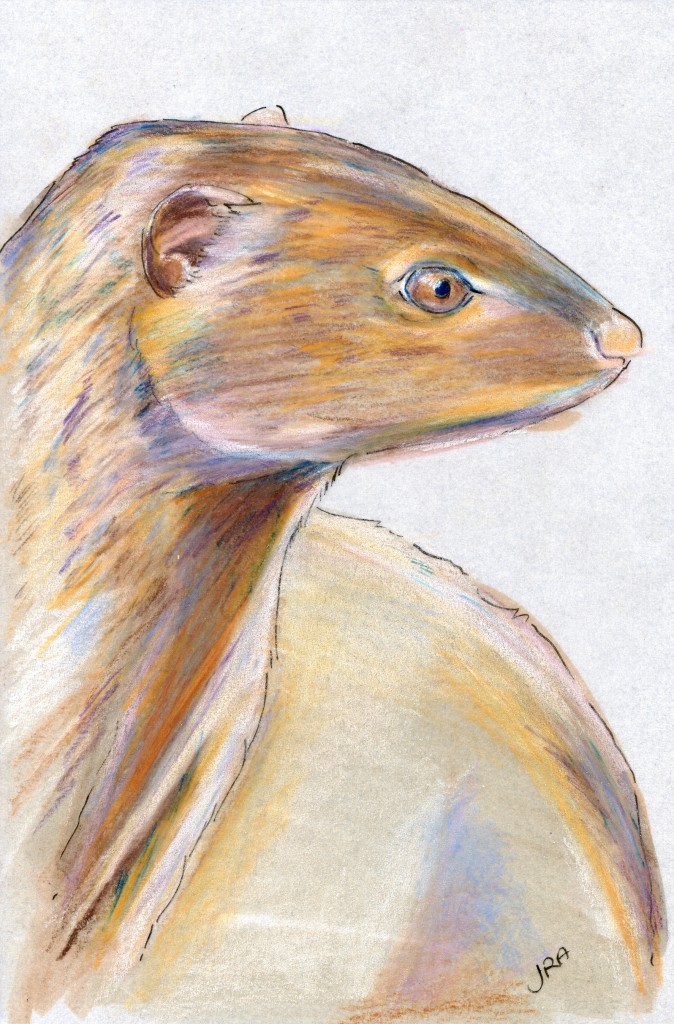
So here’s a drawing of one of Hawaii’s mongooses (all of whom are descended from the 9 that Bancroft Espeut brought from India to Jamaica). Through no fault of their own, they are a major scourge of the islands, and all the while, they’re just trying to do what mongooses do. No one’s come up with a really great idea for getting rid of them—poison seems the most promising, and they may as well skip the prairie dog vacuum—but at least they stand as a lesson about the dangers of tampering with the balance of ecosystems.

(Note that this is another of those taxonomically controversial species. Are the mongooses from Jamaica and Hawaii small Asian mongooses, or are they a different species, the small Indian mongoose (H. auropunctatus)? Is the small Indian mongoose a different species in the first place, or just a subspecies of the small Asian one? Or is it not a even a subspecies? Perhaps one day we’ll all agree.)

{ 1 comment }