Posts tagged as:

squirrel

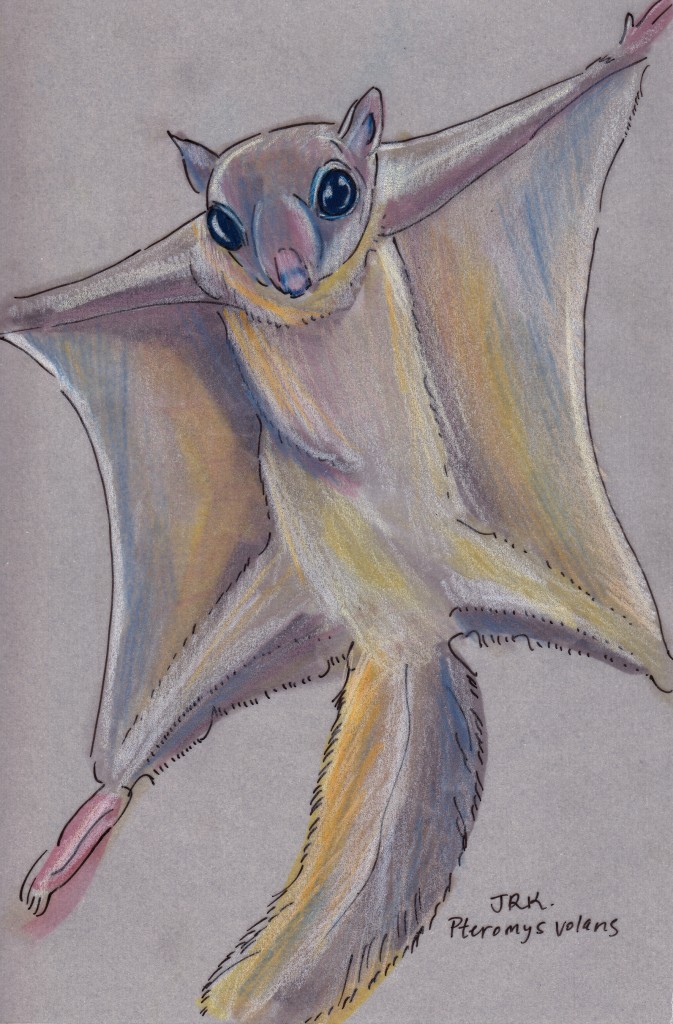
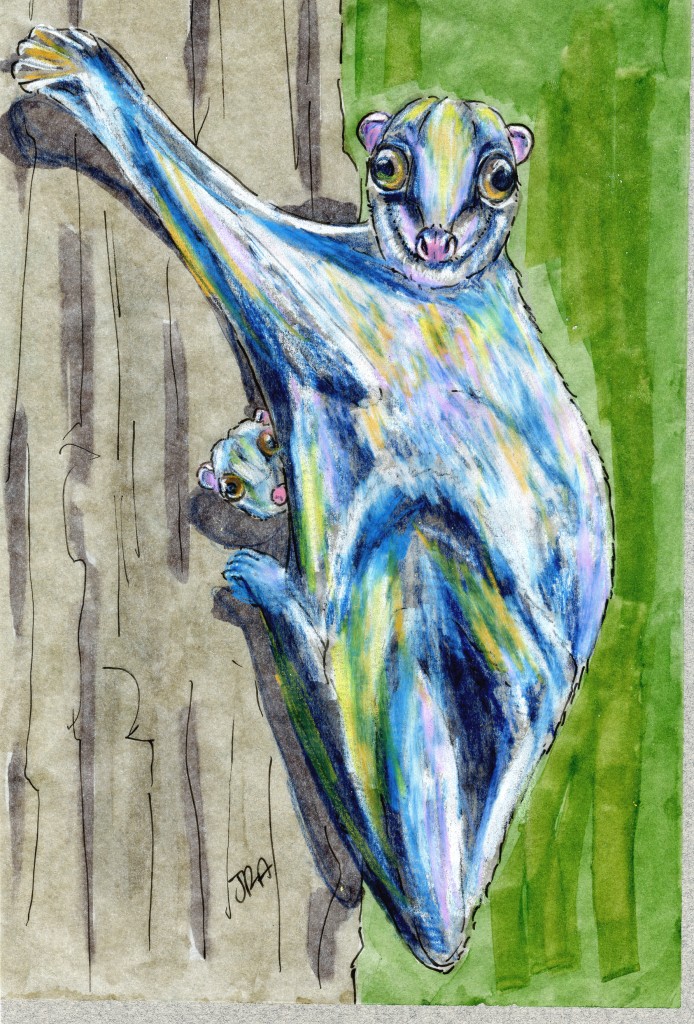
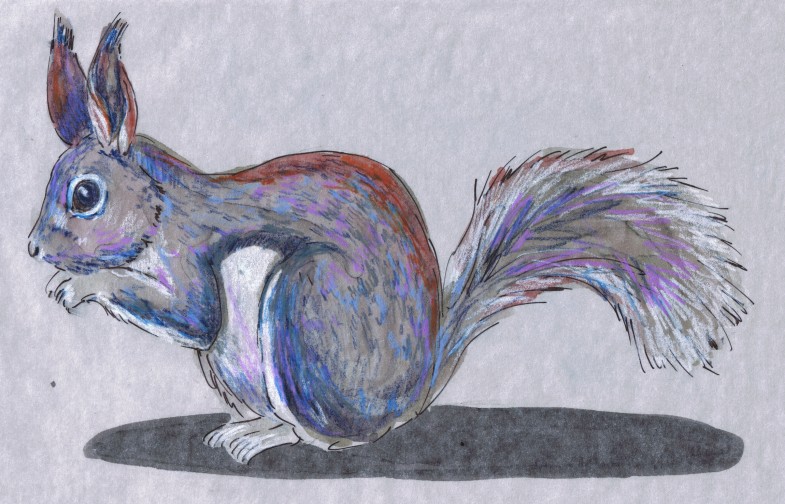
Siberian flying squirrel (click image to enlarge)


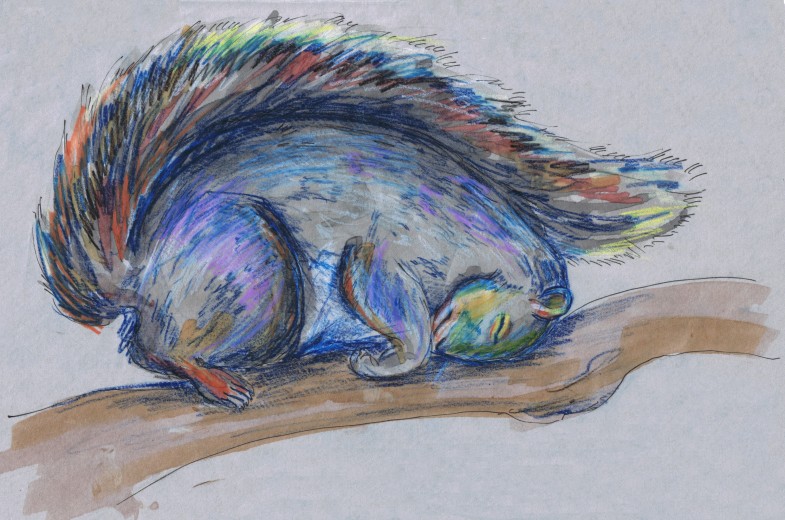
Siberian flying squirrel by Coco, age 12

0392

This week, we’re looking at a few mammals from Primorye, a region in the far east of Russia that you can learn a bit more about in my post for Monday’s musk deer. For today, Coco and I drew Siberian flying squirrels. They are quite common throughout the forests of northern Europe and Asia, where they glide through the treetops by night, snacking on seeds, leaves, buds, and catkins, which are downy, flowering spikes on some trees. An idyllic lifestyle to be sure, a lifestyle from a magical story.

{ 4 comments }

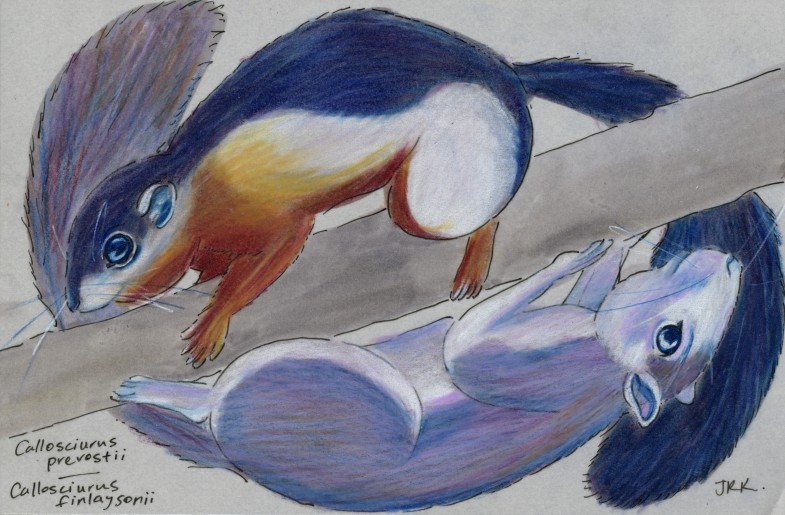
Prevost's squirrel and Finlayson's squirrel (click image to enlarge)


0365
0364

Well, mammals, we made it! Mammal Number 365 is here, with his buddy Number 364, ready to meet you and celebrate a year’s worth of Daily Mammals, completed on average once every four days, which doesn’t sound too bad, until you do the math and realize that at that rate, it will take me an additional 52 years to draw all the mammal species. In 52 years, I’ll be 85. Will you still be visiting my website? I hope so! (Will there still be websites?)

Thank you for visiting and meeting my mammals, even if I am a little slow in getting them to you. I appreciate every one of you wonderful viewers and readers, whether you post comments or not, whether you come once or every day, whether you’re related to me or a stranger. Thank you! This project is rewarding on its own, but it’s even better with company. Thank you, especially, for sticking with me through the long hiatuses.

I write today’s post from my bed, where I’m hopped up on oxycodone for my broken calcaneus. I don’t have my mammal books in here, so this entry will be a tad thin on facts. When I called these squirrels beautiful, I wasn’t bragging about my drawing. The Latin name of their genus, Callosciurus, means “beautiful squirrels,” and each species in this genus has striking colors or markings, like these two. Both of these species live in Thailand. Prevost’s squirrel also calls Brunei, Indonesia, and Malaysia home, while Finlayson’s hangs out in Cambodia, Laos (which is officially called Lao People’s Democratic Republic), Myanmar, and Vietnam.

Florent Prévost, whose name one of these squirrels bears, was a French naturalist and artist, and George Finlayson, namesake of the other squirrel, was a Scottish naturalist and surgeon. I’ve recently started looking up some of these mammals’ names in the Eponym Dictionary of Mammals, or rather its Google Books preview. It’s a new book, out in 2009, and it costs $65, which is not in my budget right now. My public library doesn’t have it, but it does have a copy of my other favorite resource for learning about the names of mammals, A.F. Gotch’s Mammals: Their Latin Names Explained. That one is from 1979 and is out of print. I know I’ve mentioned it several times on this site, and I check it out from the library every now and then.

{ 2 comments }

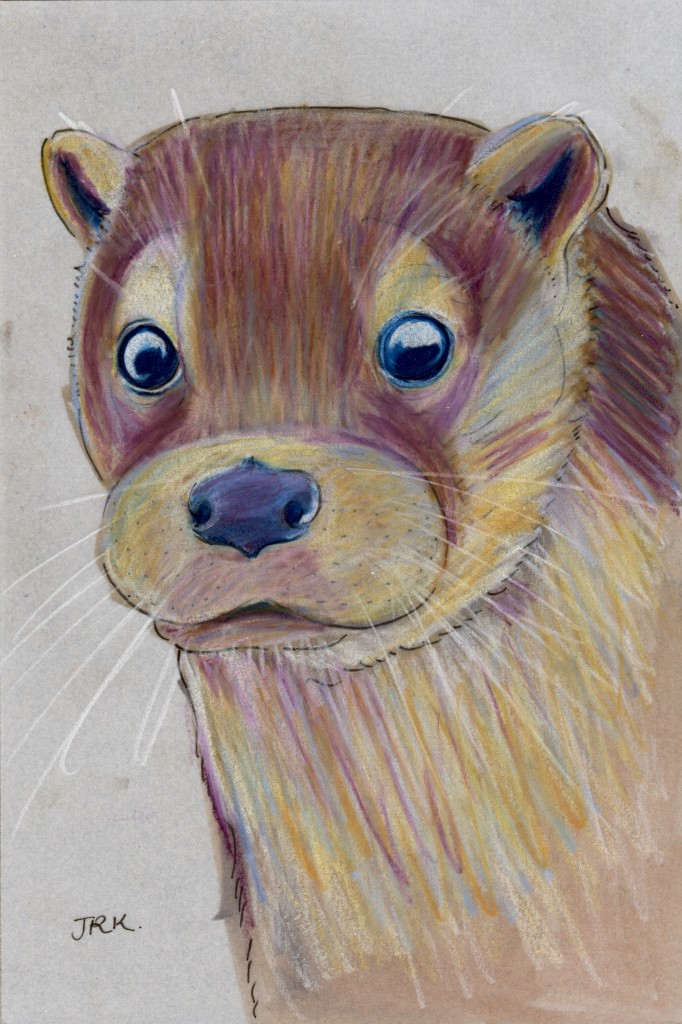
European otter (click image to enlarge)

0328

Hi, mammals! I think I’ll be on track to finish the Mammals of the World Cup on schedule with the actual World Cup if I post all of Group E today and then get back to once-a-day tomorrow. (Whether I will succeed is still unknown, as life has been pretty stressful around here. But I’m trying!) Also, I’m really not doing my best work lately, so dumping four mammals on you at once might distract you from that fact.

Our first mammal is the European otter (Lutra lutra), who is representing the Netherlands, where its numbers had decreased to almost nothing but it has been reintroduced. The Netherlands beat Slovakia (where the Yak part of my name comes from) in the Round of 16 and will be playing Brazil in the quarterfinals on Friday.

Orca (click image to enlarge)

0329

The orca or killer whale (Orcinus orca) is playing for Denmark tonight. Did you know that orcas in groups have been known to take down blue whales? It’s unlikely, I think, that anyone is going to beat the orca in this World Cup. Denmark, on the other hand, didn’t make it out of the group stage.

Japanese dwarf flying squirrel (click image to enlarge)

0330

From Japan, the Japanese dwarf flying squirrel (Pteromys momonga), which is also known as the momonga! It’s just too cute to be believed, really, and is also represented on one of my favorite Yu-Gi-Oh! cards, seen below. (I’m very into Yu-Gi-Oh! now. It comes with the 14-year-old son. I have a beast deck. Besides the Nimble Momonga, I also have a Tree Otter, a Sea Koala, a Kangaroo Champ, a Green Baboon Defender of the Forest, and a Rescue Cat.)

A very handy Yu-Gi-Oh! card (click image to enlarge)

Japan made it to the Round of 16 but lost to Paraguay today. After the group stage, they don’t allow ties anymore. First, they have 30 minutes of overtime, and if there’s still a draw, they take turns taking penalty kicks, which are kicks from a spot 12 yards from the goal. Five players from each team try that, and if there’s still a draw after the penalty kicks, they play sudden death. After the 30 minutes of extra time, the Japan-Paraguay game was tied 0-0, and Paraguay won in penalty kicks.

Allen's swamp monkey (click image to enlarge)

0331

This is Allen’s swamp monkey (Allenopithecus nigroviridis), and it’s from Cameroon (as well as Congo and the Democratic Republic of the Congo). Its scientific name means “Allen’s ape, black and green,” and it is indeed kind of black-and-green colored. Cameroon didn’t get out of the group stage at the World Cup.

Group E Results

Well, the killer whale is the killer whale, and none of these guys stand a chance against that apex predator. It moves on to the next round, and I think our mustelid friend in this group, the European otter, could do some damage to the swamp monkey, and obviously the momonga is adorable and tiny and hopeless against any of the other three. So the two mammals continuing on to the Round of 16 from Group E are:

Orca (Denmark)
and
European Otter (Netherlands)

{ 5 comments }

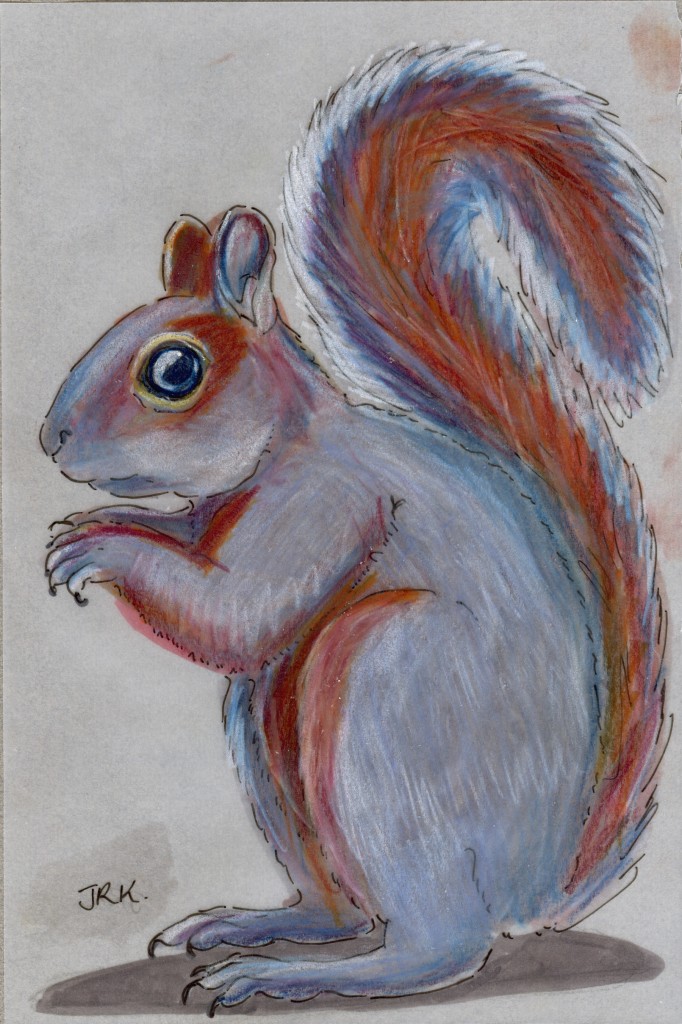
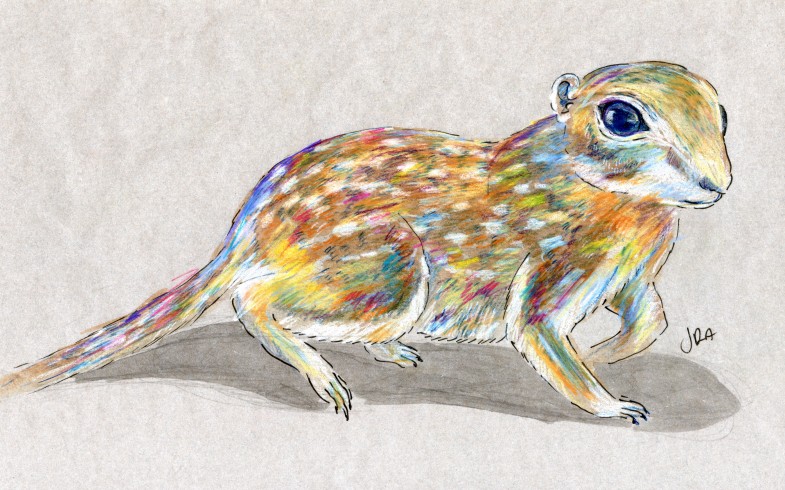
Mexican gray squirrel (click image to enlarge)


0313

To celebrate the World Cup, I’m drawing one mammal from each of the 32 competing countries. Today’s is the Mexican gray squirrel, also called the Mexican red-bellied squirrel, a busy little guy who is native to the treetops of both Mexico and Guatemala. (Guatemala’s national soccer team has never qualified for the World Cup.) The Mexican gray squirrel, like all other squirrels, I imagine, likes to eat nuts and seeds, but it also occasionally treats itself to a raid on a mango or cacao plantation. The species is widespread and not threatened (hooray! cue vuvuzelas!).

Mexico, whose national team is nicknamed El Tri for the country’s tricolor flag, is in the World Cup’s Group A, a tough bunch of contenders, as we discussed yesterday. In Friday’s opening game of the tournament, Mexico just managed to tie South Africa 1–1. Of course a win would have made either team happy, but the level of competition in their group is such that neither is out of the running yet. (If you missed the game, here’s the Guardian’s live blog of it.) Next, South Africa takes on Uruguay on Wednesday and Mexico faces France on Thursday.

Mexico is the USA’s major rival in soccer/fútbol, which makes life hard for some Mexican-Americans at World Cup time. Mexico has hosted the World Cup twice, and both times the team made it to the quarterfinals, but El Tri has never made it any further than that.

{ 2 comments }

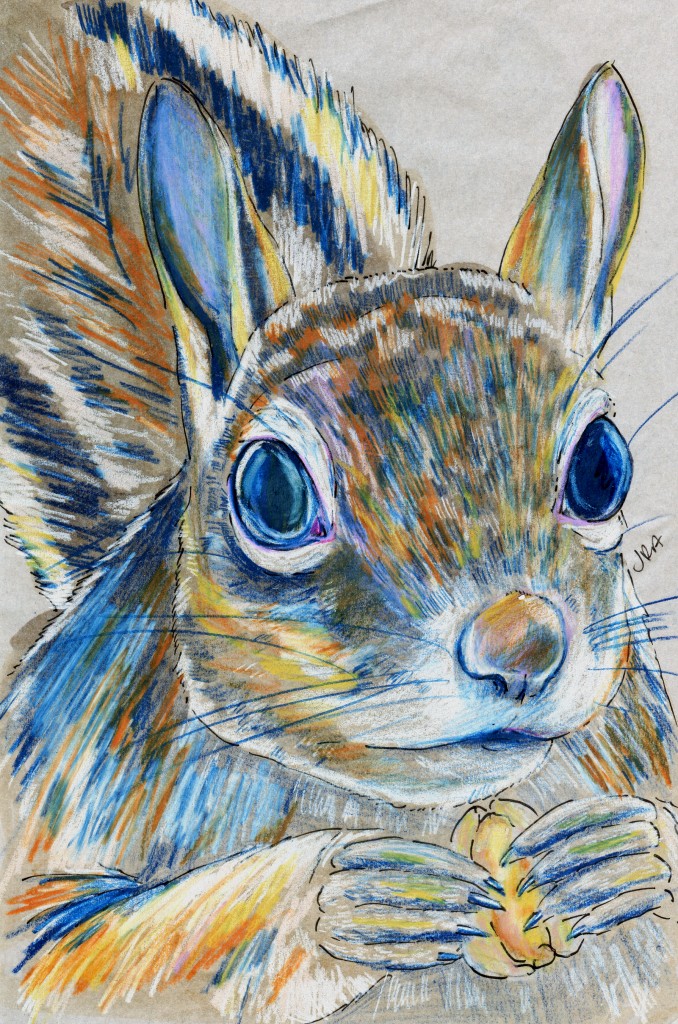
Red Squirrel (Sciurus vulgaris)

by JR Kinyak on June 11, 2010

in Rodents

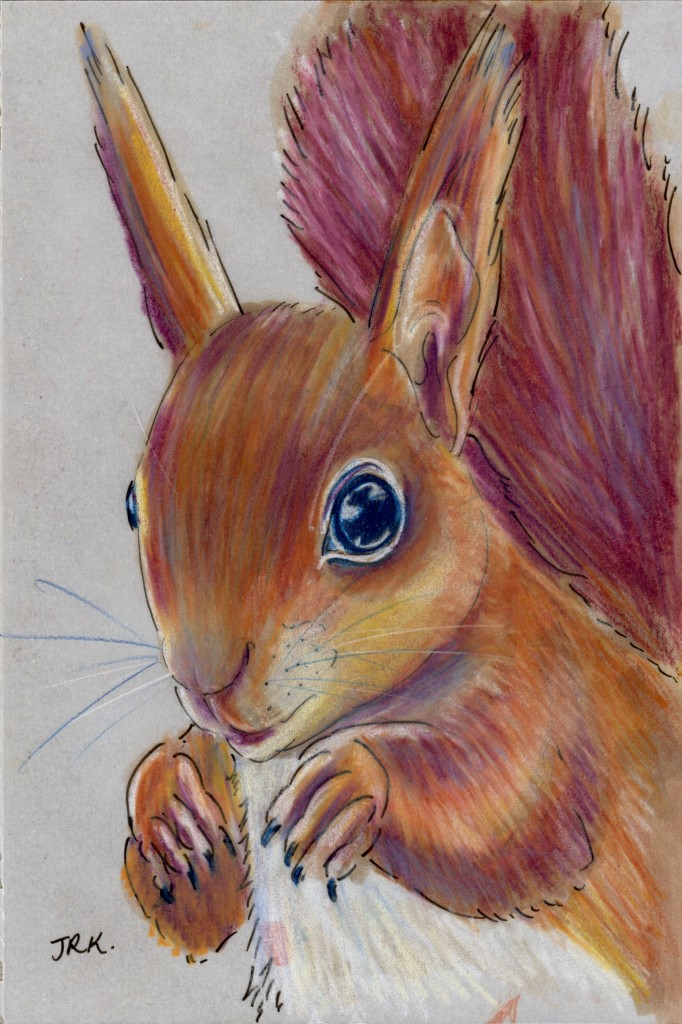
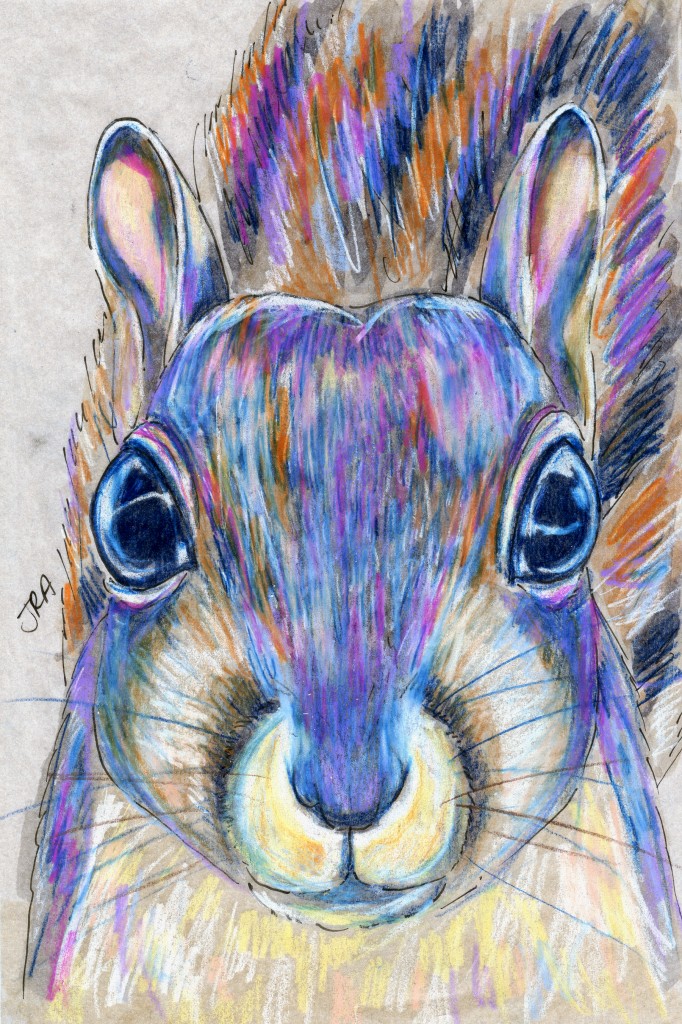
Red squirrel (click image to enlarge)

0310

This pretty red squirrel species lives in Europe and Asia. In Italian, its name is scoiattolo comune, in German it’s Eichhörnchen, in French it’s ecureuil roux, in Swedish it’s ekorre, in Danish it’s egern, and in Spanish it’s ardilla roja.

Earlier this week, our friends visited, and one of their kids, nine-year-old Nicola, drew some mammals with Coco and me. Here are Coco’s and Nicola’s squirrels, which are a different species from the red squirrel I drew, but fit here anyhow.

Sleeping squirrel by Coco, age 11


Hungry squirrel by Nicola, age 9

{ 0 comments }

Indian Giant Squirrel (Ratufa indica)

by JR Kinyak on May 6, 2009

in Rodents

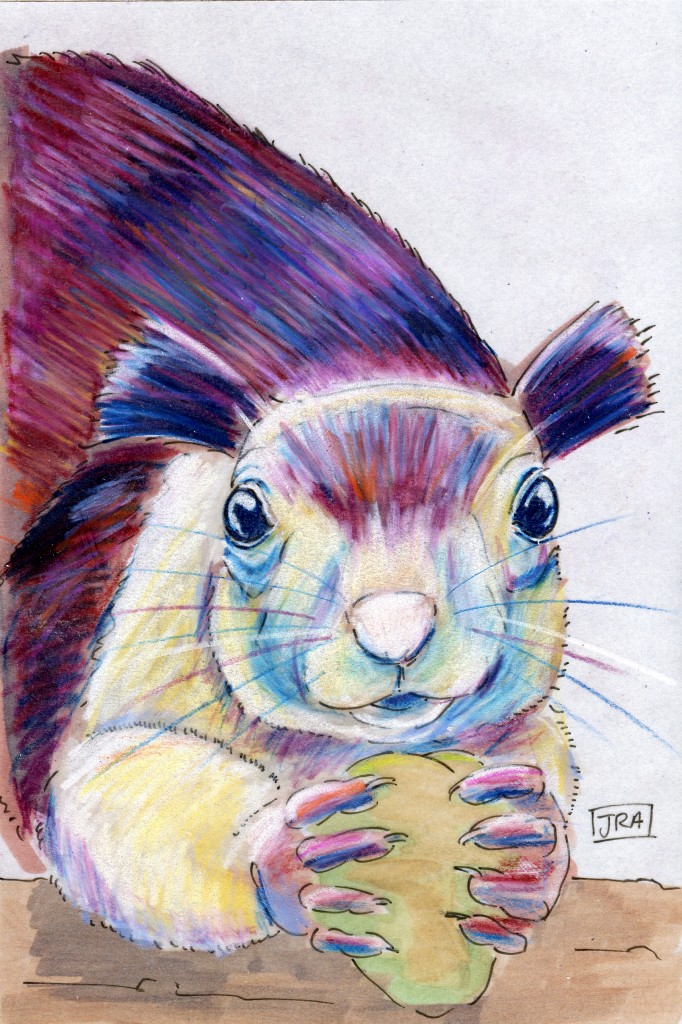
Indian giant squirrel (click to enlarge)

Indian giant squirrel (click to enlarge)

0256

While I was researching yesterday’s Indian palm squirrel, I ran across this gorgeous species. I was going to save him to draw later because he’s so colorful with such crazy ears, but then today, it got late and I was going to just go to bed but then I thought, no, I have three days in a row, need to keep it going, so I decided to draw somebody really fun, and thus, your Indian giant squirrel.

{ 2 comments }

Indian palm squirrel (click image to enlarge

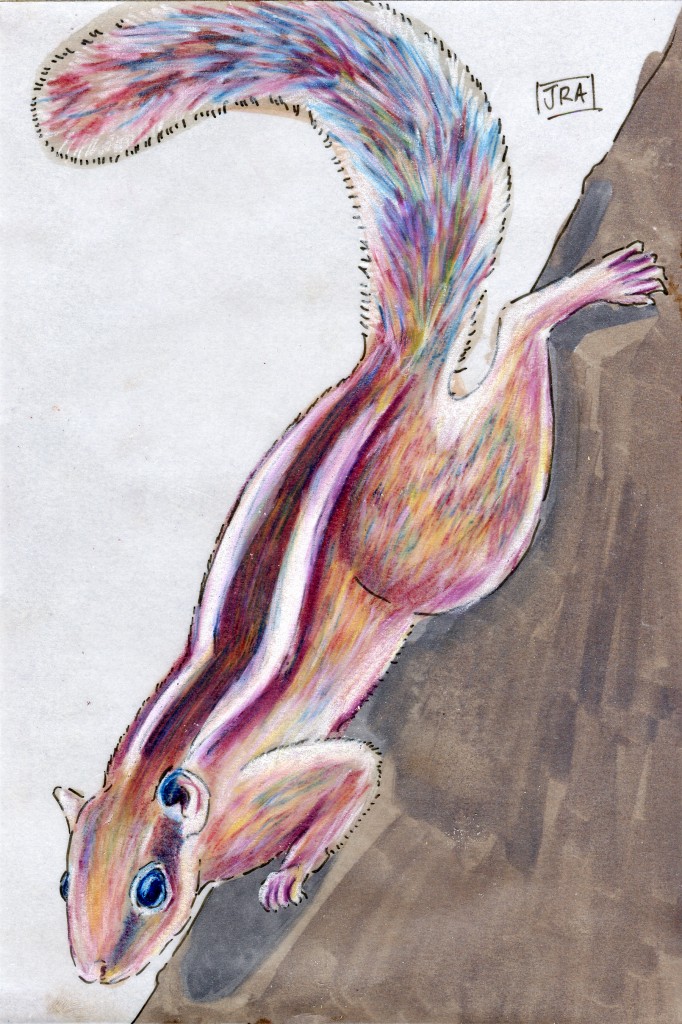
Indian palm squirrel (click image to enlarge)

0255

The Indian palm squirrel is a funambulist of the palms! Thinking of the words somnambulist or ambulatory, you can almost come close to figuring out what that means: a fun walker! Sort of. A funambulist is a tightrope walker (funis is Latin for rope; the word fun, on the other hand, comes from the Middle English fon, meaning fool, and this squirrel is no fool).

Indian palm squirrels are endemic to India and Sri Lanka. In a Hindu legend, the god Ram was searching for his beloved wife Sita, who had been kidnapped by a demon. At one point in the epic that tells his story, he must build a bridge across a sea, and he is aided by an army of monkeys and bears. But monkeys and bears aren’t the only animals that help him. This is from a version of the story on the India Times website:

The entire army of monkeys promptly got to work, under the supervision of Hanuman and Jamvant. Ram sat under a tree thinking of Sita and the days ahead.

After a while, he noticed something that moved him to tears. A little squirrel, who had been watching the monkeys carry huge boulders and rocks to build the bridge, began to do her bit to help the Lord. She began carrying little pebbles in her mouth and her tiny hands from a little mound near the tree to the site of construction.

A much amused and pleased Ram picked up the squirrel and petted her, running his fingers from her head down to her tail. The squirrel was blessed and forever marked with stripes—the mark of Lord Ram and a trophy of love.

A while back, a commenter suggested that the Daily Mammal could function as a sort of horoscope, where your personality can be compared to characteristics of the mammal I draw on your birthday. So if you, like me, were born on May 4, you resemble an Indian palm squirrel: you’re agile, fearless, hardworking, and willing to wreak minor destruction to get what you want.

{ 0 comments }