Posts tagged as:

sexual selection

click image to enlarge

0240

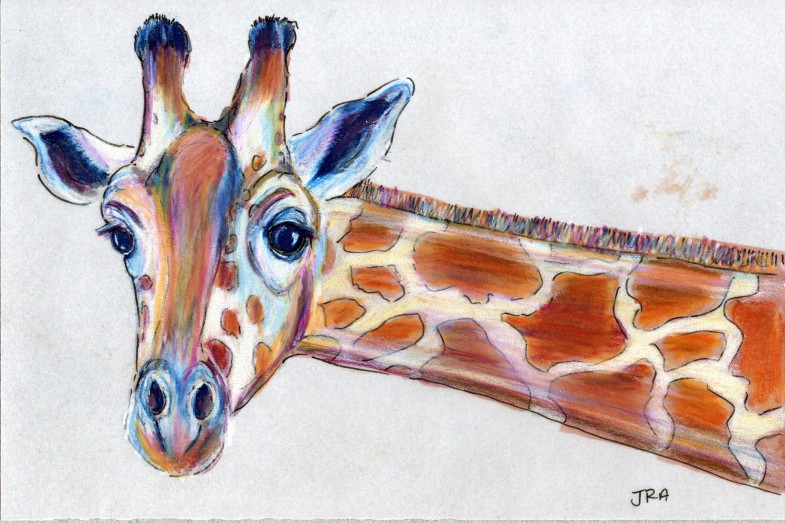
Tonight, we conclude our celebration of Charles Darwin’s 200th birthday with one last look at a mammal he wrote about in The Origin of Species.

Although Darwin’s work is widely available for free online (see The Complete Work of Charles Darwin Online, and you’re probably all set), I still find it easier and more satisfying to thumb through an actual book. It’s kind of like rewinding a cassette tape versus placing a needle on a record. For me, anyway. So I bought a Penguin edition of Origin. There were three different printings to choose from at my bookstore, and I picked the middle one, price-wise, which seemed to have decent paper. Turns out it’s a reprint of the first edition, and Darwin produced six editions total, each quite different from the previous. All this is to say that in the sixth edition, Darwin added a second chapter dealing with objections to his theory. In that chapter, he discusses the giraffe in great detail, discussing how and why it might be advantageous for a “nascent giraffe” to evolve a long, long neck.

It seems that the giraffe is still throwing people for a loop. When I was researching giraffe photos online for reference, I found one posted on Flickr that had a long, not overly polite discussion in the comments section about whether or not it was possible for a giraffe’s neck to evolve, or whether the very fact of the giraffe’s long neck was proof of the creation of the giraffe as a whole being, immutable and perfect. To me, it seems a textbook example of natural selection: the protogiraffes with the longest necks were able to eat more than the others. They lived longer because they ate longer. They reproduced more because they lived longer. More giraffes were born with long necks. And so on. But people still have problems with it because the giraffe seems unique, because it requires special structural adaptations in order to operate with such a long neck, or maybe because it looks like something someone like Dr. Seuss would have had to think up.

The giraffe reference I particularly like in Origin, though, is in my first-edition reproduction. After discussing the problem of the evolution of organs of seeming perfection (like the eye), Darwin addresses the problem of the evolution of “organs of little apparent importance.” In his charmingly open and self-effacing way, he writes, “I have sometimes felt much difficulty in understanding the origin of simple parts, of which the importance does not seem sufficient to cause the preservation of successively varying individuals.” Darwin goes on to point out that we shouldn’t be so arrogant as to presume we know what’s important and what’s not. And the example he uses is the giraffe’s tail:

“The tail of the giraffe looks like an artificially constructed fly-flapper; and it seems at first incredible that this could have been adapted for its present purpose by successive slight modifications, each better and better, for so trifling an object as driving away flies; yet we should pause before being too positive even in this case, for we know that the distribution and existence of cattle and other animals in South America absolutely depends on their power of resisting the attacks of insects: so that individuals which could by any means defend themselves from these small enemies, would be able to range into new pastures and thus gain a great advantage. It is not that the larger quadrupeds are actually destroyed (except in some rare cases) by the flies, but they are incessantly harassed and their strength reduced, so that they are more subject to disease, or not so well enabled in a coming dearth to search for food, or to escape from beasts of prey.”

First of all, don’t you love that 19th-century sentence structure, with endless commas, colons, semicolons, and then more commas? I love it. What Darwin is saying here* is that a fly-swatter is not as trivial as it seems. Fighting off flies saps a person’s energy, and so it makes sense that the best fly-flighters would have a reproductive advantage. I imagine this is why giraffes have such lovely eyelashes, too.

My husband Ted has a theory that sexual selection could play a part here (see my lion post of a couple days ago). In his theory, female giraffes would be more attracted to those male giraffes who coolly switched their tails, rather than those who itched and jumped because flies were crawling all over them. It makes sense to me.

*I should note that my mammalogy is completely self taught. Two of my worst teachers ever were my two biology teachers (7th grade and 8th grade). What knowledge I have of science is from my dad (a geologist and painter) and my own curiosity and love of animals. So if I’m telling you really, really obvious things about evolution, I apologize. I’m just learning it all myself.

{ 2 comments }

Darwin Days: Lion (Panthera leo)

by JR Kinyak on February 11, 2009

in Carnivores,Theme Weeks

click image to enlarge
0238

It’s quite fashionable to equate the theory of evolution with Charles Darwin himself. Science magazines and books sell with covers blaring “Darwin Was Wrong,” “Was Darwin Wrong?,” and “What Darwin Got Wrong.” Meanwhile, intelligent-design and creationism proponents attack “Darwinism,” and the New York Times publishes “Darwinism Must Die So That Evolution May Live” and “Let’s Get Rid of Darwinism.” By creating an -ism, the New York Times pieces suggest, “Darwinists” devalue their own arguments, putting them on the same level as, for instance, creationism.

The fact, as far as I can tell, is that Darwin was right about many, many things, and most of those things that he was wrong about (mainly because things like genetics and continental drift hadn’t yet been discovered, and the man couldn’t do it all!) have nevertheless been built on his foundation. Many of the articles celebrating Darwin’s bicentennial point out how remarkable it is that after 150 years, On the Origin of Species is still relevant. Today we’ll talk about one of the ideas Darwin had before his time and that is still being studied and proven: sexual selection.

Basically, sexual selection refers to the favoring of certain traits solely because they are attractive to mates. As Darwin says in Chapter 4 of Origin, “This depends, not on a struggle for existence, but on a struggle between the males for possession of the females; the result is not death to the unsuccessful competitor, but few or no offspring.” To attract females, males develop showy traits like bright feathers, big antlers, or electric guitars. The reasons why females are attracted to these things in the first place are not fully known; it could be that a male with big horns, for instance, has good genes in other ways; another theory holds that if a male can thrive despite the “handicap” of a huge tail or something, he must be pretty strong.

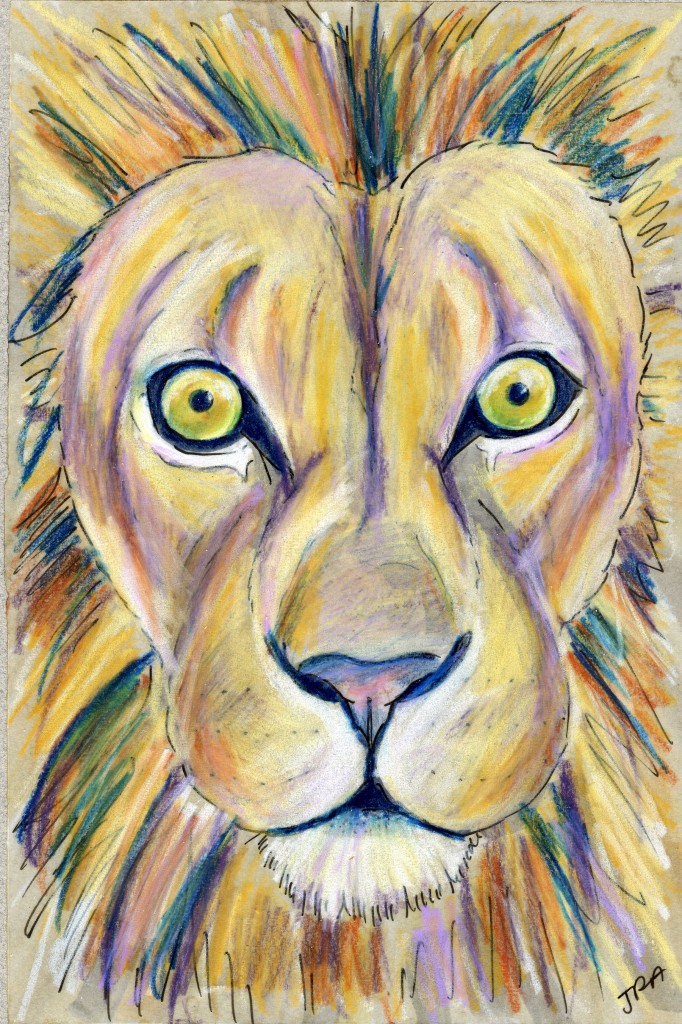
The lion’s mane has long been a puzzle. In 1859, in Origin, Darwin wrote, “The males of carnivorous animals are already well armed; though to them and to others, special means of defence may be given through means of sexual selection, as the mane of the lion, and the hooked jaw to the salmon; for the shield may be as important for victory, as the sword or spear.” The going theory for many years was that manes protected male lions from the claws and teeth of their rivals, but now it doesn’t appear that’s true because fighting lions don’t tend to go for the head and neck in particular.

Studies in the past several years have focused on the variations in mane length and color. Researchers found that the luxuriousness of a lion’s mane depended on its climate: lower, hotter, and more humid climates meant skimpier, lighter-colored manes because it can get hot under all that hair. The researchers were also surprised to learn that manes continue developing after the lion’s sexual prime has come and gone. In the hottest places, older males are the only ones with manes to write home about. It makes me wonder if there could be a reverse sexual selection going on there: if you don’t have a mane in a hot place, does it indicate that you’re younger and therefore more virile? I don’t know.

Scientists also fooled around with trying to lure both male and female lions with fake dummy lions of varying mane lengths. They found that males approached the shorter-maned dummies 9 out of 10 times, and females approached the longer-maned ones 13 out of 14 times. The males that intrigued the females intimidated the other males, in other words.

Here’s a book I read part of once that postulates that all human creative culture—from art to architecture to comedy to writing books, etc.—is the result of sexual selection. In other words, men do cool things because chicks dig it: The Mating Mind by Geoffrey Miller.

{ 3 comments }