Posts tagged as:

rat

Rats Three Ways (Neotoma spp.)

by JR Kinyak on March 26, 2009

in Rodents

The Daily Mammal Book Club is discussing My Family and Other Animals by Gerald Durrell. Join in!

click image to enlarge

0248
0247
0246

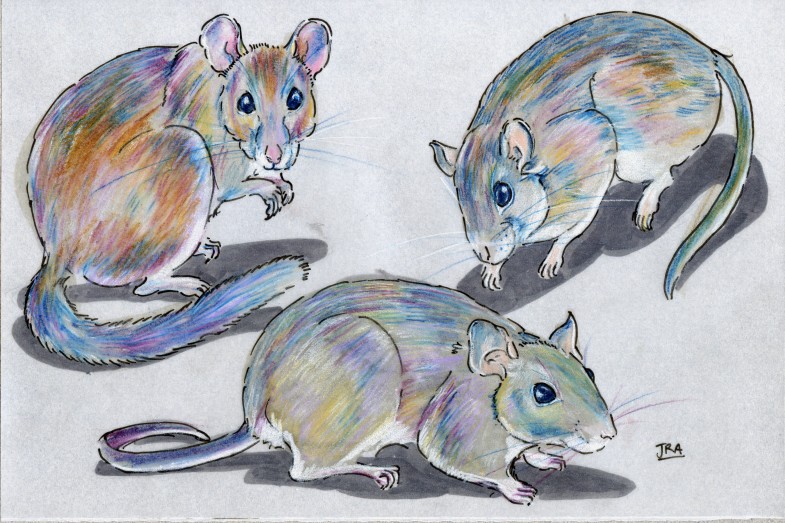
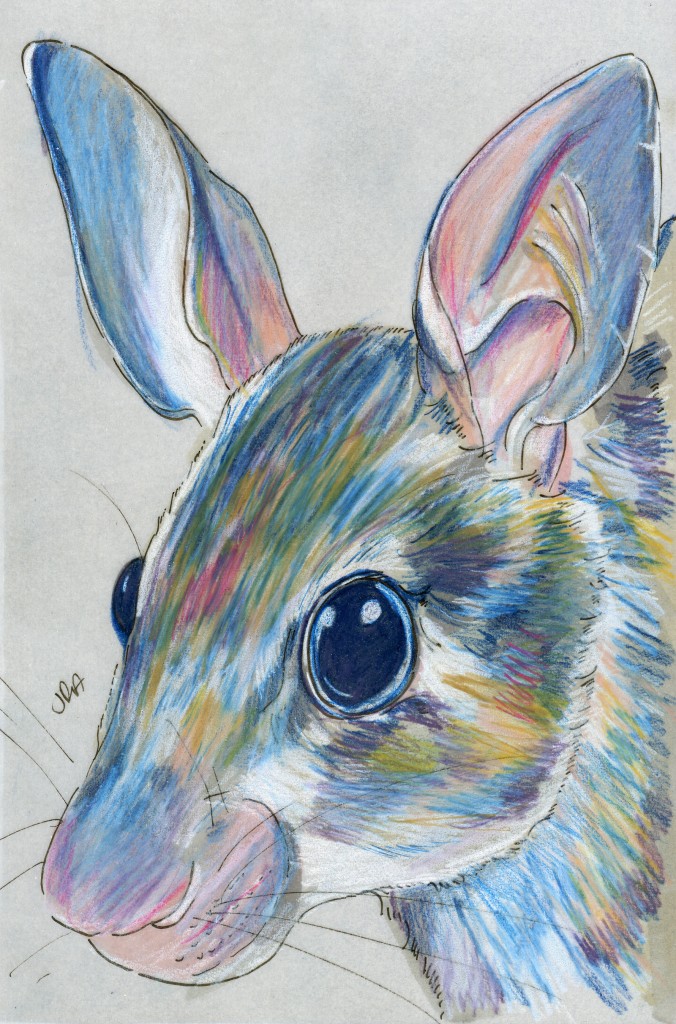
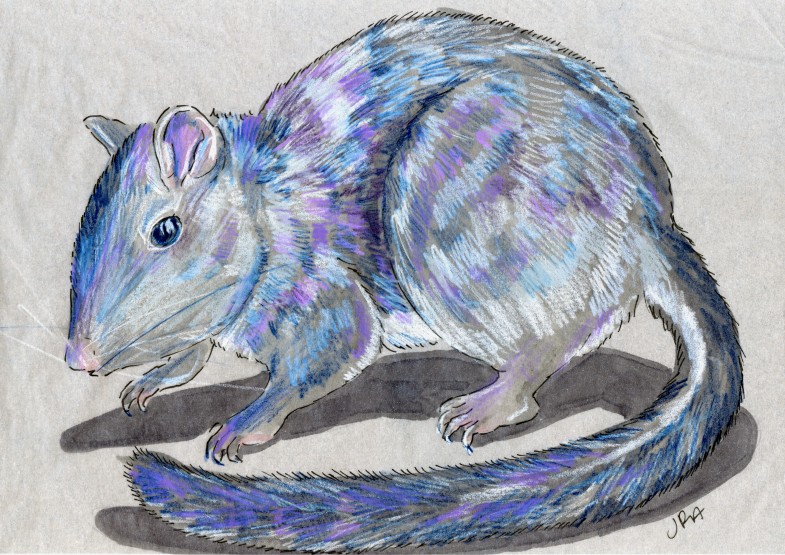
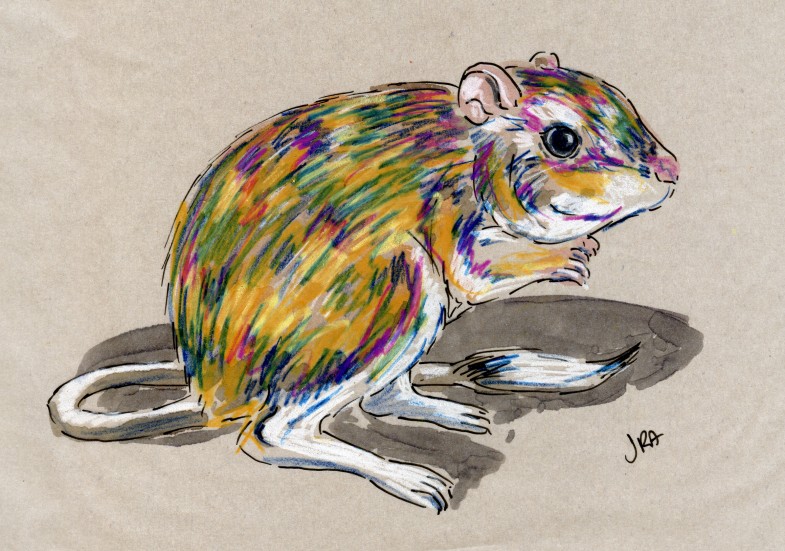
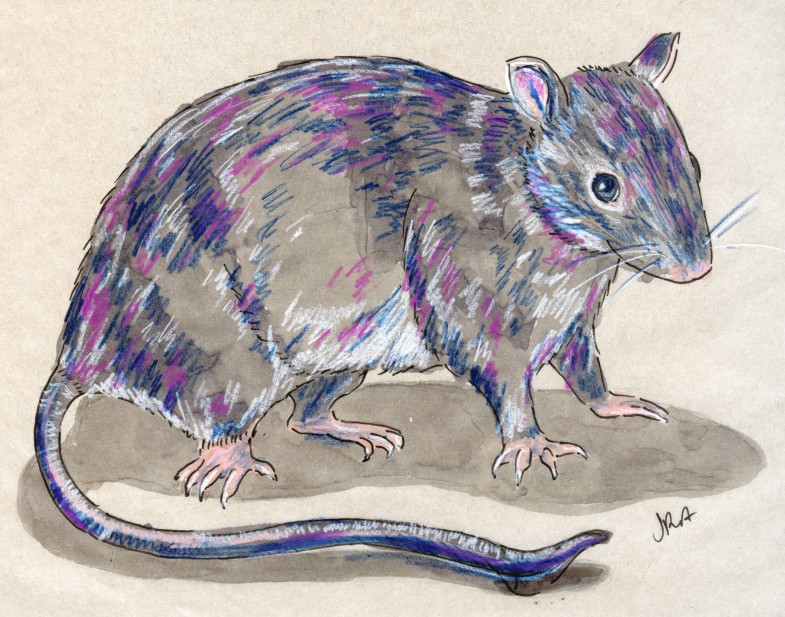
Here are three rats for you! They’re in the wood rat or pack rat genus, Neotoma. Clockwise from the top left, we have N. cinerea (bushy-tailed wood rat), N. floridana (eastern wood rat), and N. lepida (desert wood rat). Wood rats are also sometimes called trade rats. Mammalian Species quotes a 1946 guide to the mammals of Nevada:

“It is supposed that when one of these rats carrying an object of its fancy comes to another more attractive object, it drops the first and continues on its way with the second. If the second object be the watch of a camper, who in the morning finds a piece of old bone where the watch lay when the camper went to sleep the evening before, he will think the name trade rat appropriate.”

Just, you know, hypothetically, right?

There are two words related to wood rats that you may not know. Both could prove useful in describing, say, someone’s housekeeping. Middens means a pile of bodily waste or a dunghill. Amberat is a deceptively beautiful word meaning crystallized rat urine. (I don’t know if it’s a portmanteau from amber and rat, but I hope so. I really love this word.) Here, in a book about the Grand Canyon, is a chapter all about amberat, and here is a photograph of it at UtahCaver.com. Apparently, it has a red-gold color and can be built up to several inches thick. It may or may not have a sweet smell.

Amberat helps fossilize wood-rat middens for later examination by interested parties. Archaeologists have found rodent middens that are 50,000 years old. The rats use the same middens for generations, so there’s all kinds of intriguing stuff in there. At Mesa Verde, they’ve found middens that show signs of exposure to smoke, suggesting that the wood rats coexisted with the Anasazi.

{ 2 comments }

click image to enlarge
0213
0212

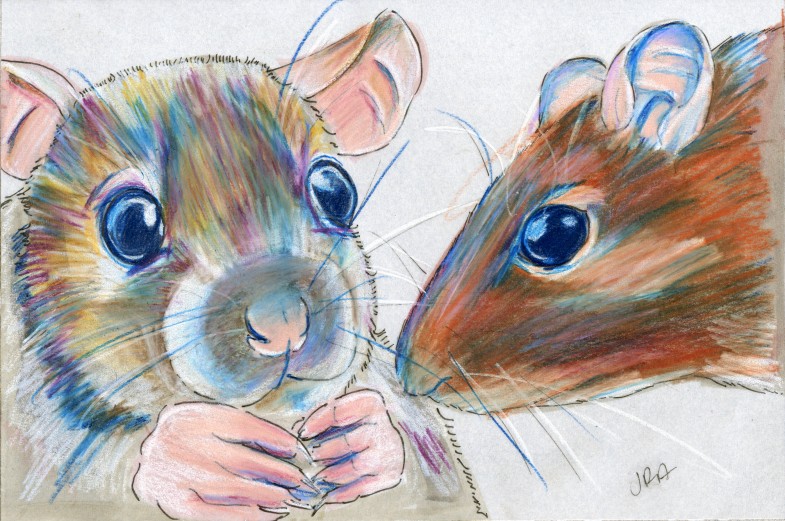
As I write this, there are only about 11 hours left until Barack Obama assumes the presidency, which means we’ll be celebrating his home state for only a little while longer here at the Daily Mammal. The other day, we looked at the small Asian mongoose, which was imported to kill Hawaiian rats. Now, let’s meet a couple of the rats in question.

On the left is the Norway or brown rat, Rattus norvegicus. This rat came to Hawaii on European ships in the 19th century. The fellow on the right is a Polynesian or Pacific rat, otherwise known as Rattus exulans. It came centuries earlier in Polynesian canoes. These two species, as well as the black or roof rat, are responsible for the extinction of a number of Hawaiian bird species and the decline of even more, both because they prey on the birds and their nests, and because they compete with birds for food. They also carry a range of diseases and parasites. And they love to destroy sugarcane, pineapple, coffee, macadamia, and banana crops. They don’t think of it as destruction, though; to them, it’s just lunch.

The mongooses didn’t eradicate the rats of Hawaii, as it was hoped they would. Now, poison is the best way to get rid of them, and you can use electric fences to keep them out of places you’d rather they not visit.

We haven’t visited with Ivan T. Sanderson, author of Living Mammals of the World, in a while. Here’s what he says about one of today’s rodents:

“Although Man is undeniably ‘top-mammal’ in certain ways, and the Elephant may be regarded as the most highly ‘evolved,’ there is little doubt that some rat, and probably the Brown Rat (Rattus norvegicus) is actually the finest—in every sense of the word and especially in efficiency—product that Nature has managed to create on the planet today…Rats preserve a much more practical balance between compassion for and indifference to their own kind than we do. While weaklings or cripples among their numbers may be left alone, ‘fools’ and ‘criminals’ seem often to be deliberately eliminated or killed outright. All of this results in much sounder eugenics than we practice. That there are more individual Brown Rats in North America than there are people, is not the result of man’s carelessness, indifference, or wasteful and dirty habits; it is the result of the greater stamina and, frankly, commonsense of the rats.”

I don’t know about you, but I’m okay with our unsound eugenics! The Polynesian rat is called kiore in the Maori language, and it reached New Zealand, as it did Hawaii, in Polynesian canoes. In traditional Maori culture, the kiore plays an important part in ceremonies and mythology. You can read about that here in the Te Ara Encyclopedia of New Zealand.

{ 0 comments }

click image to enlarge
0207
0206
0205

It’s always nice to knock off multiple rodents in one drawing. You have no idea how much the rodents gnaw at me. Forty percent of all mammals are rodents. Forty percent. As I’ve mentioned before, I did not consider that fact when I first thought, “I know! I’ll draw all the mammal species!” In order not to spend the last few years of this project drawing nothing but rodents, I should probably draw them three days a week. Would that bore you?

This particular drawing is one of those good exercises in perfectionism prevention for me. Sometimes I’m not at all happy with my work. But then I remember that there are 5,000 species, so I’m bound to dislike at least 500 of my drawings. Weird!

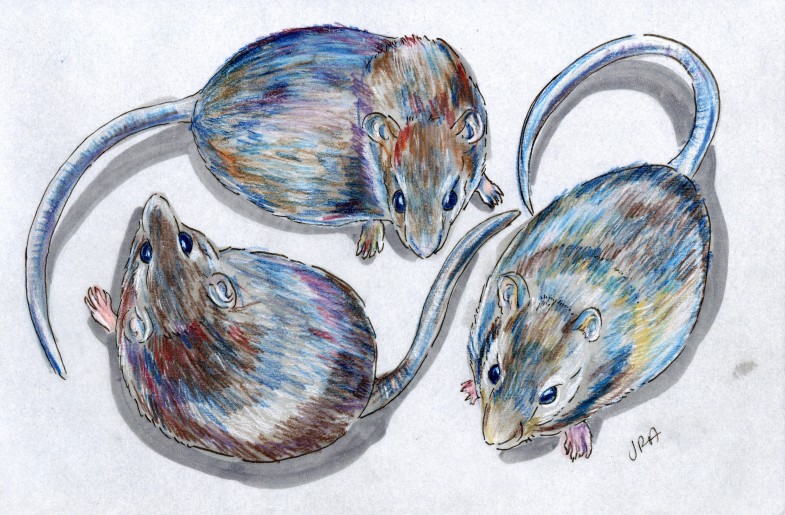
Shown here, clockwise from lower left, are:

Swamp Rat (Rattus lutreolus), who lives in Australia. This rat is notable, according to its species account in Mammalian Species, because “under experimental conditions, R. lutreolus was able to tolerate long periods of water deprivation. Intake of solid food and urine output declined during this period…The ecological significance of its extraordinary tolerance for water imbalance requires study.” Also, it has the shortest tail of all the rats in Australia. And other than the Tasmanian subspecies, it likes to live in wetlands.

Bush Rat (Rattus fuscipes), another Australian. Did you know there are Australian Alps? I didn’t, until I read that “although mainly a lowland species, R. fuscipes occurs in Australian Alps to 2,210 m.” in Mammalian Species. I could go on to tell you about what Mammalian Species describes as “a serendipitous discovery relating to dietary intake of fluoroacetate by R. fuscipes of Western Australia,” but I won’t. This particular species account is rather long, but in browsing through it, I see that “During major fires, R. fuscipes retreats into burrows; afterward it hides in deep accumulations of ash.”

Marsh Rice Rat (Oryzomys palustris), of the eastern United States, from southeastern Pennsylvania to the Florida Keys and as far west as Illinois. This rat is semi-aquatic, and like the swamp rat, it lives in wetlands. In several states, marsh rice rats are the main sustenance of barn owls, and they’re also preyed on by other owls, cottonmouths, water snakes, hawks, raccoons, foxes, mink, weasels, and skunks.

{ 6 comments }

Malagasy Giant Jumping Rat (Hypogeomys antimena)

by JR Kinyak on January 11, 2009

in Rodents

click image to enlarge

0203

Ah, Madagascar, an island of the strange and wondrous. The Malagasy giant jumping rat is another EDGE (evolutionarily distinct and globally endangered) species, which means that it’s irreplaceable…and at risk of disappearing completely.

This nocturnal forager lives only in one small part of western Madagascar, where it forages for seeds, leaves, and fruit. It’s the largest rodent in Madagascar. Like a rabbit, it has long ears and long back feet for jumping. It also occupies the same ecological niche that rabbits occupy in other places. Unlike a rabbit, it has only one or two babies a year.

The major threats to the giant jumping rat are climate change—specifically, aridification—habitat destruction, hunting, and introduced predators like cats and dogs.

Durrell Wildlife Conservation Trust page for the Malagasy giant jumping rat.

{ 0 comments }

click image to enlarge
0128


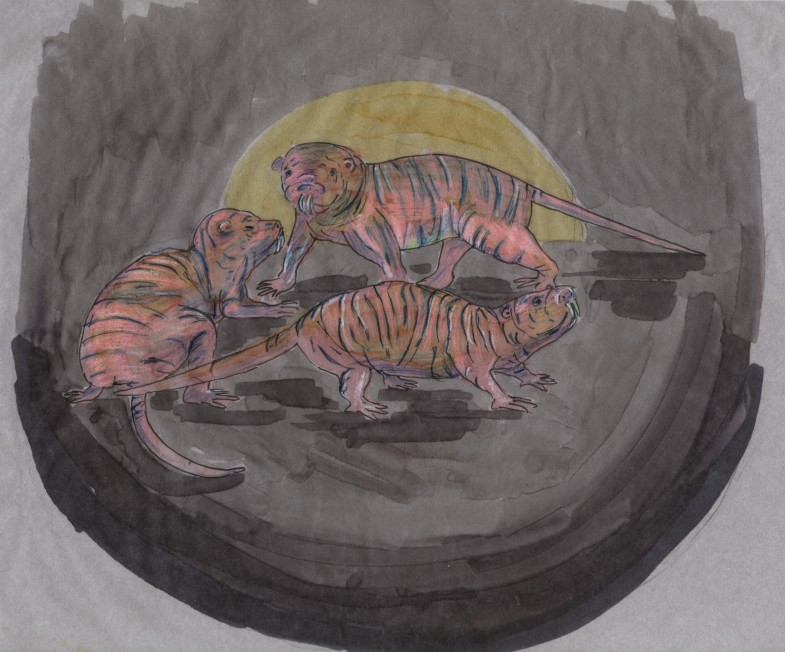
“The coelacanth of rodents,”
this Laotian rat is a member of a family scientists thought had been extinct for 11 million years. So those scientists must have been surprised when they found some for sale in a food market in 1996!

Actually scientists initially thought the rat was a member of a brand-new family and described it as such. Other scientists who excitedly read the 2005 paper that described the new family recognized its resemblance to the Diatomys fossils they studied, and released their own paper in 2006 making the claim that the Laotian rock rat is actually what’s called a “Lazarus” mammal. (Like yesterday, I don’t have the fortitude to decipher the scientific articles to figure out whether this claim still stands or not.) There is only one other mammal species known to have that long a gap in its fossil history.

The 1996 specimens were joined by more dead Laotian rock rats in 1998, but it wasn’t until 2006 that scientists saw a living one. You can see a photo here on the National Geographic site.

{ 4 comments }


0091

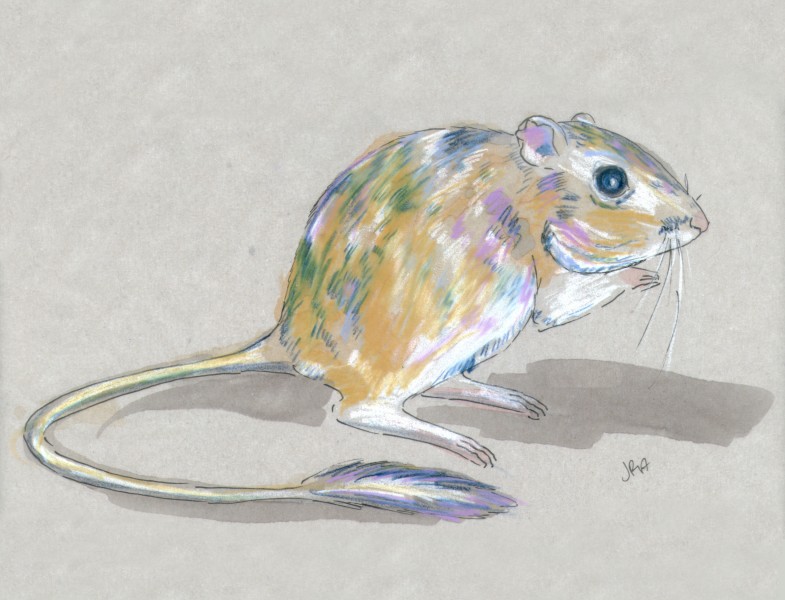
Texas kangaroo rat! For Kate! Sarah’s mom! Yay!

—————-
Now playing: Freddie Fender – Dime
via FoxyTunes

{ 0 comments }

24 Hours: Black Rat (Rattus rattus)

by JR Kinyak on December 22, 2007

in Mammalthons, Rodents


0084

Soon, it will be the year of the rat, which is why Ramona requested this fellow. She’s a rat herself—astrologically speaking—which is why we could call her Ratmona, but I don’t think we should. Black rats are also called roof rats, house rats, and ship rats, which I suppose gives us a good idea of where we can expect to find them.

{ 2 comments }