Posts tagged as:

rabbit

Before we meet a long-eared jackrabbit from Mexico, an announcement:

Like everyone, my daughter Coco and I have been saddened by the earthquakes and tsunamis in Japan this month. We’ve decided to have a Daily Mammal fundraiser to raise some money to help people and animals affected by the disasters.

Next week, beginning Sunday and running through Saturday, the two of us will post drawings of Japanese mammals. We’ll post a new mammal each morning of the week at 10 am mountain time. Our drawings will be for sale with all proceeds going to help victims of the Japanese earthquakes. Half of the money will go to the American Red Cross, to help human mammals, and half to Animal Refuge Kansai, a Japanese organization that’s rescuing animals who lost their homes.

My drawings will be selling for $50, or $60 with a mat. Coco’s will be $25 unmatted and $35 matted. (The drawings are 6″ x 9″ and the mats are 9″ x 12″.)

Please come back Sunday and all next week to meet some beautiful mammals from Japan and consider purchasing a drawing to help victims of the tsunami and earthquake, and please invite your friends to stop by, too.

Now on to the jackrabbit!

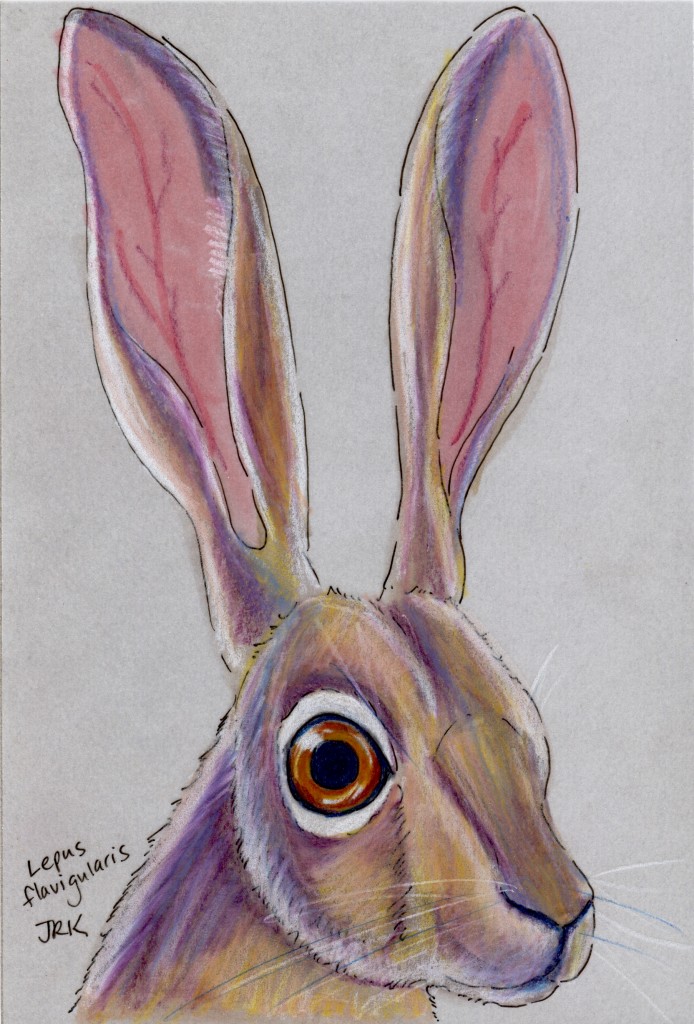
Tehuantepec jackrabbit (click image to enlarge)


0366

This jackrabbit lives in Oaxaca, Mexico, on the Isthmus of Tehuantepec. It used to live in Chiapas, too, but that population seems to be gone. The rabbit is quite endangered; fewer than 1,000 individuals remain. It lives in savannas and grassy dunes along the shores of salt lagoons, and it is threatened by hunting, habitat destruction due to agriculture and human settlements, and fires caused by humans. I would venture that this jackrabbit’s enormous ears are not to enhance its hearing but rather to act as cooling devices, like the huge ears of the fennec fox. If you’d like to read a scholarly article about this hare’s home range and social behavior, here is a link to a PDF of one from a 2006 issue of Journal of Mammalogy by Verónica Farías et al.

Isn’t it sometimes so difficult to remember or even to believe that humans are just another kind of mammal? We would make the top ten list of anybody’s list of the world’s strangest mammals—if we weren’t the only ones who make such lists. In the two-volume Walker’s Mammals of the World, which I believe is one of the definitive reference works on mammal species, we humans are represented solely by images of astronauts. Isn’t that remarkable? Can you think of a better way to show what makes us distinct in the world? Well, you could show us as the only species that willfully destroys its own habitat (surely we are), but that’s a bit of a downer. We’re great apes…who figured out how to visit the moon! It’s amazing.

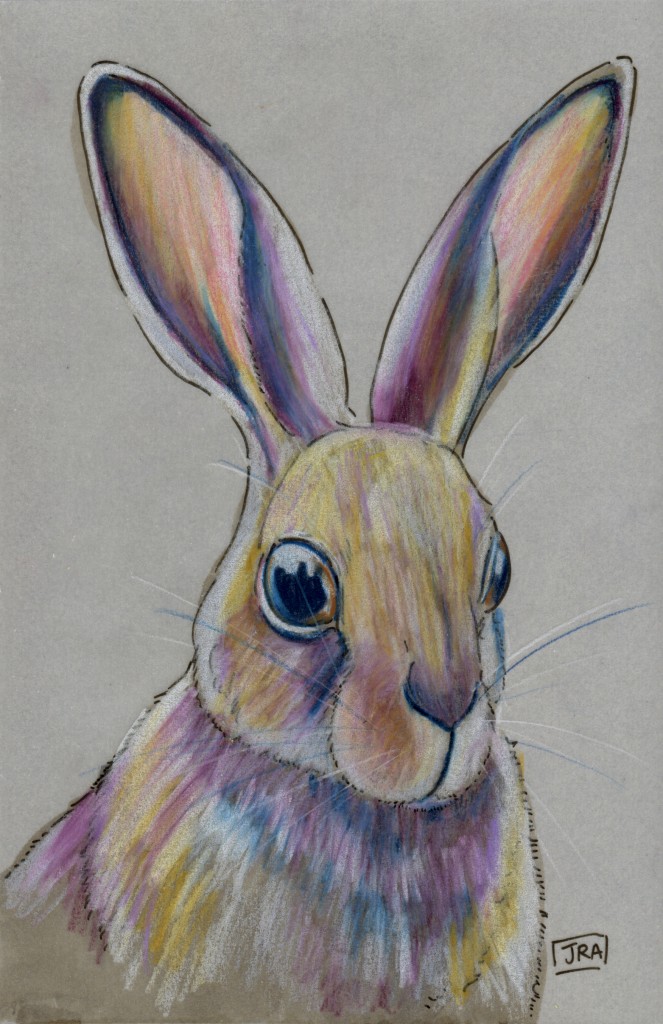
Anyway, a mammal named Coco drew the Tehuantepec jackrabbit, too, and her drawing is gorgeous. You will likely want to begin collecting her work next week, when you can still get an original drawing for $25, instead of waiting until she’s grown up and famous and they’re selling for $25,000.

Tehuantepec jackrabbit by Coco, age 12 (click image to enlarge)

{ 2 comments }

Snowshoe hare (click image to enlarge)

Snowshoe hare (click image to enlarge)


0268

Snowshoe hares live in Canada and the northern United States. Their name comes from their amazingly adapted hind feet, which are large and broad with a stiff coat of hair that lets them walk on top of snow. Their other impressive adaptation is their coloring. In the summer, they’re reddish brown, but when fall comes, they begin molting, replacing their brown fur with a new, fluffy white coat. In between the two coats, their fur is patchy, like patchy snow that falls and melts in the autumn or spring. Young snowshoe hares especially rely on this protective coloration to escape predators. They’ll freeze when they sense danger, trying to blend into the background. Older hares will often choose to run instead, and they can go as fast as 27 miles an hour.

{ 0 comments }

Amami Rabbit (Pentalagus furnessi)

by JR Kinyak on May 8, 2009

in Other Orders

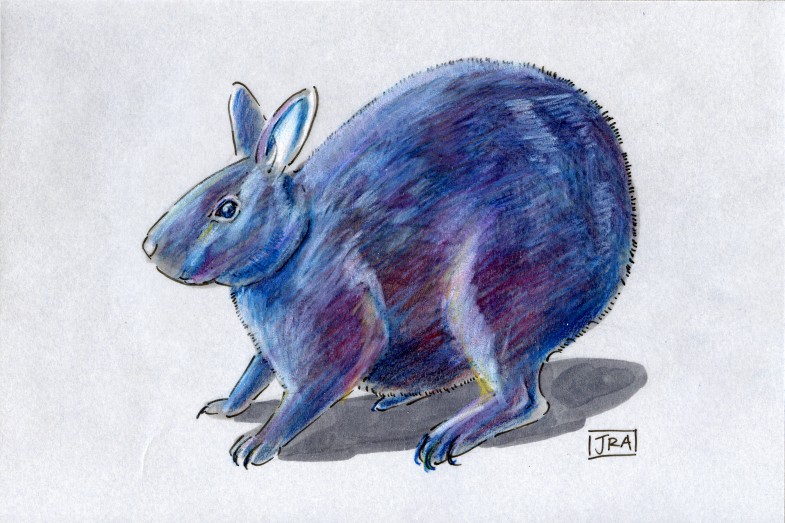
Amami rabbit (click image to enlarge)

Amami rabbit (click image to enlarge)


0258

This fuzzy, stout rabbit lives only on the Japanese islands of Amami and Tokuno. It’s endangered, and both its population and its range have been decreasing. There are probably fewer than 5,000 of these rabbits in existence. They’re considered “living fossils” because they are very similar to ancient fossil rabbits and markedly different from other living rabbit species. They have unusually short ears, long noses, sturdy bodies, dark and dense fur, and curved claws.

Because they’re nocturnal and rare, Amami rabbits are still somewhat mysterious to science. One curious habit they have is that of sealing up their nursing burrows. A female Amami rabbit will give birth in a special burrow, then seal it up when she goes out for the night. She’ll come back to nurse the babies once every couple of nights. This goes on for a few months, at which point she ushers the babies out of the house, telling them it’s time to take care of themselves for once.

In addition to ordinary endangered species lists, Japan also designates what it calls natural monuments. These are plants or animals, natural features and structures, minerals, or wilderness areas. To qualify as a natural monument, something must be not only threatened, but also culturally important. Of the almost 1,000 natural monuments, 75 are classified as special natural monuments, and the Amami rabbit is one.

“The Secretive Rabbits of Amami, The Japan Times

Amami rabbit on the EDGE (evolutionarily distinct and globally endangered) website

{ 3 comments }

click image to enlarge

0160

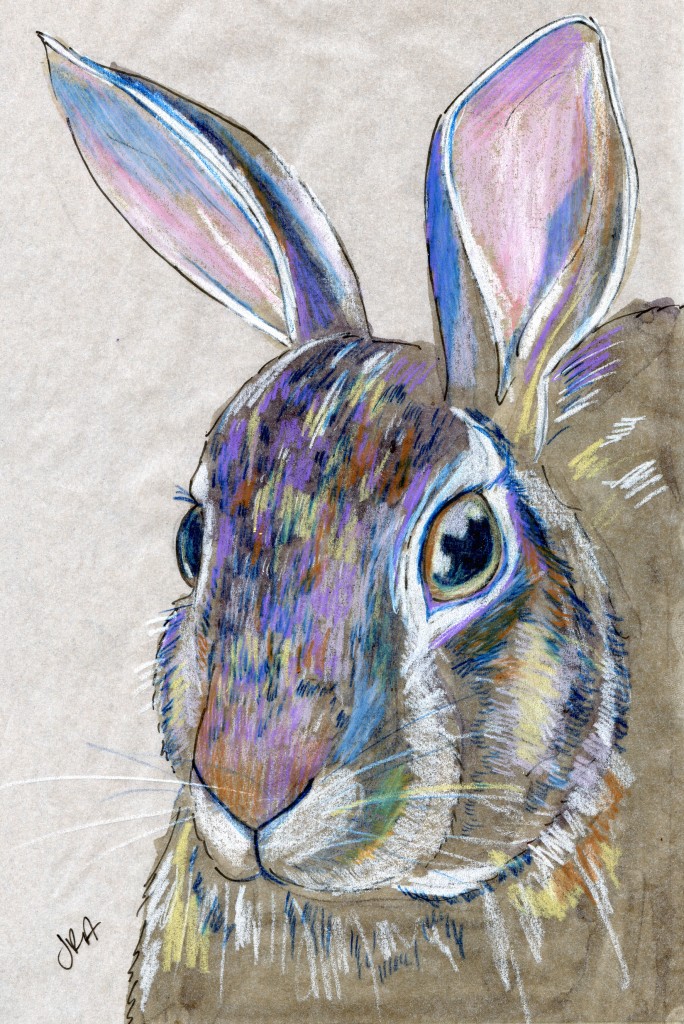
Here is a cottontail for Sonja. It’s the same kind as the ones in her backyard.

{ 2 comments }

Take this mammal home with you!

click image to enlarge

0126

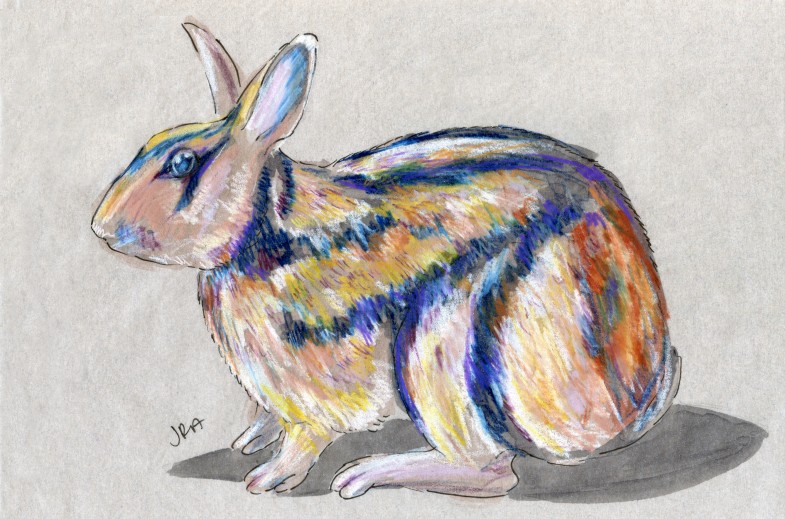
This special rabbit is for two other special rabbits: Umi and Errol.

Here’s a way to uncover new species that seems to be more common than you’d think: find them for sale as food in a market! That’s how, in 1999, scientists “discovered” the Annamite striped rabbit, which is native to Vietnamese and Laotian mountains. (Someone needs to invent some kind information-sharing network that would allow people who live in species-rich places like the Laotian mountains or Borneo to share what they know with scientists. One of the scientists involved in finding the Annamite rabbit told the New York Times, regarding the team’s trips to the market, “We had already made discoveries or rediscoveries of four new species…So we were kind of clued in to anything that looked weird.”)

The rabbits are similar to the other species of striped rabbit, the Sumatran, and both are known for their red behinds. The Sumatran rabbit has only been seen once since 1916—that’s how rare it is. The two striped species are separated by some 1,000 miles and thought to have diverged 8 million years ago.

Wildlife Conservation Society: “Bizarre Striped Rabbit Discovered in Asia”

{ 0 comments }

Jack Rabbit (Lepus californicus)

by JR Kinyak on June 16, 2007

in Other Orders

jackrabbit720014

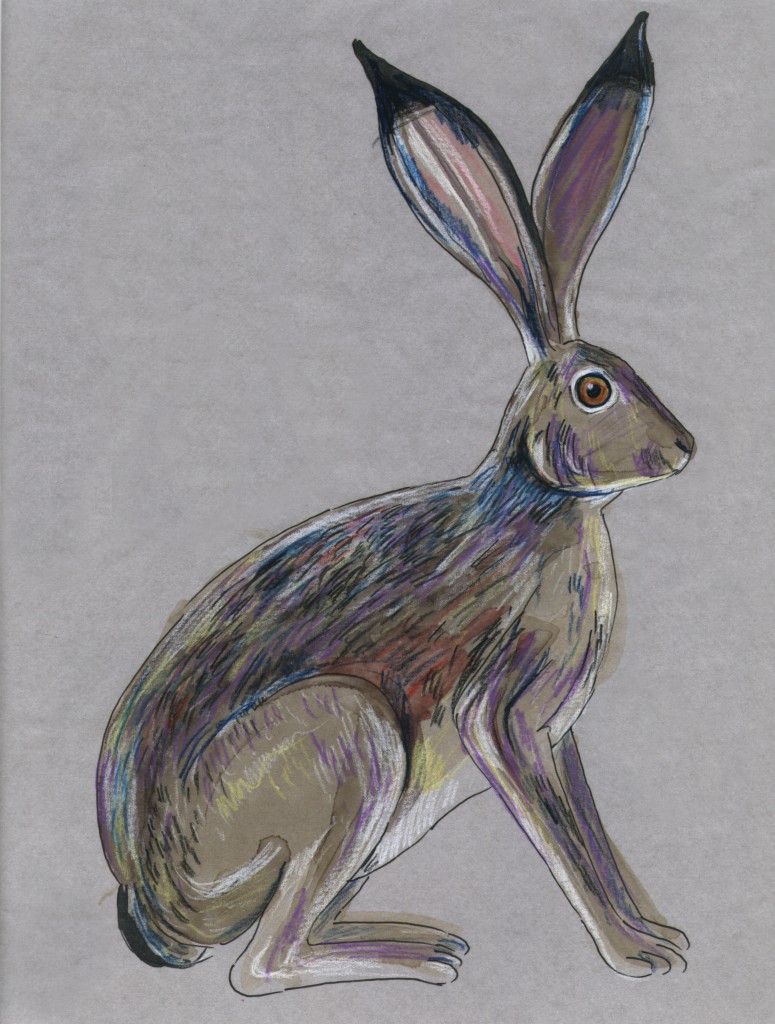
Maleta also wanted a rabbit, but instead, she’s getting a hare! Several varieties of jack rabbits live in western North America, but they’re not really rabbits. Hares are different because their babies (called leverets) are born with fur and open eyes, while baby rabbits (or kits) are born hairless with their eyes closed. Also, rabbits make nests in which to give birth, while hares don’t.

{ 0 comments }