Posts tagged as:

names

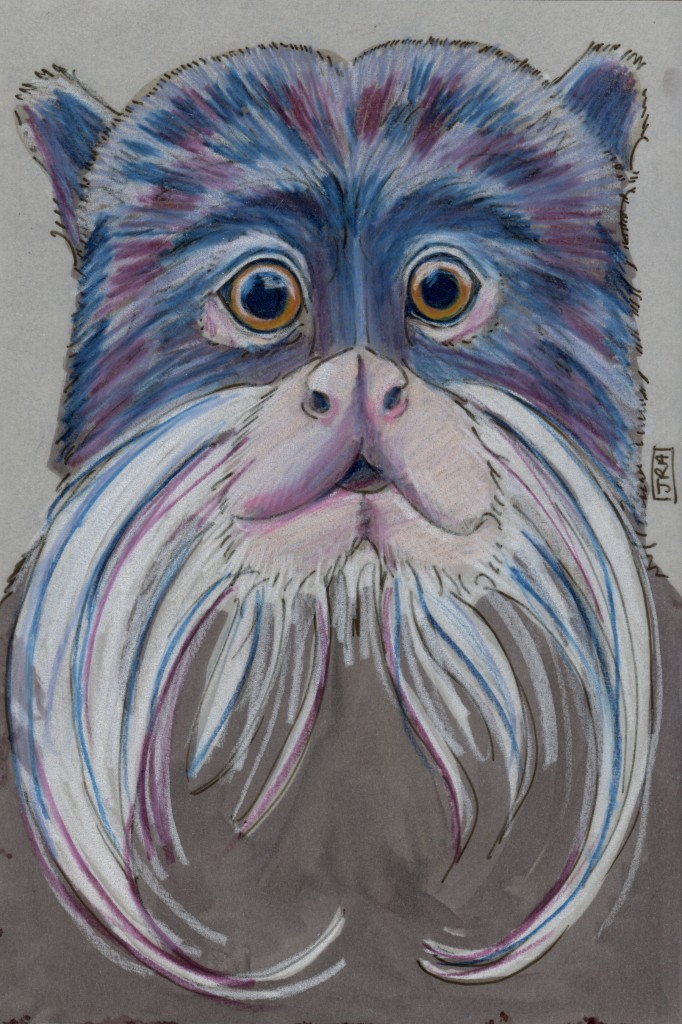
Emperor Tamarin (Saguinus imperator)

by J.R. Atkins on July 10, 2009

in Primates

Emperor tamarin (click image to enlarge)

Emperor tamarin (click image to enlarge)


0272

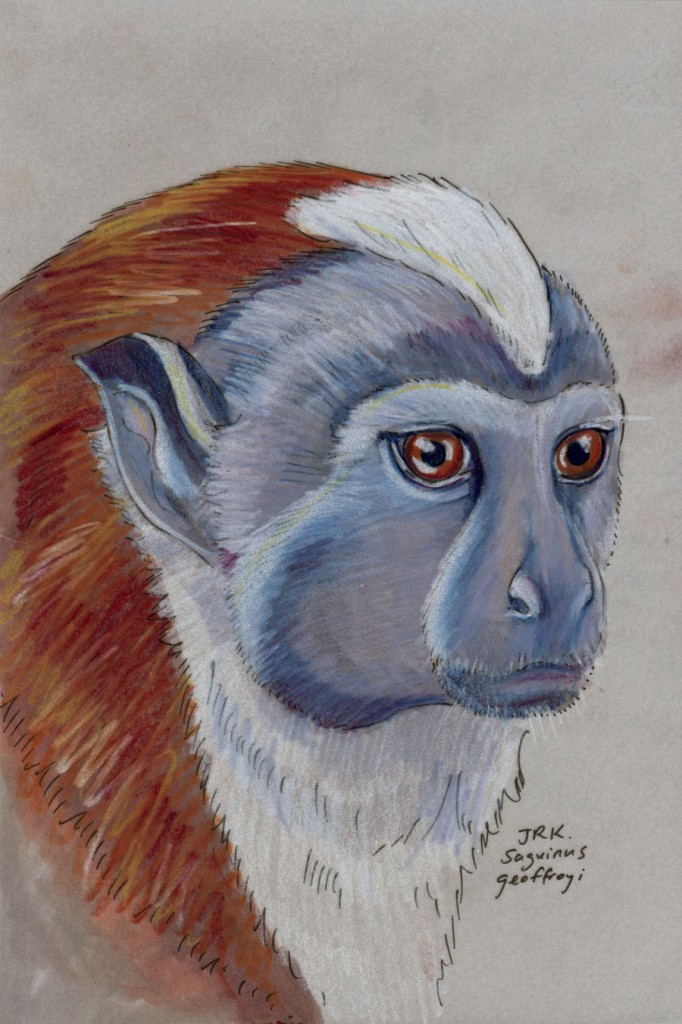
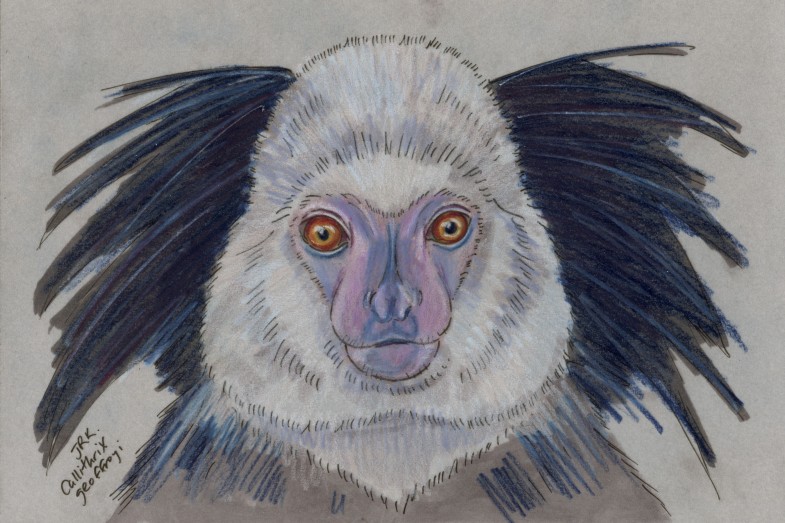
I have two things I’d like to share with you about the emperor tamarin (also known as the emperor marmoset). First, according to Mammals—Their Latin Names Explained by A.F. Gotch,

“A taxidermist, so the story goes, had never seen a live tamarin and twisted the white ‘moustache’ upwards to look like the Emperor of Germany, instead of letting it droop in the natural position. It thus acquired the name Emperor Tamarin as a joke, but the name stuck, and the Latin name became established as Saguinus imperator.”

Second, check out this clip from a BBC series called Clever Monkeys, in which we learn about the mother emperor tamarin’s cunning use of mannies, and then have a good weekend:

{ 2 comments }

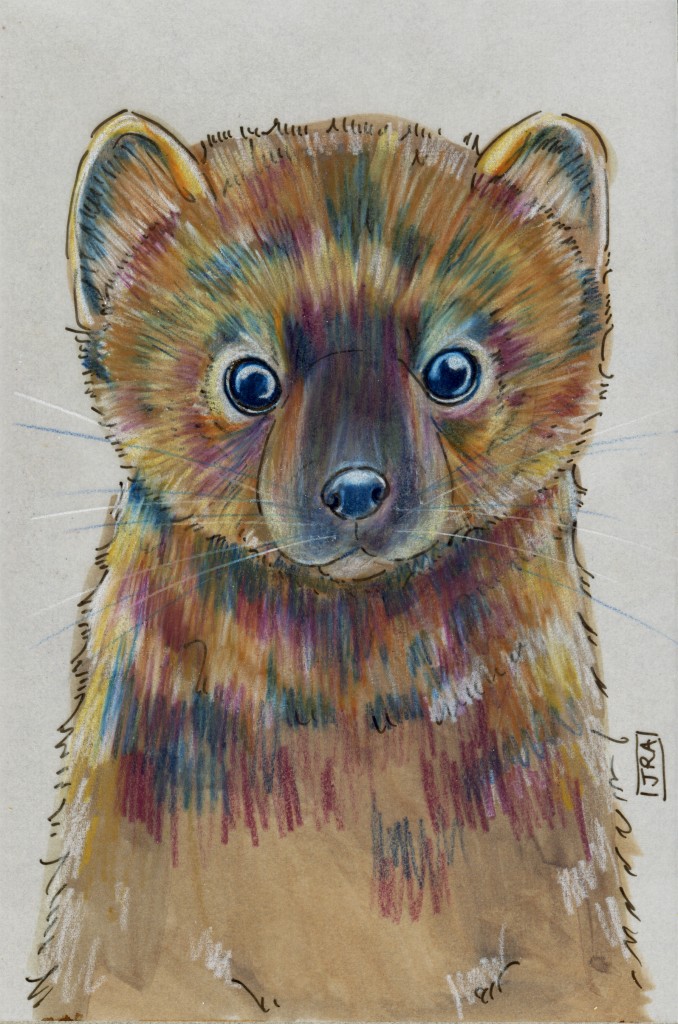
Fisher (click image to enlarge)

Fisher (click image to enlarge)


0269

Fishers live only in North America, and currently only in northern North America, from Alaska and Canada down to the Sierra Nevadas and the Appalachians. At one time, they ranged as far south as Tennessee and North Carolina, but they’ve disappeared from much of their historic range because of excessive trapping and habitat loss from logging.

Fishers don’t get their name because they eat fish. They mainly eat birds, small mammals, and carrion. It’s possible that they’re called fishers because at one point they raided some fisherman’s fish traps, but it’s most likely that the name comes from the Dutch word fitchet, or polecat—an animal the fishers resemble. (Incidentally, fitchet comes from the root visse, which means “nasty.”)

The fisher is one of the only animals that can kill a porcupine. It sounds quite horrific, really. The fisher will circle the porcupine, taking every opportunity to bite the porcupine’s face, where it doesn’t have quills. The porcupine circles, too, trying to keep its back to the fisher. Sometimes the porcupine will seek protection by pressing its face against a tree; the fisher might climb the tree and attack from above, forcing the porcupine away. When the porcupine has sustained enough injuries to the face to wear it out and stop it from protecting itself, it dies, often from shock, blood loss, or injuries to the top of the head! Then the fisher starts eating, beginning with the heart, liver, and lungs, and leaving behind only the feet, skin, and bones of the porcupine.

{ 4 comments }

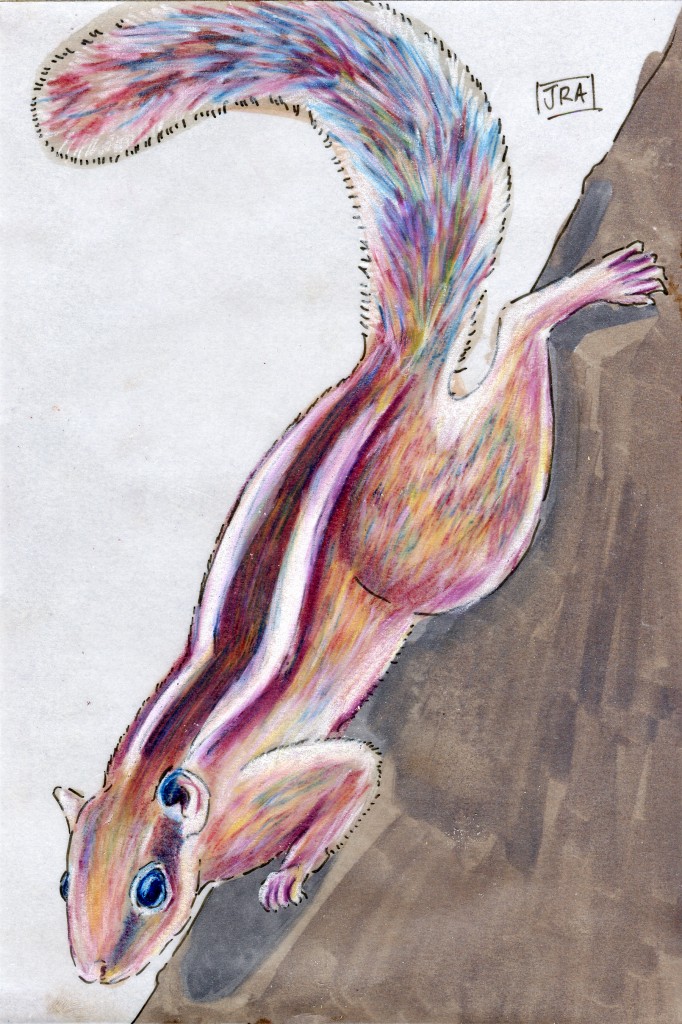
Indian palm squirrel (click image to enlarge

Indian palm squirrel (click image to enlarge)

0255

The Indian palm squirrel is a funambulist of the palms! Thinking of the words somnambulist or ambulatory, you can almost come close to figuring out what that means: a fun walker! Sort of. A funambulist is a tightrope walker (funis is Latin for rope; the word fun, on the other hand, comes from the Middle English fon, meaning fool, and this squirrel is no fool).

Indian palm squirrels are endemic to India and Sri Lanka. In a Hindu legend, the god Ram was searching for his beloved wife Sita, who had been kidnapped by a demon. At one point in the epic that tells his story, he must build a bridge across a sea, and he is aided by an army of monkeys and bears. But monkeys and bears aren’t the only animals that help him. This is from a version of the story on the India Times website:

The entire army of monkeys promptly got to work, under the supervision of Hanuman and Jamvant. Ram sat under a tree thinking of Sita and the days ahead.

After a while, he noticed something that moved him to tears. A little squirrel, who had been watching the monkeys carry huge boulders and rocks to build the bridge, began to do her bit to help the Lord. She began carrying little pebbles in her mouth and her tiny hands from a little mound near the tree to the site of construction.

A much amused and pleased Ram picked up the squirrel and petted her, running his fingers from her head down to her tail. The squirrel was blessed and forever marked with stripes—the mark of Lord Ram and a trophy of love.

A while back, a commenter suggested that the Daily Mammal could function as a sort of horoscope, where your personality can be compared to characteristics of the mammal I draw on your birthday. So if you, like me, were born on May 4, you resemble an Indian palm squirrel: you’re agile, fearless, hardworking, and willing to wreak minor destruction to get what you want.

{ 0 comments }

Nilgai (click image to enlarge)

Nilgai (click image to enlarge)


0254

The nilgai is an antelope that lives in India and parts of Nepal and Pakistan. For an antelope, it has a weird scientific name: Boselaphus tragocamelus means ox-deer-goat-camel. Perhaps they just really didn’t know and wanted to hedge their bets. The word nilgai comes from a Hindi word meaning “blue bull.” (The male nilgai’s bluish gray hide reminds me of grulla, my favorite color in Ben K. Green’s The Color of Horses. When I was a kid, my dad and I enjoyed looking at that book at B. Dalton or Waldenbooks while my mom and sister were shopping elsewhere in the mall.)

Some 35,000 feral nilgai roam ranchland in Texas. In the 1930s, the King Ranch decided to experiment with breeding the hardy antelope in tough Texas as an alternative source of meat. That didn’t really take off. Now, the Texas nilgai are handy targets for trophy hunters.

{ 2 comments }

Little Red Kaluta (click image to enlarge)

Little Red Kaluta (click image to enlarge)

0253

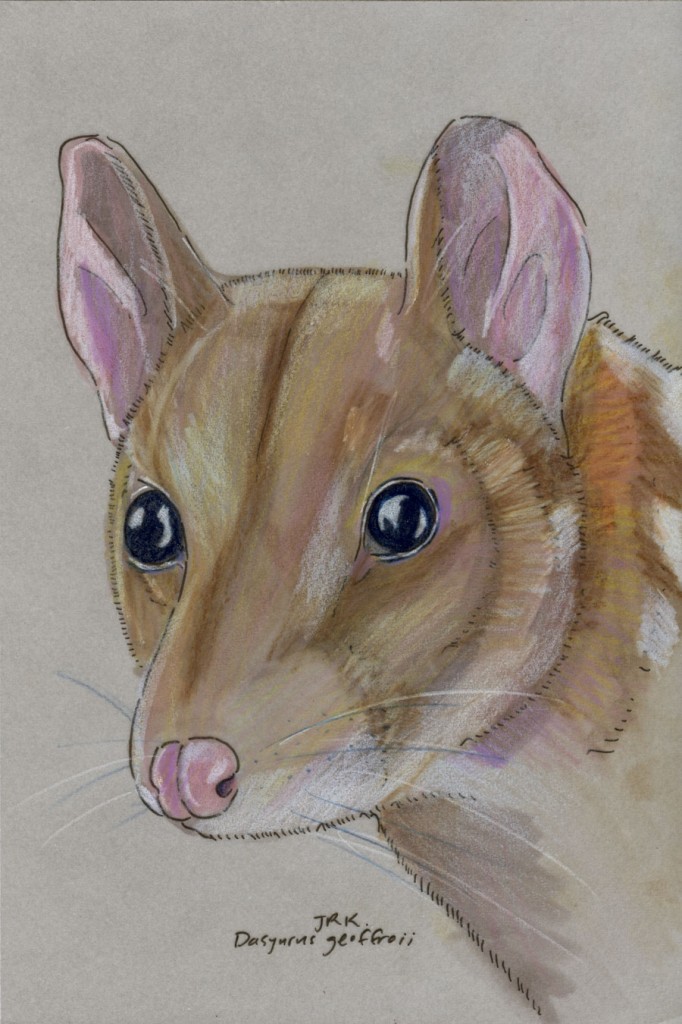
This little marsupial is widespread in the desert of northwestern Australia, where it likes to eat insects and small vertebrates. The young are born in November, and they’re old enough to mate by the time kaluta mating season rolls around the following September. Sadly, all males die shortly after the mating season, apparently from the stress of competing for females!

In this little guy’s Latin name, kaluta is an aboriginal word for the animal, and dasy means hairy. Rosamondae is in honor of Rosamund Clifford, a legendarily beautiful redhead of the 12th century. She was the mistress of Henry II from her teen years until shortly before her death, in a convent, in her 20s. Many tales have arisen about her over the years, the most persistent, perhaps, being that she was poisoned by Henry’s jealous wife, Eleanor of Aquitane. This is probably not true, but artists have long been intrigued by the story. Below is a painting by J.W. Waterhouse from 1905. See evil Eleanor poking her head through the curtains behind the unsuspecting Rosamund? She has followed Rosamund’s embroidery thread through a labyrinthine garden to find the king’s mistress in her secret castle.

Fair Rosamund by J.W. Waterhouse, 1905

Fair Rosamund by J.W. Waterhouse, 1905

Here’s another painting of the same scene. This one is from 1862 and was painted by Edward Coley Burne-Jones.

Fair Rosamund and Queen Eleanor by E.C. Burne-Jones, 1862

Fair Rosamund and Queen Eleanor by E.C. Burne-Jones, 1862

This beautiful striped rose was named for Rosamund Clifford, too.

Rosa Mundi (Rosa gallica versicolor) by Sebastian Crump

Rosa Mundi (Rosa gallica versicolor) by Sebastian Crump

{ 2 comments }

Olive Baboon (click image to enlarge)

Olive Baboon (click image to enlarge)

0252

The olive baboon lives in a wide swath of land across the middle of Africa. It’s one of those rare mammals that not only is safe from extinction, but whose numbers seem to be growing. Let’s all celebrate that ’cause it gets depressing around here, doesn’t it?

Papio in the baboon’s scientific name comes from a French word for baboon (according to A.F. Gotch, whom you may or may not believe). Anubis, of course, is the Egyptian god of the afterlife who has the head of a jackal. I’m guessing that anubis in this monkey’s name is a reference to the way baboons’ snouts resembles those of dogs.

On the other hand, whoever named Papio anubis may have been thinking of the lofty status baboons held in ancient Egypt. They were kept as pets (and possibly fruit pickers or other kinds of workers), depicted in art, and mummified in tombs. Supposedly, the Egyptians used their feces as an ingredient in aphrodisiacs. The Egyptian religion associated baboons with the sun god, perhaps because of the raucous ruckus they make at dawn, as well as with the afterlife. Baboons also represented the god Thoth, who was in charge of writing, wisdom, and judging the dead, as well as Hapy, the god of the Nile. The Egyptian god Babi has the head of a baboon. He’s vicious and bloodthirsty and lives on entrails and souls. Our word baboon may come from his name. Interestingly, it’s not known whether baboons were native to Egypt at that time or they were imported from Nubia.

Although it appears ancient Egyptian baboons were respected in theory, analysis of mummified baboon remains indicates that the monkeys were malnourished and kept in too-small cages.

Here is an ancient Egyptian baboon statue at the British Museum, along with some information about baboons and Egypt, and here’s another at the Metropolitan Museum.

{ 2 comments }

Click image to enlarge.

Click image to enlarge.

0251

Our current system of naming animals and plants is based on the system that Carl Linnaeus published in 1758. While others, including Aristotle, had previously attempted to organize the world’s living things into various arrangements, Linnaeus gave us an important innovation: the binomial system. Each animal (or plant or whatever) is known by a unique pair of names; no other creature has the same name. We’re the only Homo sapiens; the cotton-top tamarin is the only Saguinus oedipus. (Of course, there can be other members of the genus Homo and the genus Saguinus, but they have to have distinctive second, or species, names.)

The organization that keeps track of and codifies the system of naming animals is the International Commission on Zoological Nomenclature. The rules are quite extensive. My favorite guidelines are those that require namers to make every effort to ensure that their names are euphonious (pleasing to the ear) and that they don’t give offense.

Linnaeus was Swedish, but he wrote in Latin, as did pretty much everyone else writing about scientific matters at the time. The scientific names of animals are often referred to, casually, as their Latin names, and the rules governing naming do require the Latinization of some words. But there’s also a lot of classical Greek in the names, and many names derive from local words for the animals.

Many animals have redundant names (tautonyms, to use the official terminology), like Gorilla gorilla, Dama dama, and Uncia uncia. Usually, this happens when the name of the animal’s genus (the first name in the binomial system) changes, but the species name can’t. I like the black rhinoceros’s name because it’s redundant in two languages: diceros means two horns in Greek and bicornis means two horns in Latin.

The black rhinoceros’s common name is odd, too. The rhino is not black; it’s gray. Apparently, it was named the black rhinoceros to distinguish it from the white rhinoceros, which is also gray, not white. That animal’s common name comes from the Dutch word weit, which means wide, like the rhino’s muzzle. (My source for all this is A.F. Gotch’s book Mammals: Their Latin Names Explained.)

The black rhino is classified as critically endangered, the last step before extinction. It’s so bad, in fact, that the IUCN, which assesses the status of the world’s species, obscures the rhino’s range on its map “for security reasons.” While the black rhino was pretty numerous at the start of the 20th century, poaching caused a 96 percent decrease in the species’ population between 1970 and 1992. Black rhino horns are carved to create decorative handles for weapons and used in traditional medicine. Traditional medicine is going to be the death of a lot of mammal species.

{ 2 comments }