Posts tagged as:

multiples

Rats Three Ways (Neotoma spp.)

by J.R. Atkins on March 26, 2009

in Rodents

The Daily Mammal Book Club is discussing My Family and Other Animals by Gerald Durrell. Join in!

click image to enlarge

0248
0247
0246

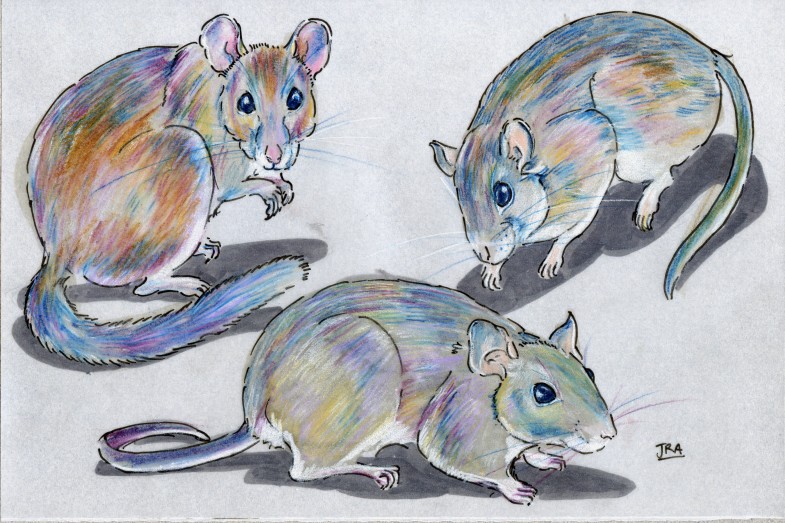
Here are three rats for you! They’re in the wood rat or pack rat genus, Neotoma. Clockwise from the top left, we have N. cinerea (bushy-tailed wood rat), N. floridana (eastern wood rat), and N. lepida (desert wood rat). Wood rats are also sometimes called trade rats. Mammalian Species quotes a 1946 guide to the mammals of Nevada:

“It is supposed that when one of these rats carrying an object of its fancy comes to another more attractive object, it drops the first and continues on its way with the second. If the second object be the watch of a camper, who in the morning finds a piece of old bone where the watch lay when the camper went to sleep the evening before, he will think the name trade rat appropriate.”

Just, you know, hypothetically, right?

There are two words related to wood rats that you may not know. Both could prove useful in describing, say, someone’s housekeeping. Middens means a pile of bodily waste or a dunghill. Amberat is a deceptively beautiful word meaning crystallized rat urine. (I don’t know if it’s a portmanteau from amber and rat, but I hope so. I really love this word.) Here, in a book about the Grand Canyon, is a chapter all about amberat, and here is a photograph of it at UtahCaver.com. Apparently, it has a red-gold color and can be built up to several inches thick. It may or may not have a sweet smell.

Amberat helps fossilize wood-rat middens for later examination by interested parties. Archaeologists have found rodent middens that are 50,000 years old. The rats use the same middens for generations, so there’s all kinds of intriguing stuff in there. At Mesa Verde, they’ve found middens that show signs of exposure to smoke, suggesting that the wood rats coexisted with the Anasazi.

{ 2 comments }

Darwin Days: Tuco-Tucos Six Ways (Ctenomys spp.)

by J.R. Atkins on February 10, 2009

in Rodents, Theme Weeks

click image to enlarge

0235
0234
0233
0232
0237
0236

The day after tomorrow, February 12, 2009, is Charles Darwin’s 200th birthday. (It’s also Abraham Lincoln’s.) I’ve recently begun reading Darwin’s The Origin of Species, and I’ve decided to try to do a little something in celebration of Darwin’s immense contribution. I’m going to be highlighting a few mammals that Darwin discusses in The Origin of Species, and I’ll try to tell you something of what Darwin says about them. Since I haven’t read the whole book, I’m going to be reading the sections that mention these mammals out of order and a bit out of context, but I’ll do my best, and maybe my more Darwin-literate readers can help out where needed. I also am pretty clueless as to where Darwin’s ideas have been expanded or improved upon. Incidentally, the book is actually quite accessible, and I’m sorry I didn’t read it earlier. You can read it online or download a PDF at Google Books.

Chapter Five of The Origin of Species is titled “Laws of Variation.” In a section called “Effects of Use and Disuse,” Darwin posits that the shrunken state of the wings of some birds on islands where they have no predators results from disuse. There’s nothing to fly away from, so generations of birds stopped flying and used their legs more, and through natural selection their legs were strengthened and their wings, eventually, made useless. As another example, Darwin discusses animals that live in underground burrows and caves and have small, furred-over, or absent eyes, thanks to disuse. It’s dark down there, so eyes aren’t very helpful, and gradually, they are selected out, while things like longer whiskers and antennae, which are helpful underground, are favored.

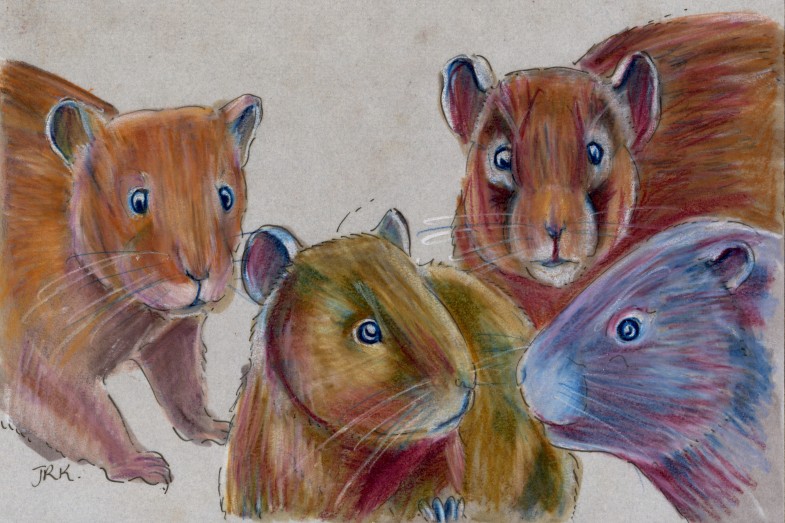
The tuco-tucos, of which there are some 50 different species, live in burrows in South America. Although they spend a lot of time underground, they do occasionally peer out of their homes, and their small but useful eyes allow them to do that without necessarily having to actually exit the premises. It’s easy for them to duck back under if need be. (The amount of time they spend outside their burrows varies from species to species.)

Darwin says that he was told by someone who caught a lot of tuco-tucos that they are often blind. A tuco-tuco that Darwin kept in captivity was blind, he says, thanks to an inflammation of the eye. As Darwin points out, animals that live primarily underground don’t really need their eyes, and eyes are just another thing that can get infected, so why not do away with them? (Eventually. Over generations.)

Genetic analysis of one tuco-tuco species, the colonial tuco-tuco (C. sociabilis) yielded surprising results a few years back. For the past three millennia, the colonial tuco-tuco has had almost no genetic diversity. Usually, a lack of genetic variation means doom for a species, but the colonial t-t has survived pretty well. The reason, researchers think, is that it has evolved a very social way of life, unlike the other tuco-tuco species. If everyone is related, there’s no reason to compete; instead, you can help your cousins breed, since they’re passing on your genes, as well as their own. (In a practical sense, I think I would be more likely to get along with everyone if they were more or less my clones, too, but personality clashes are probably not a significant factor in the colonial t-t’s survival.)

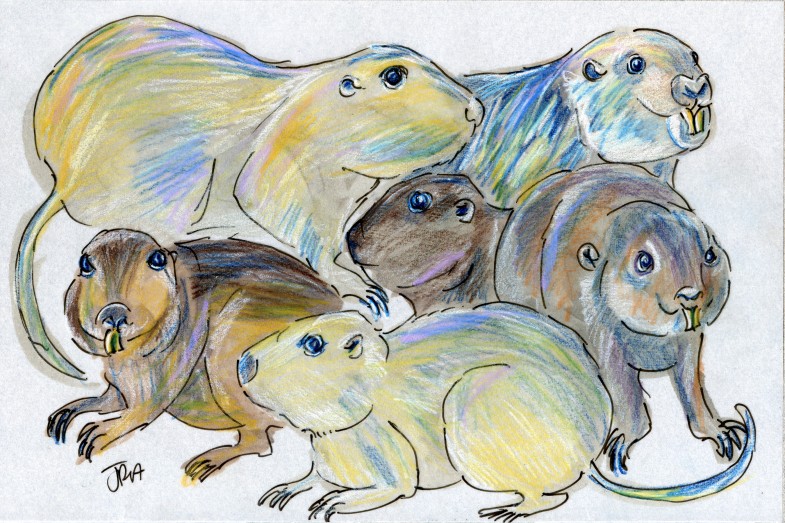
According to Walker’s Mammals of the World, “Systematic understanding of this complex genus is in a state of flux, and it is likely that there will be much change in the number and relationships of species…” In this drawing of the goofy-looking guys, clockwise from the upper right are C. fulvus, C. sociabilis, C. flamarioni, C. talarum, C. peruanus, and in the middle, C. haigi.

{ 8 comments }

Various Voles (Macrotus spp.)

by J.R. Atkins on June 22, 2008

in Rodents

click image to enlarge

0183
0182
0181
0180

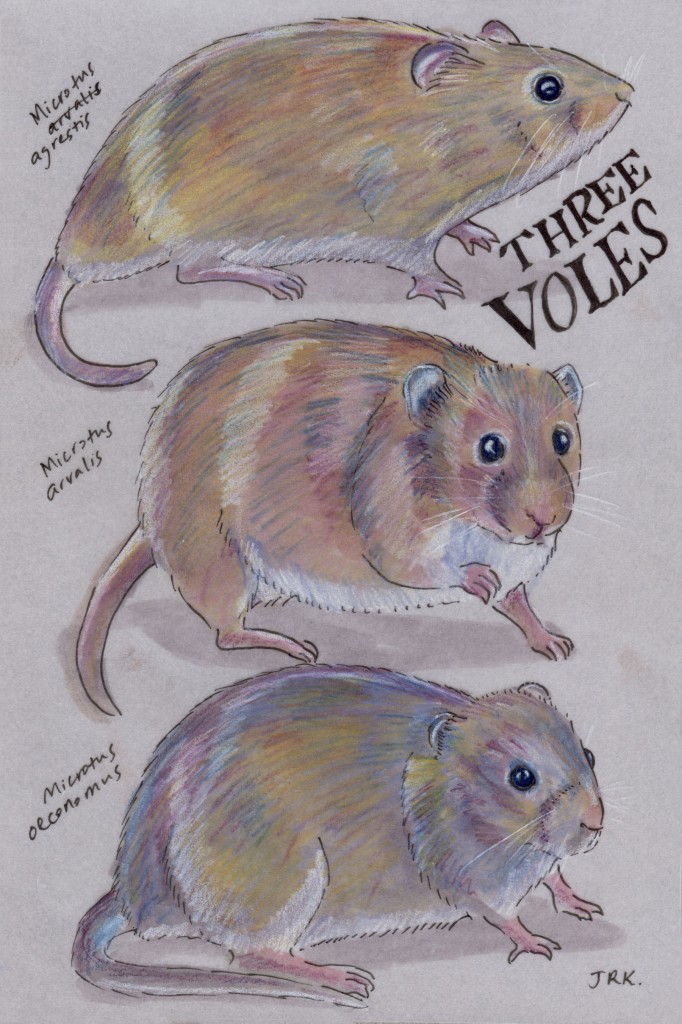
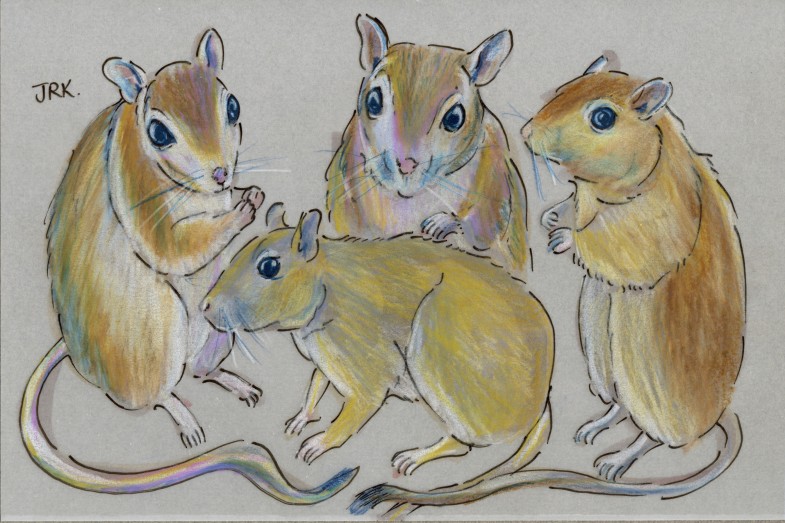
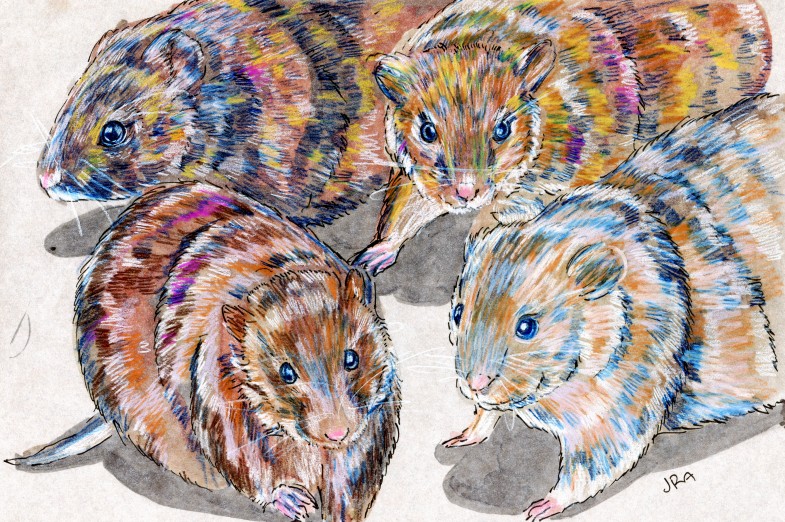
Clockwise from the top left, say hello to a California vole (Microtus californicus), a Mediterranean pine vole (Microtus duodecimcostatus), a Japanese grass vole (Microtus montebelli), and a Mexican vole (Microtus mexicanus).

Voles are little mouselike rodents that burrow around in many kinds of environments. The four shown here have nothing in common, as far as I know, other than the fact that they each have a place name in their common name. Walker’s Mammals of the World has a couple of interesting things to say about the voles of the Microtus genus:

In general the social life of Microtus is something of an enigma. A number of species are known to live in what appear to be colonies of hundreds of individuals. The animals therein, however, may be totally uncooperative and extremely aggressive toward one another.

That reminds me a bit of some Homo sapiens families I know. Walker’s also says:

…Microtus appears to be slow-moving, docile, and easily trapped and tamed. When upset these voles may emit a high-pitched squeak, gnash their teeth, and either flee or freeze depending upon their location and previous activity.

Poor upset voles! Here on YouTube you can see a not-noticeably-distressed captive Japanese grass vole working on his nest.

Consecutive days of mammals: 3
Record: 16

{ 1 comment }

April 19: Daily Mammal 24-Hour Mammal Marathon 2! Details later this week.

click image to enlarge

0140
0139
0138
0137
0141

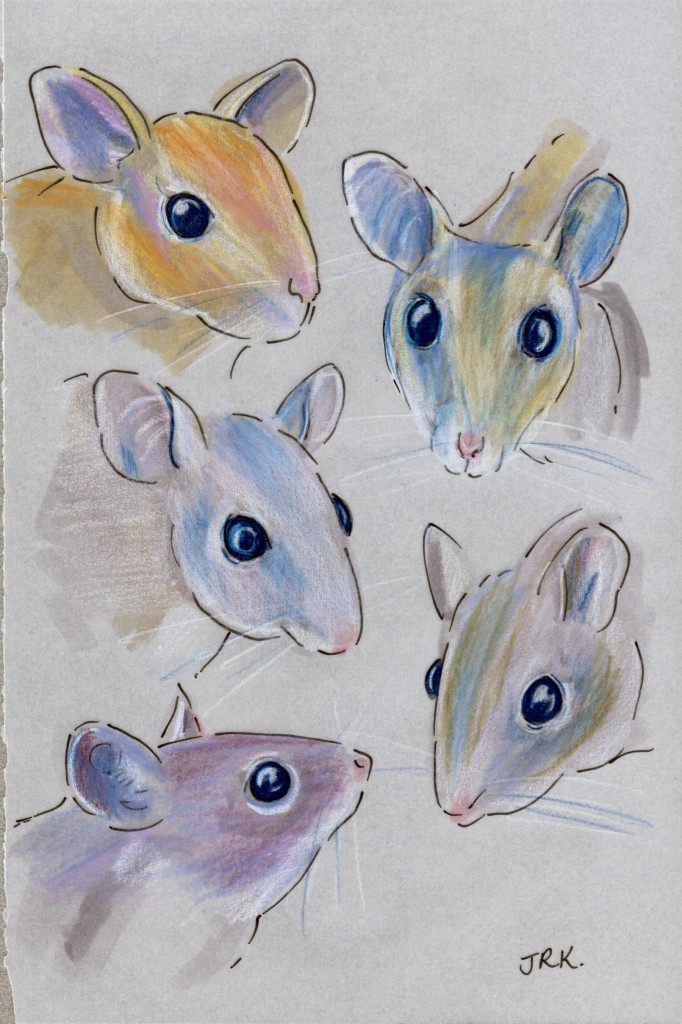
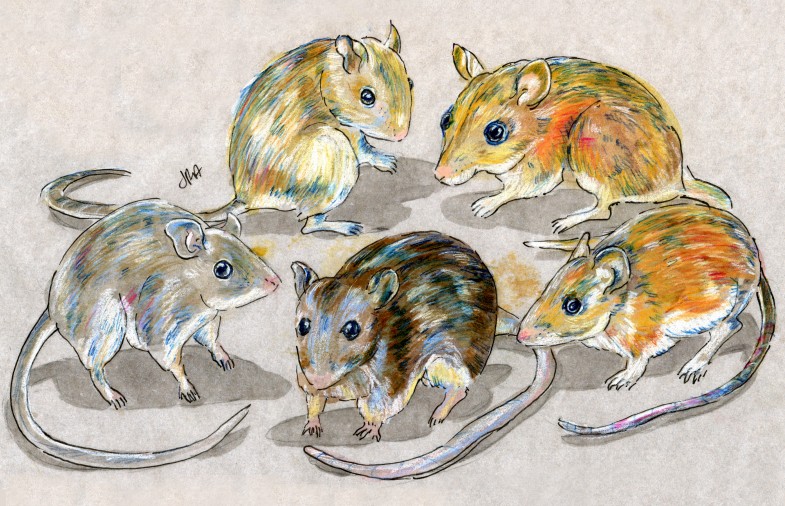
Those of you who have been following the Daily Mammal from the start know how daunting the rodents are. Nearly half of the 5,000 named mammal species are rodents, and as Ivan T. Sanderson says in Living Mammals of the World, “whole slews of these look almost exactly alike.” Not only are there are thousands and thousands of them, something I had not considered when I decided to begin this project, but there aren’t very good photos of a great many of them. A while back, I drew a set of five sleeping dormice, and found it heartening to check several rodents off the list at once. Here’s another of those multi-mouse drawings. This time we’re tackling five deer mice (major hantavirus carriers), of the Peromyscus genus.

I didn’t have photographs of a single one of these mice. Instead, I had photographs of Peromyscus species that are much more common in the US, and I had very detailed descriptions of these five species from the species accounts in Mammalian Species, which I download in PDF from Virginia Hayssen’s website. Now, let me tell you, I do not as yet speak the language of zoology, but I’m going to learn it. There are standard names for describing animals’ fur, or pelage, as we mammalogists call it: ochre, buffy, tawny, and a wash of brown may all mean tan to you and me, but not to those whose eyes are trained to discern the nuances. Would my biologist readers let me know where I can get a chart or something that shows what those colors really are? I read that Munsell Soil Color Charts are used for describing pelage—is that where these names come from? I’d like to know.

Anyway, in drawing these mice, I had only the scientific descriptions to go on, and only my experience with acrylic paints to help me decipher the meaning of the colors. (Well, that and the fact that I’ve known three cocker spaniels named Buffy.) Here’s where you come in.

CONTEST: I’m going to type, below, some hints from the descriptions of these mice. The first person to identify in a comment to this post which of the five is which wins this drawing, matted and ready for framing. Ted is not eligible. Here we go.

Aztec mouse (P. aztecus):

  • Dorsal coloration is pale ochre mixed with black
  • Sides are reddish
  • Underparts are light buff
  • A black orbital ring is present
  • Size is medium

California mouse (P. californicus):

  • Annulations are not thoroughly concealed
  • Color is generally blackish brown above, sides ochraceous-tawny, venter pale olive gray to buffy brown
  • Largest species of the genus in the United States

Canyon mouse (P. crinitus)

  • Feet white
  • Dorsal pelage silky
  • Dorsal individual hairs lead-gray at base, succeeded by ochraceous to buffy subterminal band, and tipped with brown or back; dark grayish bases of hairs sometimes visible through buffy to pale grayish shade of dorsum
  • Hairs of forehead, nose, and face appearing slightly more grayish than body
  • Venter white
  • Size small to medium for genus

Gleaning mouse (P. spicilegus)

  • Unworn pelage has upperparts rich, tawny approaching ocherous rufous, dusky and dusky-tipped hairs uniformly distributed throughout upperparts
  • Black or nearly black orbital ring extends posteriorly into a grizzled area between the eye and the base of the ear
  • White feet
  • Tail blackish-brown above, white below with coarse annulations
  • Medium in size for the genus

Hooper’s deer mouse (P. hooperi)

  • Upper parts grayish with faint to moderate wash of brown
  • Underparts pale cream
  • Hind feet and lower legs whitish
  • Medium size for genus

Good luck!

{ 8 comments }

Five Species of Dormouse

by J.R. Atkins on February 6, 2008

in Rodents

Don’t forget to download your free Daily Mammal valentines!

click image to enlarge

0120
0119
0118
0117
0121

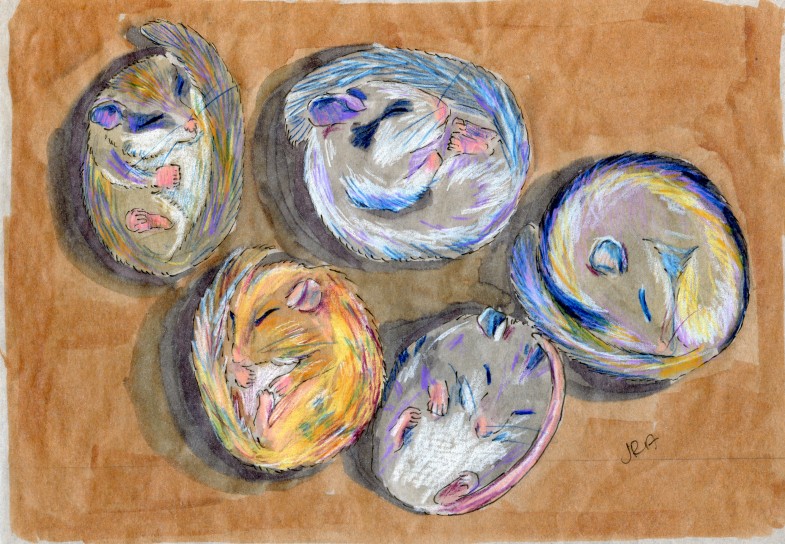
Hello from Orange, Texas, and the Holiday Inn Express. Here is a drawing of not one, not two, but count ‘em, five dormice. And not only are there five dormice, but get this: they’re five dormice of different species. (Yes, this is a strategy to speed up the drawing of the 2,000 or so rodents in the world.) Please be advised that they would not ordinarily be all together in a nest like this, living as they do in different areas and such. But you would be likely to find any one of the five sleeping if you found them at all: they’re nocturnal, spending most of the day in a state of torpor and hibernating half the year.

Clockwise from the top left: Dryomys nitedula (forest dormouse), Eliomys melanurus (Asian garden dormouse), Glirulus japonicus (Japanese dormouse), Myomimus personatus (masked mouse-tailed dormouse), and Muscardinus avellanarius (hazel dormouse), the species immortalized in Alice in Wonderland.

This mammal is sold. Find another one to take home with you!

{ 0 comments }