Posts tagged as:

mouse

April 19: Daily Mammal 24-Hour Mammal Marathon 2! Details later this week.

click image to enlarge

0140
0139
0138
0137
0141

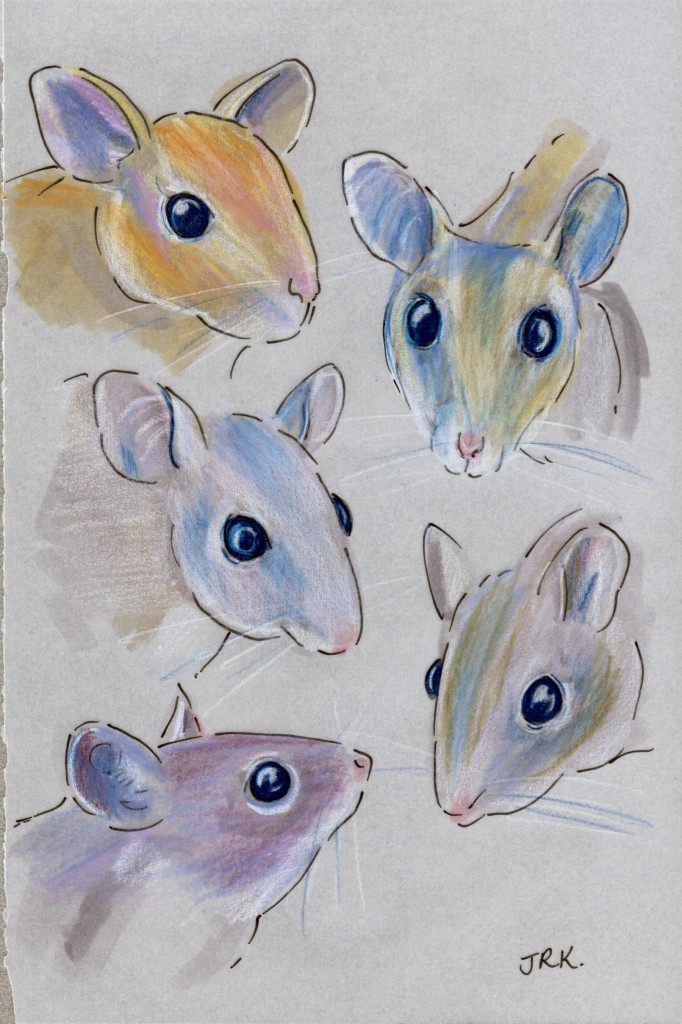
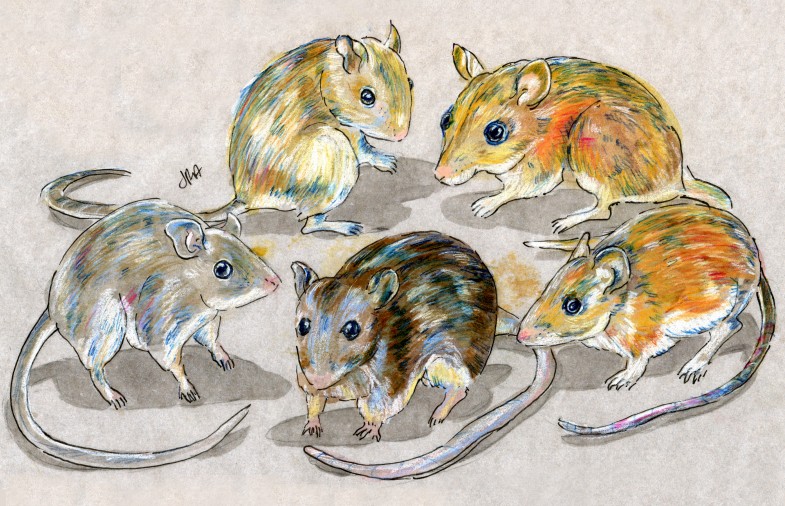
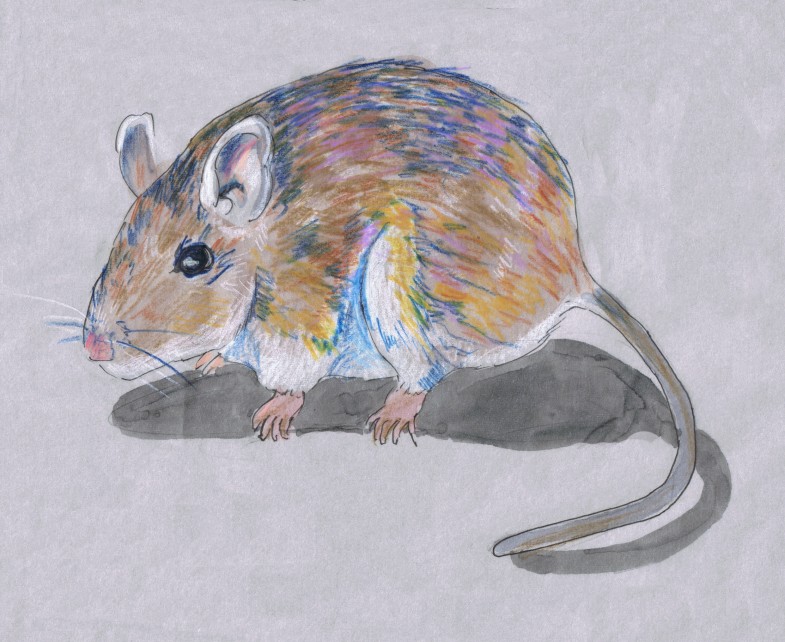
Those of you who have been following the Daily Mammal from the start know how daunting the rodents are. Nearly half of the 5,000 named mammal species are rodents, and as Ivan T. Sanderson says in Living Mammals of the World, “whole slews of these look almost exactly alike.” Not only are there are thousands and thousands of them, something I had not considered when I decided to begin this project, but there aren’t very good photos of a great many of them. A while back, I drew a set of five sleeping dormice, and found it heartening to check several rodents off the list at once. Here’s another of those multi-mouse drawings. This time we’re tackling five deer mice (major hantavirus carriers), of the Peromyscus genus.

I didn’t have photographs of a single one of these mice. Instead, I had photographs of Peromyscus species that are much more common in the US, and I had very detailed descriptions of these five species from the species accounts in Mammalian Species, which I download in PDF from Virginia Hayssen’s website. Now, let me tell you, I do not as yet speak the language of zoology, but I’m going to learn it. There are standard names for describing animals’ fur, or pelage, as we mammalogists call it: ochre, buffy, tawny, and a wash of brown may all mean tan to you and me, but not to those whose eyes are trained to discern the nuances. Would my biologist readers let me know where I can get a chart or something that shows what those colors really are? I read that Munsell Soil Color Charts are used for describing pelage—is that where these names come from? I’d like to know.

Anyway, in drawing these mice, I had only the scientific descriptions to go on, and only my experience with acrylic paints to help me decipher the meaning of the colors. (Well, that and the fact that I’ve known three cocker spaniels named Buffy.) Here’s where you come in.

CONTEST: I’m going to type, below, some hints from the descriptions of these mice. The first person to identify in a comment to this post which of the five is which wins this drawing, matted and ready for framing. Ted is not eligible. Here we go.

Aztec mouse (P. aztecus):

  • Dorsal coloration is pale ochre mixed with black
  • Sides are reddish
  • Underparts are light buff
  • A black orbital ring is present
  • Size is medium

California mouse (P. californicus):

  • Annulations are not thoroughly concealed
  • Color is generally blackish brown above, sides ochraceous-tawny, venter pale olive gray to buffy brown
  • Largest species of the genus in the United States

Canyon mouse (P. crinitus)

  • Feet white
  • Dorsal pelage silky
  • Dorsal individual hairs lead-gray at base, succeeded by ochraceous to buffy subterminal band, and tipped with brown or back; dark grayish bases of hairs sometimes visible through buffy to pale grayish shade of dorsum
  • Hairs of forehead, nose, and face appearing slightly more grayish than body
  • Venter white
  • Size small to medium for genus

Gleaning mouse (P. spicilegus)

  • Unworn pelage has upperparts rich, tawny approaching ocherous rufous, dusky and dusky-tipped hairs uniformly distributed throughout upperparts
  • Black or nearly black orbital ring extends posteriorly into a grizzled area between the eye and the base of the ear
  • White feet
  • Tail blackish-brown above, white below with coarse annulations
  • Medium in size for the genus

Hooper’s deer mouse (P. hooperi)

  • Upper parts grayish with faint to moderate wash of brown
  • Underparts pale cream
  • Hind feet and lower legs whitish
  • Medium size for genus

Good luck!

{ 8 comments }

Five Species of Dormouse

by J.R. Atkins on February 6, 2008

in Rodents

Don’t forget to download your free Daily Mammal valentines!

click image to enlarge

0120
0119
0118
0117
0121

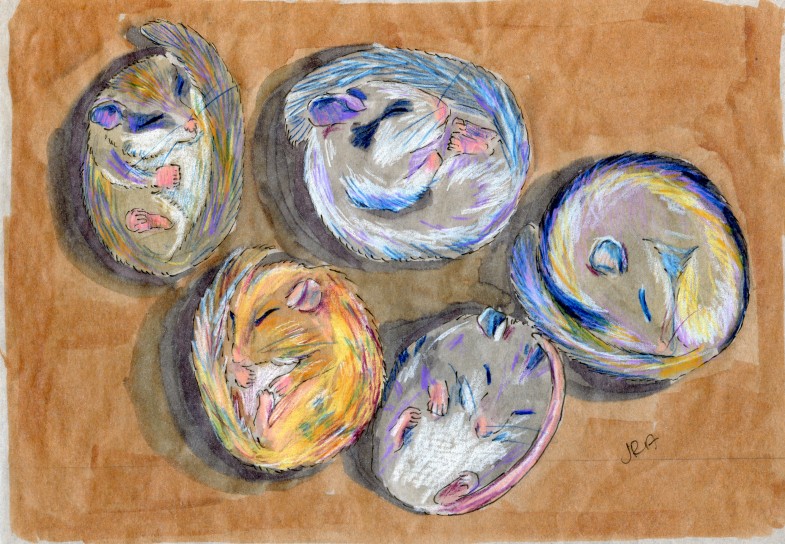
Hello from Orange, Texas, and the Holiday Inn Express. Here is a drawing of not one, not two, but count ‘em, five dormice. And not only are there five dormice, but get this: they’re five dormice of different species. (Yes, this is a strategy to speed up the drawing of the 2,000 or so rodents in the world.) Please be advised that they would not ordinarily be all together in a nest like this, living as they do in different areas and such. But you would be likely to find any one of the five sleeping if you found them at all: they’re nocturnal, spending most of the day in a state of torpor and hibernating half the year.

Clockwise from the top left: Dryomys nitedula (forest dormouse), Eliomys melanurus (Asian garden dormouse), Glirulus japonicus (Japanese dormouse), Myomimus personatus (masked mouse-tailed dormouse), and Muscardinus avellanarius (hazel dormouse), the species immortalized in Alice in Wonderland.

This mammal is sold. Find another one to take home with you!

{ 0 comments }

click image to enlarge

0115

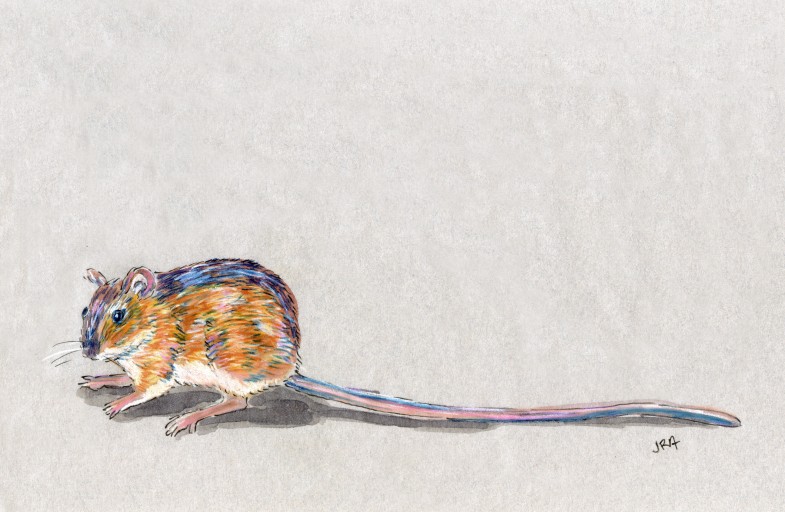
Hey, little fellow, what are you doing up and about? You should be hibernating with all your friends!

Woodland jumping mice hibernate for six months out of the year—roughly October to May—in burrows that they either dig or borrow from other little mammals. They like to eat fruit and seeds and mushrooms and insects. And lots of things like to eat them, too—bobcats, owls, rattlesnakes, skunks, wolves, etc., etc.!

You’ll notice this one’s extremely large hind legs. That’s to help him jump—woodland jumping mice can jump a meter or more! I suspect the super-long tail helps in this somehow. Maybe Lisa, who requested a woodland jumping mouse, can tell us!

Take this mammal home with you!

{ 2 comments }

Meadow Vole (Field Mouse) (Microtus pennsylvanicus)

by J.R. Atkins on December 18, 2007

in Rodents

Please consider contributing at least $25 to Defenders of Wildlife to get your own original Daily Mammal art! Read more about 24 Mammals in 24 Hours! There are only five four three spots left!


0075

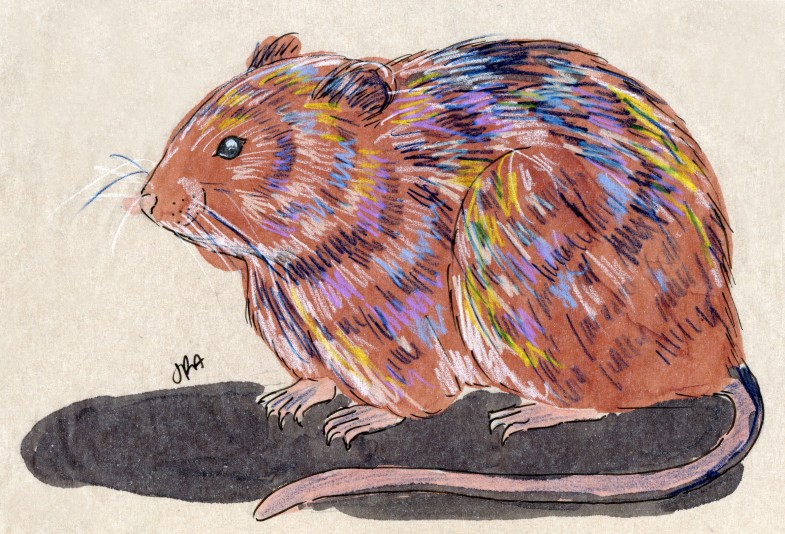
The meadow vole, meadow mouse, field mouse, or field vole is among the most populous mammals in the northeastern United States. Female meadow voles have to start reproducing when they’re three weeks old, and then they have litters about every three weeks thereafter, presumably until they die. (Males wait until they’re around six weeks old to start reproducing.) Can you imagine?

{ 0 comments }

Deer Mouse (Peromyscus maniculatus)

by J.R. Atkins on July 8, 2007

in Rodents

deermouse720036

This little guy here, unfortunately, is the most threatening vector of hantavirus in the United States. Four Corners hantavirus (or FCV) is a very real danger here in New Mexico where I live, particularly in rural areas. The virus is contracted when humans breathe in dried mouse droppings or urine that have been aerosolized, or released into the air. You’re advised to take great precaution in cleaning areas where rodents have been—no sweeping or vacuuming, just wet-mopping and wiping!—and in disposing of dead rodents. Here’s the CDC’s hantavirus website.

This deer mouse means The Daily Mammal is all caught up again!

{ 2 comments }

Edible Dormouse (Glis glis)

by J.R. Atkins on June 28, 2007

in Rodents

edibledormouse720025

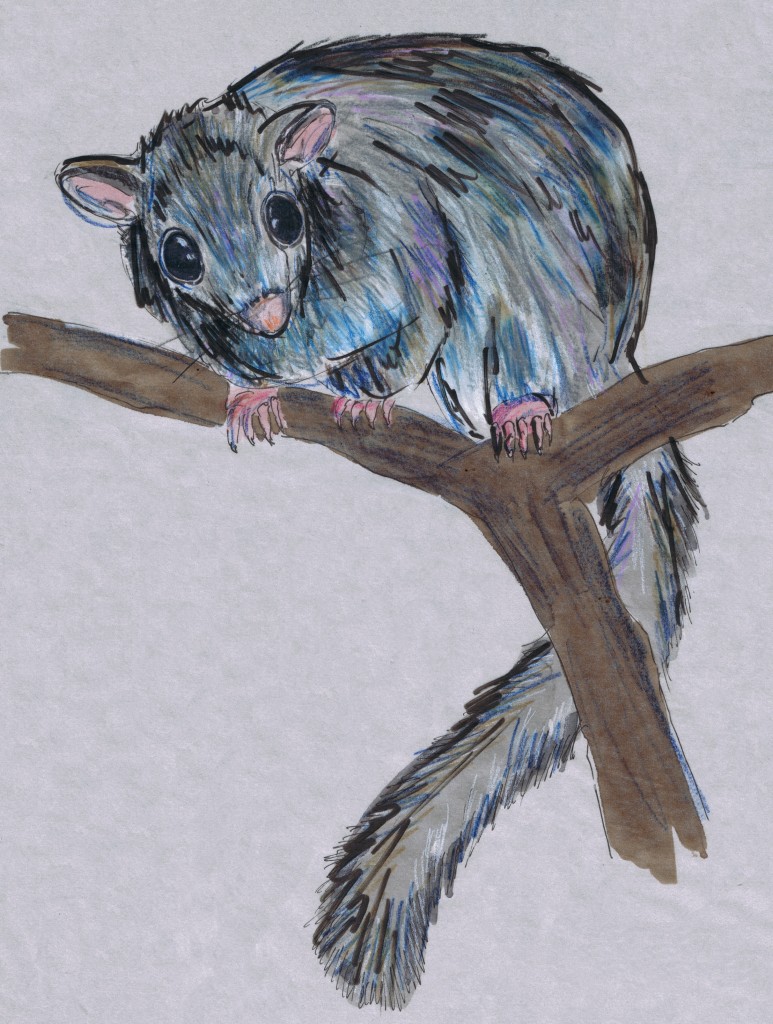
This poor little guy gets his common name from the ancient Roman delight in eating him. In fact, they kept him in special terracotta jars to fatten him up, making him all the more delicious. The Glis glis is also known as a fat dormouse because of how it pads itself out for hibernation. These dormice—which are around the size of a squirrel—were introduced into Great Britain in 1902 when the Baron Rothschild accidentally let six of them that he had brought over from the continent escape. Now, they’re a bit of a scourge, an invasive species that commandeers attics and barns, making both a great ruckus and a nuisance of itself. But since the introduced Glis glis is rare in England, it’s a protected species, which means that only licensed pest-control professionals may kill or trap it. In other words, unless you’re willing to put up the pounds sterling, you’re stuck with the little buggers.

{ 1 comment }