Posts tagged as:

monkey

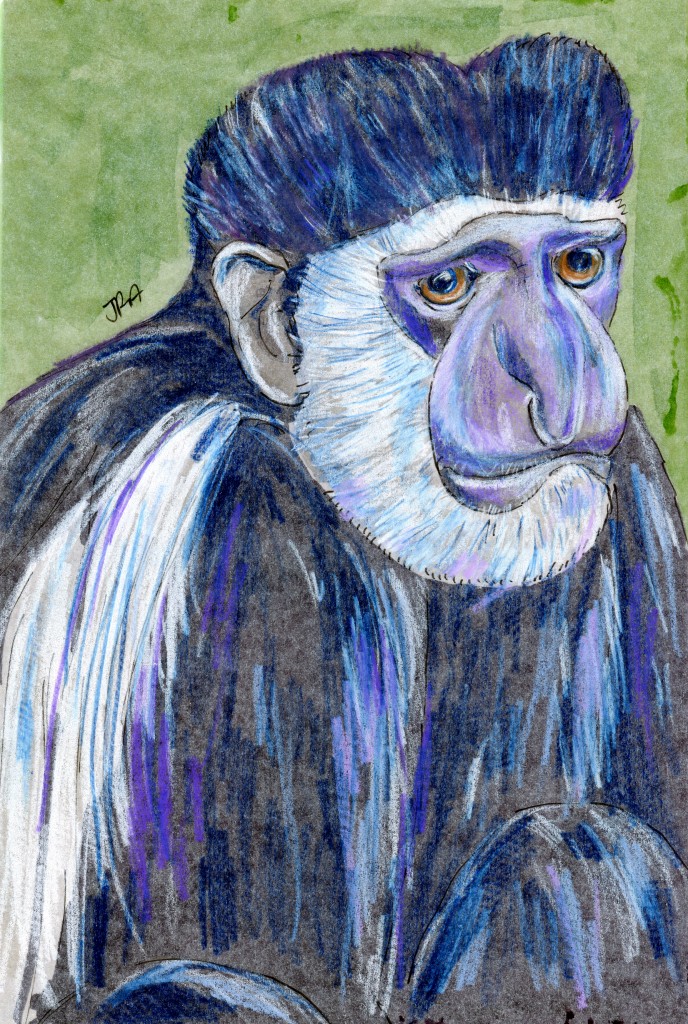
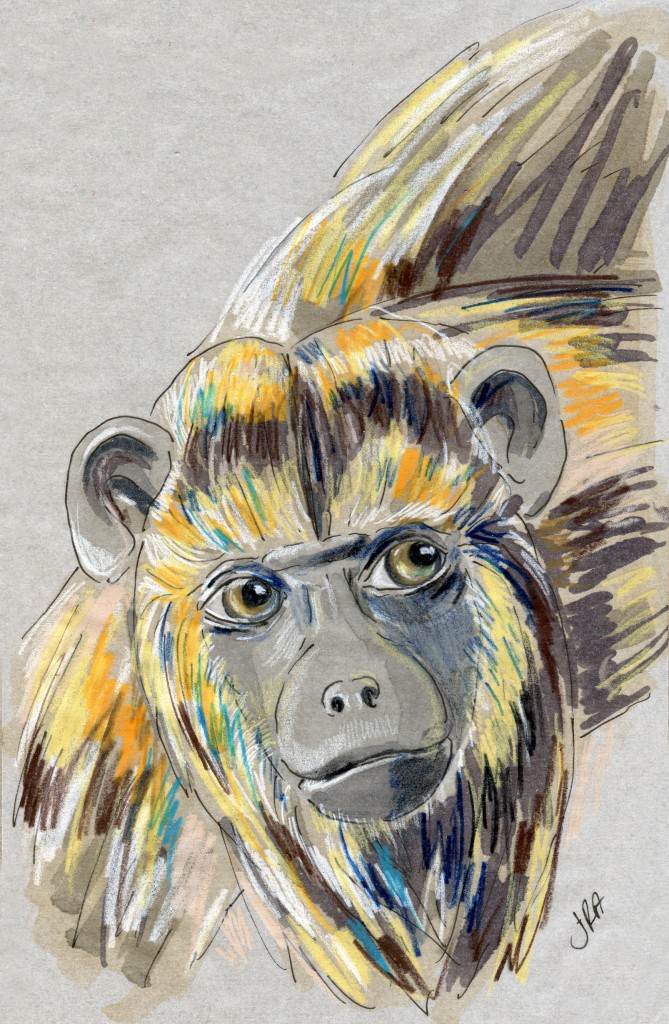
Black-and-gold howler monkey (click image to enlarge)


0333

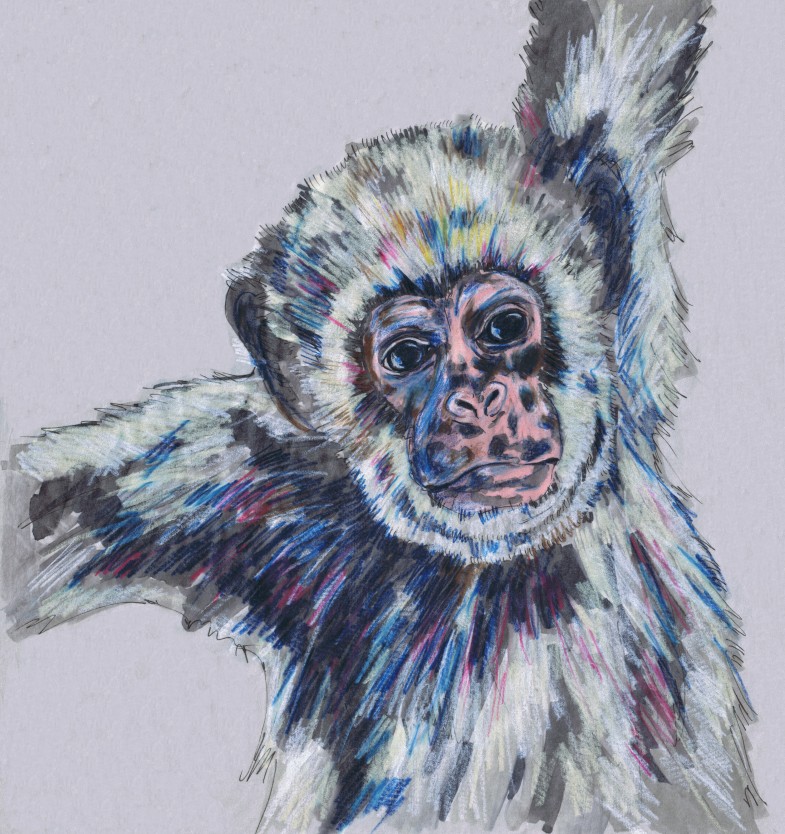
We are approximately one-third of the way to 1,000 mammals today, which would be in turn one-fifth of the way to all the mammals there are. Let’s celebrate that, as well as the World Cup, with this sad-looking black-and-gold howler monkey from Paraguay! The black-and-gold howler is also called the black howler, but so is at least one other howler monkey species (dang! look how different my drawing was back then!), and since only the males are black anyway, a better common name for this one is the black-and-gold howler. They live not only in Paraguay but in Argentina, Bolivia, and Brazil, as well, but their habitat is a patchwork of forests and not a big solid region. Good news for the black-and-gold howler: they are not endangered, and though their population seems to be decreasing, they’re good at living in disturbed forests and pretty adaptable.

Paraguay has made it to the quarterfinals of the World Cup, and will be playing against popular favorites Spain on Saturday. Most observers thought it was unlikely Paraguay would get this far, especially since one of their best scorers, Salvador Cabañas, was shot in the head in Mexico in January. He survived, but he’s still not well, and with his hospitalization, it seemed, Paraguay’s chances for success were dim. After dedicating their first-round games to their teammate, Paraguay’s team went on to eliminate Japan in the Round of 16 after the previously discussed penalty kick shootout. Also, the dumbest Paraguay World Cup news I keep seeing is that some lingerie model, famous for keeping her cell phone in her cleavage, has pledged to run naked through Asunción if her beloved la Albirroja wins.

{ 1 comment }

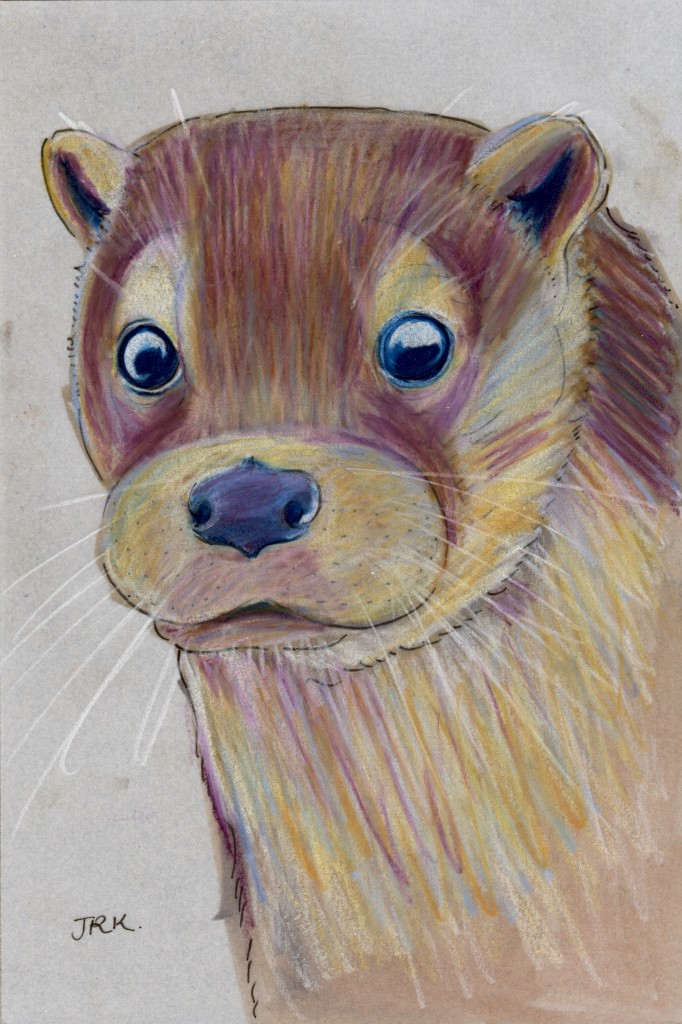
European otter (click image to enlarge)

0328

Hi, mammals! I think I’ll be on track to finish the Mammals of the World Cup on schedule with the actual World Cup if I post all of Group E today and then get back to once-a-day tomorrow. (Whether I will succeed is still unknown, as life has been pretty stressful around here. But I’m trying!) Also, I’m really not doing my best work lately, so dumping four mammals on you at once might distract you from that fact.

Our first mammal is the European otter (Lutra lutra), who is representing the Netherlands, where its numbers had decreased to almost nothing but it has been reintroduced. The Netherlands beat Slovakia (where the Yak part of my name comes from) in the Round of 16 and will be playing Brazil in the quarterfinals on Friday.

Orca (click image to enlarge)

0329

The orca or killer whale (Orcinus orca) is playing for Denmark tonight. Did you know that orcas in groups have been known to take down blue whales? It’s unlikely, I think, that anyone is going to beat the orca in this World Cup. Denmark, on the other hand, didn’t make it out of the group stage.

Japanese dwarf flying squirrel (click image to enlarge)

0330

From Japan, the Japanese dwarf flying squirrel (Pteromys momonga), which is also known as the momonga! It’s just too cute to be believed, really, and is also represented on one of my favorite Yu-Gi-Oh! cards, seen below. (I’m very into Yu-Gi-Oh! now. It comes with the 14-year-old son. I have a beast deck. Besides the Nimble Momonga, I also have a Tree Otter, a Sea Koala, a Kangaroo Champ, a Green Baboon Defender of the Forest, and a Rescue Cat.)

A very handy Yu-Gi-Oh! card (click image to enlarge)

Japan made it to the Round of 16 but lost to Paraguay today. After the group stage, they don’t allow ties anymore. First, they have 30 minutes of overtime, and if there’s still a draw, they take turns taking penalty kicks, which are kicks from a spot 12 yards from the goal. Five players from each team try that, and if there’s still a draw after the penalty kicks, they play sudden death. After the 30 minutes of extra time, the Japan-Paraguay game was tied 0-0, and Paraguay won in penalty kicks.

Allen's swamp monkey (click image to enlarge)

0331

This is Allen’s swamp monkey (Allenopithecus nigroviridis), and it’s from Cameroon (as well as Congo and the Democratic Republic of the Congo). Its scientific name means “Allen’s ape, black and green,” and it is indeed kind of black-and-green colored. Cameroon didn’t get out of the group stage at the World Cup.

Group E Results

Well, the killer whale is the killer whale, and none of these guys stand a chance against that apex predator. It moves on to the next round, and I think our mustelid friend in this group, the European otter, could do some damage to the swamp monkey, and obviously the momonga is adorable and tiny and hopeless against any of the other three. So the two mammals continuing on to the Round of 16 from Group E are:

Orca (Denmark)
and
European Otter (Netherlands)

{ 5 comments }

Barbary macaque (click image to enlarge)


0322

The World Cup is swinging right along, and we’re celebrating with a look at the mammals of the 32 countries competing in the tournament. Today we’re in Algeria, where they have these monkeys, see, the Barbary macaques. They live in the forests of Algeria and Morocco, and there’s also a population in Gibraltar, making them the only primates that live freely in Europe other than humans. Male macaques have a most endearing bonding ritual. In order to make friends with other males, a male macaque will cuddle with a baby, his own or someone else’s. When one male is holding a baby, other males will approach him, embrace him, and make googoo faces at the infant alongside him. Males who do it right find that holding a baby can really help their social status. Isn’t that funny? But like human infants, baby macaques can be unrelenting when they cry, and the downside for the baby-holding males is that they experience higher stress levels than males who don’t hold babies.

Today Group C played its final two games in the World Cup. Each group’s last two games are played simultaneously because otherwise, teams that knew the outcome of an earlier game would have incentive to throw their own game in one way or another. FIFA started structuring the World Cup that way in 1986, and Algeria was involved in the events that caused the change. In 1982, Algeria “shocked the world” when they beat reigning champions West Germany. In their group, which also included Austria and Chile, it turned out that in the final game, if West Germany beat Austria, both teams would be guaranteed to continue on to the next round, while a different outcome would have sent Algeria on. So in “the dodgiest game in football history,” West Germany scored a goal very early on and the two teams spent the rest of the game fooling around while their fans booed and even burned a flag. Algeria complained, and while FIFA declined to do anything about it at the time, they did change the rules for the next World Cup.

This World Cup was only the third that Algeria made it to. They had their glory days in the 1980s, qualifying for both the 1982 and 1986 World Cups, but then they endured a long slump known as “the walk through the desert,” coming back into their own in 2008. Today Algeria, whose nickname is the Fennecs, lost to the U.S., and England beat Slovenia, and so the U.S. and England are continuing on to the Round of 16.

Coco drew such an amazing Barbary macaque:

Barbary macaque by Coco, age 11

{ 5 comments }

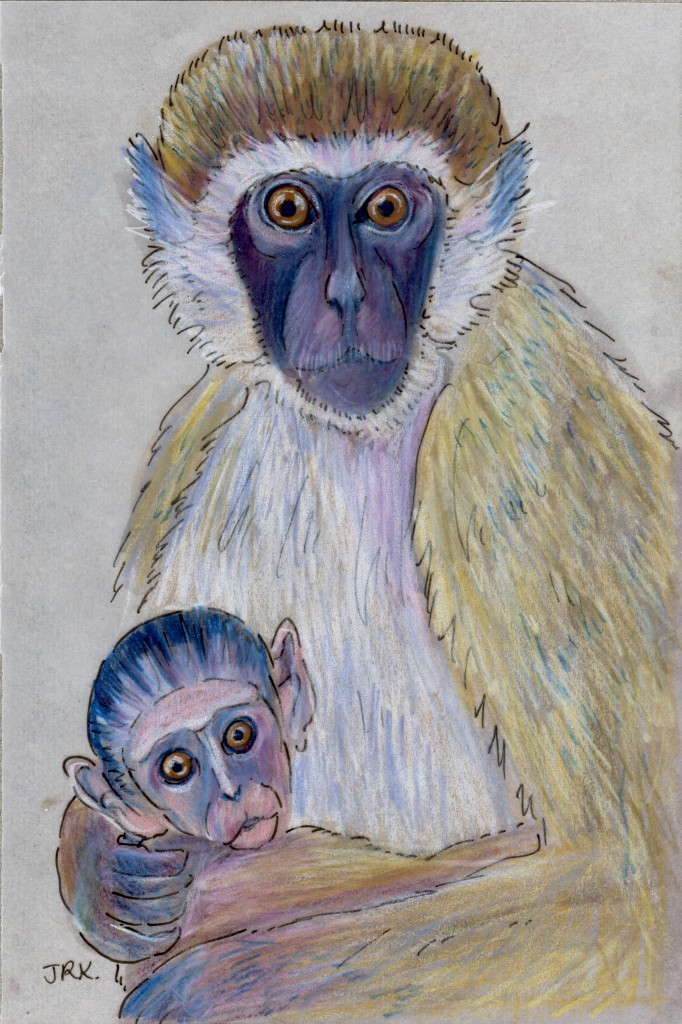
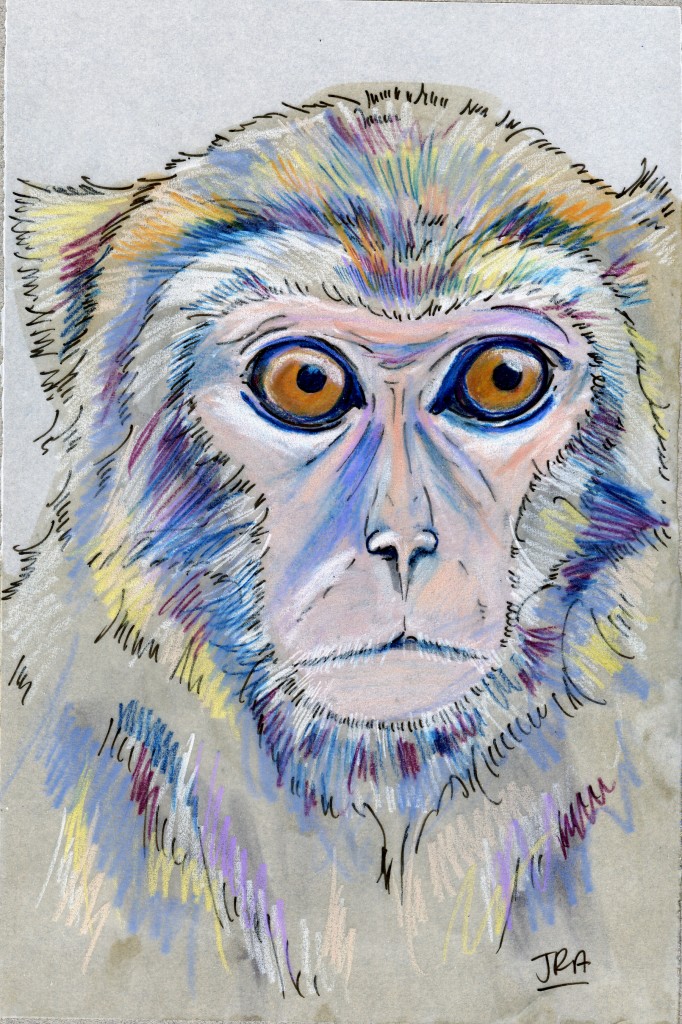
Vervet monkey mother and child (click image to enlarge)

0312

The World Cup started this past Friday, and I’m into it, partly because of this Nike commercial and partly because of this book (Cosmopolitanism by Kwame Anthony Appiah, which I enthusiastically recommend), which has me convinced of the importance of being a true citizen of the world. The international soccer/football tournament happens every four years, and this time, it’s in South Africa—the first time an African nation has hosted. Since I can’t go to South Africa, and I certainly can’t play soccer, what better way to participate than to draw one mammal from each of the 32 countries playing in the World Cup? I’ll be drawing them in the order their countries are playing, starting with our host, South Africa, and its representative, the vervet monkey.

The 32 teams of the World Cup are divided into eight groups, and they play a round-robin tournament after which the top two teams from each group advance to the round of 16. South Africa finds itself in a tough group, with former World Cup champions Uruguay and France, and Mexico, whose team isn’t bad, either. No host country has ever failed to advance to the second round of play—but South Africa, in its two previous World Cup appearances, didn’t get to round two, so this host-country winning streak could be a high-pressure curse.

On Friday, South Africa played Mexico. The game ended in a 1–1 draw, which wasn’t at all bad for South Africa, and the home team’s Sisphiwe Tshabalala scored the first goal of the tournament, a real beaut.

In our World Cup of Mammals, South Africa is represented by the vervet monkey, which lives in southern Africa’s savannas and forests in groups of a couple dozen. The vervet is also called the green monkey, and in Afrikaans, it’s the blou aap, or blue monkey, despite being yellowish-gray. Unfortunately, the old habitat squeeze has forced the vervet into the position of being a nuisance to humans in some places.

    Coco drew the most adorably charming vervet monkey ever.

    Vervet monkey by Coco, age 11

    { 7 comments }

    Gelada Monkey (Theropithecus gelada)

    by JR Kinyak on April 7, 2010

    in Primates

    gelada monkey

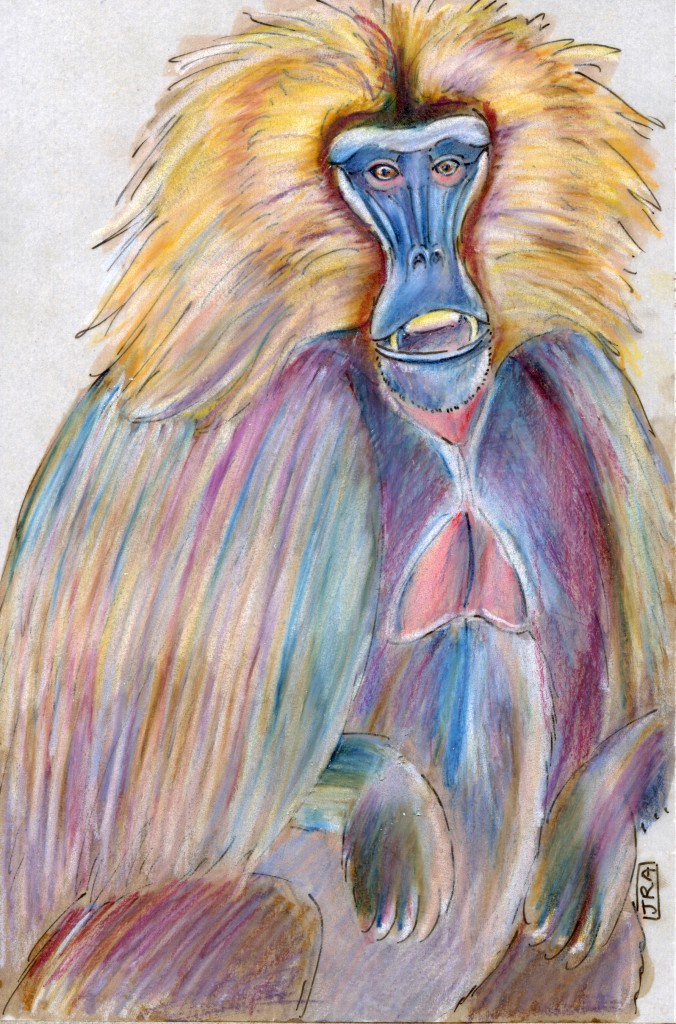
    Gelada monkey (click image to enlarge)

    0288

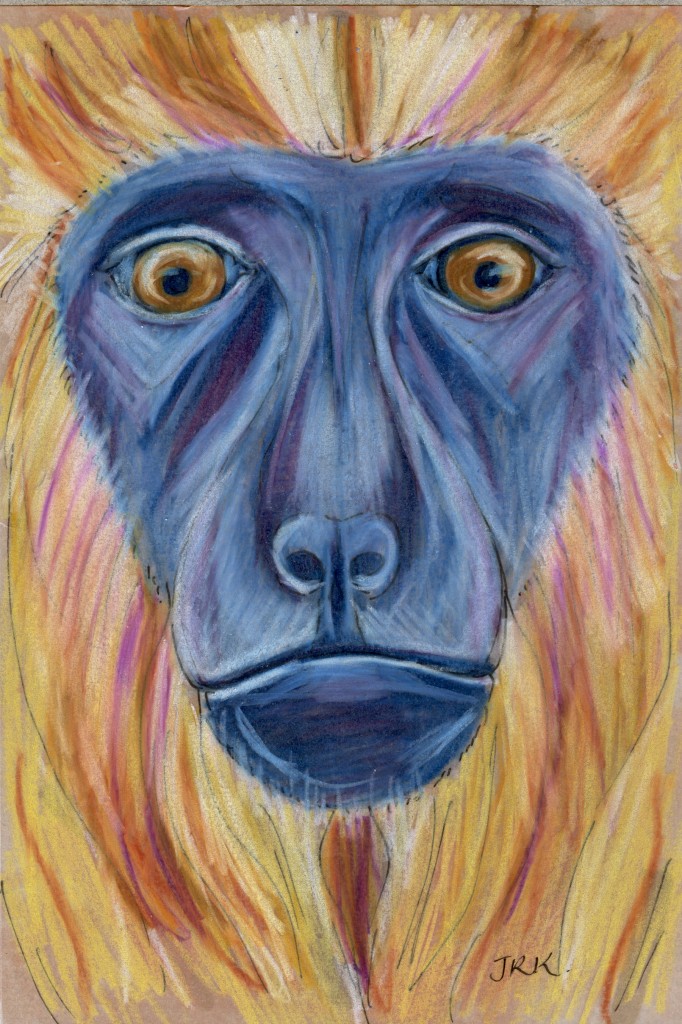
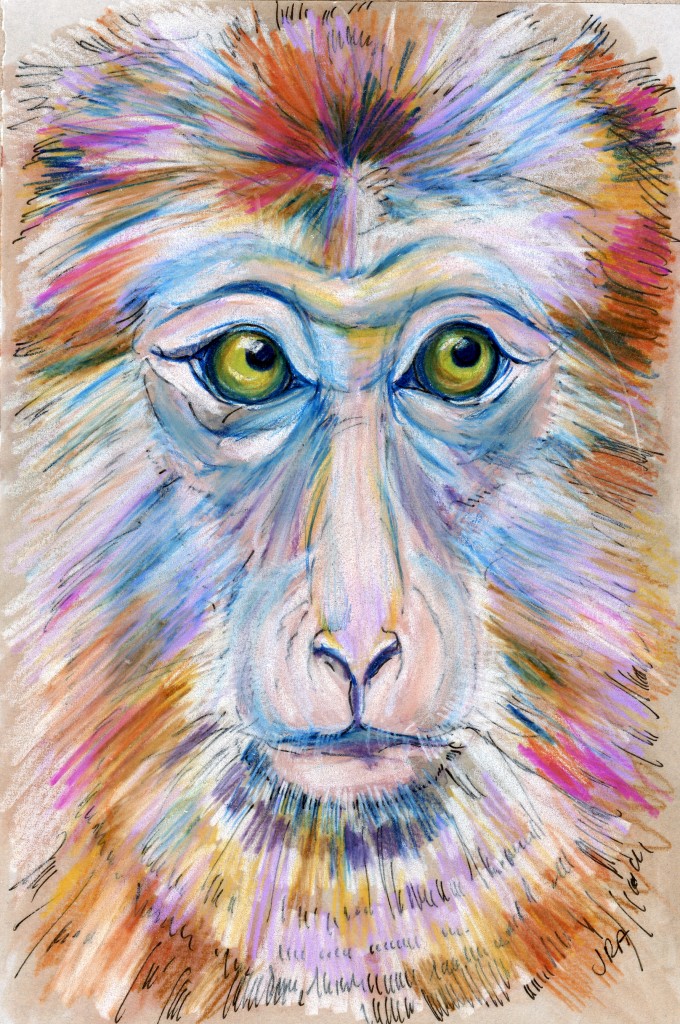
    High in the mountains of Ethiopia live large groups of monkeys, the geladas, who spend their days grazing on grass, mating, socializing, and making a variety of interesting sounds that some people speculate could reveal something about the evolution of human language and music. Also known as bleeding-heart baboons and lion baboons (although they aren’t actually baboons), the geladas are the only remaining grazing primate. (In Coco’s drawing, below, you can see a gelada with his upper lip drawn back, showing the grass he’s been eating.) They organize themselves in large troops that consist of “harem” groups as well as nonbreeding males. In the harem groups, each of which comprises a handful of females and a breeding male, the females are in charge of the family’s movements, and they decide when it’s time to trade in their male for a new one.

    Gelada by Coco, age 11 (10 when she drew it). Click image to enlarge.

    In most baboons and monkeys, swellings on the females’ rear ends indicate their reproductive ability. Because geladas spend so much time sitting on their rumps, though, this would be an impractical way for them to signal to potential mates. The red patches on their chests provide these swelling signs instead. In the female, the color and and size of the patch indicate where she is in her reproductive cycle; in the male, the patch shows his status.

    Once, the geladas were targeted for their beautiful fur. Then came the Ethiopian civil war, which brought gunfire to their mountain home and made it impossible for scientists to study the monkeys. Now, they face their biggest threat ever: climate change. As the mountains where the monkeys live get warmer, scientists say, the geladas will almost certainly become extinct. Not only does the warmer climate threaten the grasses that the monkeys depend on for nutrition, it also means that humans will be able to farm at ever-higher altitudes, and where there are farms, there cannot be geladas. These strange and beautiful monkeys are in serious danger of becoming just one more victim of our neglect and apathy toward the planet. It’s too bad the other animals have to share Earth with us.

    Gelada by Theo, age 13. Click image to enlarge.

    { 4 comments }

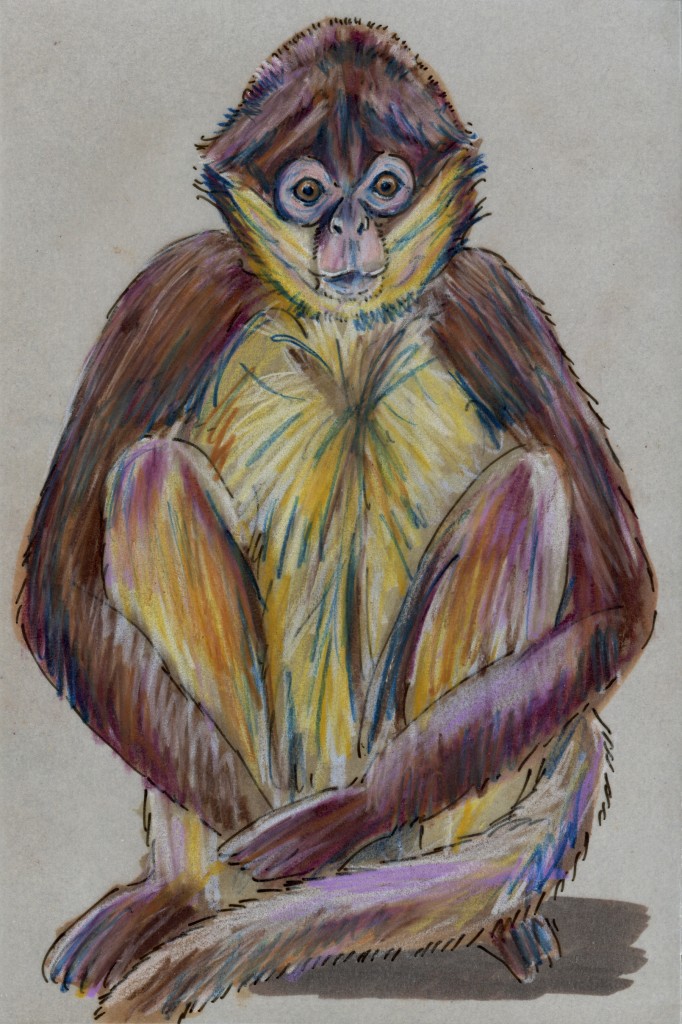
    Black-handed Spider Monkey (Ateles geoffroyi)

    by JR Kinyak on September 15, 2009

    in Primates

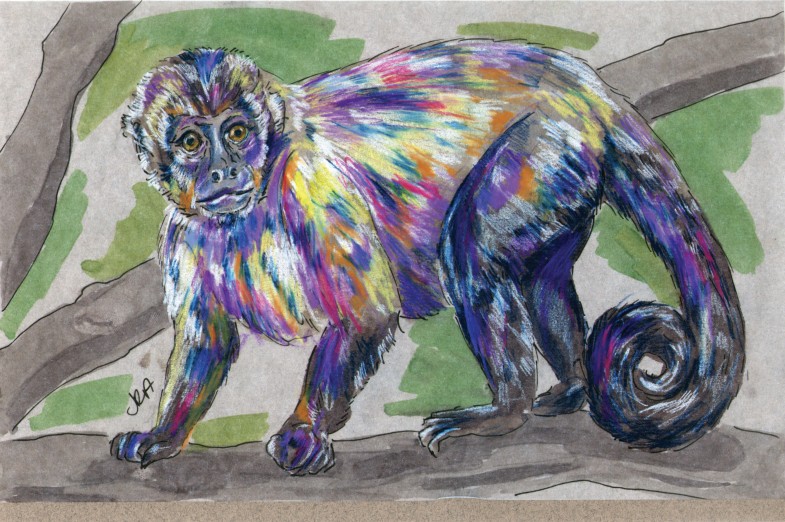
    Black-handed spider monkey (click image to enlarge)

    Black-handed spider monkey (click image to enlarge)


    0287

    These incredibly agile monkeys live throughout Central America. They’re very social, swinging through the treetops in groups of 20 or 30, munching on fruit, leaves, and flowers. They’re important distributors of fruit seeds, dispersing them through their digestive system. Unfortunately, the black-handed spider monkey is endangered due to habitat loss.

    { 0 comments }

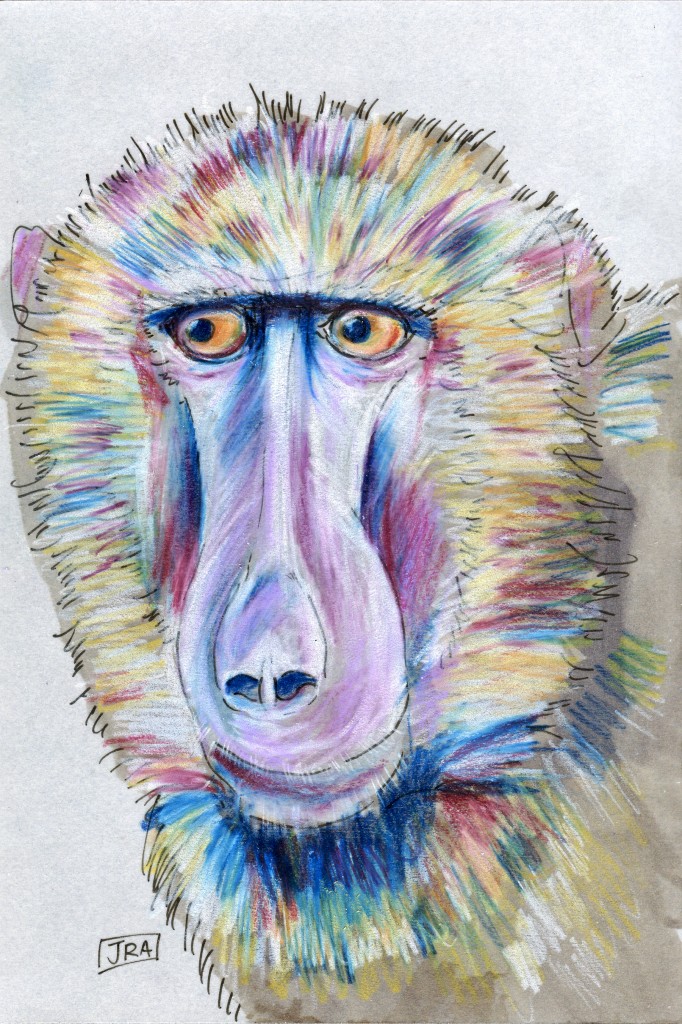
    Olive Baboon (click image to enlarge)

    Olive Baboon (click image to enlarge)

    0252

    The olive baboon lives in a wide swath of land across the middle of Africa. It’s one of those rare mammals that not only is safe from extinction, but whose numbers seem to be growing. Let’s all celebrate that ’cause it gets depressing around here, doesn’t it?

    Papio in the baboon’s scientific name comes from a French word for baboon (according to A.F. Gotch, whom you may or may not believe). Anubis, of course, is the Egyptian god of the afterlife who has the head of a jackal. I’m guessing that anubis in this monkey’s name is a reference to the way baboons’ snouts resembles those of dogs.

    On the other hand, whoever named Papio anubis may have been thinking of the lofty status baboons held in ancient Egypt. They were kept as pets (and possibly fruit pickers or other kinds of workers), depicted in art, and mummified in tombs. Supposedly, the Egyptians used their feces as an ingredient in aphrodisiacs. The Egyptian religion associated baboons with the sun god, perhaps because of the raucous ruckus they make at dawn, as well as with the afterlife. Baboons also represented the god Thoth, who was in charge of writing, wisdom, and judging the dead, as well as Hapy, the god of the Nile. The Egyptian god Babi has the head of a baboon. He’s vicious and bloodthirsty and lives on entrails and souls. Our word baboon may come from his name. Interestingly, it’s not known whether baboons were native to Egypt at that time or they were imported from Nubia.

    Although it appears ancient Egyptian baboons were respected in theory, analysis of mummified baboon remains indicates that the monkeys were malnourished and kept in too-small cages.

    Here is an ancient Egyptian baboon statue at the British Museum, along with some information about baboons and Egypt, and here’s another at the Metropolitan Museum.

    { 2 comments }