Posts tagged as:

marsupial

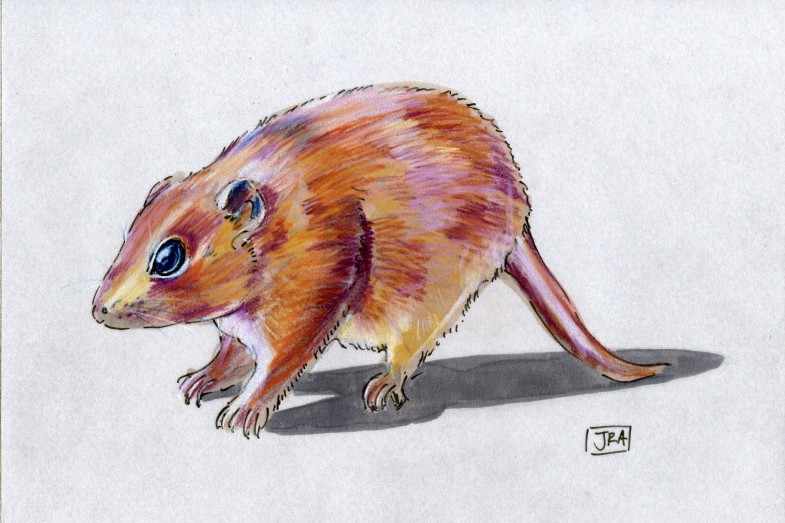
Little Red Kaluta (click image to enlarge)

Little Red Kaluta (click image to enlarge)

0253

This little marsupial is widespread in the desert of northwestern Australia, where it likes to eat insects and small vertebrates. The young are born in November, and they’re old enough to mate by the time kaluta mating season rolls around the following September. Sadly, all males die shortly after the mating season, apparently from the stress of competing for females!

In this little guy’s Latin name, kaluta is an aboriginal word for the animal, and dasy means hairy. Rosamondae is in honor of Rosamund Clifford, a legendarily beautiful redhead of the 12th century. She was the mistress of Henry II from her teen years until shortly before her death, in a convent, in her 20s. Many tales have arisen about her over the years, the most persistent, perhaps, being that she was poisoned by Henry’s jealous wife, Eleanor of Aquitane. This is probably not true, but artists have long been intrigued by the story. Below is a painting by J.W. Waterhouse from 1905. See evil Eleanor poking her head through the curtains behind the unsuspecting Rosamund? She has followed Rosamund’s embroidery thread through a labyrinthine garden to find the king’s mistress in her secret castle.

Fair Rosamund by J.W. Waterhouse, 1905

Fair Rosamund by J.W. Waterhouse, 1905

Here’s another painting of the same scene. This one is from 1862 and was painted by Edward Coley Burne-Jones.

Fair Rosamund and Queen Eleanor by E.C. Burne-Jones, 1862

Fair Rosamund and Queen Eleanor by E.C. Burne-Jones, 1862

This beautiful striped rose was named for Rosamund Clifford, too.

Rosa Mundi (Rosa gallica versicolor) by Sebastian Crump

Rosa Mundi (Rosa gallica versicolor) by Sebastian Crump

{ 2 comments }

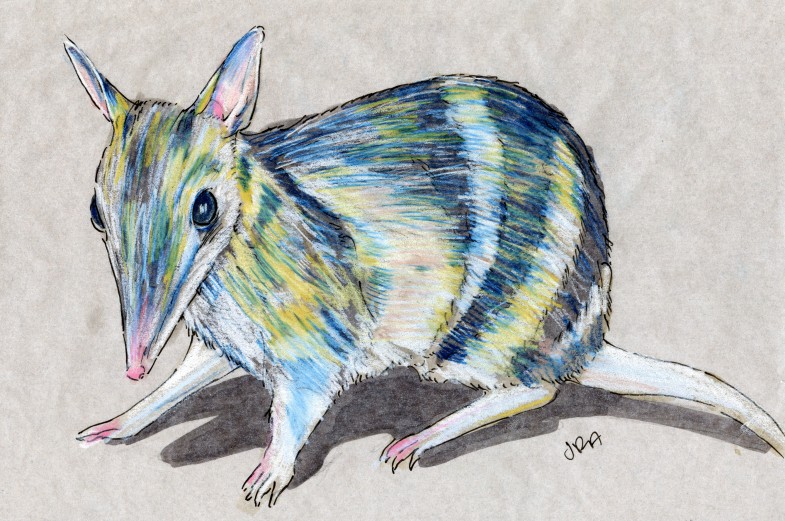
click image to enlarge

0175

The eastern barred bandicoot is a critically endangered Australian marsupial. Animal Diversity Web says there are only about 300–400 of them alive in the wild. They eat mainly insects and worms, along with some berries and grasses and such. They’re noisy and they leap along the ground.

Consecutive days of mammals: 4
Record: 16

{ 0 comments }