Posts tagged as:

humans

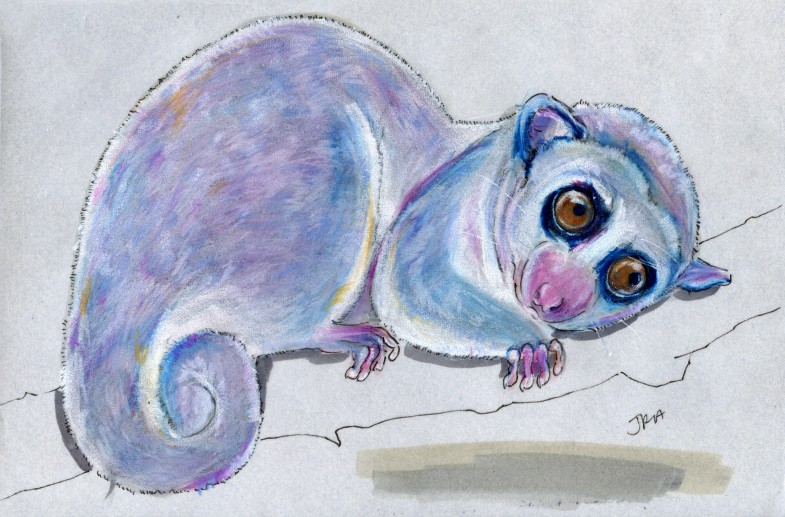
Silky anteater (click image to enlarge)


0338

I’m posting two mammals tonight, both to get a day ahead of the actual World Cup and because I really hate my second drawing and want to bury it beneath the one above, which I actually like. So first, here’s the silky anteater, also called the pygmy anteater (Cyclopes didactylus), representing Brazil. Brazil was one of the two favorites to win the whole World Cup, but it has been bounced. Tomorrow is the second semifinal game, which will be played between Germany and Spain. Holland beat Uruguay today in the first semifinal match, so there are only European teams left.

The silky anteater is a strange little beast. It lives in the trees of the rainforest, and it’s nocturnal. It eats, as its name would suggest, ants, and they’re its favorite, but it will also eat termites. It’s a small little bitty anteater, just about 8 inches long and weighing less than a pound. Apparently, it lives in a tree that has fibrous, silky seedpods, which camouflage the little anteater as he safely sleeps the day away. According to EDGE of Existence, “Its long tongue is equipped with small spikes and mucus and is perfect for gathering up ants and termites.”

Here’s an odd little cameo appearance of the silky anteater from the 1972 movie Aguirre, the Wrath of God, directed by Werner Herzog and starring Klaus Kinski:

Korean hare (click image to enlarge)


0339

North Korea is a mystery in general, and a mystery at the World Cup as well. This was the first time they’d qualified since 1966, when, according to an essay published in Time a couple of weeks ago, they “thrilled the World Cup” and ushered in a new era of competition, fitness, and endurance, even though they lost their quarterfinal match against Portugal. There’s a documentary about the 1966 team that looks interesting.

During this 2010 World Cup, a few interesting stories came to light. North Korea’s star, Jong Tae-Se, while North Korean by ancestry, was born in Japan and lives there. He said that he amazed his teammates by showing them his cell phone. They are easily amused, Jong Tae-Se says: their favorite between-games activity is rock, paper, scissors. And it’s no wonder they’ve never seen a cell phone before: they’re used to invisible ones, like the one Kim Jong-Il supposedly used to communicate with the team’s coach during their World Cup matches.

As I’ve mentioned, I’m trying to be more cosmopolitan, and the first and biggest step in that direction is to seek to understand people from other places and cultures. But it is so hard to understand people from North Korea. Of course, it would be hard to understand any country about which so little is known, but when North Koreans are allowed to talk, they sound like cult members. There’s such a huge wall there, but whether it’s a wall of terror or paranoia or brainwashing or sheer deprivation, poverty, and exhaustion, I just don’t know. Newsweek worries about the North Korean team and their families. Since they brought dishonor to their motherland, losing all three of their games, including a 7-0 drubbing by Portugal, will they mysteriously disappear or face some other terrible fate? Newsweek argues that FIFA, the organization that governs international soccer, should boycott the country, as so many sports organizations boycotted South Africa. I have to say that I don’t see why we’re not boycotting the country, based on what we know of its secretive, abusive, dictatorial regime.

None of this is any business of the Korean hare’s (Lepus coreanus), a regular old hare who lives in both Koreas and in China.

{ 3 comments }

Tatra chamois (click image to enlarge)


0335

I don’t usually highlight a particular subspecies, but when it comes to picking a representative for Slovakia, my father-in-law’s ancestral home and the source of the yak in my name, I wanted to do it up right. Meet the Tatra chamois, a subspecies of the regular chamois, which lives only in the Tatra mountains of Slovakia and Poland and numbers fewer than 200 individuals. (The chamois species in general, Rubicapra rubicapra, counts more than 400,000 members, but all but one of the subspecies are declining in number.) The threats to the Tatra chamois are poaching, habitat loss, and both interbreeding—with other introduced subspecies—and inbreeding, since there’s not enough genetic diversity in a group of 200 to sustain a healthy population. They live in rocky parts of the mountains, and they nimbly make their way through their days, munching on leaves and grass.

Slovakia’s national soccer team got its start in 1993, after Czechoslovakia split into the Czech Republic and the Slovak Republic. (There was also a Slovak national team before World War II, but after the war it was combined with the Czechoslovakian team. I’m reading an article in The New Yorker about the Eurovision Song Contest, and it mentions that several of the nations competing in the 2010 contest didn’t exist as independent countries when the contest started in 1956. That’s true of a couple of the countries in the World Cup, too.) This is the first time the team has qualified for the World Cup as Slovakia. The team’s nickname is Repre, which, according to The Guardian, is short for “reprezentacny tim” or “representative team.” (That article is really snarky. I think someone got quite bored having to write up profiles of every team.)

This year, Slovakia got to the Round of 16, where they lost to Holland, who went on to beat favorites Brazil in the quarterfinals yesterday. Coco drew a chamois, too, and here it is.

Chamois by Coco, age 11

{ 5 comments }

Marbled polecat (click image to enlarge)

0324

Today marked the end of the first stage of play in the World Cup, and the Round of 16 is set. Unfortunately, today’s country, Serbia, did not make it through, but no matter. The marbled polecat (our second mustelid in a row, by the way) still has a chance in the World Cup of Mammals!

Marbled polecats (who make me hungry with the way their fur evokes marble cake) live in Europe and Asia, but their numbers are decreasing, and the IUCN Red List classifies them as vulnerable, the last step before endangered. That is due to habitat loss, completely unsurprisingly. Polecats like steppes, brushland, and sometimes forests, and between climate change and humans being humanny, those kinds of habitats are going away.

Perhaps we should think twice before crossing them, though. The species account in Mammalian Species number 779, December 20, 2005, has the following chilling details to report:

“[Marbled polecats] have a repertoire of alternative methods to kill prey. They have 2 kinds of killing bites: the 1st is the penetration of the prey’s body by the canines, and the 2nd is crushing the prey without canine penetration (Ben-David et al. 1991). To kill small vertebrate prey, marbled polecats crush the thorax. If the prey struggles, they may pin the prey down with the forepaws and deliver head shakes or follow-up by a bite to the head or neck (Ben-David et al. 1991). On larger, more nondefensive prey (guinea pigs, Cavia porcellus), the polecat bites the nape of the neck and eventually severs the spinal column from the base of the skull. To kill large defensive prey such as rats, the marbled polecat bites the throat. Fleeing prey were bitten dorsally, but defending prey were bitten on the head or neck. Additional details on the killing methods of the marbled polecat are available (Ben-David et al. 1991).”

So let’s be careful around them, shall we? And so should the other mammals of Group D!

And what of Serbia’s national soccer team? Their showing in this World Cup was kind of confusing, apparently, with them beating a team no one thought they should have (Germany) and losing to teams everyone thought they should have beaten (Ghana, Australia). This is actually Serbia’s first World Cup under the name Serbia. The team is considered the continuation of both the Serbia and Montenegro team (after Montenegro seceded from Serbia and Montenegro, they got their own team) and the Yugoslavia team (which broke up when Yugoslavia did), so any records that the Serbia and Montenegro or Yugoslavia teams earned now belong to the Serbia team.

{ 3 comments }

Beech marten (click image to enlarge)

0323

The World Cup continues and so do the mammals! Today we have a beech marten from Slovenia. Also called the stone marten, the beech marten is pretty widespread in Europe and Asia. It lives in forests, nests in cozy crevices and hollows, and eats rodents, birds and their eggs, and berries. In researching the beech marten, I learned a new word: commensal, as in “Commensal beech martens may cause damage to roofs, insulation, and electrical wiring and pipes in houses and cars,” which is a quote from the beech marten’s page on the IUCN Red List. The dictionary says that a commensal relationship is one in which one organism benefits and the other is neither benefited nor harmed (hmm, I think I may have been in a commensal relationship myself once or twice), which confused me because it seems like damage to roofs, insulation, and electrical wiring could qualify as harm. Basically, in biology, commensal animals are those who live among humans and may annoy us but don’t get in the way too much, if I’m understanding it correctly. Rats, for example, are commensal with us. And Wikipedia points out that the mites that live in our eyelash follicles are an example of commensalism, too! Oh good!

Slovenia came in third in Group C, ahead of Algeria but behind the U.S. and England. The team was formed after Slovenia split from Yugoslavia in 1991, and this was their second World Cup.

Group C Results

In Group C, we had the European beaver from England, the American badger from the U.S., the Barbary macaque from Algeria, and today’s Slovenian beech marten. Tough group! The beaver is a rodent, but a tough one, and even though beech martens do eat rodents, I don’t think they eat rodents that weigh ten times more than they do. Badgers are notoriously vicious. I usually give an edge to primates, but the Barbary macaque is kind of small and herbivorous. So I think the mammalian Group C goes in the exact order the soccer one did, and the two mammals continuing on to the Round of 16 are:

American Badger (USA)
and
European Beaver (England)

{ 4 comments }

African bush elephant (click image to enlarge)

0319

We’re still celebrating the World Cup here at the Daily Mammal, and today we’re closing out Group B with Nigeria and the African bush elephant. These days, scientists generally divide the African elephant into two species, the bush elephant and the forest elephant. Then there’s the Asian elephant, for a total of three kinds of elephants in the world. The biggest is the African bush elephant, which can stand nearly 12 feet tall and weigh, oh, 10 tons or so. In fact, the African bush elephant is the largest land mammal of all.

I’ve just learned a few interesting things about elephants. One is that the sound of buzzing bees will drive elephants away, which means there may be an easy way to keep them from destroying farms and getting themselves killed: play them a recording of a buzzing hive, and feet-don’t-fail-me-now, or at least until they realize that it is just a recording. We need to do more study to see what would happen.

Another thing: the most common natural death for elephants is starvation. They go through several sets of teeth, each new set growing in just as the previous set is used up. But the last of their teeth are worn out around the age of 65 or 70, not to be replaced, and without being able to really eat, they starve to death. It seems so cruel, but that’s evolution for you.

And finally, a new word: musth. It’s the name for a periodic state that male elephants go through, when their testosterone levels shoot up and they become aggressive, cranky, and dangerous to know, with only one thing on their minds. The word comes from a Persian word meaning intoxicated. (The link above is to a site about keeping elephants in zoos and circuses. About musth, it says, “It is also very discouraging for the elephant keeper to work with a withdrawn, extremely aggressive elephant, which disapproves everything and actually is out to kill him.” I imagine that’s true!)

Nigeria’s soccer team is nicknamed the Super Eagles. This is their fourth World Cup; twice before they’ve made it to the Round of 16, but never any further. They came in third in this year’s African Cup of Nations, the biggest tournament in Africa (well, when the World Cup isn’t there, of course). I suppose it’s possible that they could move out of the first round this year, but of all the possible endings in Group B, only one allows that possibility. (They need Argentina to beat Greece, and then Nigeria needs to beat South Korea, and the goal differential among the non-Argentina teams needs to fall in Nigeria’s favor.) I wish that in this first World Cup held in Africa the African teams were doing better, but Ghana is the only one that’s won a game so far. (Nigeria likely would have won against Greece if not for Sani Kaita’s red card; see my Greece post for more on that.)

Group B Results

What two mammals will continue on to the Group of 16 Mammals from Group B? We have South Korea’s leopard cat, the Mediterranean horseshoe bat from Greece, Argentina’s Patagonian mara, and this here elephant. The bat may be able to get some draws by flying away from the match. Let’s say that’s what it does in all three matches, earning it 3 points (you get one point for a draw in the World Cup). The elephant obviously would trample the mara and the cat, giving it three points for each win and one for its draw with the bat, or a total of 7 points. I think the cat would beat the mara and draw with the bat, so it would have 4 points, and the mara would just have one point for its draw with the bat. So continuing on to the next round from this group are:

African bush elephant (Nigeria)
and
Leopard cat (South Korea)

{ 8 comments }

Patagonian mara (click image to enlarge)

0318

To celebrate the World Cup, I’m drawing and writing about one mammal from each of the 32 countries that are participating. Those 32 countries are divided into eight groups, and today we continue meeting Group B with a visit to Argentina. The Patagonian mara is a long-legged rodent that lives only in Argentina, and it’s one of only a handful of monogamous mammals. (Do biologists count humans as monogamous mammals?)

Argentina’s soccer players may or may not be monogamous, but they are allowed to have sex during the World Cup (not during the actual games—that should go without saying), which is for some (I think misogynistic) reason controversial. (My favorite piece of information from the article linked above is that Argentina’s coach in the 1986 World Cup was a former gynecologist.) Most likely, everybody will be letting their players have sex and eat steak from grass-fed pampas cattle during tournaments now that Argentina is one of only two teams in the World Cup that won both of its first two matches, the other being the Netherlands, and before you ask, I do not know Holland’s sex policy is, but I do know that the Dutch players are no longer allowed to use Twitter. Unless something truly nutty happens, Argentina will be continuing on to the Group of 16 after playing Greece on Tuesday.

{ 5 comments }

Coypu (click image to enlarge)


0314

Today we go a little further in our look at the mammals of the countries competing in the World Cup. Meet the coypu—you may also know it as the nutria—who is representing Uruguay. It’s a semi-aquatic rodent native to Argentina, Bolivia, Brazil, Chile, Paraguay, and Uruguay, but it didn’t stay in those southern South American countries. Because of its warm and pretty fur, the coypu was imported into North America, Europe, and Asia for fur farming. When those fur farms didn’t really take off, the coypus escaped or were released, and they quickly became invasive semi-aquatic pests, destroying native wetlands, possibly contributing to the damaged levees that flooded New Orleans after Hurricane Katrina, and generally making a nuisance of themselves. This is why they can’t serve as a metaphor for cosmopolitanism or even the global reach of soccer. A cosmopolitan seeks to understand other places, people, and cultures, not destroy them with her giant orange teeth. The coypu presents a warning, though, about the fragility of our ecosystems and a reminder that any small change can cause big destruction.

There is at least one interesting attempt to try to create some good from this situation in the southeastern United States. Righteous Fur, a New Orleans company, is selling clothing and jewelry made from the fur and teeth of coypus that are being exterminated anyway and whose pelts would otherwise be wasted. People who like wearing fur thus have a way to wear it without any deaths on their conscience, and in fact, if it’s handled right, it could be a way to actually help animals by wearing fur. (I would love a coypu-tooth necklace, but unfortunately, the Etsy shop is empty, just like mine is.)

Now as for Uruguay’s World Cup team, tomorrow they play South Africa on a day when surely no one will root against the home team. But I have taken an interest in Uruguay, for the plain reasons that they were in the first game I watched (a 0–0 draw against France) and I feel sorry for them because nearly everybody else has a much more stylish typeface on the back of their shirts. You can kind of see what I mean in the photo below. I think it’s a question of Puma vs. Adidas design. Uruguay wears Puma, most everyone else wears Adidas, and Adidas seems to have picked a much cooler style of type.

France in white, Uruguay in blue. AP photo.


Anyway, Uruguay is in Group A, which is completely up for grabs after both of the group’s first games ended in draws. I’m rooting for South Africa tomorrow, but I wish Uruguay well. Here is Coco’s charismatic coypu.

Coypu by Coco, age 11

{ 4 comments }