Posts tagged as:

goat

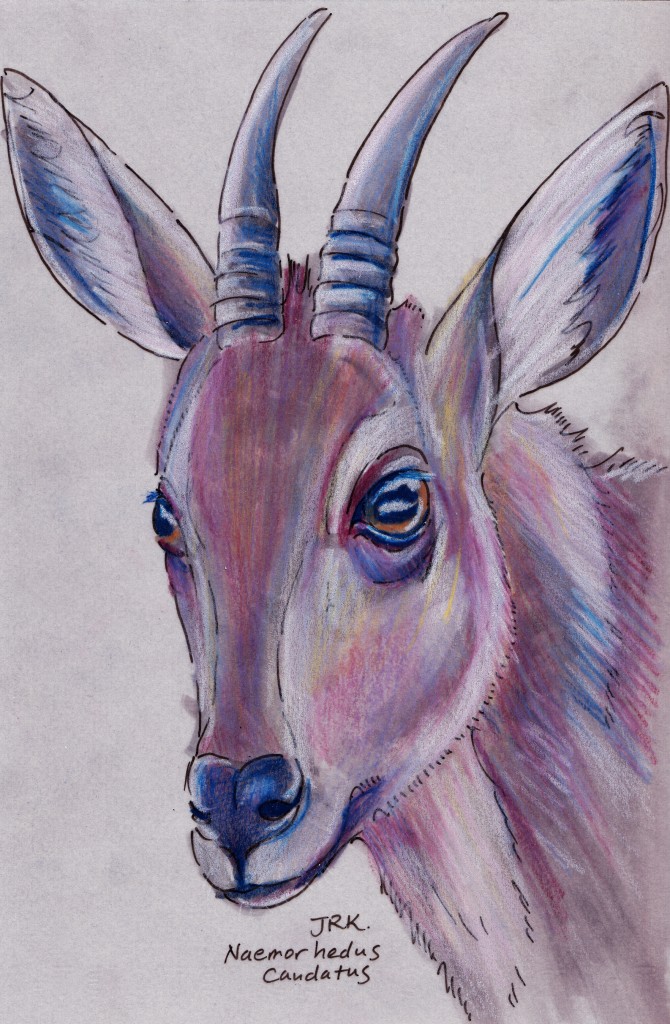
Long-tailed goral (click image to enlarge)


Long-tailed goral by Coco, age 12


0393

Here is a long-tailed goral, another mammal of Primorye, the region in the far east of Russia that we’re visiting this week. If you’d like a brief introduction to the place and why we’re there, check out Monday’s musk deer. The long-tailed goral is a goat that lives in China, Russia, and north and south Korea. It’s rare for a goat to have a long tail, so this goral has something to boast about. There are about 1,300 long-tailed gorals in all the world. Isn’t that remarkable? There are 6 billion of us—just the one species, Homo sapiens—and only 1,300 of this other species. They’re currently classified as vulnerable by the International Union for Conservation of Nature, and they are a natural monument in South Korea.

According to Animal Diversity Web, long-tailed gorals (which are also called Chinese gorals) “communicate with one another in times of emergency with wheezing alarm sounds…During mating season, males attract females with a “zer… zer” or “ze-ze-ze” call. When females approach and are ready to encourage a male, they make a whistling noise.” That is also what I do when I’m ready to encourage a male, coincidentally.

{ 5 comments }

Today begins our week-long Mammalthon to benefit Japan. As I’m sure you know, Japan was hit by a major earthquake and tsunami earlier this month. Tens of thousands of people have died, and hundreds of thousands have lost their homes. The Daily Mammal would like to do something to help in some small way.

Both of today’s drawings have sold, but all week, Coco and I will be posting drawings of Japanese mammals. You can buy the original drawings and 100 percent of the purchase price will go to benefit victims of the Japanese earthquakes: half to the American Red Cross and half to Animal Refuge Kansai, a Japanese organization that’s rescuing pets who lost their homes in the earthquakes and tsunamis.

You can buy just a drawing—mine are $50 and Coco’s are $25—or get it matted for $10 more. We’ll cover the shipping, and we’ll send them all out at the end of the week. Please note that if you want a matted drawing, you’ll have to wait an extra week or so because while I’ve ordered mats, I don’t have them yet.

Click the “Donate” button at the bottom of this post if you’d just like to donate to our fund without buying a drawing.

Japanese serow (click image to enlarge)

0369

Today’s mammal is the Japanese serow, a goat-antelope that is endemic to the mountains of Japan. It’s particularly widespread on the islands of Honshu and Shikoku. The IUCN says it’s a species of least concern. As I’ve been researching and drawing these wild mammals, I’ve been wondering about how they’ve been affected by the earthquakes. I don’t think anyone’s had the time to find out yet. Here’s Coco’s drawing of the serow:

Japanese serow by Coco, age 12 (click image to enlarge)

Japan designates certain places, minerals, plants, and animals as natural monuments deserving of recognition under the country’s laws that protect cultural properties. There are about 1,000 so designated natural monuments, and 75 of them are further classified as special natural monuments. The Japanese serow was named a special natural monument in the 1950s. At least one of the other species we’ll be meeting this week also has this prestigious designation.

{ 2 comments }

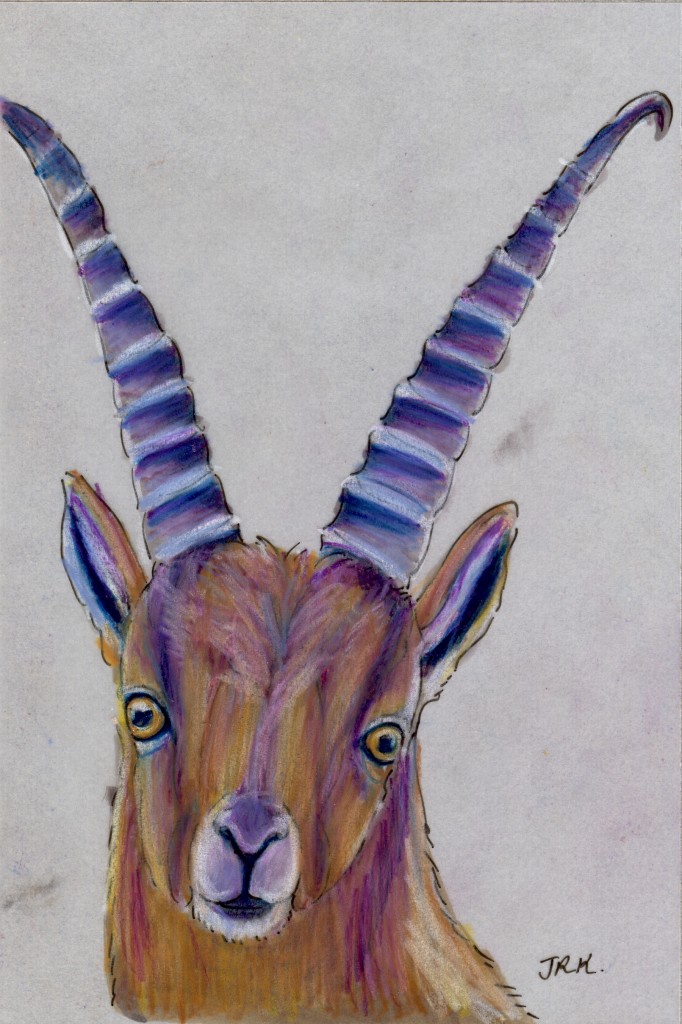
Spanish ibex (click image to enlarge)


0342

The Spanish ibex is our penultimate mammalian World Cup competitor! Representing Spain, natch, it’s a nimble goat that lives in rocky places, once throughout the Iberian Peninsula, but now only in Spain and where it’s been reintroduced to Portugal. Of the four subspecies that once existed, only two remain. The last Pyrenean ibex, Capra pyrenaica pyrenaica, died in 2000 after being hit by a tree. It was successfully cloned, if you can call it a success when your clone only lives for seven minutes. The Capra pyrenaica species as a whole, however, is doing well, its numbers increasing as it hops its way over the cliffs of Spain.

Spain’s soccer team is doing well, too. Of the 19 World Cups in history, Spain has qualified for 13. Although it’s never before done better than fourth place, it was one of the favorites to win the whole thing this year, and sure enough, Spain will be playing in the finals against the Netherlands on Sunday.

{ 0 comments }

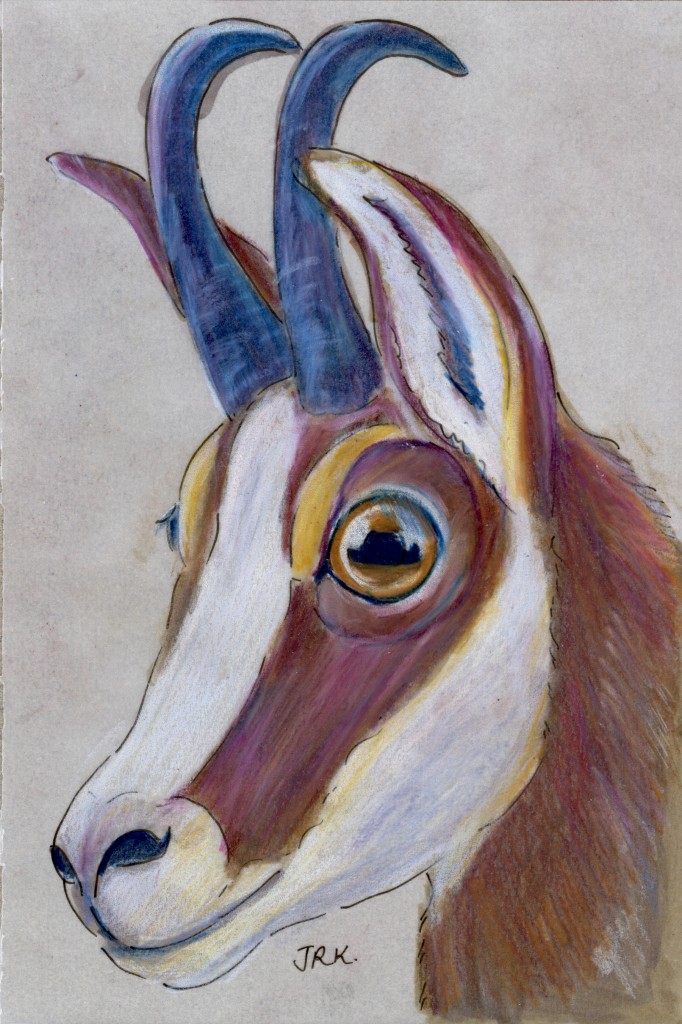
Tatra chamois (click image to enlarge)


0335

I don’t usually highlight a particular subspecies, but when it comes to picking a representative for Slovakia, my father-in-law’s ancestral home and the source of the yak in my name, I wanted to do it up right. Meet the Tatra chamois, a subspecies of the regular chamois, which lives only in the Tatra mountains of Slovakia and Poland and numbers fewer than 200 individuals. (The chamois species in general, Rubicapra rubicapra, counts more than 400,000 members, but all but one of the subspecies are declining in number.) The threats to the Tatra chamois are poaching, habitat loss, and both interbreeding—with other introduced subspecies—and inbreeding, since there’s not enough genetic diversity in a group of 200 to sustain a healthy population. They live in rocky parts of the mountains, and they nimbly make their way through their days, munching on leaves and grass.

Slovakia’s national soccer team got its start in 1993, after Czechoslovakia split into the Czech Republic and the Slovak Republic. (There was also a Slovak national team before World War II, but after the war it was combined with the Czechoslovakian team. I’m reading an article in The New Yorker about the Eurovision Song Contest, and it mentions that several of the nations competing in the 2010 contest didn’t exist as independent countries when the contest started in 1956. That’s true of a couple of the countries in the World Cup, too.) This is the first time the team has qualified for the World Cup as Slovakia. The team’s nickname is Repre, which, according to The Guardian, is short for “reprezentacny tim” or “representative team.” (That article is really snarky. I think someone got quite bored having to write up profiles of every team.)

This year, Slovakia got to the Round of 16, where they lost to Holland, who went on to beat favorites Brazil in the quarterfinals yesterday. Coco drew a chamois, too, and here it is.

Chamois by Coco, age 11

{ 5 comments }

Alpine ibex (click image to enlarge)


0332

Here we go with our World Cup celebration, meeting one mammal from each of the 32 countries that were in the World Cup! Were is a key word in this case, as reigning champ Italy, today’s country, didn’t make it out of the group stage. But that’s not the alpine ibex’s fault!

Alpine ibexes were once pretty common in the Swiss, French, Austrian, German, and Italian Alps, and in Slovenia and Bulgaria, where they had been introduced. By the 19th century, it was extinct everywhere—because of overhunting and poaching—except for one small part of Italy, where about 100 Alpine ibexes were left. In the 20th century, reintroduction programs successfully brought the ibex back to all the countries where it should have been, and now its numbers are actually increasing, according to the IUCN Red List.

Here is a very short video of ibexes being reintroduced in Austria. I love that they’re carted up the mountain in crates, from which they spring exuberantly. And I love that the gamekeepers are wearing the traditional Tyrolean hats and that they pass a bottle down the line to drink to the ibexes.

I forgot to post Coco’s Bechstein’s bat with mine the other day, and that’s a shame because it’s so incredibly wonderful, so here it is now.

Bechstein's bat by Coco, age 11 (click image to enlarge)

{ 4 comments }

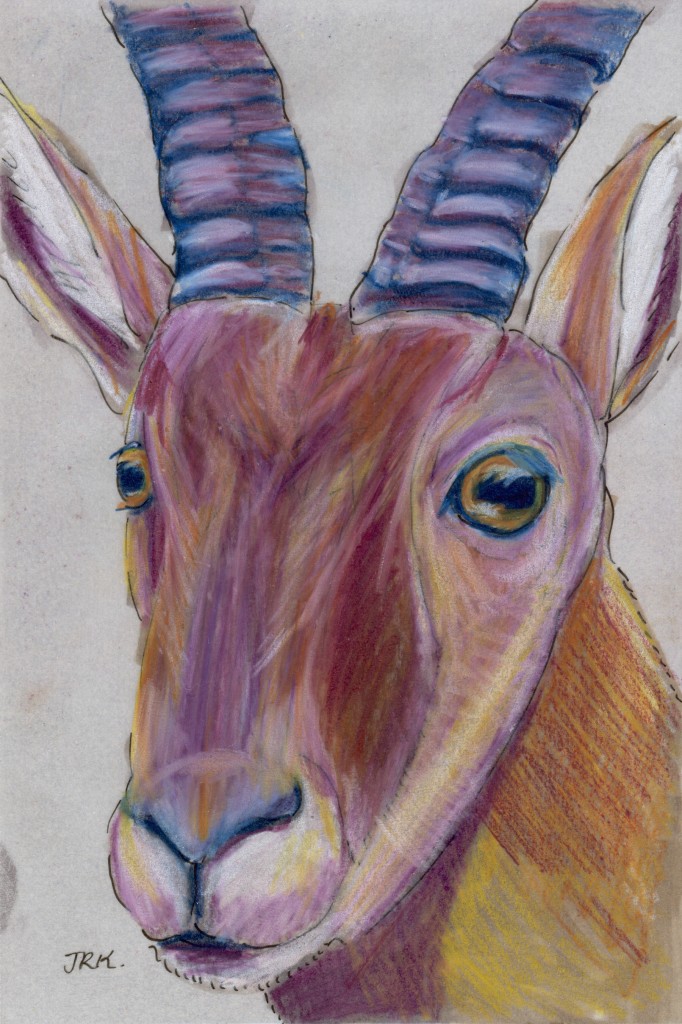
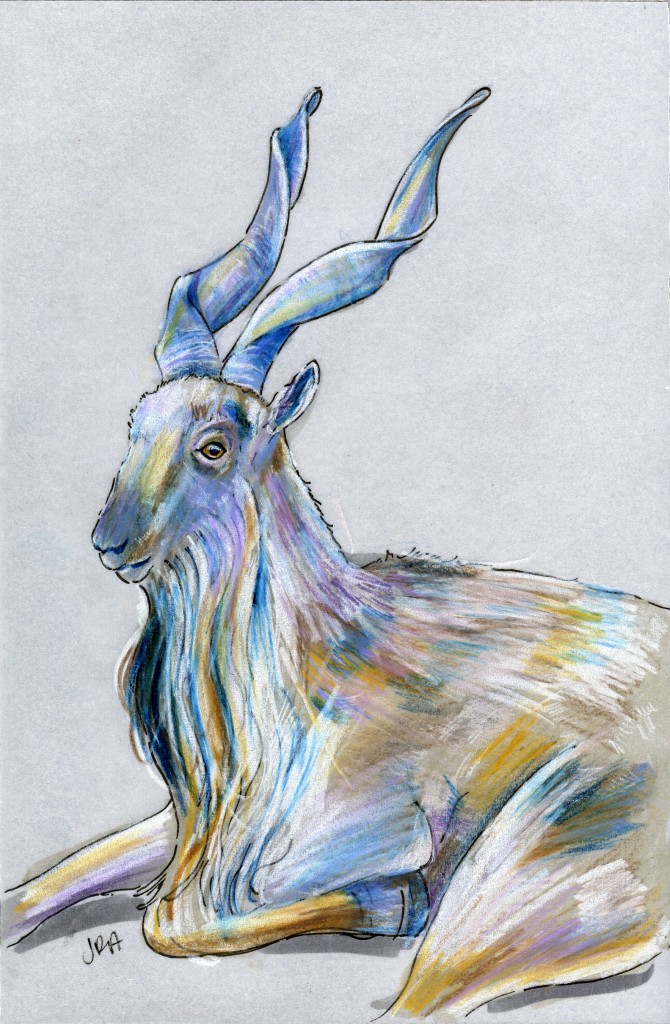
Markhor (Capra falconeri)

by JR Kinyak on January 12, 2009

in Ungulates

click image to enlarge

0204

This twisty goat lives in the western Himalayas, in parts of Pakistan, Afghanistan, India, Turkmenistan, and Uzbekistan. It’s endangered due to hunting for food and “traditional medicine,” warfare, and increasing competition with livestock. Hunting permits for the markhor can fetch quite a price: a couple of weeks ago some Norwegian paid US$81,200 for the right to kill one in Pakistan.

The word markhor comes from Farsi words for snake and eating, which is a little mysterious because goats don’t eat snakes. It could refer to the horns, which in their ribbony way are reminiscent of snakes.

{ 2 comments }

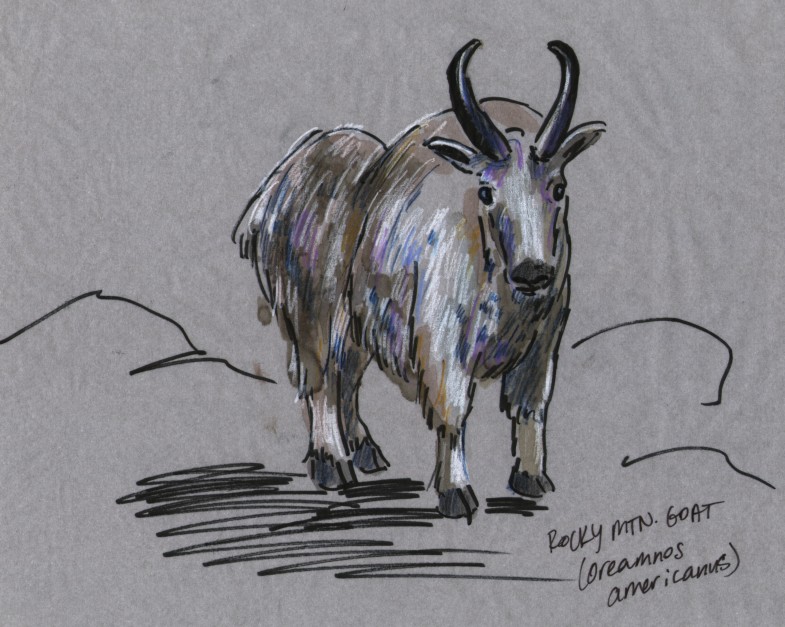
Rocky Mountain Goat (Oreamnos americanus)

by JR Kinyak on June 3, 2007

in Ungulates

rockymountaingoat72

0001

In 14 years, I will have drawn every mammal there is! Or something! So to get started, I’m going to be filling some years-old requests from my friend Leigh, beginning with the Rocky Mountain goat. Both sexes have the horns. This guy here has his summer coat.

Rocky mountain goat on Animal Diversity Web.

{ 0 comments }