Posts tagged as:

evolution

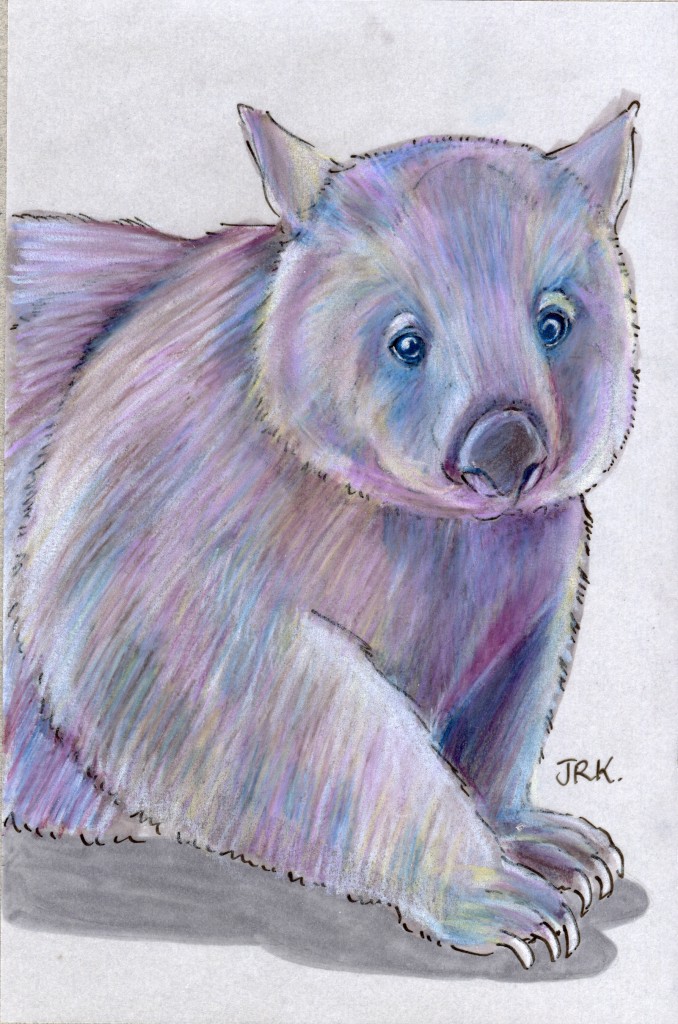
Common Wombat (Vombatus ursinus)

by JR Kinyak on April 10, 2010

in Marsupials

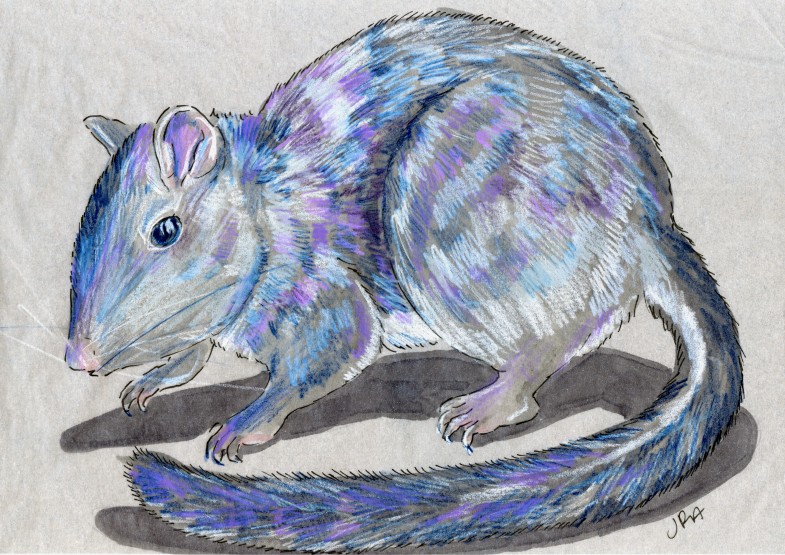
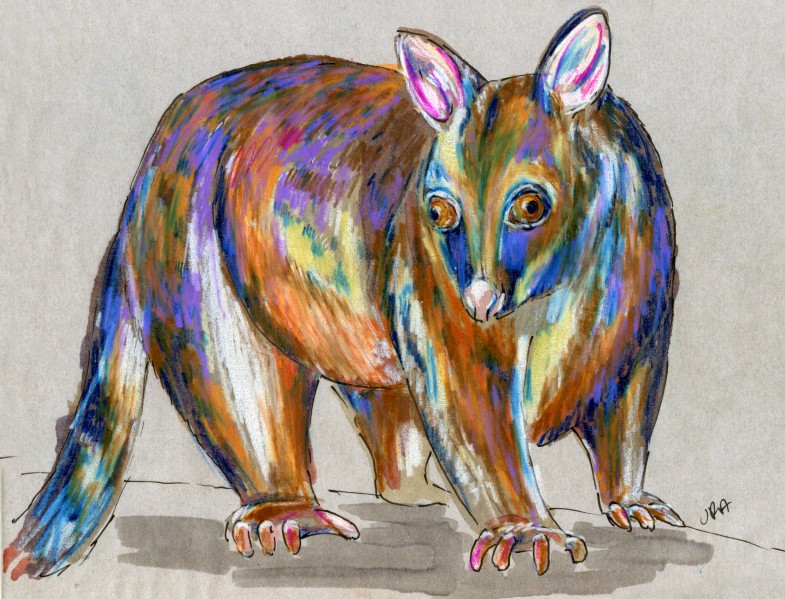
Common wombat (click image to enlarge)

0291

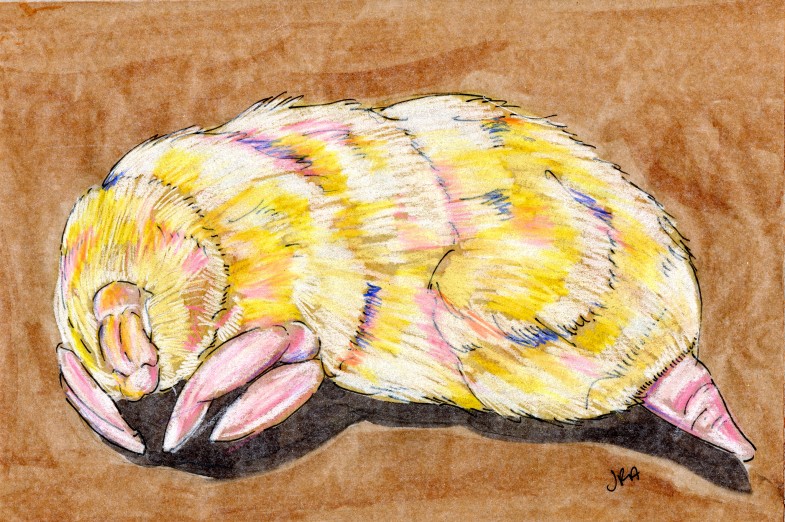
Wombats are Australian marsupials, and the common wombat is, naturally, the most common of the three wombat species. Common wombats live along the coast of southeastern Australia, in alpine areas and sandy places. The wombats’ claim to fame is that they are the only known large, herbivorous burrowing mammals: all the other burrowing herbivores are small, and all the other large burrowers are carnivores or insectivores. That’s because being a herbivore requires a lot of time and energy spent on foraging (don’t I know it), and being a burrower requires a lot of time and energy spent on digging. Large herbivores usually don’t have that kind of free time.

And wombats are large! The common wombat ranges from about 50 pounds to nearly 90, or about the size of a pretty-big dog to about the size of a really big dog. They look like they’d be about rabbit-sized, or at least they do to me, but no, they’re humongous. However, they have extraordinarily slow metabolisms and really don’t need to eat much at all: only about half as much as a kangaroo does, and a kangaroo weighs about the same as a wombat. That means the wombat can nocturnally forage at its leisure and spend most of its time lazing underground.

Coco drew a wombat, too!

Common wombat by Coco, age 11 (click image to enlarge)

{ 5 comments }

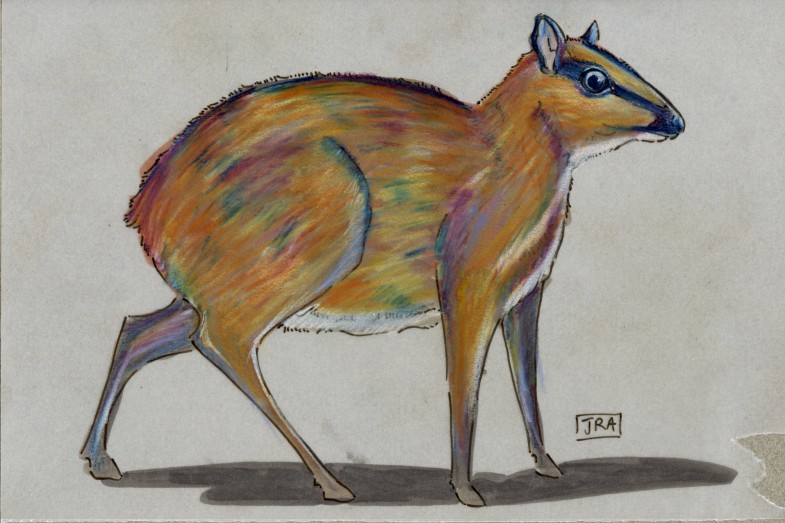
Greater Mouse-Deer (Tragulus napu)

by JR Kinyak on July 13, 2009

in Ungulates

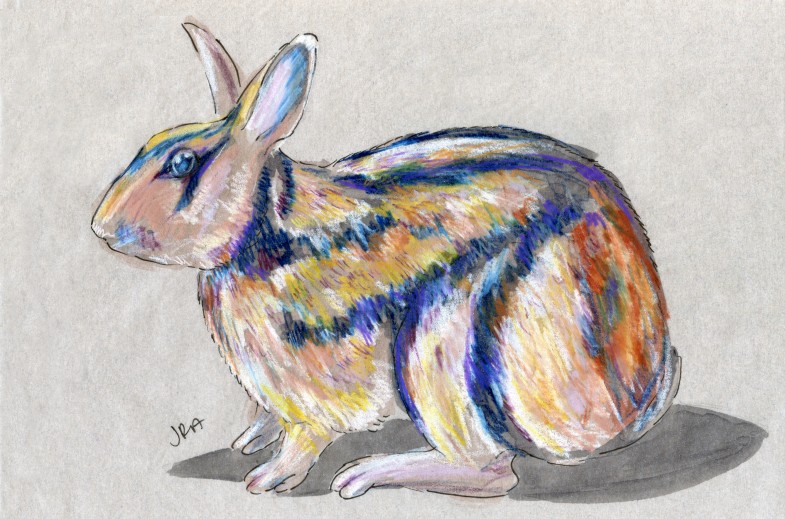
Greater mouse-deer (click image to enlarge)

Greater mouse-deer (click image to enlarge)


0273

The greater mouse-deer is a teeny-tiny little thing, more or less rabbit-sized with legs the size of pencils. (I drew this one’s front legs too big.) The deer, also called chevrotains, live in Brunei, Indonesia, Malaysia, Myanmar, and Thailand. They weigh about 11 pounds, and unusually for deer, they don’t have horns or antlers. They do have big ol’ upper canine teeth, though, that become tusk-like in males.

Here’s an alarming (to me) fact: female greater mouse-deer spend only about two hours between giving birth and becoming pregnant again! They’re pregnant their whole lives. This leads me to ask a question of my biologist readers: are the pregnancies of other mammals as uncomfortable as ours? I’m thinking of morning sickness, varicose veins, hemorrhoids, backache, swollen ankles, etc. Is this unique to humans, and if so, why?

A remarkable thing about greater mouse-deer (which are sometimes called “living fossils” because of how ancient they are as a species) is that they are amazingly good swimmers. Scientists have observed them fleeing predators—say, humans or mongooses—by jumping into the water and staying under for up to five minutes at a time. They’ll swim around for an hour to keep away from a threat. Another Asian mouse-deer species does the same thing, as does an African relative of the species. These observations have lent credence to the idea that whales evolved from deer-like mammals.

Supposedly, greater mouse-deer make good pets. I think they would look particularly cute paired up with an Italian greyhound.

BBC: “Aquatic deer and ancient whales”

{ 3 comments }

click image to enlarge

0240

Tonight, we conclude our celebration of Charles Darwin’s 200th birthday with one last look at a mammal he wrote about in The Origin of Species.

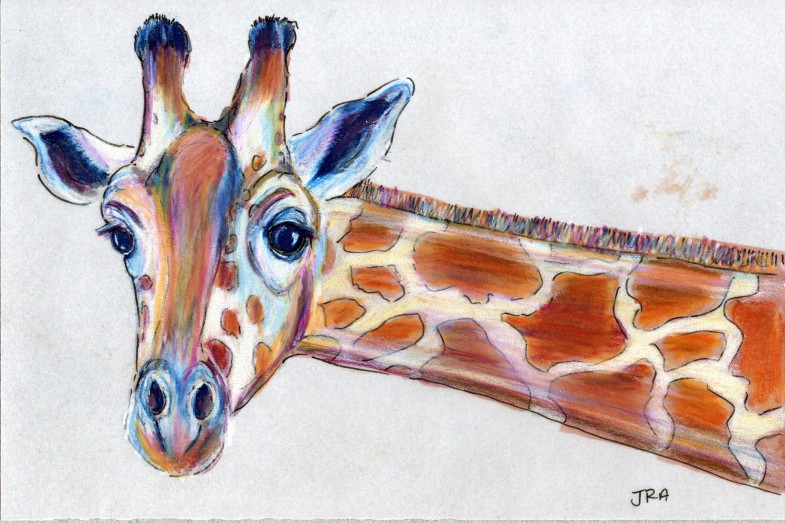
Although Darwin’s work is widely available for free online (see The Complete Work of Charles Darwin Online, and you’re probably all set), I still find it easier and more satisfying to thumb through an actual book. It’s kind of like rewinding a cassette tape versus placing a needle on a record. For me, anyway. So I bought a Penguin edition of Origin. There were three different printings to choose from at my bookstore, and I picked the middle one, price-wise, which seemed to have decent paper. Turns out it’s a reprint of the first edition, and Darwin produced six editions total, each quite different from the previous. All this is to say that in the sixth edition, Darwin added a second chapter dealing with objections to his theory. In that chapter, he discusses the giraffe in great detail, discussing how and why it might be advantageous for a “nascent giraffe” to evolve a long, long neck.

It seems that the giraffe is still throwing people for a loop. When I was researching giraffe photos online for reference, I found one posted on Flickr that had a long, not overly polite discussion in the comments section about whether or not it was possible for a giraffe’s neck to evolve, or whether the very fact of the giraffe’s long neck was proof of the creation of the giraffe as a whole being, immutable and perfect. To me, it seems a textbook example of natural selection: the protogiraffes with the longest necks were able to eat more than the others. They lived longer because they ate longer. They reproduced more because they lived longer. More giraffes were born with long necks. And so on. But people still have problems with it because the giraffe seems unique, because it requires special structural adaptations in order to operate with such a long neck, or maybe because it looks like something someone like Dr. Seuss would have had to think up.

The giraffe reference I particularly like in Origin, though, is in my first-edition reproduction. After discussing the problem of the evolution of organs of seeming perfection (like the eye), Darwin addresses the problem of the evolution of “organs of little apparent importance.” In his charmingly open and self-effacing way, he writes, “I have sometimes felt much difficulty in understanding the origin of simple parts, of which the importance does not seem sufficient to cause the preservation of successively varying individuals.” Darwin goes on to point out that we shouldn’t be so arrogant as to presume we know what’s important and what’s not. And the example he uses is the giraffe’s tail:

“The tail of the giraffe looks like an artificially constructed fly-flapper; and it seems at first incredible that this could have been adapted for its present purpose by successive slight modifications, each better and better, for so trifling an object as driving away flies; yet we should pause before being too positive even in this case, for we know that the distribution and existence of cattle and other animals in South America absolutely depends on their power of resisting the attacks of insects: so that individuals which could by any means defend themselves from these small enemies, would be able to range into new pastures and thus gain a great advantage. It is not that the larger quadrupeds are actually destroyed (except in some rare cases) by the flies, but they are incessantly harassed and their strength reduced, so that they are more subject to disease, or not so well enabled in a coming dearth to search for food, or to escape from beasts of prey.”

First of all, don’t you love that 19th-century sentence structure, with endless commas, colons, semicolons, and then more commas? I love it. What Darwin is saying here* is that a fly-swatter is not as trivial as it seems. Fighting off flies saps a person’s energy, and so it makes sense that the best fly-flighters would have a reproductive advantage. I imagine this is why giraffes have such lovely eyelashes, too.

My husband Ted has a theory that sexual selection could play a part here (see my lion post of a couple days ago). In his theory, female giraffes would be more attracted to those male giraffes who coolly switched their tails, rather than those who itched and jumped because flies were crawling all over them. It makes sense to me.

*I should note that my mammalogy is completely self taught. Two of my worst teachers ever were my two biology teachers (7th grade and 8th grade). What knowledge I have of science is from my dad (a geologist and painter) and my own curiosity and love of animals. So if I’m telling you really, really obvious things about evolution, I apologize. I’m just learning it all myself.

{ 2 comments }

click image to enlarge

0239

Welcome, readers of the Blog for Darwin blog carnival! (A blog carnival is a collection of posts from different blogs but on the same topic. I’m participating in one that compiles posts related to Darwin today through the 15th. Click the link above to read some of the other bloggers’ posts.) At the Daily Mammal, we’re celebrating Charles Darwin’s 200th birthday (today! happy birthday!) with a look at some of the mammals that Darwin mentions in his Origin.

Chapter Six of Origin is dedicated to answering some of the problems that Darwin anticipates people finding with his theory. One of these issues is the seemingly amazing perfection of certain natural structures, like the eye, and the incredulity with which people consider that such perfection could arise gradually through natural selection. Another is the apparent lack of transition species: if species are always changing one into another, why don’t we see all kinds of transition species, both now and in the fossil record? And how is it even possible that, for instance, a land animal could evolve into an aquatic one? How would the transitional species in between have lived?

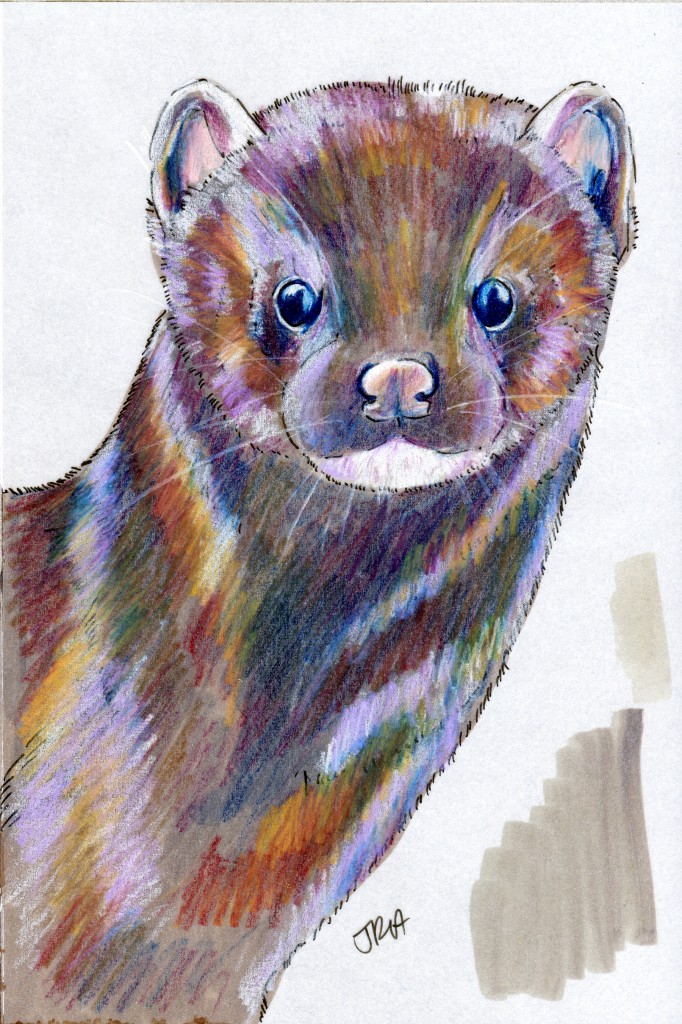
That’s where this fellow, the American mink, comes in. Darwin writes:

“It would be easy to show that within the same group carnivorous animals exist having every intermediate grade between truly aquatic and strictly terrestrial habits; and as each exists by a struggle for life, it is clear that each is well adapted in its habits to its place in nature. Look at the Mustela vison of North America, which has webbed feet and which resembles an otter in its fur, short legs, and form of tail; during summer this animal dives for and preys on fish, but during the long winter it leaves the frozen waters, and preys like other polecats on mice and land animals.”

So, taking this mink as an example, if certain traits that lent themselves to living in the water began to be an advantage in the struggle for survival—say, water levels rose or predators pushed the minks out of their normal territory into one more waterlogged—the minks that were better adapted to aquatic living would be more likely to survive and reproduce their genes. And with successive generations, these characteristics would be strengthened, and as more and more minks were born with these adaptations, they would through greater numbers eventually take over, and perhaps we would have a new species. At least that’s this laywoman’s interpretation of the idea. Another example:

“In North America a black bear was seen by Hearne swimming for hours with widely open mouth, thus catching, like a whale, insects in the water. Even in so extreme a case as this, if the supply of insects were constant, and if better adapted competitors did not already exist in the country, I can see no difficulty in a race of bears being rendered, by natural selection, more and more aquatic in their structure and habits, with larger and larger mouths, till a creature was produced as monstrous as a whale.”

Another thing to ponder is the way humans, through hunting, for instance, are creating unnatural selection. A recent study found that as bighorn sheep are hunted for their gigantic, beautiful, curling horns, those with smaller, less impressive horns are more likely to survive and reproduce. The result seems to be a decrease in horn size across the population. And since it seems that those bighorns with the biggest horns are also the most healthy and strongest, hunters are creating a weakened population. Some are calling it “evolution in reverse.” Perhaps we would have seen something like this in the minks if fur farms hadn’t overtaken the hunting of wild minks, and if trappers and mink hunters could selectively trap and hunt only the minks with the lushest coats.

Mink are fairly solitary and fairly nocturnal. They live in burrows beside rivers and they dine on crayfish and frogs in the summer, as Darwin noted, and small mammals like shrews and rabbits in the winter. Sometimes they use fur from their prey to line their dens. They are good at swiming, diving, and climbing.

{ 5 comments }

Darwin Days: Lion (Panthera leo)

by JR Kinyak on February 11, 2009

in Carnivores, Theme Weeks

click image to enlarge
0238

It’s quite fashionable to equate the theory of evolution with Charles Darwin himself. Science magazines and books sell with covers blaring “Darwin Was Wrong,” “Was Darwin Wrong?,” and “What Darwin Got Wrong.” Meanwhile, intelligent-design and creationism proponents attack “Darwinism,” and the New York Times publishes “Darwinism Must Die So That Evolution May Live” and “Let’s Get Rid of Darwinism.” By creating an -ism, the New York Times pieces suggest, “Darwinists” devalue their own arguments, putting them on the same level as, for instance, creationism.

The fact, as far as I can tell, is that Darwin was right about many, many things, and most of those things that he was wrong about (mainly because things like genetics and continental drift hadn’t yet been discovered, and the man couldn’t do it all!) have nevertheless been built on his foundation. Many of the articles celebrating Darwin’s bicentennial point out how remarkable it is that after 150 years, On the Origin of Species is still relevant. Today we’ll talk about one of the ideas Darwin had before his time and that is still being studied and proven: sexual selection.

Basically, sexual selection refers to the favoring of certain traits solely because they are attractive to mates. As Darwin says in Chapter 4 of Origin, “This depends, not on a struggle for existence, but on a struggle between the males for possession of the females; the result is not death to the unsuccessful competitor, but few or no offspring.” To attract females, males develop showy traits like bright feathers, big antlers, or electric guitars. The reasons why females are attracted to these things in the first place are not fully known; it could be that a male with big horns, for instance, has good genes in other ways; another theory holds that if a male can thrive despite the “handicap” of a huge tail or something, he must be pretty strong.

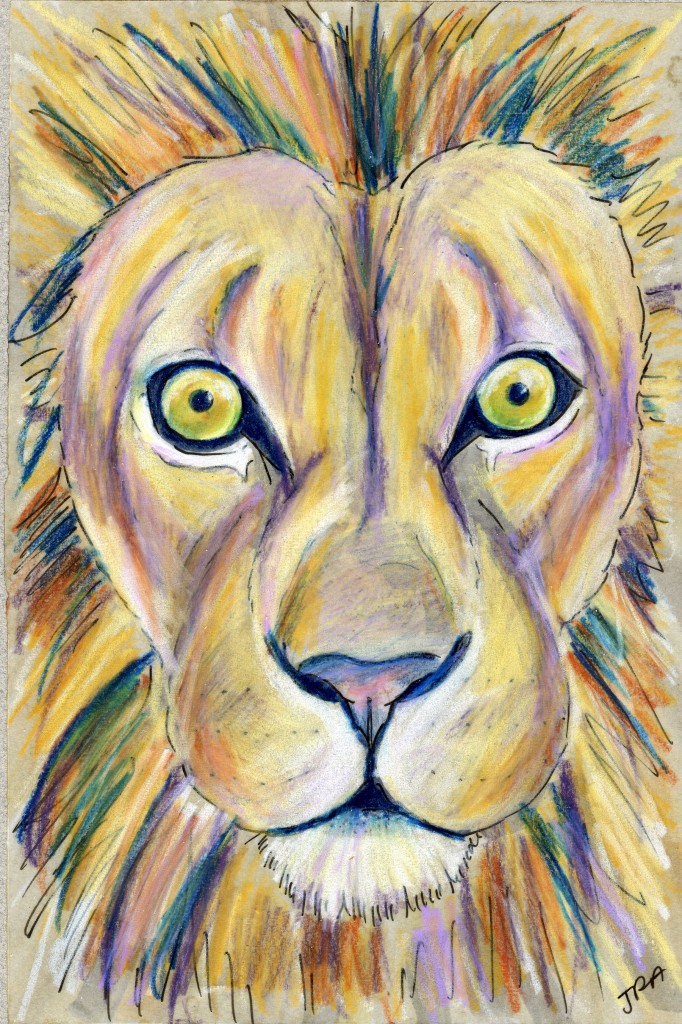
The lion’s mane has long been a puzzle. In 1859, in Origin, Darwin wrote, “The males of carnivorous animals are already well armed; though to them and to others, special means of defence may be given through means of sexual selection, as the mane of the lion, and the hooked jaw to the salmon; for the shield may be as important for victory, as the sword or spear.” The going theory for many years was that manes protected male lions from the claws and teeth of their rivals, but now it doesn’t appear that’s true because fighting lions don’t tend to go for the head and neck in particular.

Studies in the past several years have focused on the variations in mane length and color. Researchers found that the luxuriousness of a lion’s mane depended on its climate: lower, hotter, and more humid climates meant skimpier, lighter-colored manes because it can get hot under all that hair. The researchers were also surprised to learn that manes continue developing after the lion’s sexual prime has come and gone. In the hottest places, older males are the only ones with manes to write home about. It makes me wonder if there could be a reverse sexual selection going on there: if you don’t have a mane in a hot place, does it indicate that you’re younger and therefore more virile? I don’t know.

Scientists also fooled around with trying to lure both male and female lions with fake dummy lions of varying mane lengths. They found that males approached the shorter-maned dummies 9 out of 10 times, and females approached the longer-maned ones 13 out of 14 times. The males that intrigued the females intimidated the other males, in other words.

Here’s a book I read part of once that postulates that all human creative culture—from art to architecture to comedy to writing books, etc.—is the result of sexual selection. In other words, men do cool things because chicks dig it: The Mating Mind by Geoffrey Miller.

{ 3 comments }

click image to enlarge

0235
0234
0233
0232
0237
0236

The day after tomorrow, February 12, 2009, is Charles Darwin’s 200th birthday. (It’s also Abraham Lincoln’s.) I’ve recently begun reading Darwin’s The Origin of Species, and I’ve decided to try to do a little something in celebration of Darwin’s immense contribution. I’m going to be highlighting a few mammals that Darwin discusses in The Origin of Species, and I’ll try to tell you something of what Darwin says about them. Since I haven’t read the whole book, I’m going to be reading the sections that mention these mammals out of order and a bit out of context, but I’ll do my best, and maybe my more Darwin-literate readers can help out where needed. I also am pretty clueless as to where Darwin’s ideas have been expanded or improved upon. Incidentally, the book is actually quite accessible, and I’m sorry I didn’t read it earlier. You can read it online or download a PDF at Google Books.

Chapter Five of The Origin of Species is titled “Laws of Variation.” In a section called “Effects of Use and Disuse,” Darwin posits that the shrunken state of the wings of some birds on islands where they have no predators results from disuse. There’s nothing to fly away from, so generations of birds stopped flying and used their legs more, and through natural selection their legs were strengthened and their wings, eventually, made useless. As another example, Darwin discusses animals that live in underground burrows and caves and have small, furred-over, or absent eyes, thanks to disuse. It’s dark down there, so eyes aren’t very helpful, and gradually, they are selected out, while things like longer whiskers and antennae, which are helpful underground, are favored.

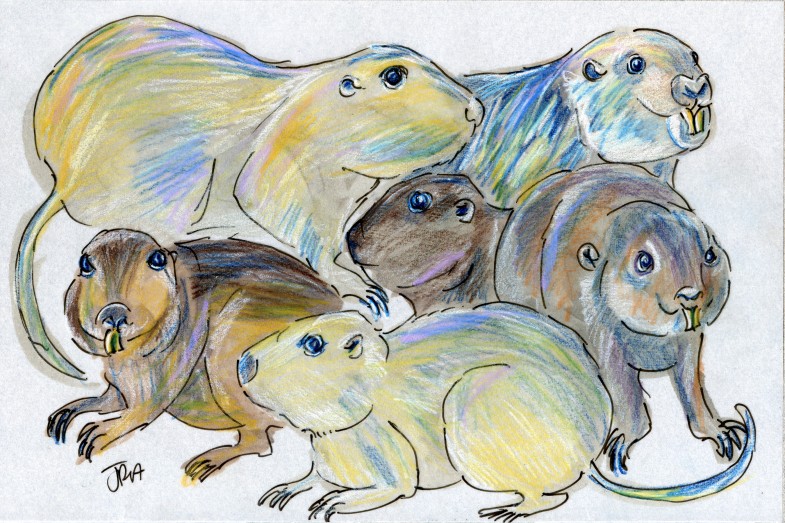
The tuco-tucos, of which there are some 50 different species, live in burrows in South America. Although they spend a lot of time underground, they do occasionally peer out of their homes, and their small but useful eyes allow them to do that without necessarily having to actually exit the premises. It’s easy for them to duck back under if need be. (The amount of time they spend outside their burrows varies from species to species.)

Darwin says that he was told by someone who caught a lot of tuco-tucos that they are often blind. A tuco-tuco that Darwin kept in captivity was blind, he says, thanks to an inflammation of the eye. As Darwin points out, animals that live primarily underground don’t really need their eyes, and eyes are just another thing that can get infected, so why not do away with them? (Eventually. Over generations.)

Genetic analysis of one tuco-tuco species, the colonial tuco-tuco (C. sociabilis) yielded surprising results a few years back. For the past three millennia, the colonial tuco-tuco has had almost no genetic diversity. Usually, a lack of genetic variation means doom for a species, but the colonial t-t has survived pretty well. The reason, researchers think, is that it has evolved a very social way of life, unlike the other tuco-tuco species. If everyone is related, there’s no reason to compete; instead, you can help your cousins breed, since they’re passing on your genes, as well as their own. (In a practical sense, I think I would be more likely to get along with everyone if they were more or less my clones, too, but personality clashes are probably not a significant factor in the colonial t-t’s survival.)

According to Walker’s Mammals of the World, “Systematic understanding of this complex genus is in a state of flux, and it is likely that there will be much change in the number and relationships of species…” In this drawing of the goofy-looking guys, clockwise from the upper right are C. fulvus, C. sociabilis, C. flamarioni, C. talarum, C. peruanus, and in the middle, C. haigi.

{ 8 comments }

Hispaniolan Solenodon (Solenodon paradoxus)

by JR Kinyak on January 10, 2009

in Other Orders

click image to enlarge

0202

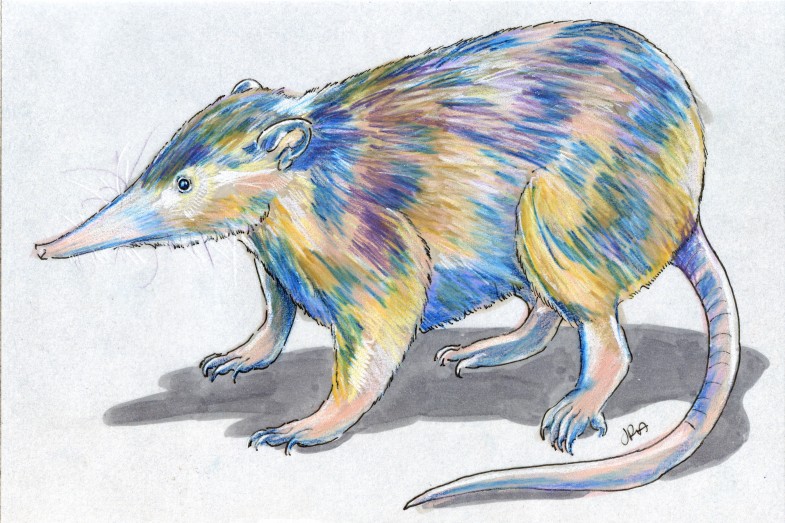
This shaggy, shrewy solenodon lives only on the island of Hispaniola, which comprises Haiti and the Dominican Republic. This species is one of only two in the solenodon genus. The other lives in Cuba.

The word solenodon comes from the Latin for groove-tooth, referring to an unusual feature: solenodons’ lower incisors have a channel connected to a gland, through which they can inject venom. While there are a few other venomous mammals, such as the male duck-billed platypus and a couple species of shrew, only solenodons can actively inject poison with their teeth.

The two solenodon species, genetic research tells us, diverged from all the rest of mammalia some 76 million years ago, during the Cretaceous period, when dinosaurs dominated the earth. This is crazily early. And the two species separated from each other about 25 million years ago, which means they’re not even that closely related. (This is around the time—give or take a few million years—that humans diverged from the Old World monkeys such as this week’s proboscis and Tonkin snub.)

Like other island dwellers, the Hispaniolan solenodon neglected to acquire the adaptations that would give it half a chance to survive against bigger, more intimidating predators. It was used to being a big fish (mammal) in a small pond (island), and so the humans who showed up, along with their accompanying dogs and mongooses, have been able to drive it into a perilously endangered existence.

BBC News, January 9, 2009: “Venomous mammal caught on camera.” (Thanks, Clare!)

EDGE (Evolutionarily Distinct & Globally Endangered) blog, January 9, 2009: “Hispaniolan solenodons—rediscovery and footage!”

{ 6 comments }