Posts tagged as:

endangered

Spectacled Bear (Tremarctos ornatus)

by JR Kinyak on April 12, 2010

in Carnivores

Spectacled bear (click image to enlarge)

0292

The only bear from South America, the spectacled bear lives in Venezuela, Ecuador, Colombia, Peru, and Bolivia. It gets its name, of course, from its professorial appearance, and it’s also known as the Andean bear, or ucumari in a native Andean language. The bear is a small one, as bears go, with males weighing up to 340 pounds and females only up to 180. There may be only a few thousand spectacled bears left in the wild. They are threatened by poaching, by habitat destruction (of course), and by farmers whose crops they try to eat. They are also used in traditional medicine and sometimes eaten. The bears themselves like to eat plants and fruit, especially bromeliads, but they’ll occasionally eat small animals.

Theo, without knowing that the bear is sometimes known, in Spanish, as oso real, drew a spectacled bear with a crown.

Spectacled bear by Theo, age 13 (click image to enlarge)

Coco drew a wonderful spectacled bear, too.

Spectacled bear by Coco, age 11 (click image to enlarge)

{ 4 comments }

Black-handed Spider Monkey (Ateles geoffroyi)

by JR Kinyak on September 15, 2009

in Primates

Black-handed spider monkey (click image to enlarge)

Black-handed spider monkey (click image to enlarge)


0287

These incredibly agile monkeys live throughout Central America. They’re very social, swinging through the treetops in groups of 20 or 30, munching on fruit, leaves, and flowers. They’re important distributors of fruit seeds, dispersing them through their digestive system. Unfortunately, the black-handed spider monkey is endangered due to habitat loss.

{ 0 comments }

Iberian Lynx (Lynx pardinus)

by JR Kinyak on July 8, 2009

in Carnivores

Iberian lynx (click image to enlarge)

Iberian lynx (click image to enlarge)


0270

The Iberian lynx is the most endangered cat species in the world. In fact, it’s in imminent danger of being the first cat to become extinct since the saber-toothed tiger. While the cats once lived in both Spain and Portugal, there’s no sign of them in Portugal anymore, and they’re confined to only two small regions in Spain now. Fewer than 150 Iberian lynx live in the wild. Fewer than 150.

The good news is that a captive-breeding program has been fairly successful; it’s preparing to release its first kittens two years ahead of schedule. Scientists have also made an important, if sad, discovery about the Iberian lynx. Most Iberian lynx litters are made up of three kittens. It turns out that it’s not uncommon for the kittens to fight to the death when they’re between 30 and 60 days old. In most litters, one kitten doesn’t survive, having been killed by a littermate. With fewer than 150 wild lynx in existence, losing one third of them while they’re still babies is particularly poignant.

Why is the Iberian lynx in so much trouble? One of the biggest reasons is that it eats almost nothing but rabbits, and depending on only one food source is never the best strategy. In the latter half of the 20th century, the rabbit population on the Iberian peninsula declined drastically not only because of deforestation, real estate development, and hunting, but also because one French doctor, in 1952, decided to control the rabbits in his garden by introducing myxomatosis, a rabbit disease. By 1954, myxomatosis had killed 90 percent of French rabbits and had spread throughout Europe, where it eventually killed off a significant portion of the Iberian lynx’s all-you-can-eat-as-long-as-it’s-rabbits food supply. Deforestation and other forms of habitat destruction affect the lynx directly, as well.

El Programa de Conservación Ex-Situ del Lince Ibérico (it’s in Spanish)
SOS Lynx, a Portugal-based organization working to save the Iberian lynx

{ 3 comments }

Tasmanian devil (click image to enlarge)

Tasmanian devil (click image to enlarge)


0262

Tasmanian devils are feisty, aggressive guys, with a screech that’s invariably described as bloodcurdling or bone-chilling. They dine on carrion, and they especially love to eat dead wallabies and opossums. They get into scuffles over their food, during which they nip at each other’s faces, and their complicated, violent mating rituals also involve rival males biting each other’s faces. Tasmanian devils have extremely strong jaws, which let them crunch on bones. Their genus name, Sarcophilus, means “flesh lover.” Listen to their screams in this video:

But Tasmanian devils are in big trouble: over the past 13 years, the wild devil population has fallen by 70 percent.

The devils are falling victim to a vicious, communicable cancer called devil facial tumor disease. Their face-biting just helps the cancer spread. The Australian government declared the devils endangered last week, and frantic efforts to save the species include captive breeding programs on the Australian mainland, the quarantine of non-affected populations with devil-proof fences, and the release of breeding pairs on isolated islands, in addition to a search for a vaccine for their cancer. If these attempts don’t work, the Tasmanian devil could be extinct within a decade or two.

  • Save the Tasmanian Devil
  • Tassie Devil Cancer Awareness
  • Tassie Devil Appeal: breed a virtual devil
  • National Geographic: “‘Teen Sex’ Rising for Cancer-Affected Tasmanian Devils”
  • { 0 comments }

    Amami Rabbit (Pentalagus furnessi)

    by JR Kinyak on May 8, 2009

    in Other Orders

    Amami rabbit (click image to enlarge)

    Amami rabbit (click image to enlarge)


    0258

    This fuzzy, stout rabbit lives only on the Japanese islands of Amami and Tokuno. It’s endangered, and both its population and its range have been decreasing. There are probably fewer than 5,000 of these rabbits in existence. They’re considered “living fossils” because they are very similar to ancient fossil rabbits and markedly different from other living rabbit species. They have unusually short ears, long noses, sturdy bodies, dark and dense fur, and curved claws.

    Because they’re nocturnal and rare, Amami rabbits are still somewhat mysterious to science. One curious habit they have is that of sealing up their nursing burrows. A female Amami rabbit will give birth in a special burrow, then seal it up when she goes out for the night. She’ll come back to nurse the babies once every couple of nights. This goes on for a few months, at which point she ushers the babies out of the house, telling them it’s time to take care of themselves for once.

    In addition to ordinary endangered species lists, Japan also designates what it calls natural monuments. These are plants or animals, natural features and structures, minerals, or wilderness areas. To qualify as a natural monument, something must be not only threatened, but also culturally important. Of the almost 1,000 natural monuments, 75 are classified as special natural monuments, and the Amami rabbit is one.

    “The Secretive Rabbits of Amami, The Japan Times

    Amami rabbit on the EDGE (evolutionarily distinct and globally endangered) website

    { 3 comments }

    Guadalupe fur seal (click image to enlarge)

    Guadalupe fur seal (click image to enlarge)


    0257

    Between yesterday’s squirrel and this seal today, I’m thinking about just going ahead and declaring this Interesting Ears Week.

    The Guadalupe fur seal, as a species, has a dramatic story, full of hope and heartbreak. Once numerous from the Revillagigedo Islands of Mexico to the Farallones off of San Francisco, the seals were hunted so relentlessly in the 19th century that they were thought to be extinct from 1895 to 1926. Then, some fishermen “discovered” a group of them on Guadalupe Island, off Baja California. What did these fishermen do with these invaluable seals, thought lost forever? Why, killed them, of course.

    Everyone thought they were gone for good again, but in 1949, one bull was spotted, and in 1954, people found a group on Guadalupe Island. In the half-century since then, and thanks to legal protection in both Mexico and the United States, the seals have made it back up to the Farallones once more, and their population is increasing.

    { 0 comments }

    Click image to enlarge.

    Click image to enlarge.

    0251

    Our current system of naming animals and plants is based on the system that Carl Linnaeus published in 1758. While others, including Aristotle, had previously attempted to organize the world’s living things into various arrangements, Linnaeus gave us an important innovation: the binomial system. Each animal (or plant or whatever) is known by a unique pair of names; no other creature has the same name. We’re the only Homo sapiens; the cotton-top tamarin is the only Saguinus oedipus. (Of course, there can be other members of the genus Homo and the genus Saguinus, but they have to have distinctive second, or species, names.)

    The organization that keeps track of and codifies the system of naming animals is the International Commission on Zoological Nomenclature. The rules are quite extensive. My favorite guidelines are those that require namers to make every effort to ensure that their names are euphonious (pleasing to the ear) and that they don’t give offense.

    Linnaeus was Swedish, but he wrote in Latin, as did pretty much everyone else writing about scientific matters at the time. The scientific names of animals are often referred to, casually, as their Latin names, and the rules governing naming do require the Latinization of some words. But there’s also a lot of classical Greek in the names, and many names derive from local words for the animals.

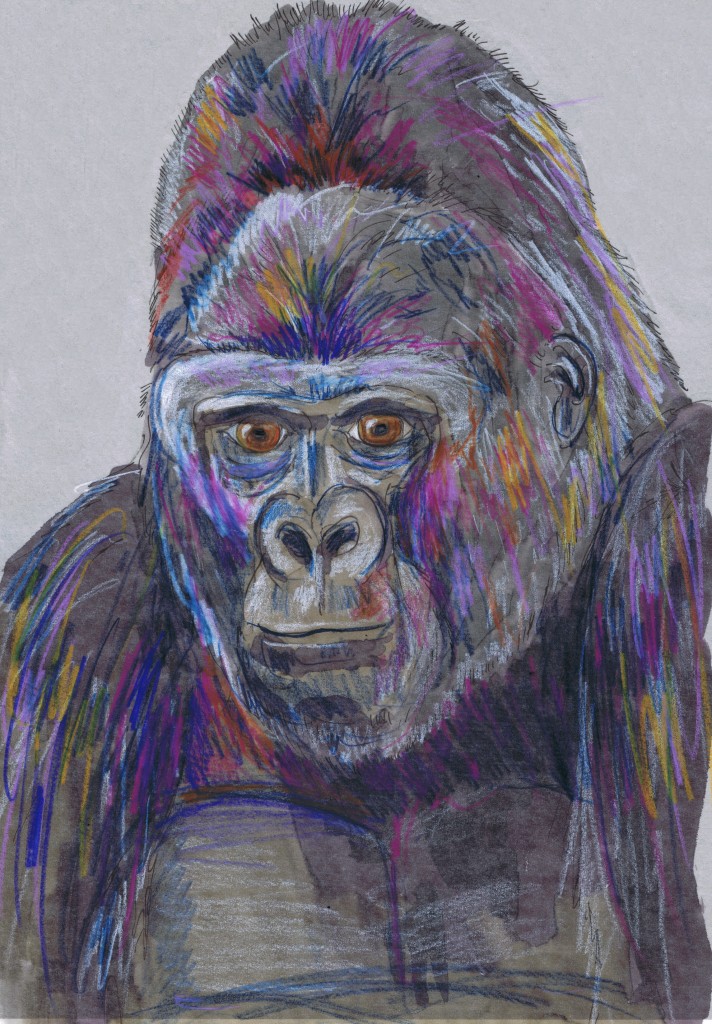
    Many animals have redundant names (tautonyms, to use the official terminology), like Gorilla gorilla, Dama dama, and Uncia uncia. Usually, this happens when the name of the animal’s genus (the first name in the binomial system) changes, but the species name can’t. I like the black rhinoceros’s name because it’s redundant in two languages: diceros means two horns in Greek and bicornis means two horns in Latin.

    The black rhinoceros’s common name is odd, too. The rhino is not black; it’s gray. Apparently, it was named the black rhinoceros to distinguish it from the white rhinoceros, which is also gray, not white. That animal’s common name comes from the Dutch word weit, which means wide, like the rhino’s muzzle. (My source for all this is A.F. Gotch’s book Mammals: Their Latin Names Explained.)

    The black rhino is classified as critically endangered, the last step before extinction. It’s so bad, in fact, that the IUCN, which assesses the status of the world’s species, obscures the rhino’s range on its map “for security reasons.” While the black rhino was pretty numerous at the start of the 20th century, poaching caused a 96 percent decrease in the species’ population between 1970 and 1992. Black rhino horns are carved to create decorative handles for weapons and used in traditional medicine. Traditional medicine is going to be the death of a lot of mammal species.

    { 2 comments }