Posts tagged as:

elephant

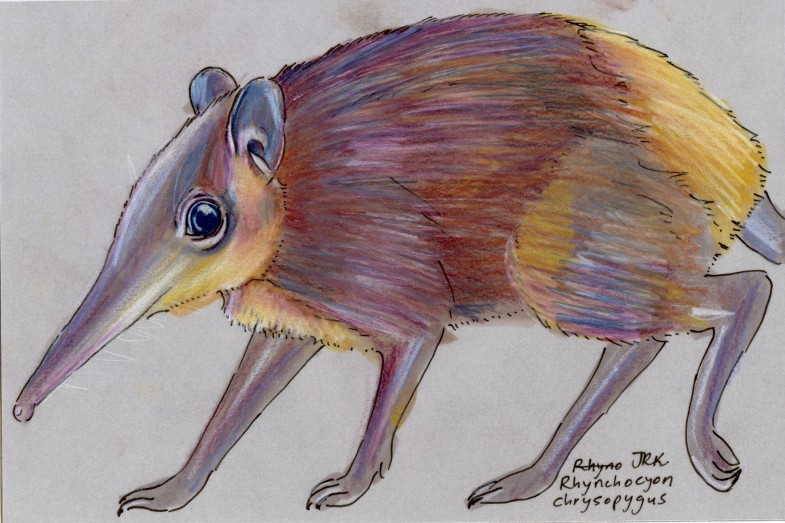
Golden-rumped elephant shrew (click image to enlarge)


0398

Here is the golden-rumped elephant shrew, which is also known as a golden-rumped sengi, or a yellow-rumped either one of those. It’s not actually related to the shrews, although it is related to the elephants, distantly. Some things I’ve learned about this fellow:

1. Translating its scientific name at the website of a zoology course at the University of Alberta, I see that this sengi’s official name means snout-dog golden-rump. (Pygos means rump, and is found in the word callipygian, “having well-shaped buttocks,” which is one of those words that middle-schoolers delight in discovering in the dictionary.)

2. The rump is golden for a reason. That pretty blond fur covers a padded area of super-tough skin. The idea seems to be that predators will be attracted to the golden glow and bite there, rather than somewhere that might hurt more.

3. The golden-rumped sengi lives only in a tiny area of coastal Kenya.

4. It’s number 46 on the EDGE list of the top 100 evolutionarily distinct and globally endangered mammals—in other words, this endangered species is particularly irreplaceable.

5. This elephant shrew is monogamous, which is quite rare for a small mammal, or indeed, any mammal.

6. It can be very difficult to distinguish between the members of the Rhynchocyon genus, also known as the giant forest sengis, in the field, but the California Academy of Sciences has a page dedicated to helping you tell them apart.

7. According to the American Society of Mammalogists’ species account of this elephant shrew,

“If mildly disturbed, Rhynchocyon freezes until the danger passes, or, if further disturbed, it walks away while loudly slapping the leaf litter with its tail every 1 to 3 seconds. If pursued, Rhynchocyon takes flight using a swift half-bound gait…hammering the leaf litter loudly with its rear legs, and producing a characteristic “crunch, crunch, crunch” sound as it disappears.”

8. The golden-rumped elephant shrew is diurnal, or active during the day, and spends its nights in a nest it builds on the forest floor. For some reason, it requires a new nest every other day or so. It builds the new nest in the morning, and the construction takes about two hours.

Below is Coco’s golden-rumped elephant shrew. See you tomorrow!

Golden-rumped elephant shrew by Coco, age 12

{ 4 comments }

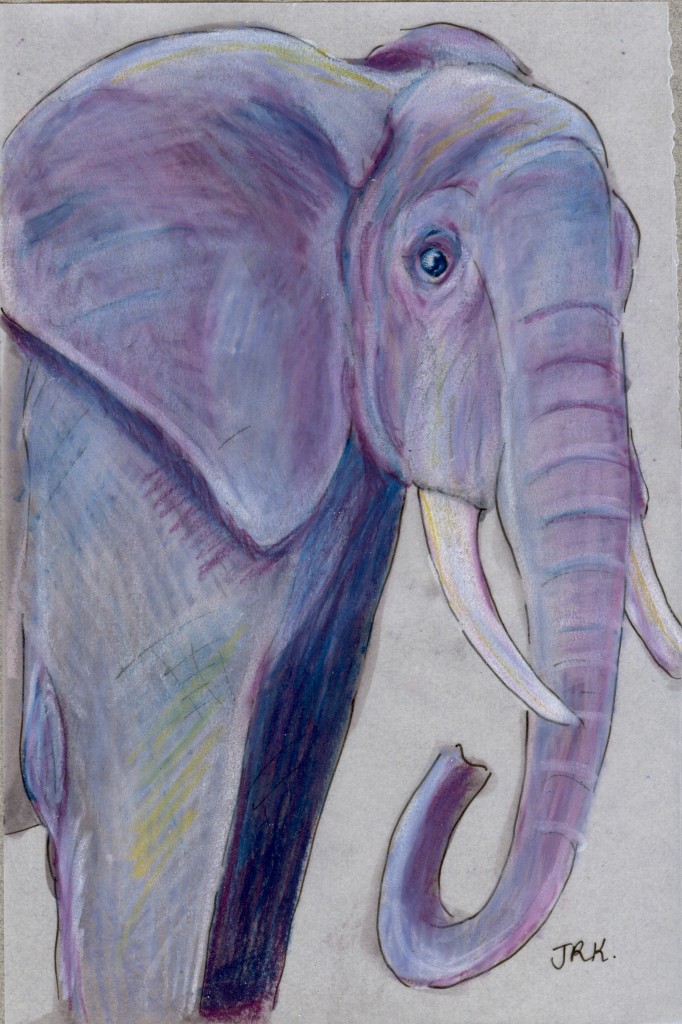
African bush elephant (click image to enlarge)

0319

We’re still celebrating the World Cup here at the Daily Mammal, and today we’re closing out Group B with Nigeria and the African bush elephant. These days, scientists generally divide the African elephant into two species, the bush elephant and the forest elephant. Then there’s the Asian elephant, for a total of three kinds of elephants in the world. The biggest is the African bush elephant, which can stand nearly 12 feet tall and weigh, oh, 10 tons or so. In fact, the African bush elephant is the largest land mammal of all.

I’ve just learned a few interesting things about elephants. One is that the sound of buzzing bees will drive elephants away, which means there may be an easy way to keep them from destroying farms and getting themselves killed: play them a recording of a buzzing hive, and feet-don’t-fail-me-now, or at least until they realize that it is just a recording. We need to do more study to see what would happen.

Another thing: the most common natural death for elephants is starvation. They go through several sets of teeth, each new set growing in just as the previous set is used up. But the last of their teeth are worn out around the age of 65 or 70, not to be replaced, and without being able to really eat, they starve to death. It seems so cruel, but that’s evolution for you.

And finally, a new word: musth. It’s the name for a periodic state that male elephants go through, when their testosterone levels shoot up and they become aggressive, cranky, and dangerous to know, with only one thing on their minds. The word comes from a Persian word meaning intoxicated. (The link above is to a site about keeping elephants in zoos and circuses. About musth, it says, “It is also very discouraging for the elephant keeper to work with a withdrawn, extremely aggressive elephant, which disapproves everything and actually is out to kill him.” I imagine that’s true!)

Nigeria’s soccer team is nicknamed the Super Eagles. This is their fourth World Cup; twice before they’ve made it to the Round of 16, but never any further. They came in third in this year’s African Cup of Nations, the biggest tournament in Africa (well, when the World Cup isn’t there, of course). I suppose it’s possible that they could move out of the first round this year, but of all the possible endings in Group B, only one allows that possibility. (They need Argentina to beat Greece, and then Nigeria needs to beat South Korea, and the goal differential among the non-Argentina teams needs to fall in Nigeria’s favor.) I wish that in this first World Cup held in Africa the African teams were doing better, but Ghana is the only one that’s won a game so far. (Nigeria likely would have won against Greece if not for Sani Kaita’s red card; see my Greece post for more on that.)

Group B Results

What two mammals will continue on to the Group of 16 Mammals from Group B? We have South Korea’s leopard cat, the Mediterranean horseshoe bat from Greece, Argentina’s Patagonian mara, and this here elephant. The bat may be able to get some draws by flying away from the match. Let’s say that’s what it does in all three matches, earning it 3 points (you get one point for a draw in the World Cup). The elephant obviously would trample the mara and the cat, giving it three points for each win and one for its draw with the bat, or a total of 7 points. I think the cat would beat the mara and draw with the bat, so it would have 4 points, and the mara would just have one point for its draw with the bat. So continuing on to the next round from this group are:

African bush elephant (Nigeria)
and
Leopard cat (South Korea)

{ 8 comments }