Posts tagged as:

dna

click image to enlarge

0235
0234
0233
0232
0237
0236

The day after tomorrow, February 12, 2009, is Charles Darwin’s 200th birthday. (It’s also Abraham Lincoln’s.) I’ve recently begun reading Darwin’s The Origin of Species, and I’ve decided to try to do a little something in celebration of Darwin’s immense contribution. I’m going to be highlighting a few mammals that Darwin discusses in The Origin of Species, and I’ll try to tell you something of what Darwin says about them. Since I haven’t read the whole book, I’m going to be reading the sections that mention these mammals out of order and a bit out of context, but I’ll do my best, and maybe my more Darwin-literate readers can help out where needed. I also am pretty clueless as to where Darwin’s ideas have been expanded or improved upon. Incidentally, the book is actually quite accessible, and I’m sorry I didn’t read it earlier. You can read it online or download a PDF at Google Books.

Chapter Five of The Origin of Species is titled “Laws of Variation.” In a section called “Effects of Use and Disuse,” Darwin posits that the shrunken state of the wings of some birds on islands where they have no predators results from disuse. There’s nothing to fly away from, so generations of birds stopped flying and used their legs more, and through natural selection their legs were strengthened and their wings, eventually, made useless. As another example, Darwin discusses animals that live in underground burrows and caves and have small, furred-over, or absent eyes, thanks to disuse. It’s dark down there, so eyes aren’t very helpful, and gradually, they are selected out, while things like longer whiskers and antennae, which are helpful underground, are favored.

The tuco-tucos, of which there are some 50 different species, live in burrows in South America. Although they spend a lot of time underground, they do occasionally peer out of their homes, and their small but useful eyes allow them to do that without necessarily having to actually exit the premises. It’s easy for them to duck back under if need be. (The amount of time they spend outside their burrows varies from species to species.)

Darwin says that he was told by someone who caught a lot of tuco-tucos that they are often blind. A tuco-tuco that Darwin kept in captivity was blind, he says, thanks to an inflammation of the eye. As Darwin points out, animals that live primarily underground don’t really need their eyes, and eyes are just another thing that can get infected, so why not do away with them? (Eventually. Over generations.)

Genetic analysis of one tuco-tuco species, the colonial tuco-tuco (C. sociabilis) yielded surprising results a few years back. For the past three millennia, the colonial tuco-tuco has had almost no genetic diversity. Usually, a lack of genetic variation means doom for a species, but the colonial t-t has survived pretty well. The reason, researchers think, is that it has evolved a very social way of life, unlike the other tuco-tuco species. If everyone is related, there’s no reason to compete; instead, you can help your cousins breed, since they’re passing on your genes, as well as their own. (In a practical sense, I think I would be more likely to get along with everyone if they were more or less my clones, too, but personality clashes are probably not a significant factor in the colonial t-t’s survival.)

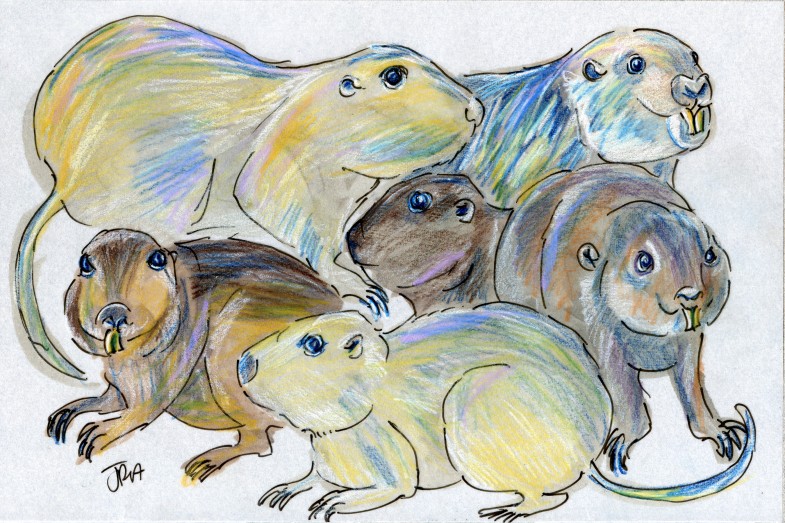
According to Walker’s Mammals of the World, “Systematic understanding of this complex genus is in a state of flux, and it is likely that there will be much change in the number and relationships of species…” In this drawing of the goofy-looking guys, clockwise from the upper right are C. fulvus, C. sociabilis, C. flamarioni, C. talarum, C. peruanus, and in the middle, C. haigi.

{ 8 comments }

Hispaniolan Solenodon (Solenodon paradoxus)

by JR Kinyak on January 10, 2009

in Other Orders

click image to enlarge

0202

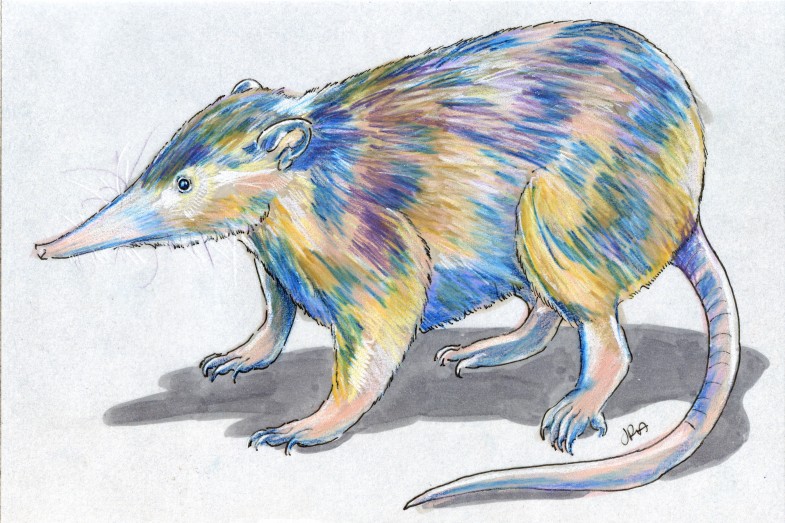
This shaggy, shrewy solenodon lives only on the island of Hispaniola, which comprises Haiti and the Dominican Republic. This species is one of only two in the solenodon genus. The other lives in Cuba.

The word solenodon comes from the Latin for groove-tooth, referring to an unusual feature: solenodons’ lower incisors have a channel connected to a gland, through which they can inject venom. While there are a few other venomous mammals, such as the male duck-billed platypus and a couple species of shrew, only solenodons can actively inject poison with their teeth.

The two solenodon species, genetic research tells us, diverged from all the rest of mammalia some 76 million years ago, during the Cretaceous period, when dinosaurs dominated the earth. This is crazily early. And the two species separated from each other about 25 million years ago, which means they’re not even that closely related. (This is around the time—give or take a few million years—that humans diverged from the Old World monkeys such as this week’s proboscis and Tonkin snub.)

Like other island dwellers, the Hispaniolan solenodon neglected to acquire the adaptations that would give it half a chance to survive against bigger, more intimidating predators. It was used to being a big fish (mammal) in a small pond (island), and so the humans who showed up, along with their accompanying dogs and mongooses, have been able to drive it into a perilously endangered existence.

BBC News, January 9, 2009: “Venomous mammal caught on camera.” (Thanks, Clare!)

EDGE (Evolutionarily Distinct & Globally Endangered) blog, January 9, 2009: “Hispaniolan solenodons—rediscovery and footage!”

{ 6 comments }

click image to enlarge

0127

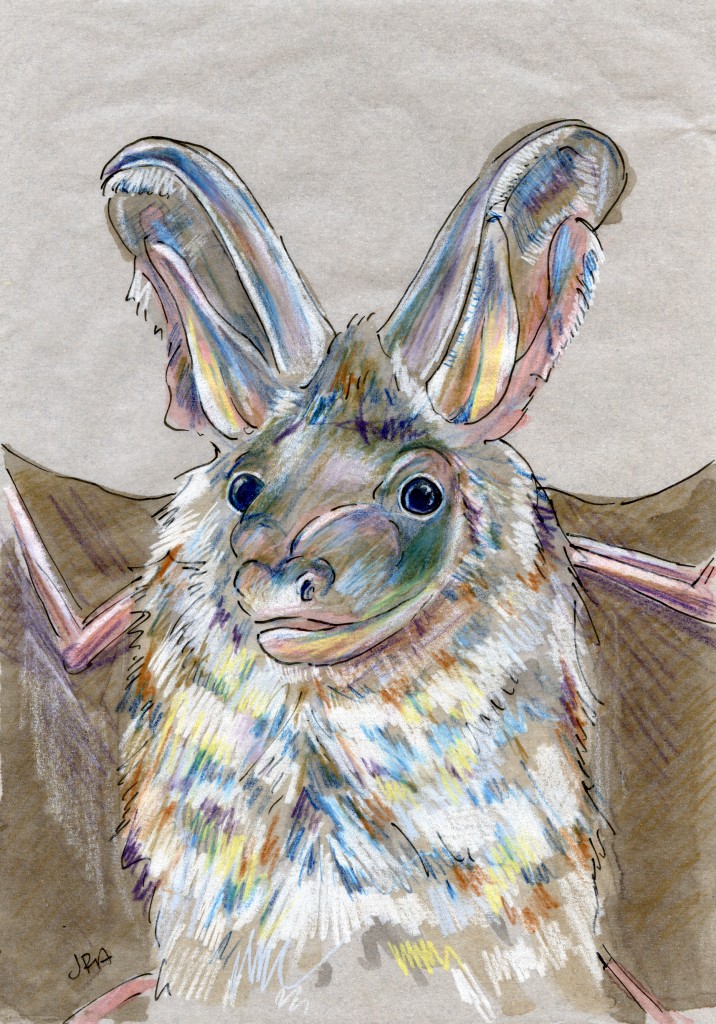
Here’s another one that was discovered to be a species through DNA, at least I think that’s what happened. I’m sorry to say that I’m a little too bushed to figure it all out right now. I’ll leave that to you, if you care to download the PDF of the 2002 article that described this little guy for the first time. Plecotus alpinus, my friend, I am sorry that your roll of the 5,000-sided die came up this month, when I cannot give you the time I ordinarily (I hope) would be able to, but it had to happen to someone.

Here is a fact I learned while researching Mr. Alpine Long-Eared Bat, though. See the long, sort of triangular-shaped things on the front of his ears? Those are called tragi (singular tragus). The word comes from the Greek tragos, or goat, which my dictionary explains thusly: “with reference to the characteristic tuft of hair that is often present, likened to a goat’s beard.” I think it’s likely that the triangular-shaped things we have in front of our ears are also tragi, although neither we nor the Alpine long-eared bat have the characteristic tuft of hair.

Homepage of Andreas Kiefer, one of the professors who first described this bat

{ 4 comments }

click image to enlarge

0125

Hi, mammals! I’ve learned many things since I started on my quest to draw every mammal species on earth. The most recent: business trips and a daily drawing blog just don’t mix. I’ve been traveling a lot the past few weeks—a whole lot—and it doesn’t look to let up until this summer. Sometimes that means I don’t get to draw; sometimes that means I can’t post my drawings. Please stick with me, though: I’m just as committed to this goal as ever, and your visits, comments, and general support mean the world to me!

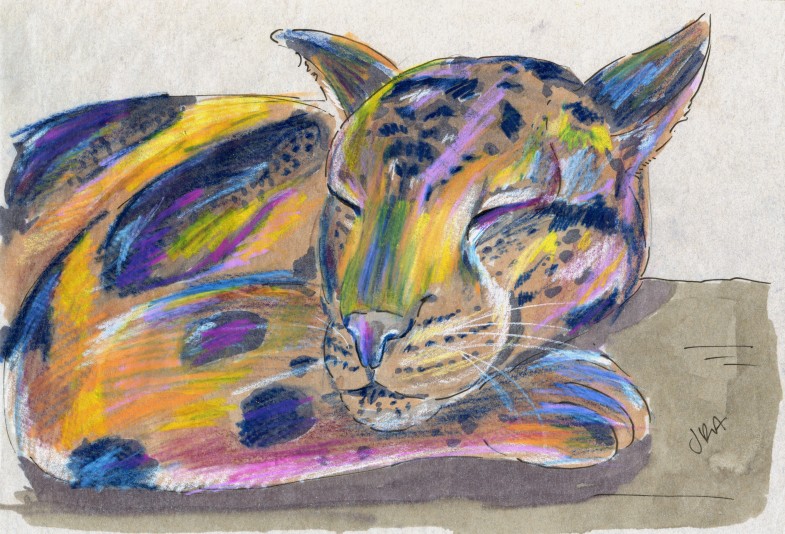
This cat is an example of another way new mammal species are “discovered.” Science has known about the clouded leopards that live on Borneo and Sumatra for quite a while, but always thought they were the same species as the clouded leopards that live elsewhere in southeast Asia. A scientist quoted in The Daily Mail, though, had a different idea:

“The moment we started comparing the skins of the mainland clouded leopard with the leopard found on Borneo, it was clear we were comparing two different species.

“It’s incredible that no one has ever noticed these differences.”

Isn’t it, though? DNA testing confirmed that not only were the two kinds of leopard completely different species, they were, all the articles point out, as different from each other as lions are from tigers. The new species was officially described in 2007.

I suppose scientists are busy people, and no one had bothered to really think about this particular cat and whether it was a subspecies or a species or just slightly darker in color because of geographical variance or what. But clouded leopards were first described in 1821, the Bornean subspecies in 1823. That’s nearly 200 years, people!

Science Daily: “New Species Declared: Clouded Leopard on Borneo and Sumatra

{ 2 comments }

American Bison (Bison bison)

by JR Kinyak on July 4, 2007

in Ungulates

americanbison720032

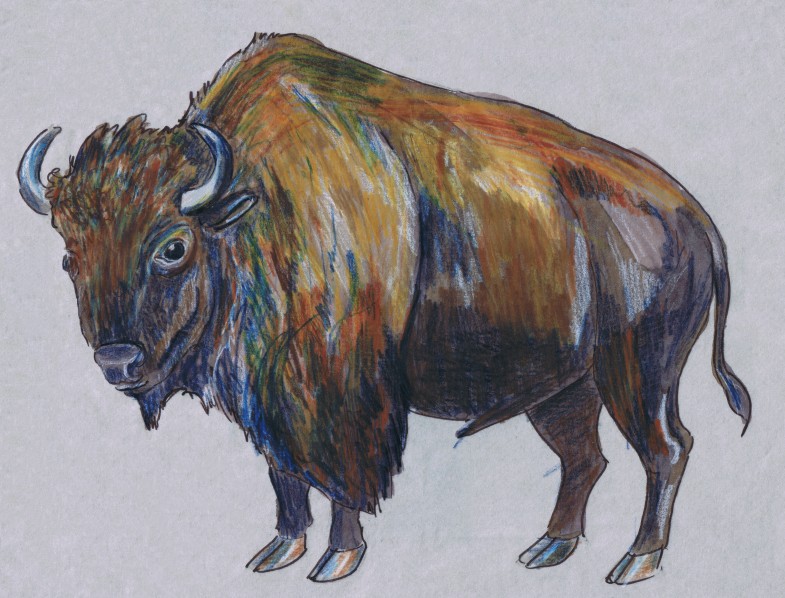
Happy independence day! Here is a symbol of America, the American bison. I drive past a small herd of them every day on my way home from work. Sometime I want to try to draw one when it’s shedding its winter coat, when just the shoulders are padded with the thick, matted fur.

The New York Times had an article a few months ago about how most of the bison herds in the US are diluted with the DNA of cattle. There are two federal herds that are pure bison, one state herd in Utah, and then there’s Ted Turner’s herd on his Vermejo Park ranch in New Mexico, where you can hunt them.

{ 0 comments }

Sumatran Orangutan (Pongo abelii)

by JR Kinyak on June 28, 2007

in Primates

sumatranorangutan720026

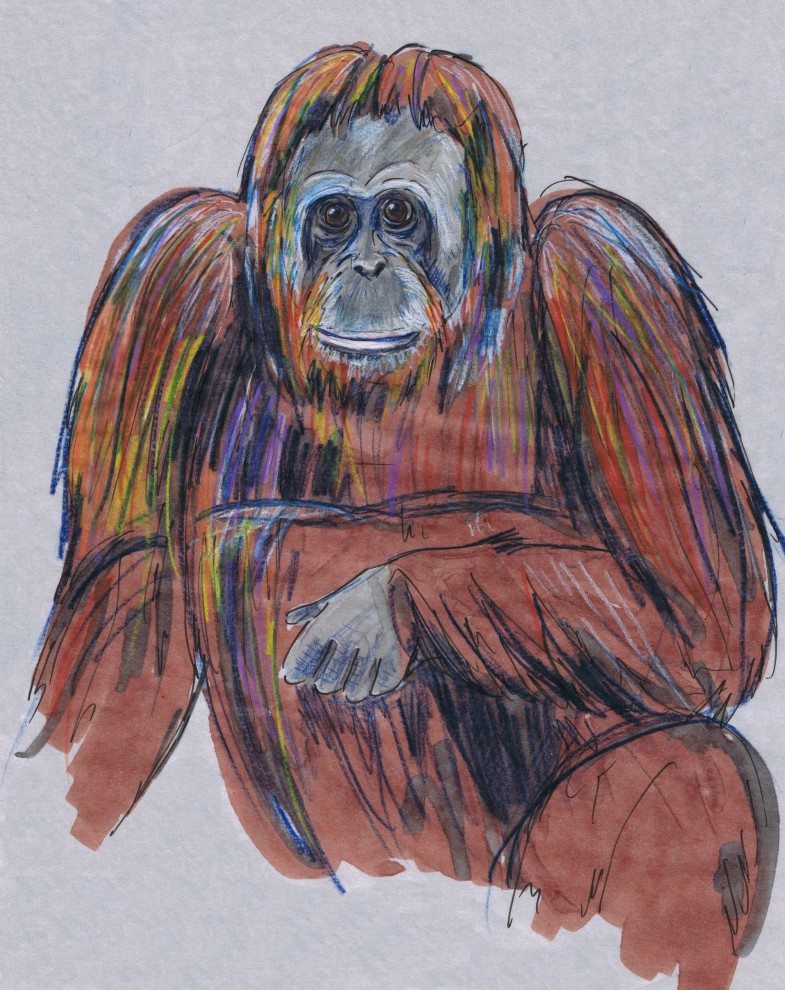
Until the 1990s, scientists thought there was only one species of orangutan, Pongo pygmaeus, with two subspecies, the Sumatran and Bornean orangutans. Well, DNA testing meant they could check to be sure, and what do you know? The Sumatran and Bornean orangutans turned out to be separate species. They’re pretty much indistinguishable unless you can inspect their genes, but I think the Sumatran ones have slightly longer hair.

{ 0 comments }