Posts tagged as:

discovery

click image to enlarge

0222

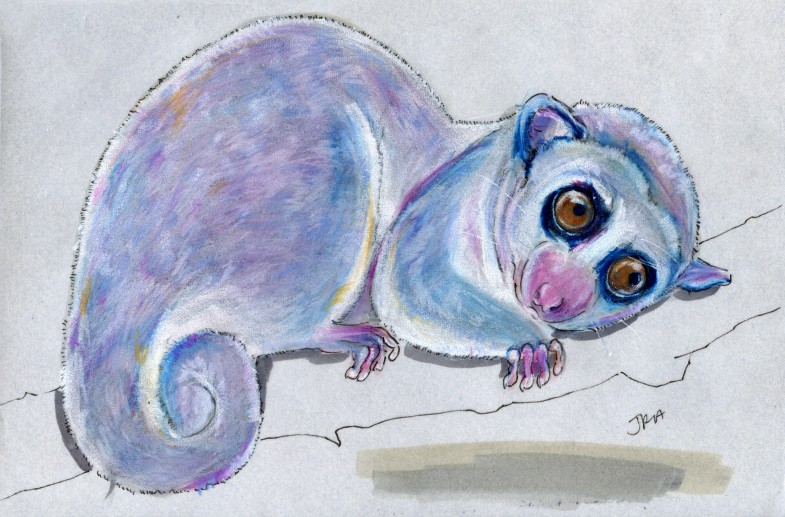
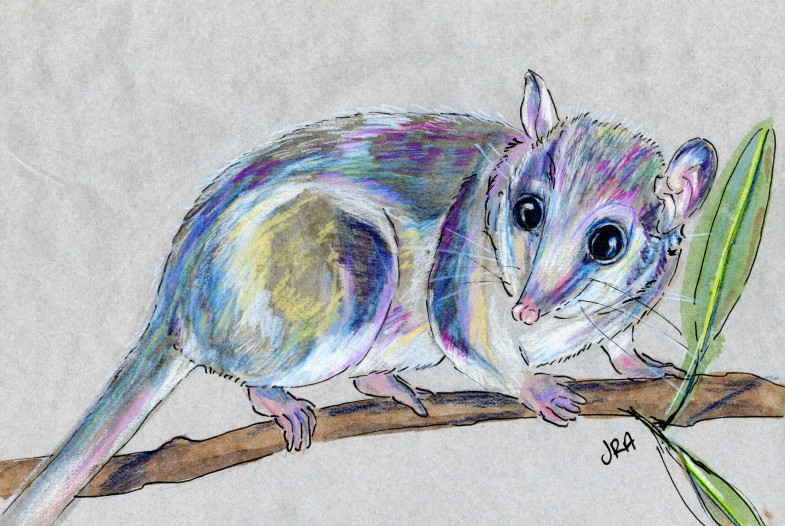
Well, I originally picked this lemur for Hibernators Week because I was under the impression that it was an estivator (see Sunday’s post if you’re wondering what I’m talking about). My beloved but flawed Ivan T. Sanderson told me that, as did Animal Diversity Web. But from what I can tell, that’s not necessarily correct. These Malagasy lemurs go into torpor between March and November…which is winter in the southern hemisphere. It’s rather hemisphericentric of us to call that estivation, isn’t it? Estivation can also refer to torpor during a hot or dry season, so maybe it’s not technically wrong, but it certainly is etymologically. So instead of an estivator, here’s a torpid primate for you.

But the fact that the fat-tailed dwarf lemur is a torpid primate is extraordinary enough, it turns out. This guy is one of only two primate species that enter into seasonal torpid periods, and our friend here is the only primate that is torpid for such a long period. And that fat tail of his? It’s literally a fat tail, where the fat-tailed dwarf lemur stores the fat reserves that get it through its torpid season. And it gets really fat, more so than I showed here.

These lemurs feast on fruit, flowers, nectar, pollen, and the occasional insect or two. They may be responsible for pollinating some of the plants in their Malagasy home, and the fact that they mark the branches they’re traveling on with their feces helps create a fecund (I just looked it up, and feces and fecund do not come from the same root at all—weird, huh?) environment for parasite plants to grow on the trees. During Madagascar’s wet season, fat-tailed dwarf lemurs spend their nights eating up to get those tails nice and plump while they can. When it gets dry, they curl up in little balls and drift off into torpidity.

A word about Madagascar. I’m sorry to say that the country is in turmoil right now, and demonstrations have killed about a hundred people in the past few weeks. Today, the president of Madagascar fired the mayor of the nation’s capital, Antananarivo, after the mayor announced that he was now going to be in charge of the country. It’s all pretty awful and unfortunate. Madagascar is one of the most special and important places on earth, biologically, and is plagued by poverty, deforestation, and violent political upheaval. I wish all the Malagasy people and animals well right now. Here is a New York Times article from today about the situation.

And now a quick word about lemurs. You might like to watch this short video of the director of Duke University’s Lemur Center talking about why she thinks it’s irresponsible of scientists to keep “discovering” new lemur species, a state of affairs that obviously has an effect on the Daily Mammal. I regret that I didn’t get the chance to go to the Lemur Center when I had occasion to travel to North Carolina, and I hope I will get to visit someday. Of course, I also long to visit Madagascar.

{ 1 comment }

Hispaniolan Solenodon (Solenodon paradoxus)

by JR Kinyak on January 10, 2009

in Other Orders

click image to enlarge

0202

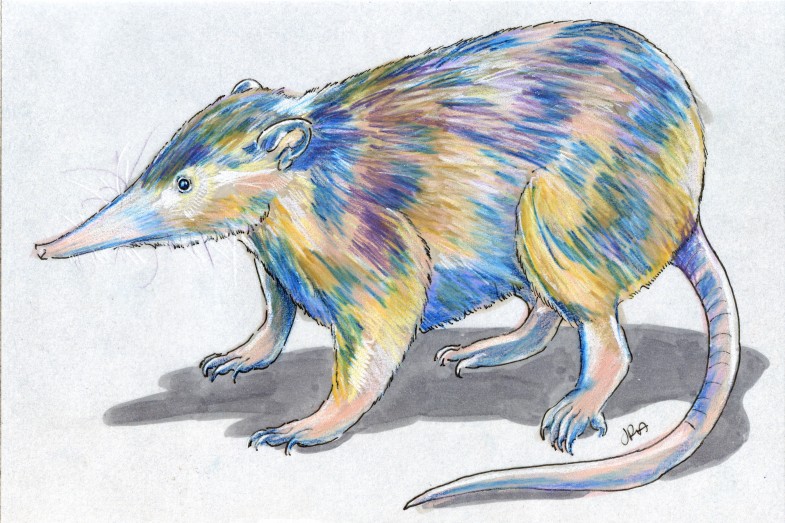
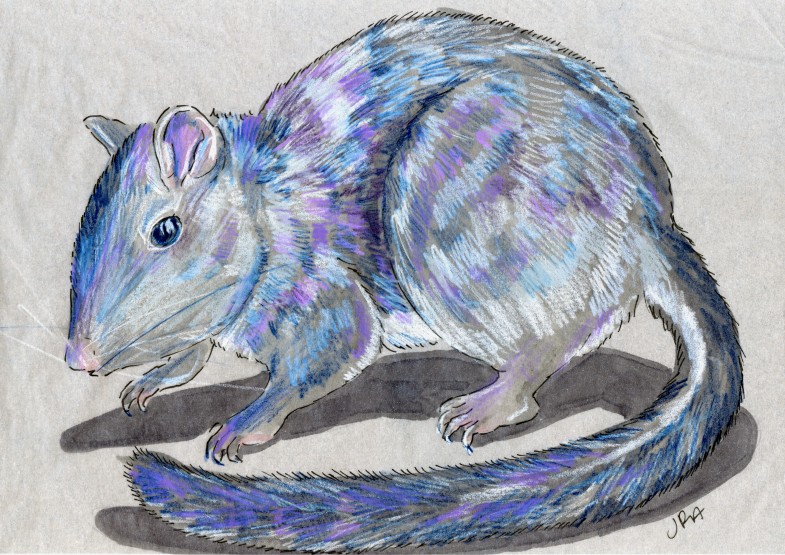
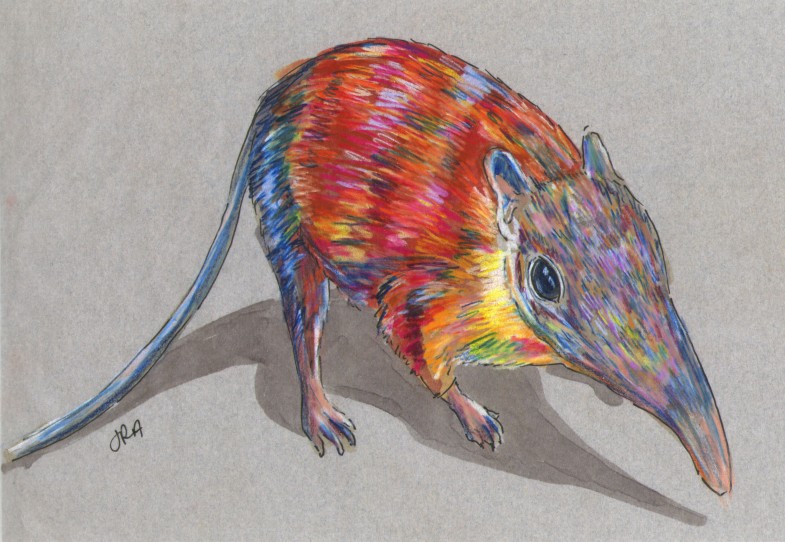
This shaggy, shrewy solenodon lives only on the island of Hispaniola, which comprises Haiti and the Dominican Republic. This species is one of only two in the solenodon genus. The other lives in Cuba.

The word solenodon comes from the Latin for groove-tooth, referring to an unusual feature: solenodons’ lower incisors have a channel connected to a gland, through which they can inject venom. While there are a few other venomous mammals, such as the male duck-billed platypus and a couple species of shrew, only solenodons can actively inject poison with their teeth.

The two solenodon species, genetic research tells us, diverged from all the rest of mammalia some 76 million years ago, during the Cretaceous period, when dinosaurs dominated the earth. This is crazily early. And the two species separated from each other about 25 million years ago, which means they’re not even that closely related. (This is around the time—give or take a few million years—that humans diverged from the Old World monkeys such as this week’s proboscis and Tonkin snub.)

Like other island dwellers, the Hispaniolan solenodon neglected to acquire the adaptations that would give it half a chance to survive against bigger, more intimidating predators. It was used to being a big fish (mammal) in a small pond (island), and so the humans who showed up, along with their accompanying dogs and mongooses, have been able to drive it into a perilously endangered existence.

BBC News, January 9, 2009: “Venomous mammal caught on camera.” (Thanks, Clare!)

EDGE (Evolutionarily Distinct & Globally Endangered) blog, January 9, 2009: “Hispaniolan solenodons—rediscovery and footage!”

{ 6 comments }

Chinese Stump-tailed Macaque (Macaca thibetana)

by JR Kinyak on August 13, 2008

in Primates

click image to enlarge

0197

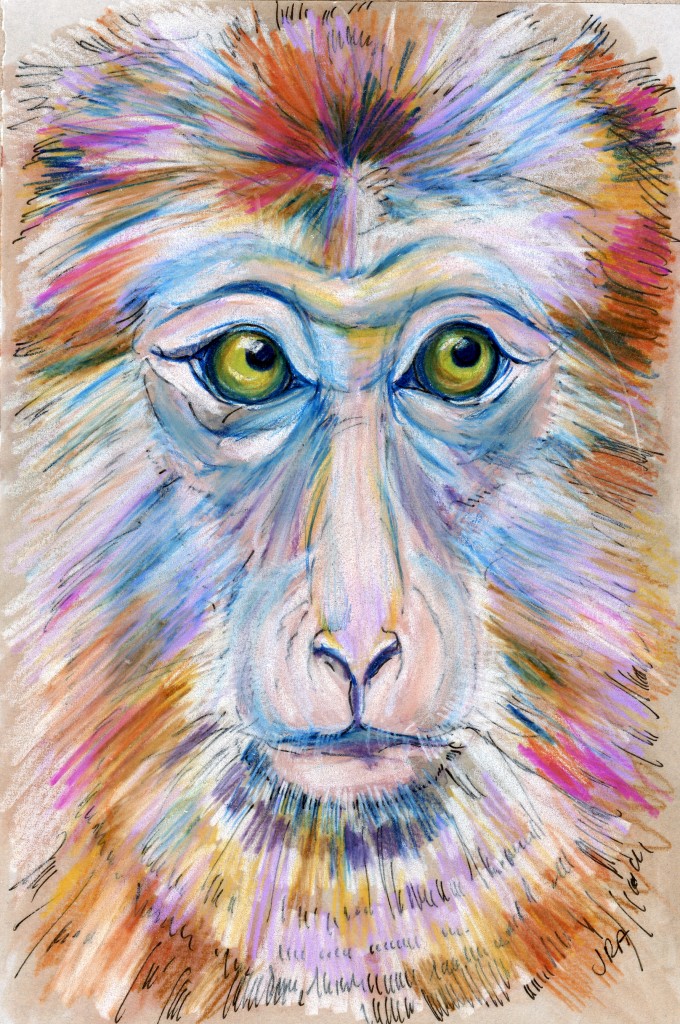
This fuzzy fellow is called the Chinese stump-tailed macaque for reasons that would be obvious if you could see his backside. But he’s also known as the Tibetan macaque and Père David’s macaque. These macaques are frugivorous (they eat fruit) for the most part, but they’ll also eat some insects, leaves, and seeds when the situation warrants.

As for Père David, who inspired one of the Tibetan macaque’s common names, he was a Catholic missionary named Jean Pierre Armand David. He was a clergyman by profession and an all-around naturalist by passion. Père David, who died in 1900, seems to have been one of those now-all-too-rare “Renaissance souls” with a wide range of interests and fields of study. He was, apparently, the person who introduced Europe to the panda (or the panda to Europe), and in addition to zoology, he also studied botany, paleontology, and geology, and he was a beloved science teacher before being shipped off to China.