0299
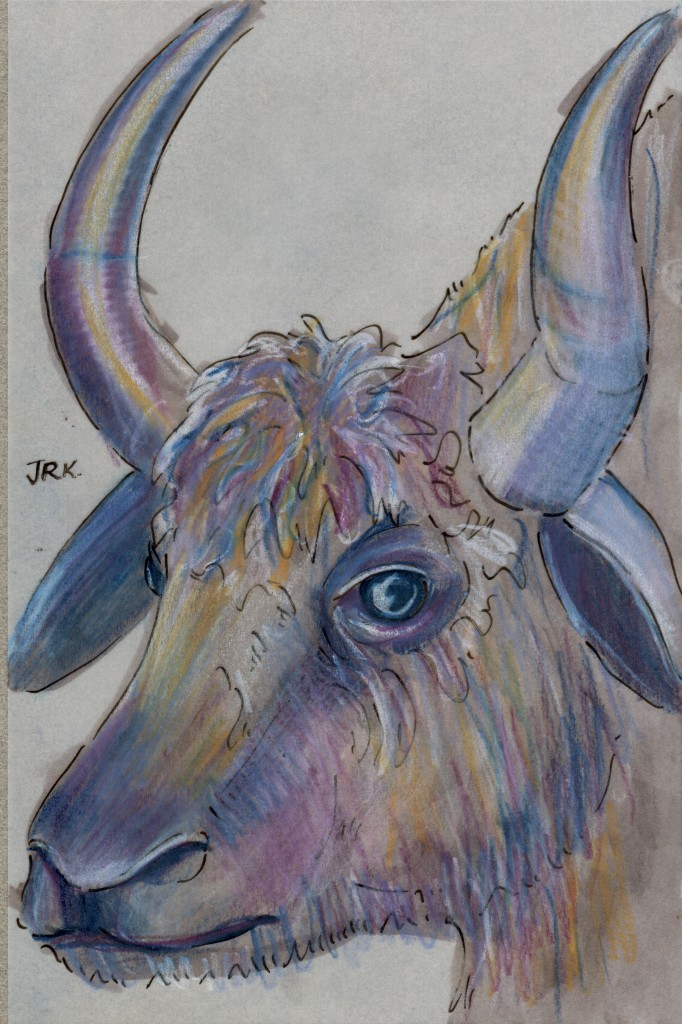
In honor of our adoption finalization and name change to Kinyak, Theo and I drew yaks! The powerful, shaggy animals are native to Tibet and produce delicious butter, which Tibetans use in their tea.
{ 2 comments }
Posts tagged as:
In honor of our adoption finalization and name change to Kinyak, Theo and I drew yaks! The powerful, shaggy animals are native to Tibet and produce delicious butter, which Tibetans use in their tea.
{ 2 comments }
To honor (if that’s the word) Sarah Palin’s stepping down as governor as Alaska, let’s meet some of the mammals of the 49th state. (Because yesterday’s beluga whale lives in Alaska, I took the liberty of retroactively including it in this theme week, which I only just thought of.)
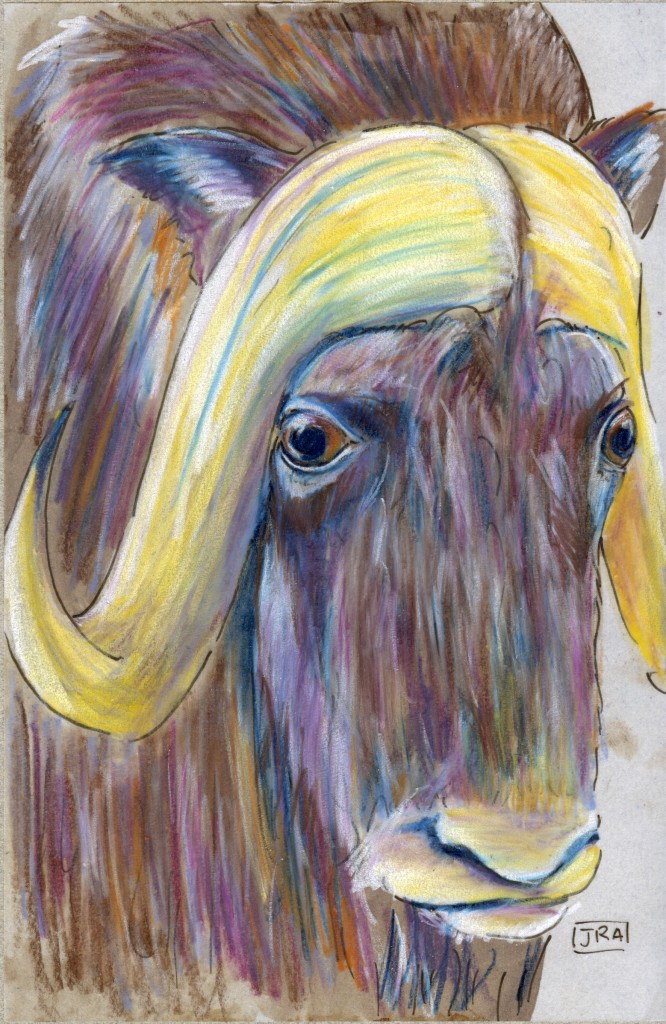
The muskox’s scientific name means “musky sheep-cow.” DNA analysis suggests that it’s more closely related to the goat family than to sheep or cows, and it doesn’t have musk, per se, but it does have rather pungent urine that it uses in various intimidating ways.
Muskoxen are native to Alaska, Greenland, and Canada, but they became extinct in Alaska in the 1800s. In the 1930s, 34 muskoxen from Greenland were reintroduced to the then-territory, and now there are some 2,000 living in the state. They’ve been introduced to Svalbard, Russia, and parts of Scandinavia, too.
The muskox has two coats, an outer one called guard hairs and an incredibly warm, downy undercoat called qiviut. And yes, that is an acceptable Scrabble word! Pronounced kiv-ee-yute, qiviut is several times warmer than sheep’s wool and softer than cashmere. As you can imagine, that means it’s very luxurious and expensive. (If anyone wants to send me a qiviut scarf, I won’t complain!)
Qiviut is one of the muskox’s very effective Arctic adaptations; others include short legs and a lot of body fat. Those short legs and fatty bodies mean that muskoxen can’t run very fast for very long, so when they’re threatened, a herd of muskoxen will line up facing their predator, showing their fearsome horns and keeping their calves behind them. If the predators come from multiple directions, the muskoxen form a circle with the babies in the middle.
{ 1 comment }
Sometimes I see articles online or in magazines that I think would interest Daily Mammal readers. When they concern mammals I haven’t drawn yet, I can feature them as Daily Mammal Now posts. But when I’ve already drawn them, or just don’t want to or can’t draw them right away for some reason, I don’t have a good vehicle to share them with you.
That’s why I’m going to start occasionally (weekly? fortnightly? semiweekly? who knows?) pointing you to some very recent news stories and articles that you might want to read, or at least know about. Here’s the first Mammal News Roundup.
Daily Mail, May 12, 2008: There’s a cow the size of an elephant. He was left on the doorstop of an English animal sanctuary when he was an infant. The first picture makes him look especially large; check it out. Note to Americans: swede is what Brits call rutabaga.
Science Daily, May 13, 2008: Double mammal newsflash: In Brazil, they’re training dogs to recognize the scent of various endangered mammals (like the jaguar and the giant anteater), helping researchers monitor their populations.
Madison, Wisconsin’s Capital Times, May 13, 2008: They’re still trying to figure out what’s causing white-nose syndrome, the strange ailment that’s devastating some populations of bats in the northeastern United States. (Click on the Daily Mammal Now link above for more.)
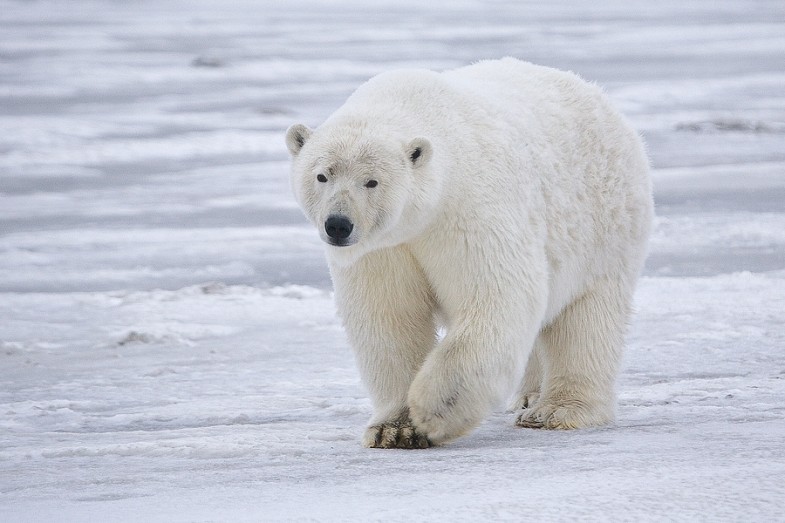
U.S. Department of the Interior news release, May 14, 2008: Polar bears are now listed as a threatened species under the Endangered Species Act. Since climate change is a major cause of polar bears’ decline, but it’s very difficult, to say the least, to prove how any particular action by Americans influences the climate change that’s harming the bears, it is unclear how much the move will help the bears.
When I drew the polar bear, I found in my research that some people think that the polar bear is actually the same species as the brown bear. I looked into that a little more today and learned some interesting things. It seems polar bears, which are recognized as a distinct species by most anyone without an ax to grind, evolved from the brown bear pretty recently, some 200,000 years ago. And they were still developing adaptations as recently as 40,000 years ago.
I wonder how you would decide when the species was still the brown bear and when it had become the polar bear. Maybe there’s a bare minimum of changes and differences that must be present? Or a certain number of DNA markers that should be present or absent? Or is it a case of “you know it when you see it”?
Some people, evidently regarded as nuts by some other people, think that melting ice in the Arctic will force the polar bear to evolve back into the brown bear, but it seems pretty likely to me that they’re endangered enough that we can’t expect them to be around long enough for that to happen with no intervention. Being an amateur biologist, though, I can just speculate.
BBC News, December 10, 2007: An Icelandic (yay!) scientist found the most ancient polar bear jawbone we have, a 150,000-year-old specimen. The article discusses, in brief, the evolutionary history of the polar bear.
(Polar bear photograph by Scott Schliebe, USFWS)
{ 3 comments }
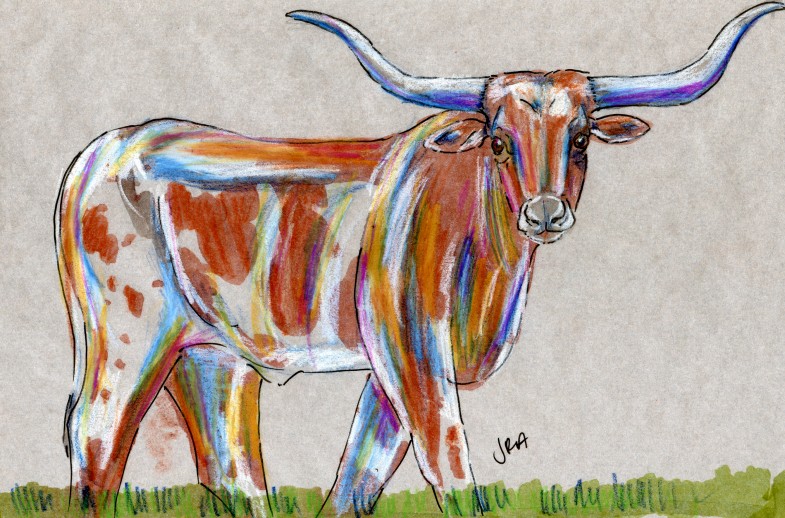
The Texas longhorn, which is a breed of the domestic cow, is a pretty special American animal. It’s descended from the first cattle that were brought to North America (by the Spanish), and it’s the only breed of cow to evolve on its own, without human direction. Rangy and lean, longhorns can survive in extremely harsh environments. While they once roamed the plains and grasslands of the United States, they nearly went extinct early in the 20th century due to cross-breeding, but were saved by an act of Congress. This longhorn was requested by Donna.
J. Frank Dobie’s book The Longhorns
{ 6 comments }
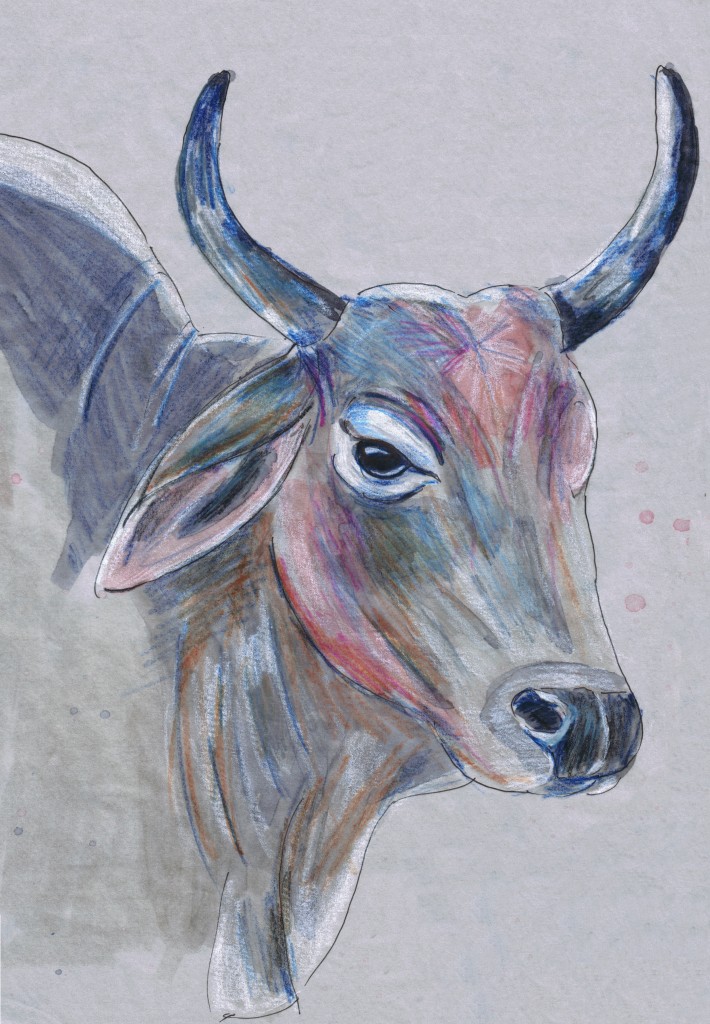
0035The zebu is a domestic cow from Asia and Africa; zebus are also known as Brahmas. I was reminded of the zebu’s existence this week when Andy Merriell, my employer, showed me a wonderful book called The 100 Best Animals. Zebus have floppy dewlaps and shoulder humps and curved horns and they’re amazingly tolerant of heat.
It seems there’s a lot of disagreement as to whether the zebu is a species—Bos indicus—or a subspecies of Bos taurus or Bos primigenius. And it further seems that B. primigenius is either another name or a subspecies of B. taurus. All I know right now is what Mammal Species of the World tells me. I am getting interested in the taxonomy and nomenclature, though, and I imagine I’ll be something of an expert by the time I’m finished with this project.
{ 1 comment }