Posts tagged as:

coco

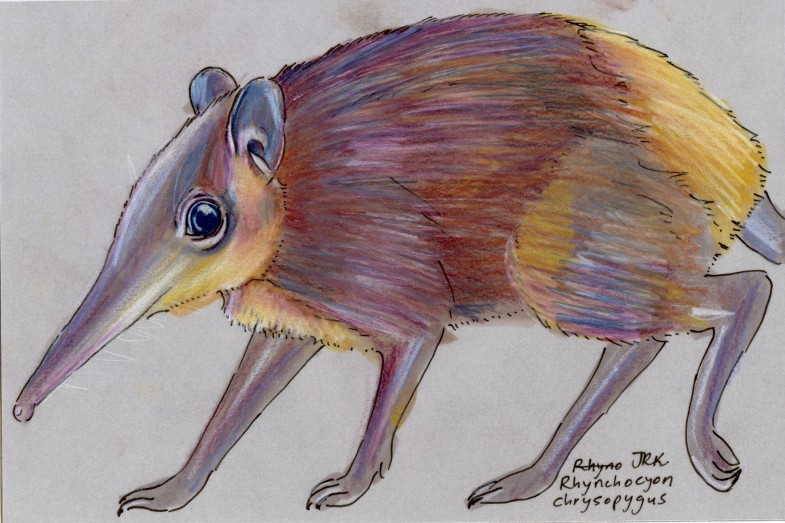
Golden-rumped elephant shrew (click image to enlarge)


0398

Here is the golden-rumped elephant shrew, which is also known as a golden-rumped sengi, or a yellow-rumped either one of those. It’s not actually related to the shrews, although it is related to the elephants, distantly. Some things I’ve learned about this fellow:

1. Translating its scientific name at the website of a zoology course at the University of Alberta, I see that this sengi’s official name means snout-dog golden-rump. (Pygos means rump, and is found in the word callipygian, “having well-shaped buttocks,” which is one of those words that middle-schoolers delight in discovering in the dictionary.)

2. The rump is golden for a reason. That pretty blond fur covers a padded area of super-tough skin. The idea seems to be that predators will be attracted to the golden glow and bite there, rather than somewhere that might hurt more.

3. The golden-rumped sengi lives only in a tiny area of coastal Kenya.

4. It’s number 46 on the EDGE list of the top 100 evolutionarily distinct and globally endangered mammals—in other words, this endangered species is particularly irreplaceable.

5. This elephant shrew is monogamous, which is quite rare for a small mammal, or indeed, any mammal.

6. It can be very difficult to distinguish between the members of the Rhynchocyon genus, also known as the giant forest sengis, in the field, but the California Academy of Sciences has a page dedicated to helping you tell them apart.

7. According to the American Society of Mammalogists’ species account of this elephant shrew,

“If mildly disturbed, Rhynchocyon freezes until the danger passes, or, if further disturbed, it walks away while loudly slapping the leaf litter with its tail every 1 to 3 seconds. If pursued, Rhynchocyon takes flight using a swift half-bound gait…hammering the leaf litter loudly with its rear legs, and producing a characteristic “crunch, crunch, crunch” sound as it disappears.”

8. The golden-rumped elephant shrew is diurnal, or active during the day, and spends its nights in a nest it builds on the forest floor. For some reason, it requires a new nest every other day or so. It builds the new nest in the morning, and the construction takes about two hours.

Below is Coco’s golden-rumped elephant shrew. See you tomorrow!

Golden-rumped elephant shrew by Coco, age 12

{ 4 comments }

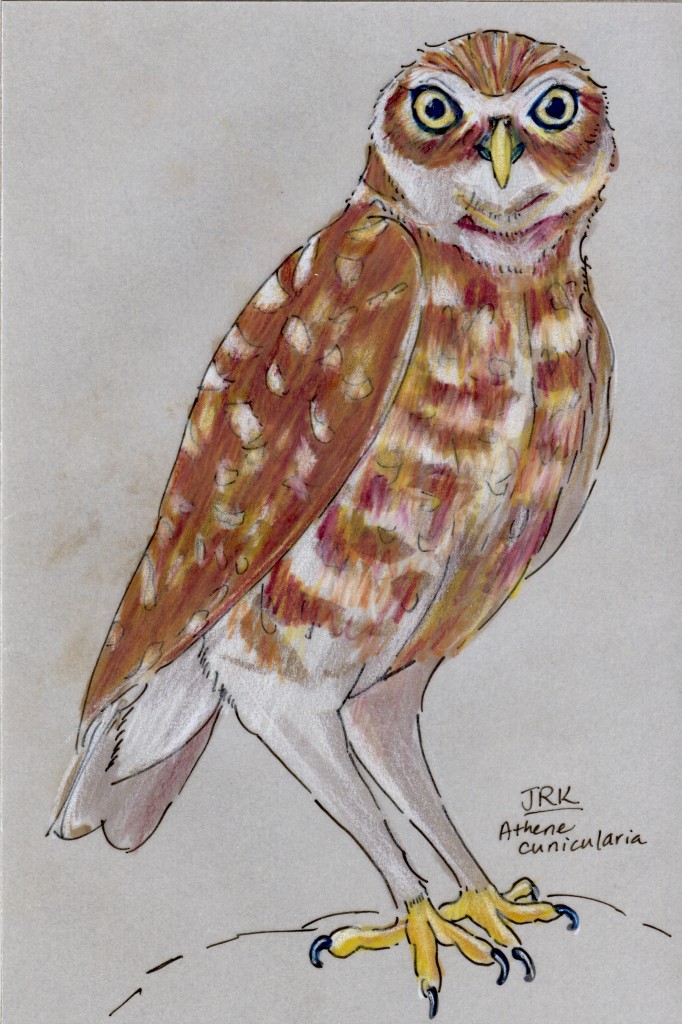
Burrowing owl (click image to enlarge)

A few years ago, I bought a copy of Mammal Tracks and Sign, which includes a sidebar about the importance of having a basic comfort with and knowledge of the natural world before you can start to track. The book recommended a program called Kamana, an at-your-own-pace naturalist training program. I asked my husband Ted for the program for Christmas and got it, and then I did nothing with it for a couple of years.

Then we adopted our kids, Theo and Coco, and then we realized that the best bet for them was homeschooling. We homeschooled Theo last year, and this year his sister joined up. I brought out my Kamana book and all four of us started working through it as a major part of our homeschool curriculum.

And it’s amazing! The first book is divided into two “trails.” The first, which we’ve completed, is about becoming more aware of your surroundings. The exercises in it have been so helpful and fun to us. We’ve just started the second trail, which involves learning about the different life forms in our area. (We are stalled on the mammal chapter at the moment, strangely enough.)

In part of the book, you practice using your senses in a new way, and you look to various animals as inspiration. The kids and I drew the animals we were learning from, and I thought I’d share them with you as a special series on the Daily Mammal. (I don’t know where Theo’s drawings are so I haven’t scanned them, but if he gives them to me, maybe you’ll be able to see them in some of these posts. In the meantime, enjoy Coco’s beautiful work.)

The first tool we practiced using was our Owl Eyes. Because of their shape, owls’ eyes are fixed in place: owls move their heads instead of their eyes. When we practiced Owl Eyes, we literally perched, on a wall, a rock, or the couch, and kept our eyes still, relaxing until we could make full use of our peripheral vision, which let us see the sky, the ground, and all around without moving. When we did want to look somewhere else, we moved our head instead of our eyes. You can take in more than you think using just the “corners” of your eyes if you practice. This can be useful out in the field if you catch some movement and don’t want to startle an animal by suddenly turning your head. Owl Eyes was the first step toward broadening our awareness in general: we’re learning to notice not just what’s directly in front of us, but the bigger picture.

Below is Coco’s barn owl. I’m not sure I’ve ever seen a more beautiful drawing, honestly.

Barn owl by Coco, age 12

{ 4 comments }

Mexican Free-tailed Bat (Tadarida brasiliensis)

by JR Kinyak on October 5, 2011

in Bats

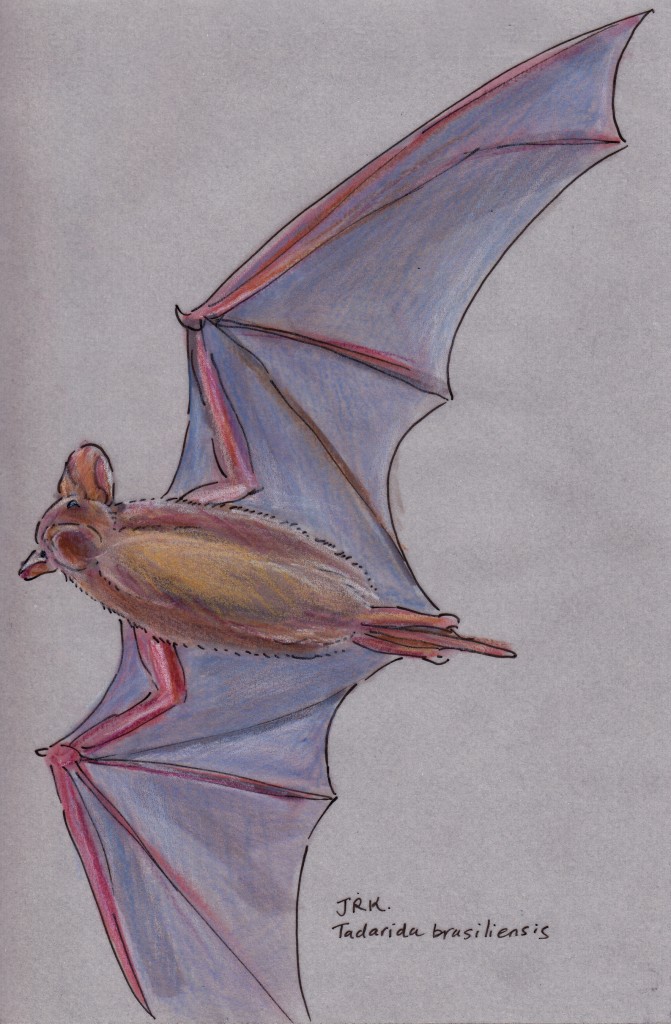
Mexican free-tailed bat (click image to enlarge)


Mexican free-tailed bat by Theo, age 15


Mexican free-tailed bat by Coco, age 12


0395

The kids and I are reading a book called Hanging with Bats, which starts with a chapter about the Mexican free-tailed bats at Carlsbad Caverns here in New Mexico. We decided to draw the bats, and then my son Theo wrote a poem to post on the Daily Mammal.

I think I may have mentioned, on this site, Thomas Nagel’s famous essay “What is it like to be a bat?” in which he explains that it is difficult (impossible?) for us to even imagine it, using the human-bat disconnection as an example of the inherent shortcomings of subjective experience in understanding objective truth. (I think that’s what it’s about.) As Nagel says, “In so far as I can imagine this (which is not very far), it tells me only what it would be like for me to behave as a bat behaves. But that is not the question. I want to know what it is like for a bat to be a bat. Yet if I try to imagine this, I am restricted to the resources of my own mind, and those resources are inadequate to the task.”

Theo’s poem, though, tries to help our imaginations, and it’s absolutely beautiful.

Through Tiny Eyes

Imagine
Screeches coming back at you, directing you
Imagine
Air flowing through your fur while slicing through air
Imagine
Air holding you airborne
Imagine
Hanging upside down,
huddling in the warmth of thousands of you
Imagine
Using your hands to cover your entire body
Imagine
Making an image of a black tornado
coming out of the black depths of a cave
Imagine
Being a bat

{ 6 comments }

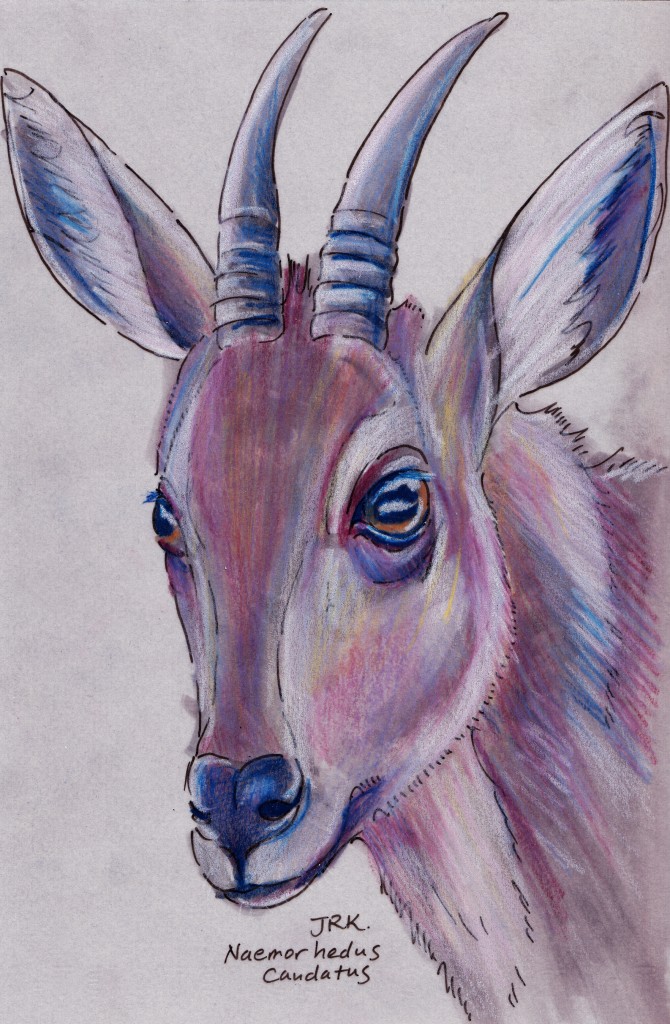
Long-tailed goral (click image to enlarge)


Long-tailed goral by Coco, age 12


0393

Here is a long-tailed goral, another mammal of Primorye, the region in the far east of Russia that we’re visiting this week. If you’d like a brief introduction to the place and why we’re there, check out Monday’s musk deer. The long-tailed goral is a goat that lives in China, Russia, and north and south Korea. It’s rare for a goat to have a long tail, so this goral has something to boast about. There are about 1,300 long-tailed gorals in all the world. Isn’t that remarkable? There are 6 billion of us—just the one species, Homo sapiens—and only 1,300 of this other species. They’re currently classified as vulnerable by the International Union for Conservation of Nature, and they are a natural monument in South Korea.

According to Animal Diversity Web, long-tailed gorals (which are also called Chinese gorals) “communicate with one another in times of emergency with wheezing alarm sounds…During mating season, males attract females with a “zer… zer” or “ze-ze-ze” call. When females approach and are ready to encourage a male, they make a whistling noise.” That is also what I do when I’m ready to encourage a male, coincidentally.

{ 5 comments }

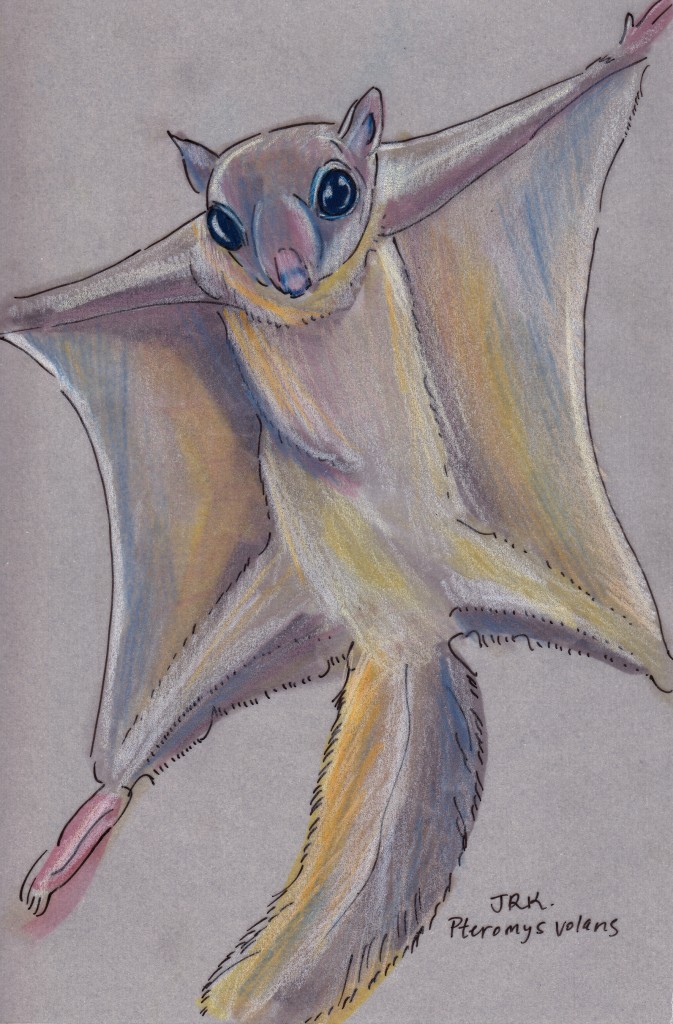
Siberian flying squirrel (click image to enlarge)


Siberian flying squirrel by Coco, age 12

0392

This week, we’re looking at a few mammals from Primorye, a region in the far east of Russia that you can learn a bit more about in my post for Monday’s musk deer. For today, Coco and I drew Siberian flying squirrels. They are quite common throughout the forests of northern Europe and Asia, where they glide through the treetops by night, snacking on seeds, leaves, buds, and catkins, which are downy, flowering spikes on some trees. An idyllic lifestyle to be sure, a lifestyle from a magical story.

{ 4 comments }

Banded Linsang (Prionodon linsang)

by JR Kinyak on September 22, 2011

in Carnivores

Banded linsang (click image to enlarge)


0386

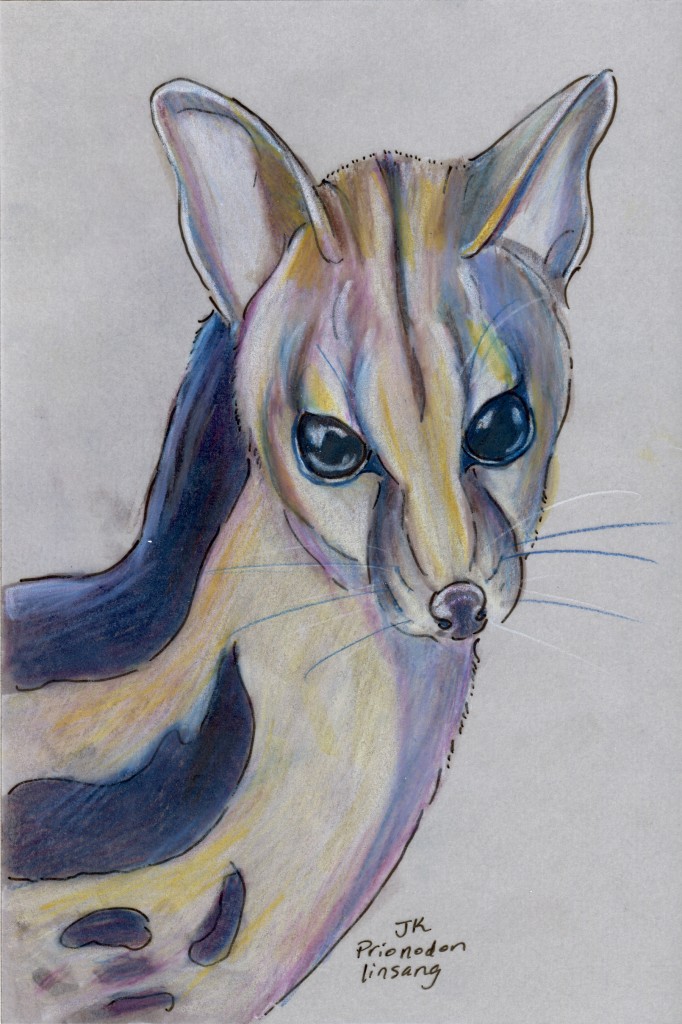
The banded linsang is a viverrid, a carnivore in the style of civets and genets: slender, long, cat-like hunters, graceful of movement and beautiful of coat. Banded linsangs live in Brunei, Indonesia, Malaysia, Myanmar, and Thailand. They make nests out of sticks and leaves between tree roots or in burrows, and they eat small mammals, such as squirrels and spiny rats; birds and bird eggs; lizards; and insects. Walker’s Mammals of the World assures us that “unlike many viverrids, Prionodon seems to be free from odor.”

Coco drew a linsang as well.

Banded linsang by Coco, age 12

{ 2 comments }

Coyote (Canis latrans)

by JR Kinyak on September 21, 2011

in Carnivores

Coyote (click image to enlarge)

Here’s an idea! Why don’t I point you to two embarrassingly bad old drawings in a row? I drew the coyote as mammal number 65, way back in 2007 (oh God, it’s been four years and I have barely a year’s worth of mammals…). Look how my drawing style has changed: very much for the better, yes? Looking over that post is bittersweet because the drawing was by request of Maleta Scrivner, a lifelong family friend who has since died. I wish I could have drawn her a better coyote back then, but heck, I think she liked just about anything I drew, or at least that’s what she let me think!

In homeschool this year, we read a book that my dad bought for me when I was 8, Coyote & by Joe Hayes. It’s a collection of Native American coyote trickster stories, and I think we’d all highly recommend it. One thing we learned was that if you want to make Coyote laugh, call him by the secret name that always gets him tickled: Yellow-Behind-the-Ears.

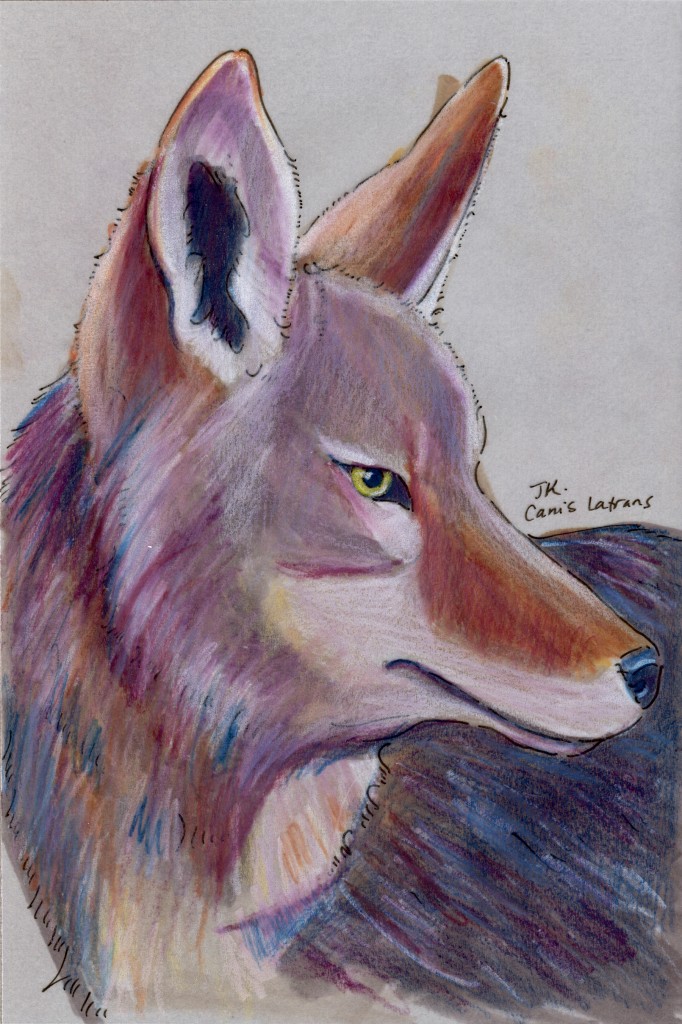
Here’s Coco’s drawing of the old trickster.

Coyote by Coco, age 12

{ 1 comment }