Posts tagged as:

books

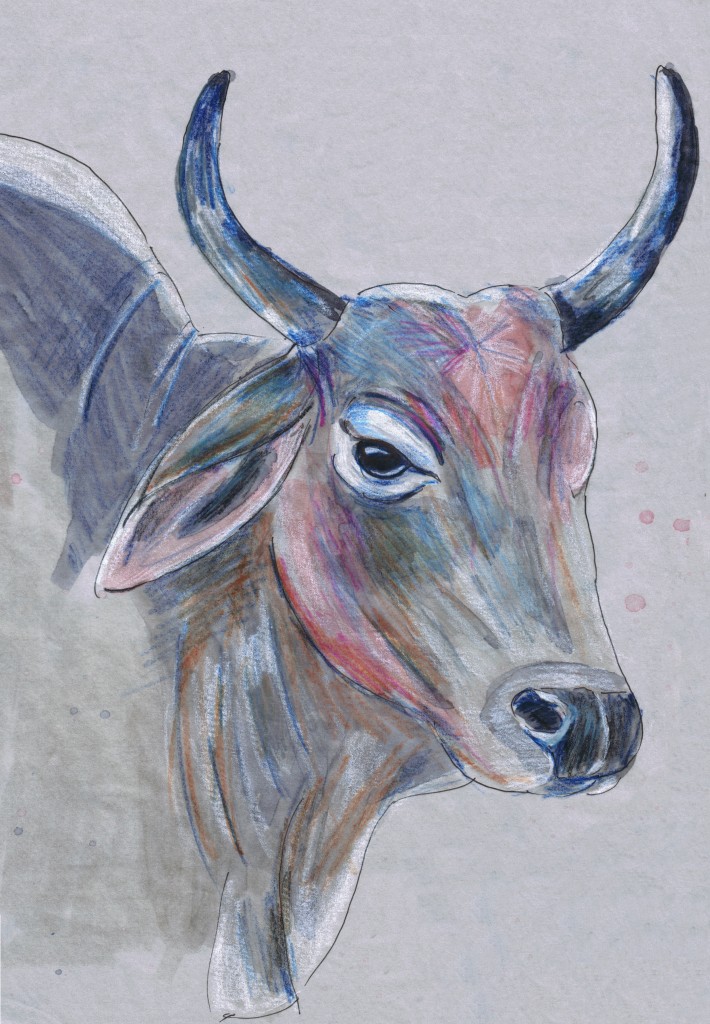
African Buffalo (Syncerus caffer)

by JR Kinyak on March 26, 2011

in Ungulates

There certainly is a fierce beast to meet today, but don’t forget that tomorrow is the beginning of the Japan Mammalthon, and Coco and I will be posting original drawings that you can buy, with all proceeds benefiting victims of the tsunamis and earthquakes. Read this post for all the details.

African buffalo (click image to enlarge)

0368

“…[I]t has an unpleasant habit of remaining quietly in its lair until the unsuspecting traveler passes closely to its place of concealment, and then leaping suddenly upon him like some terrible monster of the waters, dripping with mud, and filled with rage. When it has succeeded in its attack, it first tosses the unhappy victim in the air, then kneels upon his body, in order to crush the life out of him, then butts at the dead corpse until it has given vent to its insane fury, and ends by licking the mangled limbs until it strips off the flesh with its rough tongue.”

John George Wood,
The Illustrated Natural History, 1865

The African or Cape buffalo provides a fine case study for anyone interested in the human relationship to other mammals. This buffalo, which lives in southern Africa, is one of the “Big Five” specially prized trophy animals for hunters on safari in Africa. The five animals—the others are the leopard, the lion, the rhinoceros, and the elephant—are considered the most difficult and dangerous to hunt, and no more so, I’m sure, than this behorned fellow.

I searched Google Books for 19th-century accounts by naturalists and self-satisfied hunters and found descriptions including “grim and vicious,” “ever sulky and completely inaccessible to any mollifying influences,” “fierce, treacherous, and savage,” “terrible in outward aspect,” “savage ferocity,” and “fierce and malignant aspect.”

Seasoned hunters of the 1800s advise that “unless you are tired of life,” you should not attempt shooting this beast from the front, for it “fears nothing” and is “one of the few animals which seem to cherish the spirit of revenge.” One writer says that its ugly mug is a good illustration of the principle that “the face is the index of the mind or disposition”; another says that the buffalo’s “little fierce eyes twinkle with sullen rays.” Beware, says one chronicler of the ferocious buffalo, for it “will willingly meet the hunter half-way and try conclusions with him.” Wounded buffalo, in particular, are depicted as ruthless in their bloodthirst, power, and vengefulness. As a vegetarian, I particularly enjoyed this comment:

“It is singular that so much malignity should be found in a beast which subsists only on vegetable food; but such is undoubtedly the case.”

Not only are these buffalo depicted as dangerous, they are universally said to be downright homicidal. I read several references to their insanity and treachery. Interestingly, unlike the similar-looking Asian water buffalo, the African buffalo has never been domesticated, at least not successfully. In interviews—or at least press releases—from a couple of years ago, a scientist who published a study pinpointing genetic “regions” connected with domestication mentioned the African buffalo as a particularly hard case, one that might be helped with some sort of genetic modification.

I do not dispute that African buffalo are incredibly dangerous and responsible for many deaths, but I can’t help but think that some of these anthropomorphized accounts of their ferocity are exaggerated by the pomp and bluster of vainglorious “white hunters” who feel compelled to make their “sport” seem as perilous as possible. Hunters still spout the same lines: safariBwana.com, which calls itself “the African hunting authority,” says that the African buffalo is a “worthy hunting adversary” and “one of the only beasts in the bush that looks at you as if you owe it something.” I tried—not very hard at all—to find video of a buffalo attacking hunters, but I didn’t find much to remark on. Anyway, someone who’s being shot by a powerful rifle with a reinforced bullet—because the buffalo has such thick skin—has a right to be angry, even vengeful, if animals ever do feel such emotions.

{ 0 comments }

Prevost's squirrel and Finlayson's squirrel (click image to enlarge)


0365
0364

Well, mammals, we made it! Mammal Number 365 is here, with his buddy Number 364, ready to meet you and celebrate a year’s worth of Daily Mammals, completed on average once every four days, which doesn’t sound too bad, until you do the math and realize that at that rate, it will take me an additional 52 years to draw all the mammal species. In 52 years, I’ll be 85. Will you still be visiting my website? I hope so! (Will there still be websites?)

Thank you for visiting and meeting my mammals, even if I am a little slow in getting them to you. I appreciate every one of you wonderful viewers and readers, whether you post comments or not, whether you come once or every day, whether you’re related to me or a stranger. Thank you! This project is rewarding on its own, but it’s even better with company. Thank you, especially, for sticking with me through the long hiatuses.

I write today’s post from my bed, where I’m hopped up on oxycodone for my broken calcaneus. I don’t have my mammal books in here, so this entry will be a tad thin on facts. When I called these squirrels beautiful, I wasn’t bragging about my drawing. The Latin name of their genus, Callosciurus, means “beautiful squirrels,” and each species in this genus has striking colors or markings, like these two. Both of these species live in Thailand. Prevost’s squirrel also calls Brunei, Indonesia, and Malaysia home, while Finlayson’s hangs out in Cambodia, Laos (which is officially called Lao People’s Democratic Republic), Myanmar, and Vietnam.

Florent Prévost, whose name one of these squirrels bears, was a French naturalist and artist, and George Finlayson, namesake of the other squirrel, was a Scottish naturalist and surgeon. I’ve recently started looking up some of these mammals’ names in the Eponym Dictionary of Mammals, or rather its Google Books preview. It’s a new book, out in 2009, and it costs $65, which is not in my budget right now. My public library doesn’t have it, but it does have a copy of my other favorite resource for learning about the names of mammals, A.F. Gotch’s Mammals: Their Latin Names Explained. That one is from 1979 and is out of print. I know I’ve mentioned it several times on this site, and I check it out from the library every now and then.

{ 2 comments }

Nilgai (click image to enlarge)

Nilgai (click image to enlarge)


0254

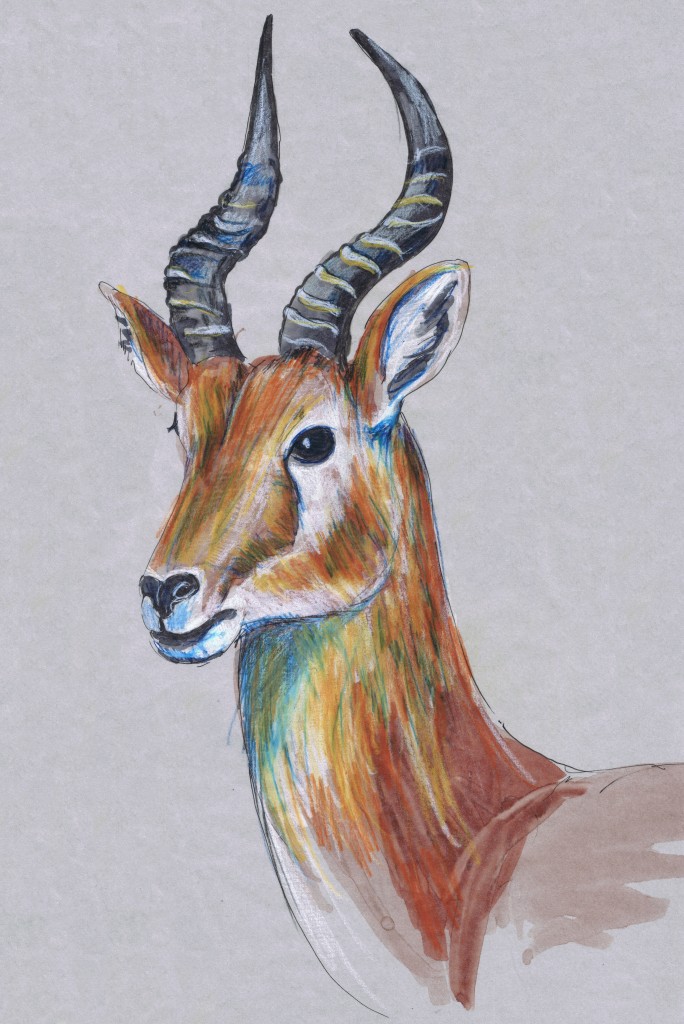
The nilgai is an antelope that lives in India and parts of Nepal and Pakistan. For an antelope, it has a weird scientific name: Boselaphus tragocamelus means ox-deer-goat-camel. Perhaps they just really didn’t know and wanted to hedge their bets. The word nilgai comes from a Hindi word meaning “blue bull.” (The male nilgai’s bluish gray hide reminds me of grulla, my favorite color in Ben K. Green’s The Color of Horses. When I was a kid, my dad and I enjoyed looking at that book at B. Dalton or Waldenbooks while my mom and sister were shopping elsewhere in the mall.)

Some 35,000 feral nilgai roam ranchland in Texas. In the 1930s, the King Ranch decided to experiment with breeding the hardy antelope in tough Texas as an alternative source of meat. That didn’t really take off. Now, the Texas nilgai are handy targets for trophy hunters.

{ 2 comments }

Click image to enlarge.

Click image to enlarge.

0251

Our current system of naming animals and plants is based on the system that Carl Linnaeus published in 1758. While others, including Aristotle, had previously attempted to organize the world’s living things into various arrangements, Linnaeus gave us an important innovation: the binomial system. Each animal (or plant or whatever) is known by a unique pair of names; no other creature has the same name. We’re the only Homo sapiens; the cotton-top tamarin is the only Saguinus oedipus. (Of course, there can be other members of the genus Homo and the genus Saguinus, but they have to have distinctive second, or species, names.)

The organization that keeps track of and codifies the system of naming animals is the International Commission on Zoological Nomenclature. The rules are quite extensive. My favorite guidelines are those that require namers to make every effort to ensure that their names are euphonious (pleasing to the ear) and that they don’t give offense.

Linnaeus was Swedish, but he wrote in Latin, as did pretty much everyone else writing about scientific matters at the time. The scientific names of animals are often referred to, casually, as their Latin names, and the rules governing naming do require the Latinization of some words. But there’s also a lot of classical Greek in the names, and many names derive from local words for the animals.

Many animals have redundant names (tautonyms, to use the official terminology), like Gorilla gorilla, Dama dama, and Uncia uncia. Usually, this happens when the name of the animal’s genus (the first name in the binomial system) changes, but the species name can’t. I like the black rhinoceros’s name because it’s redundant in two languages: diceros means two horns in Greek and bicornis means two horns in Latin.

The black rhinoceros’s common name is odd, too. The rhino is not black; it’s gray. Apparently, it was named the black rhinoceros to distinguish it from the white rhinoceros, which is also gray, not white. That animal’s common name comes from the Dutch word weit, which means wide, like the rhino’s muzzle. (My source for all this is A.F. Gotch’s book Mammals: Their Latin Names Explained.)

The black rhino is classified as critically endangered, the last step before extinction. It’s so bad, in fact, that the IUCN, which assesses the status of the world’s species, obscures the rhino’s range on its map “for security reasons.” While the black rhino was pretty numerous at the start of the 20th century, poaching caused a 96 percent decrease in the species’ population between 1970 and 1992. Black rhino horns are carved to create decorative handles for weapons and used in traditional medicine. Traditional medicine is going to be the death of a lot of mammal species.

{ 2 comments }

Daily Mammal Book Club: MFAOA 3

by JR Kinyak on March 31, 2009

in Book Club

Hi Mammals! Welcome back to the book club! (The previous meetings are here and here.) Today we have a guest club leader, my husband Ted. (By the way, if anyone is interested in kicking off the discussion with a guest post in this or any other possible future book club series, just let me know!) Here’s Ted on My Family and Other Animals by Gerald Durrell:

I’m rather behind in my reading of our current Book Club offering, My Family and Other Animals. But I wanted to share a little about the character of Spiro, for I believe I may have once met his grandson.

Spiro seems to have adopted them as his own from the moment they set foot on land, as their loyal manservant — limo driver, real estate agent, bodyguard and family counselor. Presumably he’s being paid a salary, or tipped well, for his services, though the book doesn’t go into this. The appearance is that Spiro simply latches onto them like a puppy for the sole purpose of helping them in every way. Is this realistic, or is Gerald Durrell offering us an overly rosy, idealized view of things?

I visited Greece for a couple of months about twenty years ago, with Eudokia, a girlfriend at the time who was Greek, and who was living in an apartment in Athens near family. We’d met in Art School, and she decided to move there for about six months to paint and reconnect with Greece; I cam along for a couple of months to stay with her. So though we did a fair share of sightseeing and touristy things, I lived there as a resident, not a tourist.

The Greek people are extremely warm and inviting to strangers, generous with their time and their hospitality, and do indeed seem to form quick loyalties to those they deem as friends. I remember one young man, a friend of a friend, who took on the task of host for us when we went out to a large, late dinner with a group of Eudokia’s friends, as the Greeks often do. I remember that he was an avowed Communist who nevertheless wanted nothing more than high-status American goods — when he came to visit the States a few months later he spent all his time looking for Timberland shoes and the best VCRs.

Anyway, he was gregarious and energetic, greeted me with a hug and a slap on the back, and from that moment he was my best friend and loyal advocate for the evening. At one point when the group’s conversation had gone back to nearly everyone’s native Greek, he stopped everyone and said, “my friends, we have a guest here! He is from America! We must speak only English tonight!”

His name was Niko, but it might as well have been Spiro. I’ll never forget him.

{ 7 comments }

Daily Mammal Book Club: MFAOA 2

by JR Kinyak on March 24, 2009

in Book Club

Hi again, mammals! The discussion about My Family and Other Animals by Gerald Durrell is going great so far. We’ve probably all read a little further into the book by now, but remember, even if you haven’t read any of it at all, you can still participate in the club meetings. Here are some things I thought about over the past week:

• In a comment on last week’s post, Grace said that she gets impatient with the description in the book, and Clare said that her mother feels the same way. (Grace is my mother, by the way!) Some of the Amazon reviewers said the same thing: they skip the descriptive passages to get to the stories about the family. I often skip long descriptions in books, too, but for some reason, in this book, I don’t do that. I think I’m getting into the pace of it. Plus, Durrell’s descriptions are just so good! If I were teaching creative writing, I think I would use this book as an example of how to write good description.

• The poor mother! I just love the transition from Part 1 to Part 2. Part 1 ends:

“We are not moving to another villa,” said Mother firmly; “I’ve made up my mind about that.”

She straightened her spectacles, gave Larry a defiant glare, and strutted off towards the kitchen, registering determination in every inch.

And then Part 2 begins:

The new villa was enormous…

I suppose it’s a fairly easy comic trick to pull, but it cracked me up nevertheless.

• Man, I want to live in the daffodil-yellow villa. The faded walls, the overgrown gardens, the olive groves and orange trees, the bees, the view of the sea…I just love it. It’s exactly my vision of how a villa in a Mediterranean country should be.

• I was thinking about how charmingly Durrell anthropomorphizes animals. When Madame Cyclops lays her eggs: “She turned round, lowered her hind end over the hole, and sat there with a rapt look on her face while she absentmindedly laid nine white eggs.” The scorpions in the wall: “The scorpion would lie there quite quietly as you examined him, only raising his tail in an almost apologetic gesture of warning if you breathed too hard on him.” One of the male birds: “The other male now became terribly harassed and apparently a prey to the dreadful thought that his babies might starve.” And Roger after the scorpions escaped at lunch: “Since no one had bothered to explain things to him, Roger was under the mistaken impression that the family were being attacked, and that it was his duty to defend them.”

Ordinarily, I’m not a big proponent of anthropomorphization. (Jeez, that’s a difficult word to type.) But I love the way Durrell does it. In a pretty straightforward way, it helps to create a clear picture of an animal, making it sympathetic and a subject of interest. I think that in order to care for and respect animals, we have to understand that they do have their own thoughts and lives. I don’t know if a turtle can be absentminded, a scorpion apologetic, or a bird harassed and a prey to dreadful thoughts, but being able to relate to them on an emotional level is, I think, ultimately good for both the animals and us. In this case, the accuracy of the thoughts and emotions we ascribe to the animals isn’t as important as the fact that we’re taking the time to imagine those thoughts and emotions. What do you think?

{ 1 comment }

Daily Mammal Book Club: MFAOA 1

by JR Kinyak on March 16, 2009

in Book Club


Welcome to the first book club meeting, mammals!

Let’s start talking about My Family and Other Animals by Gerald Durrell! To keep it really simple, I thought I’d just throw out a few things and then open up for comments, and we’ll see how it works. Also, please don’t think that you can’t contribute to the discussion if you haven’t read the book: you definitely can!

I don’t know how far y’all are in your reading, so I’m going to talk about the beginning of the book, y’know, the first few chapters. Some of my thoughts:

• I love the merciless way he pigeonholes his family members into particular characterizations. Margo with her acne, Leslie with his guns, Larry with…oh, Larry. He’s the funniest of all. If you didn’t know, he’s Lawrence Durrell, who became a pretty well known author. I haven’t read any of his works, though, but it does make Gerry’s descriptions funnier, don’t you think, knowing that? And then there’s the poor put-upon mother.

• How about the very concise way Durrell passes the family through Europe on their way to Corfu? “France rain-washed and sorrowful, Switzerland like a Christmas cake, Italy exuberant, noisy, and smelly, were passed, leaving only confused memories.” Just those few words really do evoke a whole trip, somehow. (Page 6 in my Penguin paperback copy.)

• The very words “The Strawberry-Pink Villa” (the title of chapter 2) create a picture to me. I think Durrell’s combined gifts for humor and description are quite remarkable. I love the way he can almost just list things, like fuchsia hedges, creamy green shutters, white cobbled paths, luxurious bougainvillea, etc., and it creates this lush, exotic (to me), redolent world. (Do you know any other writers who do that? It kind of reminds me of Francesca Lia Block’s Los Angeles in her Weetzie Bat books: all orange trees and hot dog stands and pink stucco and convertibles.)

• What do you think about the narration being from a child’s point of view? It’s interesting how a child would necessarily see things differently from his family. I wonder if other members of the family (Larry, perhaps) have written memoirs of this time. It would be interesting to read their different perspectives.

• Speaking of children, what a paradise Gerry has there. It’s safe to explore endlessly, accompanied by your loyal dog, nature is lush and vibrant, school is minimal (do you like his school setup?), your family is amusing and indulgent, and strange characters are everywhere. What do you think of Durrell’s descriptions of the inhabitants of the island?

That’s enough from me for now. Pipe in and share your thoughts!

{ 13 comments }