Posts tagged as:

bear

Spectacled Bear (Tremarctos ornatus)

by JR Kinyak on April 12, 2010

in Carnivores

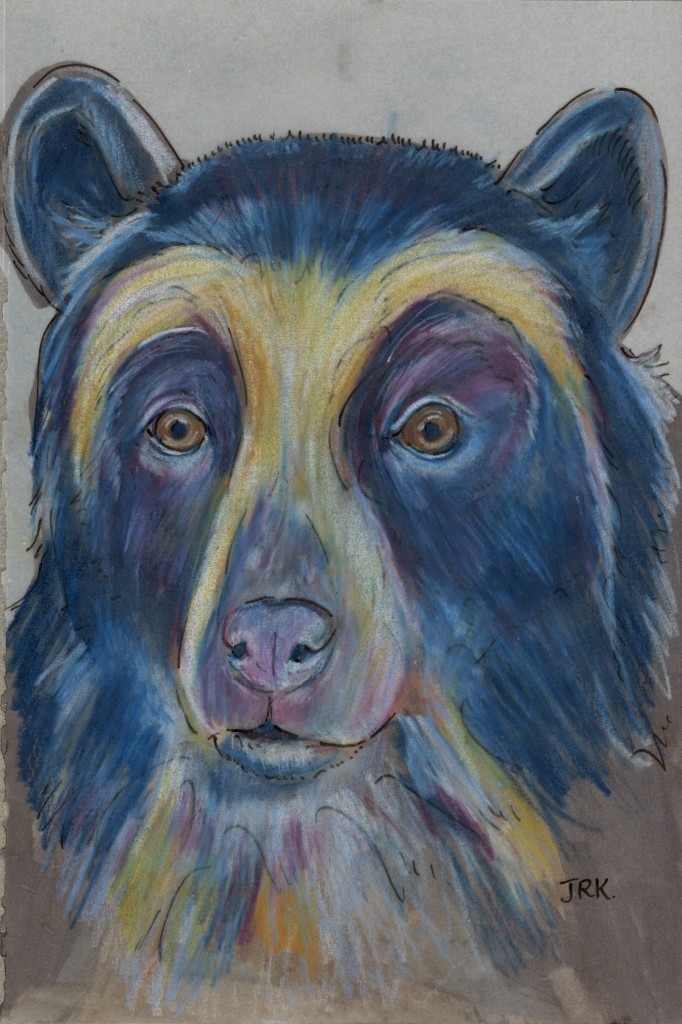
Spectacled bear (click image to enlarge)

0292

The only bear from South America, the spectacled bear lives in Venezuela, Ecuador, Colombia, Peru, and Bolivia. It gets its name, of course, from its professorial appearance, and it’s also known as the Andean bear, or ucumari in a native Andean language. The bear is a small one, as bears go, with males weighing up to 340 pounds and females only up to 180. There may be only a few thousand spectacled bears left in the wild. They are threatened by poaching, by habitat destruction (of course), and by farmers whose crops they try to eat. They are also used in traditional medicine and sometimes eaten. The bears themselves like to eat plants and fruit, especially bromeliads, but they’ll occasionally eat small animals.

Theo, without knowing that the bear is sometimes known, in Spanish, as oso real, drew a spectacled bear with a crown.

Spectacled bear by Theo, age 13 (click image to enlarge)

Coco drew a wonderful spectacled bear, too.

Spectacled bear by Coco, age 11 (click image to enlarge)

{ 4 comments }

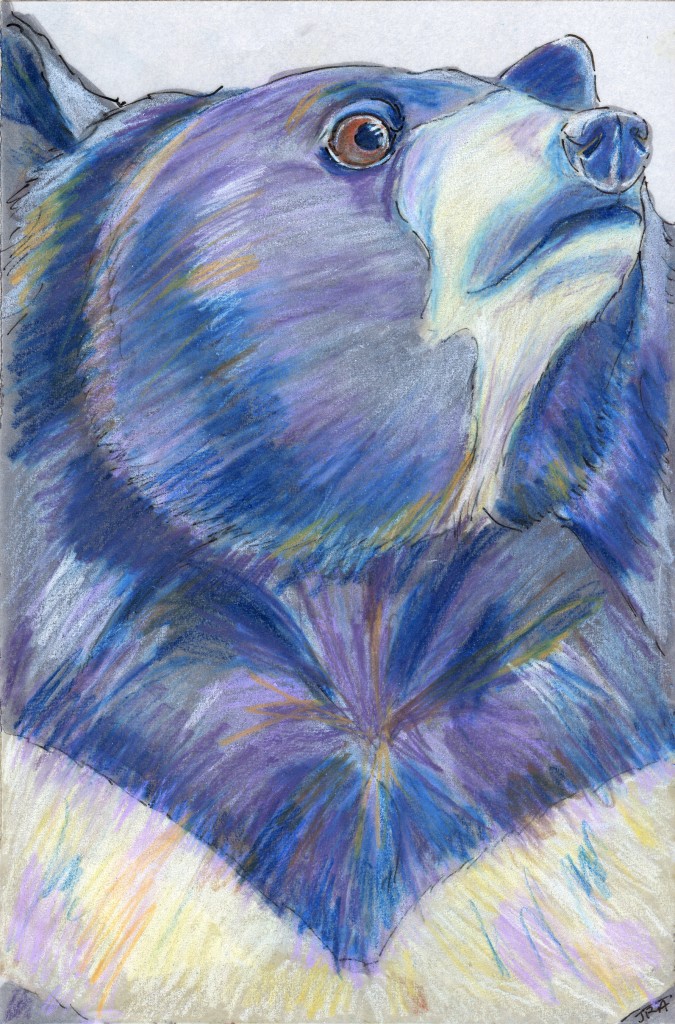
click image to enlarge

0231

Today is the last day of Hibernators Week at the Daily Mammal, so I’d like to introduce you to a bear, that classic hibernator. This particular bear is an Asiatic black bear. It lives in forests in several countries in southern Asia, including China, Japan, Iran, and Pakistan, among others. In the northern parts of its range, it hibernates, filling up on acorns and seeds to put on fat before time to head into the den. In the south, only females who are going to give birth in the winter hibernate.

IUCN classifies this bear as vulnerable, which is the last stage before endangered. Unfortunately, the Asiatic black bear is extensively hunted for its paws and its hide, and it’s a victim, like nearly everyone else, of habitat destruction. But the biggest and most upsetting threat to the Asiatic black bear is the “traditional medicine” industry. I knew that bear gall bladders were used in traditional Chinese (and Korean, Vietnamese, and others) treatments, but not until just now did I know just how terrible this is—not until just now did I think about it, I’m sorry to say.

In “traditional medicine,” a bears’ gall bladders and the bile they produce are used to treat hemorrhoids, pinkeye, impotence, headaches, heart disease, and more. Wild bears are hunted and their gall bladders taken. In 1980, informing us that this would reduce the number of wild bears killed, China began allowing bears to be “farmed” for their bile. (It didn’t reduce the number of bears being hunted in the wild. Instead, it made wild bear bile more valuable.)

And this is where it gets really, realy ugly. The “humane” method of harvesting the bears’ bile is to create a permanent hole in the bear’s abdomen and gall bladder, through which the bile drips. Other methods include metal catheters, repeated surgeries, and metal jackets. The bears on the “farms” are kept in cages not much bigger than they are. Their teeth and claws are pulled. They moan in pain, banging their heads on the bars of their cages. They live in terror and agony. This can go on for their entire lifetime: 25 years. Of pure torture. And there are thousands of bears undergoing this abuse right now.

It’s enraging, cruel, disgusting, and inhuman. And it’s also completely unnecessary. Not only does “traditional medicine” recognize a range of herbal substitute for bear bile, but Western medicine has synthesized the compound that gives the bile what healing capacity it has. (An acid in mammalian bile is especially concentrated in bears. This acid can help treat some liver ailments. But again, no one needs to take it from bears, and there’s no rational reason to think it can help a headache or hemorrhoids.)

When I added the Asiatic black bear to my list of hibernators for this week, I was just thinking about how fun it would be to draw a big, furry bear. Now I’m angry. Today, the Associated Press reported on a rescue of 12 Asiatic black bears from years of torture on a “farm” in China. They were suffering from liver tumors, blindness, and ringworm, and some of them were compulsively biting the bars of their cages. The group that rescued them is called Animals Asia, and you can help it rescue bears through a donation. If you knit, there’s another way you can help. The bears need surgery after their rescue, and they need to keep warm when they’re under anesthesia. Knitters are helping them by making big old bear mittens for them to wear. You can find out more at this site, and you might also like to read the Animals Asia blog about its rescue efforts.

{ 2 comments }

24 Hours: Giant Panda

by JR Kinyak on December 23, 2007

in Carnivores, Mammalthons


0093

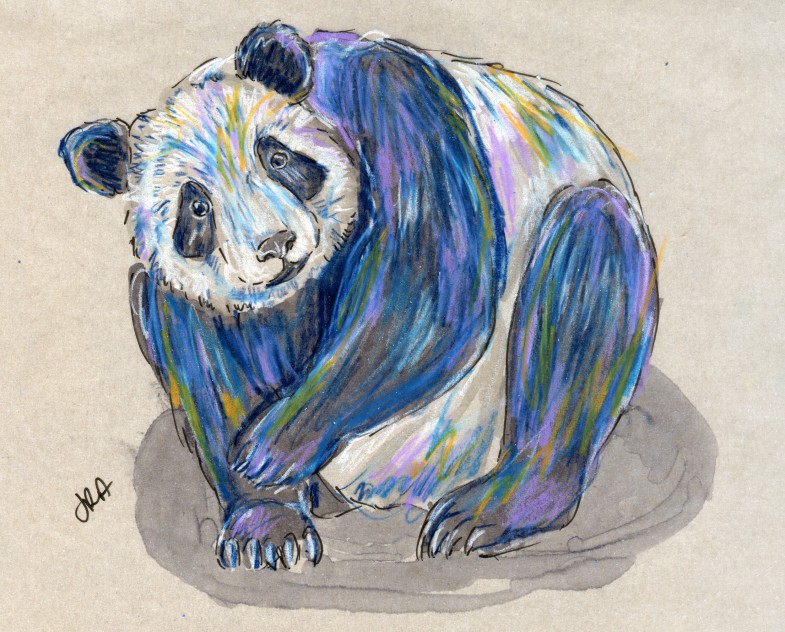
Giant panda! For my tia Leah!

—————-
Now playing:
Clyde McPhatter & The Drifters – White Christmas
via FoxyTunes

{ 3 comments }

24 Hours: Brown Bear (Ursus arctos)

by JR Kinyak on December 23, 2007

in Carnivores, Mammalthons


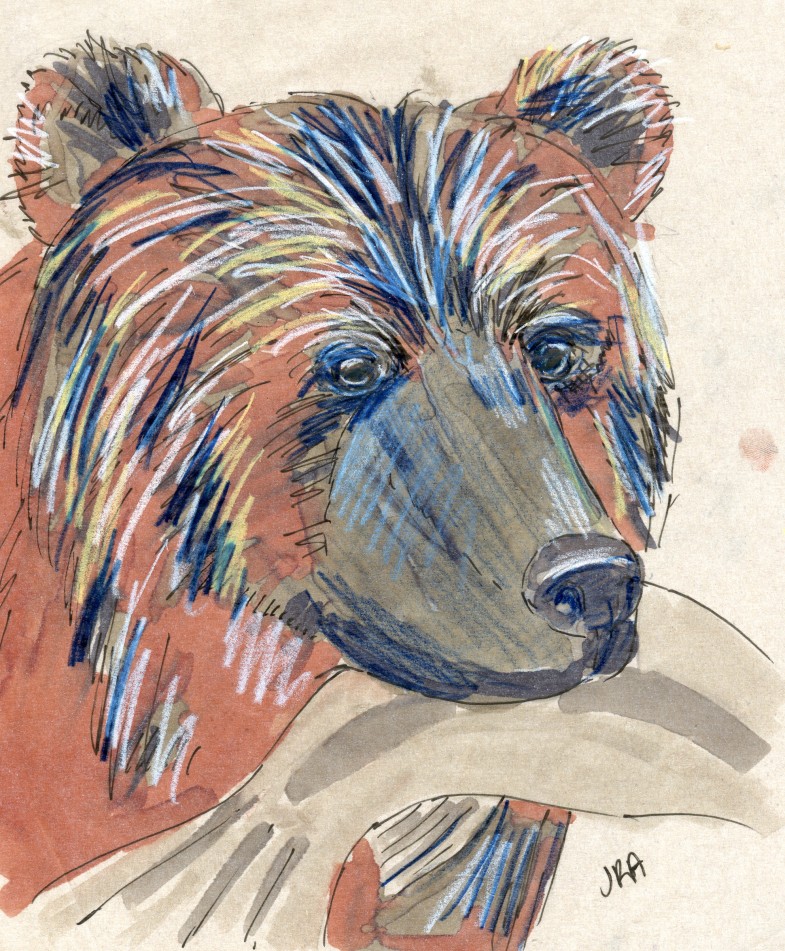
You may recall from the grizzly I drew a while back that it’s a subtype of this beautiful species, the brown bear. They’re just so big and heavy and shaggy. I really like them. This one, who has just caught a salmon for dinner, is for Kari.

Well, it looks like I’m two mammals behind! I need to speed up somehow.

{ 4 comments }

American Black Bear (Ursus americanus)

by JR Kinyak on December 4, 2007

in Carnivores


0062

The mammals are back! After a hiatus in which I bought a house, moved into it, and wrote a novel, I have returned to mammalography with a renewed commitment to reaching my goal. Thank you for your support, and please stay tuned for an announcement later this week about a special Daily Mammal event.

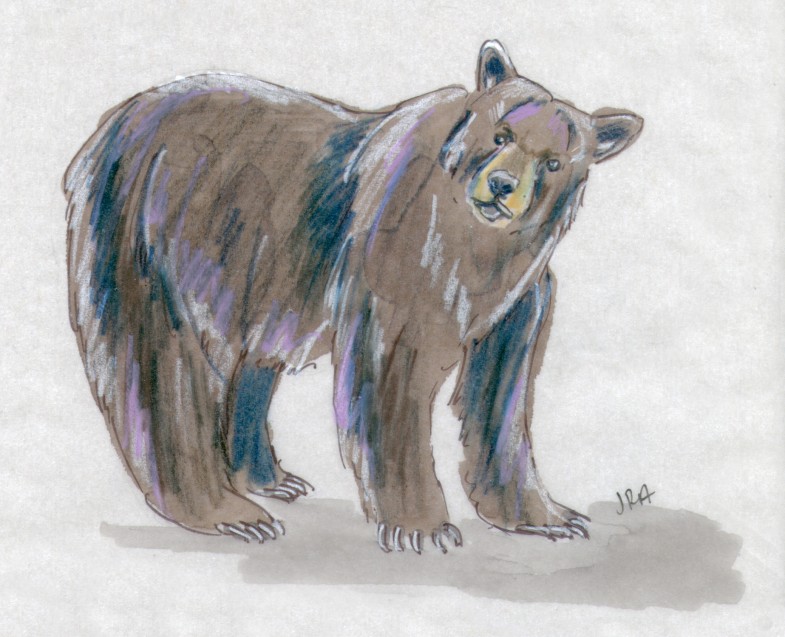
This fellow here is a black bear. They live throughout North America, in pretty good numbers overall, although they have declined a lot in some places. Their coloring seems to vary regionally—in northwestern North America, there are even very pale ones, almost white—and they’re larger in the east, where they don’t have to compete with brown bears.

Black bears don’t truly hibernate because their heart rates don’t slow down that much, but they do “enter a state of lethargy” in autumn, according to my Simon & Schuster’s Guide to Mammals.

Another thing I learned this week is that contrary to all the pro-New Mexico propaganda I’ve cheerfully taken in over the years, the character of Smokey Bear actually came before the real-life Smokey Bear, the black bear cub who lost his mother in a forest fire in Lincoln National Forest in 1950 (and whose first name was Hotfoot Teddy). The fictional character of Smokey debuted in 1944 and was named for a heroic New York firefighter called Smokey Joe Martin. Finally, it should be noted, his correct name is Smokey Bear, not Smokey the Bear.

See you tomorrow!

{ 3 comments }

Polar Bear (Ursus maritimus)

by JR Kinyak on July 13, 2007

in Carnivores

polarbear720041

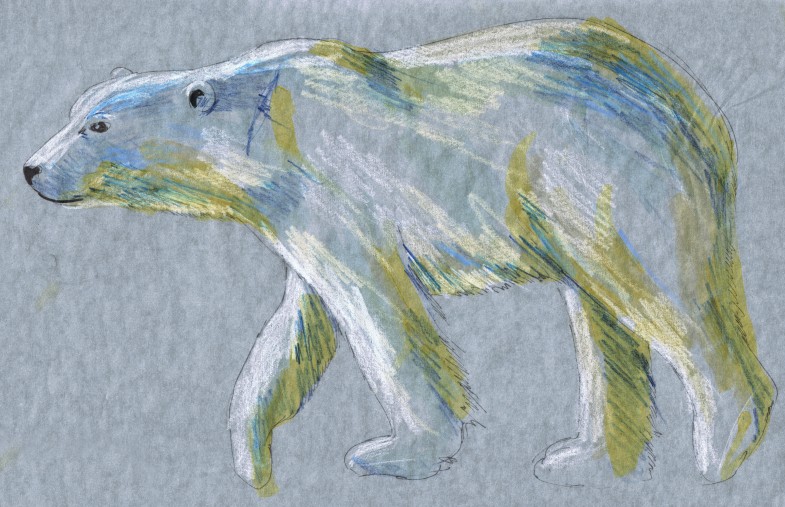
If you want to be sad, watch the “Ice World” episode of Planet Earth, in which the papa polar bear goes out to find food for his family.

{ 2 comments }

Grizzly Bear (Ursus arctos horribilis)

by JR Kinyak on June 5, 2007

in Carnivores

grizzlybear72

0003

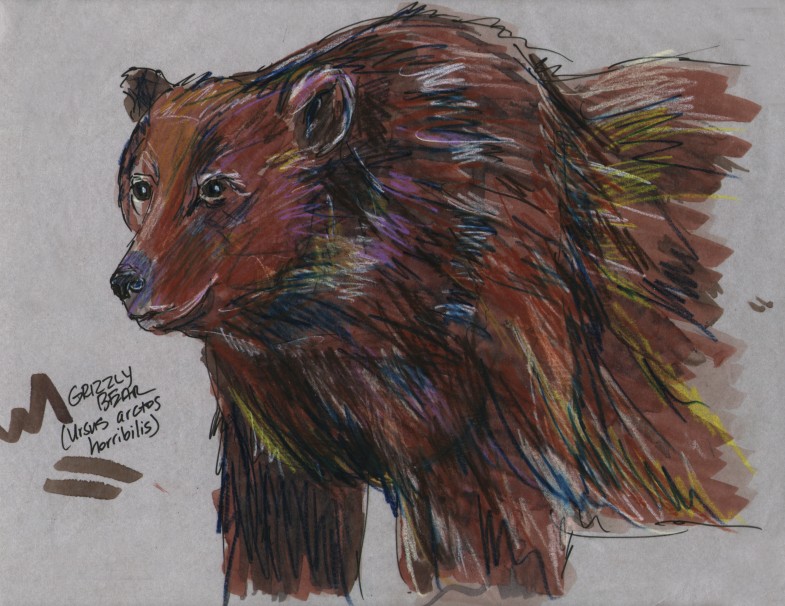
Representing the brown bear (Ursus arctos) species today is the grizzly bear subspecies (the Kodiak is also a subspecies of the brown bear). In the 19th century, there were tens of thousands of grizzlies in the lower 48 (of course, there weren’t 48 then…), but now there are only a couple thousand. The good news is that there are still plenty of them in Alaska, and the bear was recently taken off the federal threatened species list. The grizzly bear’s hump is pure muscle. It helps them dig and otherwise use their front legs. (This is another one for Leigh!)

{ 0 comments }