Posts tagged as:

antelope

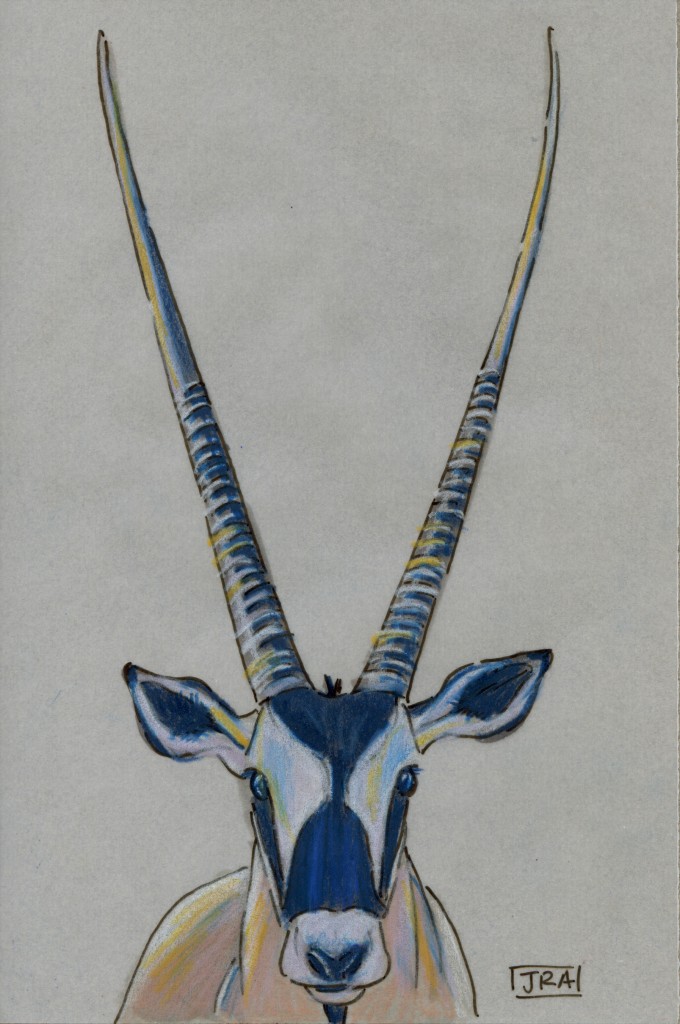
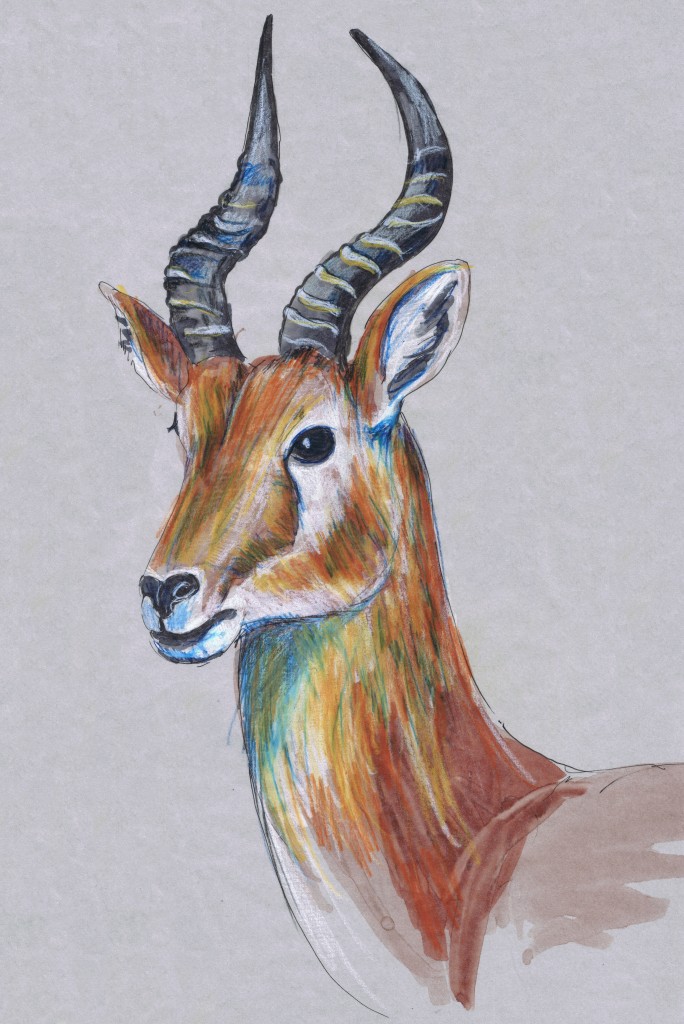
Gemsbok (Oryx gazella)

by J.R. Atkins on September 12, 2009

in Ungulates

Gemsbok (click image to enlarge)

Gemsbok (click image to enlarge)


0285

At long last, an update for the Daily Mammal. For those who hadn’t heard, about a month ago my husband and I adopted two kids, a 13-year-old and a 10-year-old. It’s going wonderfully—we love them so much—but becoming a mother to two half-grown humans all of the sudden has definitely changed my world, and it’s taking some time for me to get it all reorganized. I’ve actually finished 7 mammal drawings, but I haven’t done the research or writing on them. I’m going to start posting them now, trying, as always, for daily posting, and, also as always, probably falling short.

The gemsbok is a large antelope in the oryx genus. It lives in southern Africa and, I’m sure you’ll be glad to know, is not really in any danger of extinction. In fact, its numbers are increasing in some places. While there was a time when the gemsbok’s range was constricted by human encroachment and development, the animal’s value as a trophy for hunters means it’s not likely to die out on private land anytime soon. Plenty of gemsboks are thriving in protected areas, too.

Here’s a video of a mother gemsbok defending her calf from a pair of hungry cheetahs.

{ 3 comments }

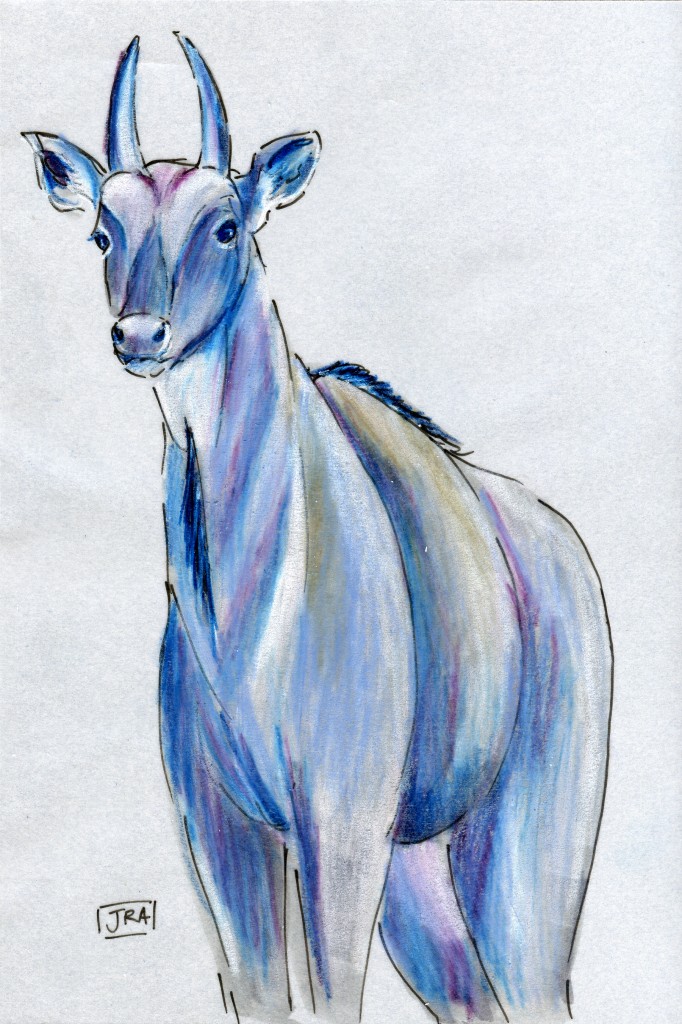
Nilgai (click image to enlarge)

Nilgai (click image to enlarge)


0254

The nilgai is an antelope that lives in India and parts of Nepal and Pakistan. For an antelope, it has a weird scientific name: Boselaphus tragocamelus means ox-deer-goat-camel. Perhaps they just really didn’t know and wanted to hedge their bets. The word nilgai comes from a Hindi word meaning “blue bull.” (The male nilgai’s bluish gray hide reminds me of grulla, my favorite color in Ben K. Green’s The Color of Horses. When I was a kid, my dad and I enjoyed looking at that book at B. Dalton or Waldenbooks while my mom and sister were shopping elsewhere in the mall.)

Some 35,000 feral nilgai roam ranchland in Texas. In the 1930s, the King Ranch decided to experiment with breeding the hardy antelope in tough Texas as an alternative source of meat. That didn’t really take off. Now, the Texas nilgai are handy targets for trophy hunters.

{ 2 comments }

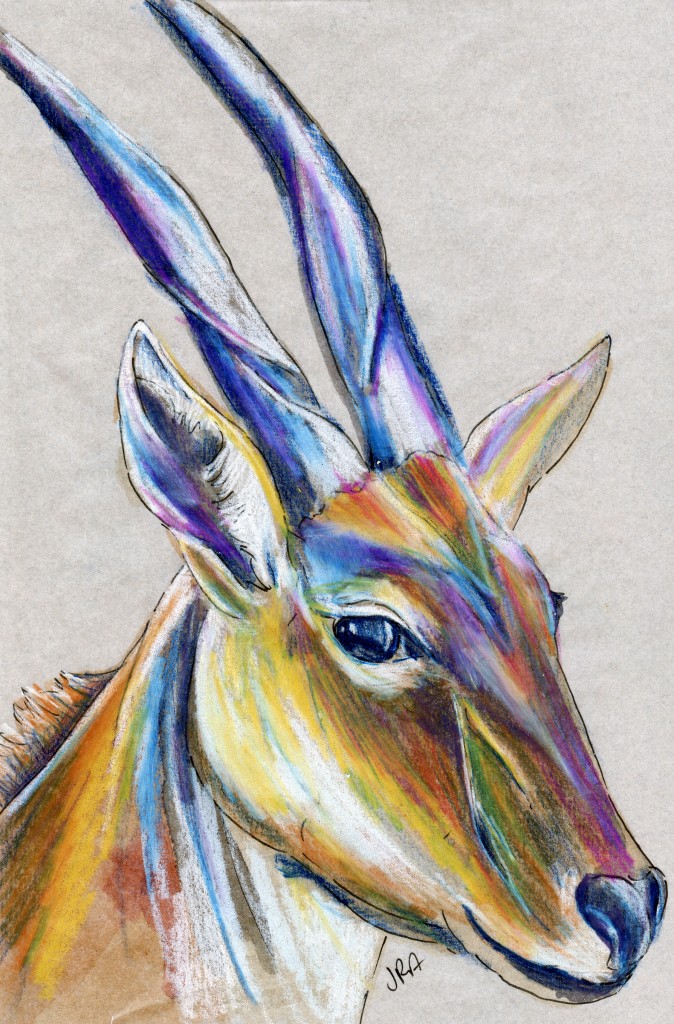
Common Eland (Taurotragus oryx)

by J.R. Atkins on June 21, 2008

in Ungulates

Take this mammal home with you! Buy the original drawing!

click image to enlarge

0178

Elands (of which there are two species, this one and the giant eland, which isn’t actually any more giant than this one, although this one is a bit more common than the giant one) are huge antelopes that live in Africa. Because they have very nutritious milk and decent meat and useful hides, people have tried, with varying success, to domesticate them as ranch animals. Overhunting is a threat to the eland, but it’s not in dire straits just yet.

Consecutive days of mammals: 1
Previous record: 16

{ 0 comments }

The 24-Hour Mammalthon has been rescheduled. It is now on May 3, 2008. There are still several slots available, so look over in the right-hand navigation bar and reserve your mammal today. It’s for a good cause.

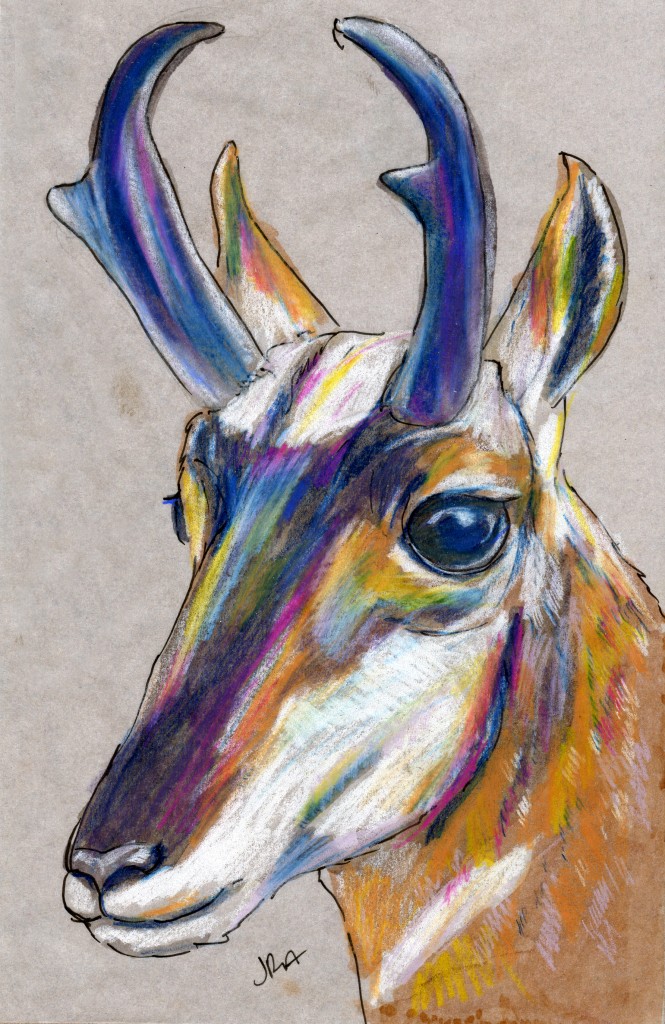
click image to enlarge

0145

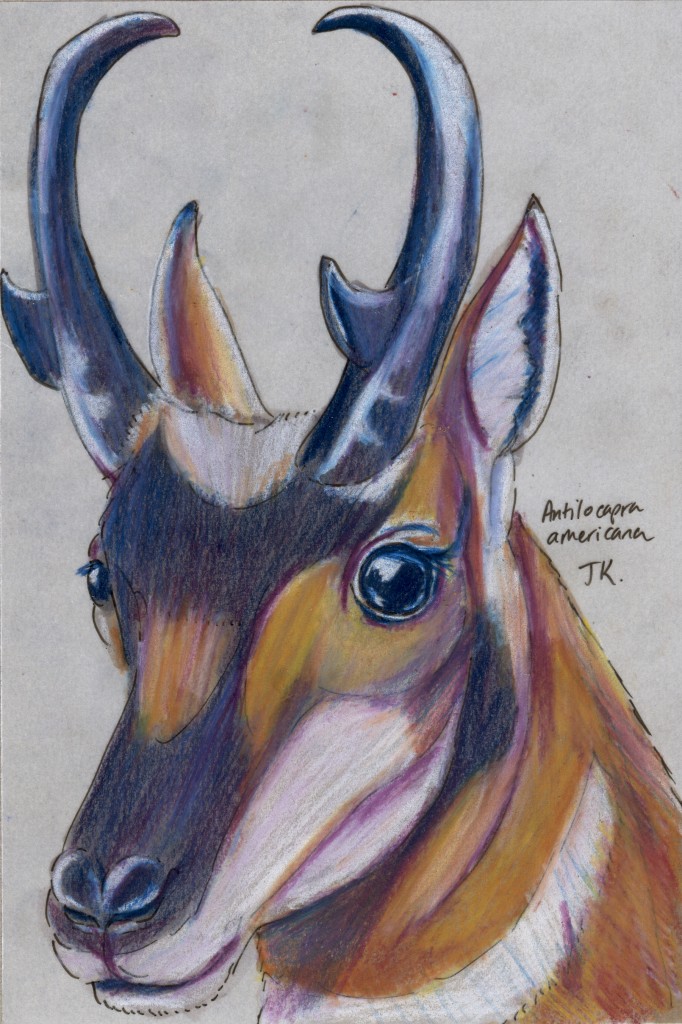
The pronghorn is often called an antelope, but it’s not really an antelope. Another nickname for it is speed goat, but it’s not a goat, either. In fact, it’s in a class—or rather, family—of its own as the only member of the Antilocapridae.

There are antlers, like deer have, and there are horns, like cows and antelope have. Do you know the difference? Antlers are made of bone and are shed each year. Horns are made of compressed hair growing on a bony core and are permanent. Then there are what pronghorns have. Their horns are keratinous, like bovine horns, but they’re branched, like deer antlers, and pronghorns shed them each year like deer do. In fact, no bovines are known to shed their whole horns the way pronghorns do. This seems to me to be the main factor that’s keeping the pronghorn in its own separate family instead of among the bovines.

Before Europeans came to America, there were tens of millions of pronghorn here. Around the turn of the century, they were nearly killed off; now there are about a million left, it seems. The fastest land animal in the western hemisphere, pronghorn apparently evolved solely in North America, never migrating anywhere else. Ivan T. Sanderson has this to say:

Nothing at all like these animals is known anywhere; they are a solitary leftover from pre-glacial times, when their tribe was much more varied…In a matter of speaking, they are a sort of minor experiment in ‘antelopes,’ initiated by Nature and then dropped.

I take issue with the “minor” part. Seeing pronghorn on the flatlands of West Texas and southeastern New Mexico was one of the things I most looked forward to as a child when we’d drive from our house in Midland, TX, to see my grandparents in Tatum, NM. I have a vivid memory of seeing them jump over a barbed-wire fence, but everyone—including my dad and Ivan T.—says they can’t jump fences. It must have been a daydream.

This pronghorn, along with the rest of the New Mexico mammals this week, is dedicated to the memory of Maleta Scrivner, a dear family friend who loved dogs and desert animals.

{ 4 comments }

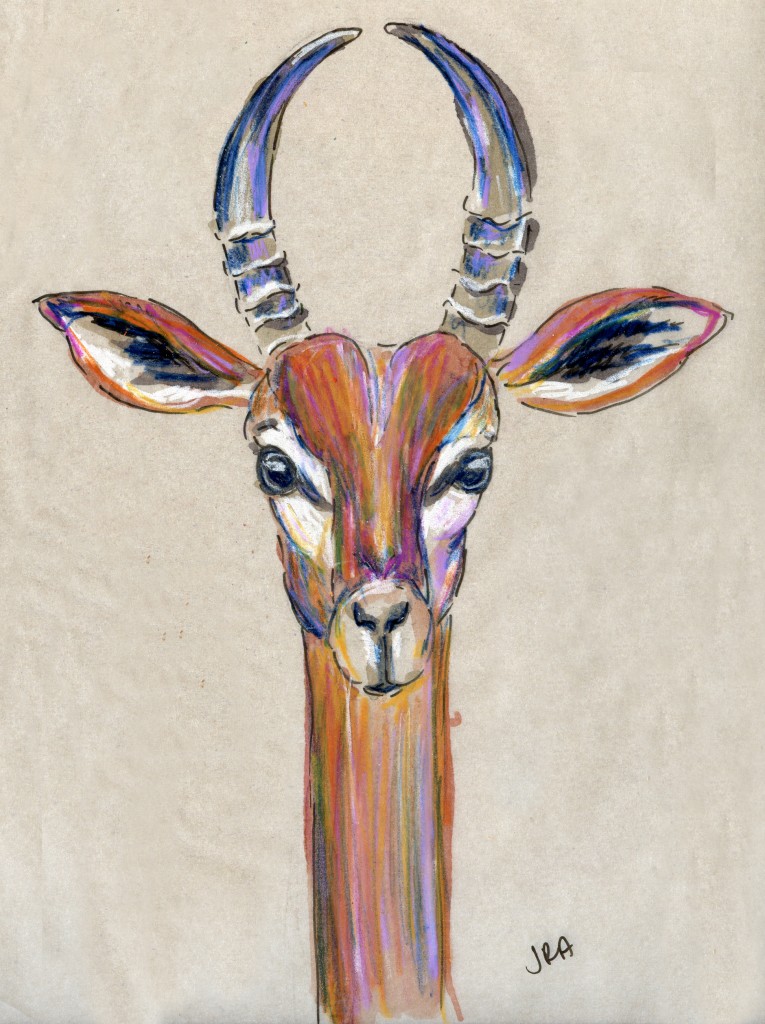
24 Hours: Gerenuk (Who knows?)

by J.R. Atkins on December 23, 2007

in Mammalthons, Ungulates


0092

Joe said “Pick something obscure that you think would be fun to draw,” so here, Joe, is your gerenuk, also called the giraffe-necked antelope! He was indeed fun to draw. If you want to see some really strange and beautiful creatures, look for photos of the gerenuk.

—————-
Now playing:
Teddy Pendergrass – Love TKO
via FoxyTunes

{ 2 comments }

Saiga Antelope (Saiga tatarica)

by J.R. Atkins on December 19, 2007

in Ungulates

Check in throughout the day on Saturday, December 22, to see 24 Mammals in 24 Hours!


0076

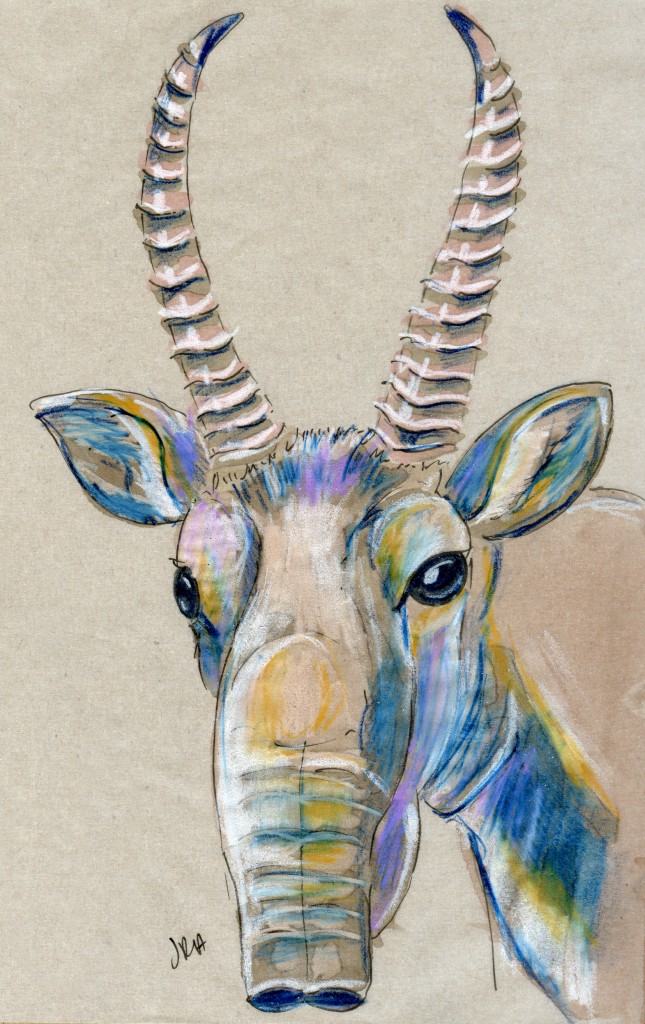
I just love these guys; sadly, saigas are severely endangered, owing to habitat destruction and, especially, widespread poaching—their horns are a valuable ingredient in traditional Chinese medicine. In fact, their numbers have plummeted almost 95 percent in less than 20 years, a rate that is unheard of and very alarming.

They live on the steppes of central Asia. Some think their strange proboscis helps filter out the dust; others think it heats up the air they breathe before it reaches their lungs.

I came snout-to-snout with a stuffed saiga specimen at the Wagner Free Institute of Science in Philadelphia. I hope I can see a live one someday. I hope it’s even possible.

The saiga is number 62 on the EDGE list of 100 evolutionarily distinct and globally endangered species.

Saiga conservation in Russia

{ 2 comments }

Bongo (Tragelaphus eurycerus)

by J.R. Atkins on August 23, 2007

in Ungulates


0059

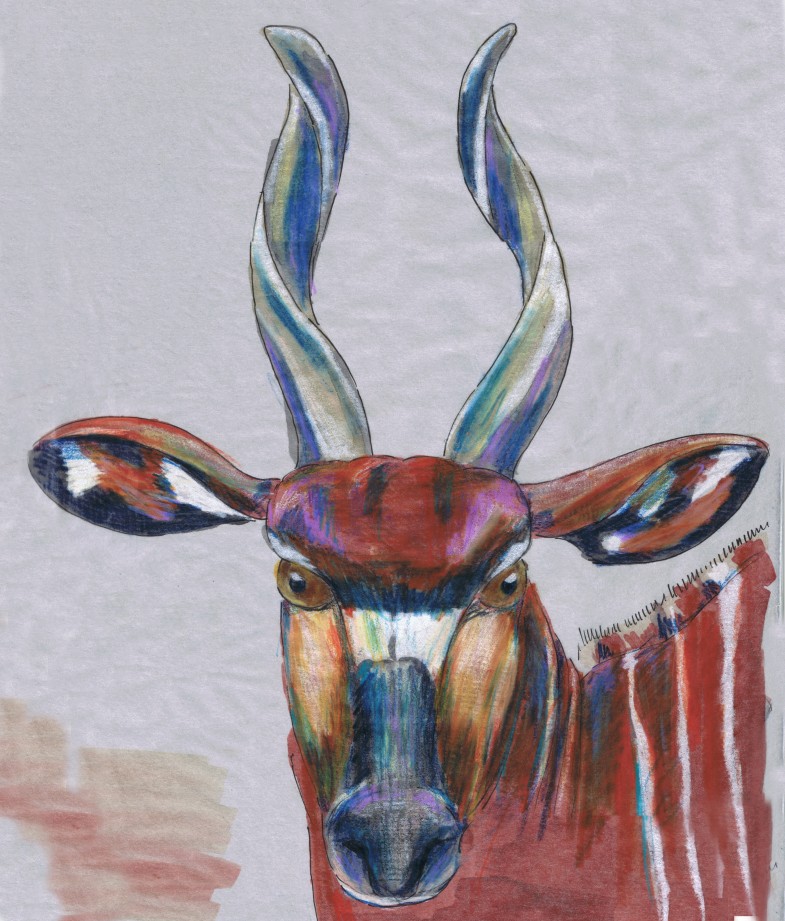
The Bongo is a large African antelope. Both males and females have “lyre-shaped” horns. (I love that description—lyre-shaped.) Their numbers are decreasing, and they’re threatened by the destruction of their forest habitat. One idea that might help bongos is the establishment of wildlife corridors that would let them safely travel from one national park to another. To learn more, visit the African Wildlife Foundation’s site.

{ 0 comments }