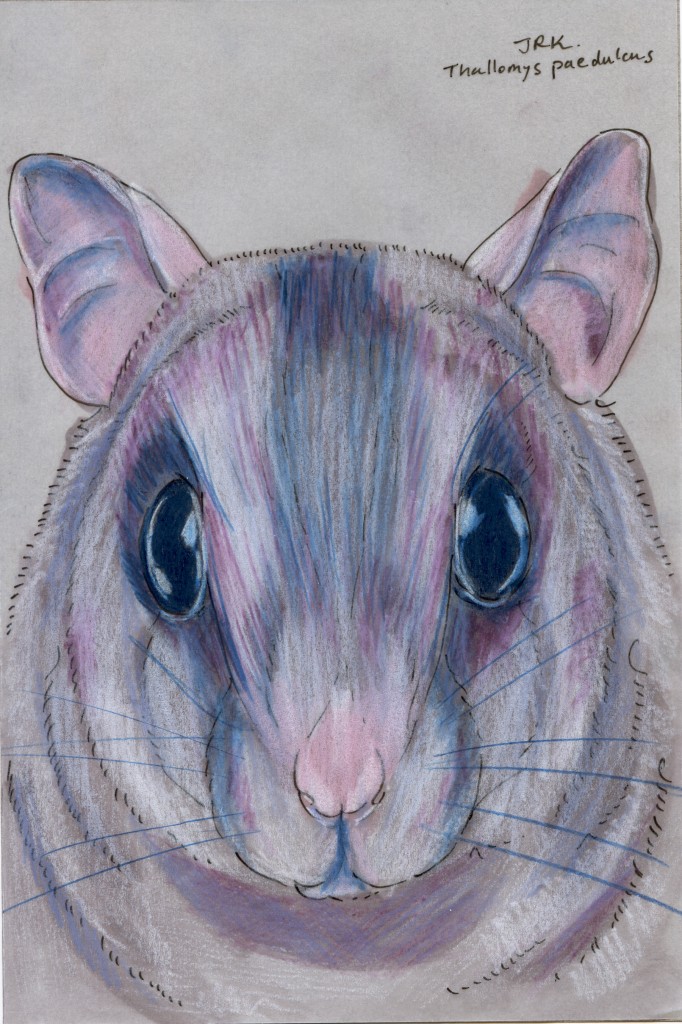
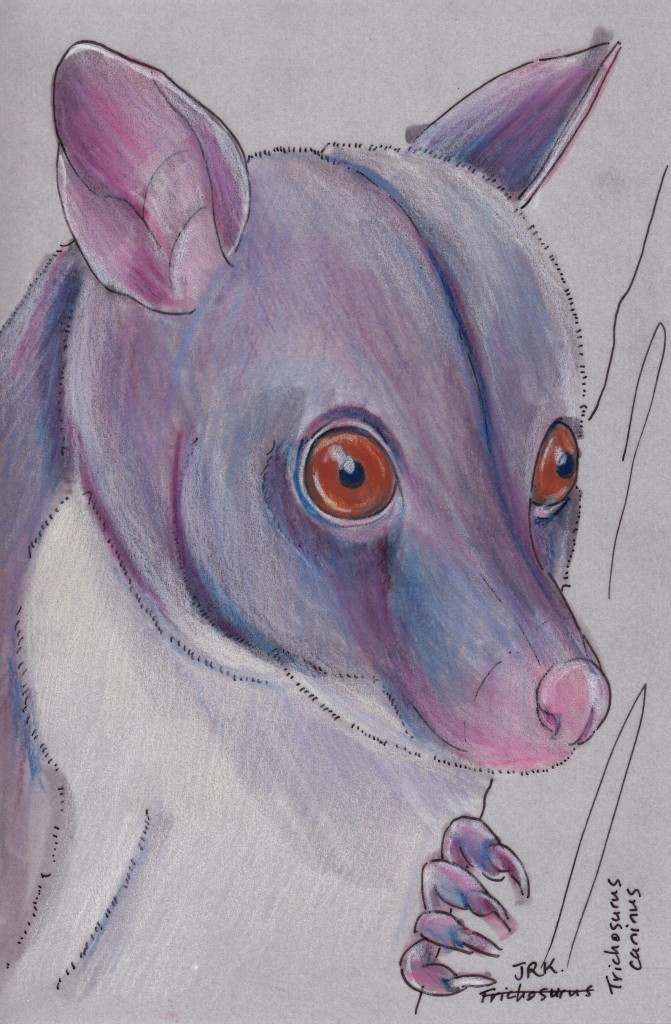
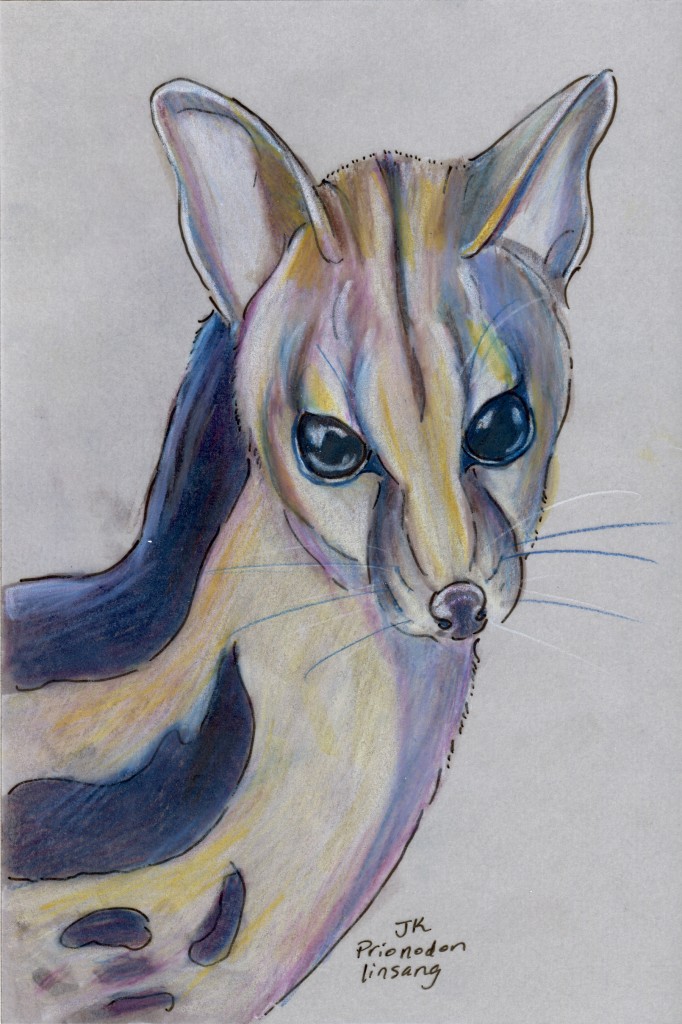
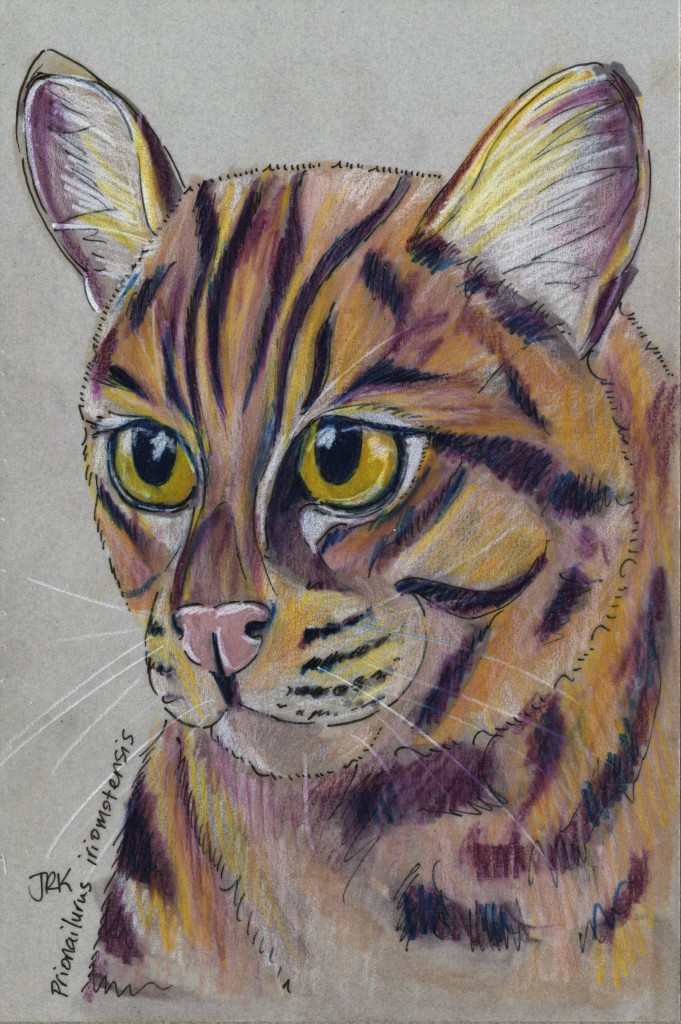
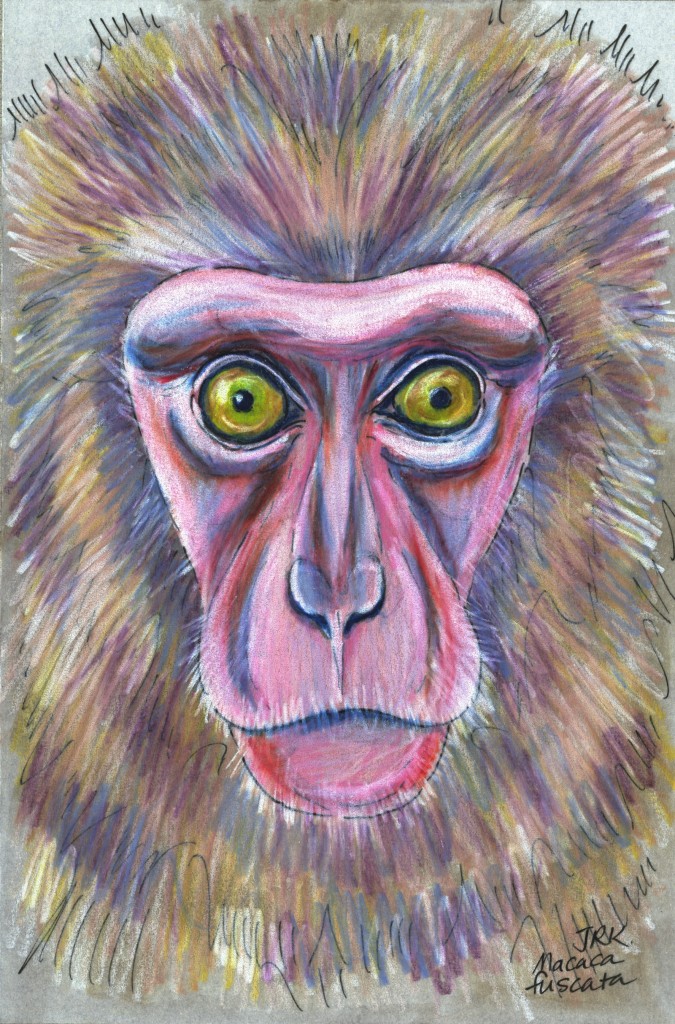
Short-eared brushtail possum (click image to enlarge)

0396

I drew this fellow last week, and just now, sitting down to research him, I ended up tumbling about in my books and online, finding not a lot about the possum—he’s a marsupial who lives in a little-bitty sliver of eastern Australia—but several other bits and pieces somewhat related to the species, which is also known as the bobuck.

For instance, as a spiritual totem, the short-eared brushtail possum could be associated with “mushroom and fungi energy” and both “broadcasting yourself” and “retreating into dark places.” (I don’t mean to sound overly snarky. I’m not into totem animals…at all…well, I don’t know, maybe I am, not in terms of religion or spirituality or trances or deep oneness of the soul, but in terms of affinities and identification, I could get into it. I relate to tree kangaroos and sloths. But I don’t go for the new-agey part of it. Anyway, the woman who runs the above-linked site says she noticed a glut of information about wolves as spirit animals and a lack of attention to marsupial moles, and I love that.) Isn’t the illustration of the possum at that link gorgeous? I quite like it.

Also, I learned that there’s a taxonomic quandary of some kind around this possum. You can read a bit about it at the Australian Museum’s website, but I’m not going to get sucked in. Basically, I just blindly draw the mammals listed in the Smithsonian’s Mammal Species of the World, and that’s that.

Speaking of that list, finding the link to it just now has alerted me that the website has been updated and now has a searchable database. I’ve been working off the spreadsheet they used to have available for download. Now I’ll have to decide whether or not to merge my old list with the new. You think that you can just say, “I know what would be neat—I’m going to draw all the mammals in the world!” But it turns out to be much more complicated than that.

Finally, I picked this possum out of my copy of Furred Animals of Australia, published in the United States in 1947, a book that I’ve referred to often in the past but haven’t thought much about. This time, I decided to Google the author, Ellis Troughton, wondering if he might be a naturalist of the adventurous, tall-tale variety. I don’t think he is, necessarily, but I did learn that he served in World War I in France from 1916 to 1919, and that during World War II he investigated scrub typhus in New Guinea. (I’m not entirely sure what the implications of that fact are.) He was the Australian Mammal Society’s first Honorary Life Member. (Is that a society of mammals? Aren’t they all?) And most perplexing of all, I found a solitary reference, in an interview with a physiologist conducted by the Australian Academy of Science, to Ellis Troughton being nicknamed “Naughty Troughty,” which I guess might rhyme in Australia. Why was he called that? I have no idea. I wish I did, though.

These bits of information inspired me to go through the introductory and…stuff-at-the-end material of Furred Animals of Australia in a quest for more about Mr. Troughton. (What is the word for stuff in the front and back of a book that isn’t the main part of the book? I can’t think of it.) I found, in the back, “Collecting Hints,” in which Mr. Troughton tells us how to preserve the small animals that we may injure in clearing timber or that our cat might bring in. He advises that “every effort should be made to preserve any small mammals accidentally killed about homesteads…The presentation of such specimens to the local museums represents a very material contribution to the knowledge of our unique Australian fauna of mammals.” Even if you’re not in Australia, something to consider, yes?

In the front of the book, Mr. Troughton reprints “A Creed for Nature Lovers” from a 1936 issue of The Australian Museum Magazine, and it’s lovely. It includes “I believe: That we should not harm living things that are harmless to us, as we hope to avoid harmful things ourselves; that even harmful creatures should be controlled with due regard for their zoological heritage and right to survive.” Words to live by, and something I wish I could get my kids to understand when they want to smash every spider that gets into the house.

Speaking of children, in his introduction to the book, Mr. Troughton says:

“Pleading protection’s cause in museum lectures for school children, I have reminded them of Barrie’s Peter Pan, and his friendly fairy kept alive only by the children’s belief in such quaint things. These children will be the grown-ups of to-morrow and both young and old must put their united influence behind any sound movement for the protection of wild life…

“Only by such universal belief in their right to existence can we ensure the survival of most of the fascinating creatures for the delight and instruction of future generations; so that, in the spirit of Kipling’s beautiful ‘L’Envoi’:

Each for the joy of the working,
And each in his separate star,
Shall draw the thing as he sees it,
For the God of things as they are.”

Thanks for joining me while I draw the mammals as I see them.

{ 4 comments }

Mexican Free-tailed Bat (Tadarida brasiliensis)

by JR Kinyak on October 5, 2011

in Bats

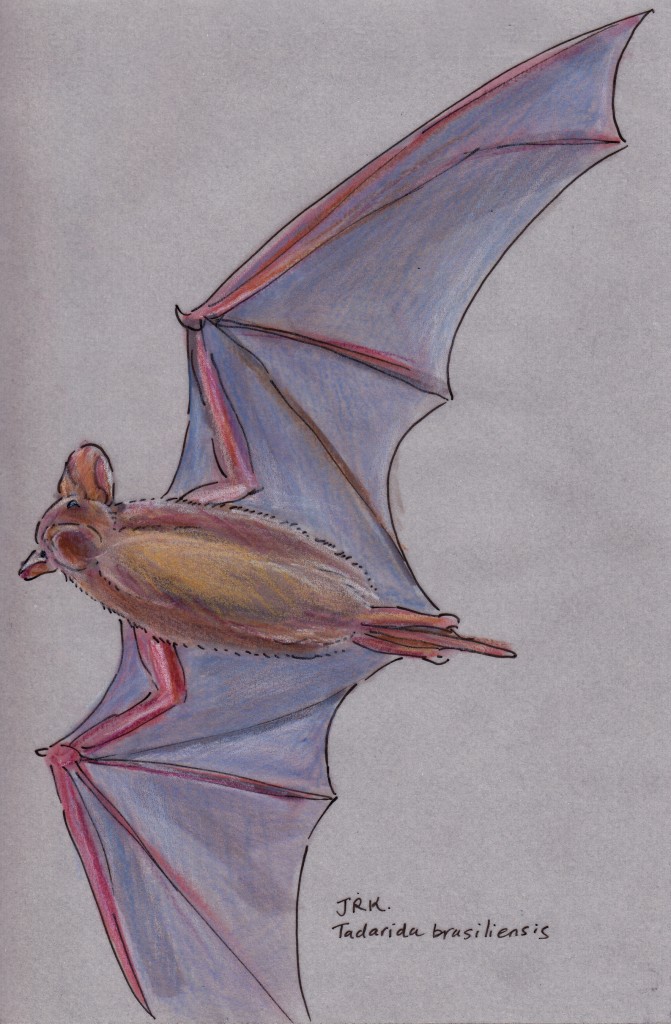
Mexican free-tailed bat (click image to enlarge)


Mexican free-tailed bat by Theo, age 15


Mexican free-tailed bat by Coco, age 12


0395

The kids and I are reading a book called Hanging with Bats, which starts with a chapter about the Mexican free-tailed bats at Carlsbad Caverns here in New Mexico. We decided to draw the bats, and then my son Theo wrote a poem to post on the Daily Mammal.

I think I may have mentioned, on this site, Thomas Nagel’s famous essay “What is it like to be a bat?” in which he explains that it is difficult (impossible?) for us to even imagine it, using the human-bat disconnection as an example of the inherent shortcomings of subjective experience in understanding objective truth. (I think that’s what it’s about.) As Nagel says, “In so far as I can imagine this (which is not very far), it tells me only what it would be like for me to behave as a bat behaves. But that is not the question. I want to know what it is like for a bat to be a bat. Yet if I try to imagine this, I am restricted to the resources of my own mind, and those resources are inadequate to the task.”

Theo’s poem, though, tries to help our imaginations, and it’s absolutely beautiful.

Through Tiny Eyes

Imagine
Screeches coming back at you, directing you
Imagine
Air flowing through your fur while slicing through air
Imagine
Air holding you airborne
Imagine
Hanging upside down,
huddling in the warmth of thousands of you
Imagine
Using your hands to cover your entire body
Imagine
Making an image of a black tornado
coming out of the black depths of a cave
Imagine
Being a bat

{ 6 comments }

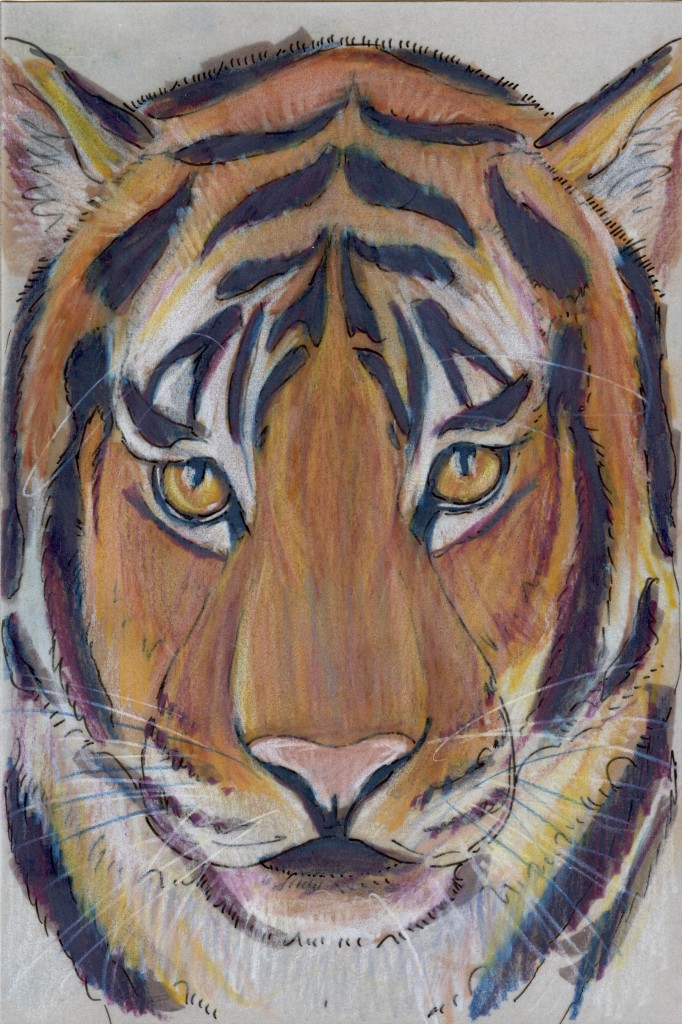
Tiger (click image to enlarge)

Before we leave Primorye at the end of our weekish-long visit, we must pay tribute to the tiger, the animal that inspired the book that inspired this week’s theme. Early in The Tiger, John Vaillant says,

“If Russia is what we think it is, then tigers should not be possible there. After all, how could a creature so closely associated with stealth and grace and heat survive in a country so heavy-handed, damaged, and cold? The nearest jungle is two thousand miles away. For these and other reasons, neither Russia the Idea nor Russia the Place are useful ways of describing the home of the Siberian tiger, which is, itself, a misnomer. This subspecies is known locally—and formally—as the Amur tiger, and it lives, in fact, beyond Siberia.”

A few pages later, he gives us a very vivid description of this most powerful of beasts:

“Of the six surviving subspecies of tiger, the Amur is the only one habituated to arctic conditions. In addition to having a larger skull than other subspecies, it carries more fat and a heavier coat, and these give it a rugged, primitive burliness that is missing from its sleeker tropical cousins…To properly appreciate such an animal, it is most instructive to start at the beginning: picture the grotesquely muscled head of a pit bull and then imagine how it might look if the pit bull weighed a quarter of a ton. Add to this fangs the length of a finger backed up by rows of slicing teeth capable of cutting through the heaviest bone. Consider then the claws: a hybrid of meat hook and stiletto that can attain four inches along the outer curve, a length comparable to the talons on a velociraptor. Now, imagine the vehicle for all of this: nine feet or more from nose to tail, and three and a half feet high at the shoulder. Finally, emblazon this beast with a primordial calligraphy: black brushstrokes on a field of russet and cream, and wonder at our strange fortune to coexist with such a creature.”

I love that “primordial calligraphy” and of course that last idea, that we are fortunate to coexist with tigers. As I’ve said before, one thing that this Daily Mammal project has given me is a huge sense of awe and wonder at the beauty and variety of life here on this planet, and for the miracle of evolution. I am indeed grateful to live in the same world as the tiger, even if, as Vaillant says in his book, “it alone can mete out death at will.”

{ 3 comments }

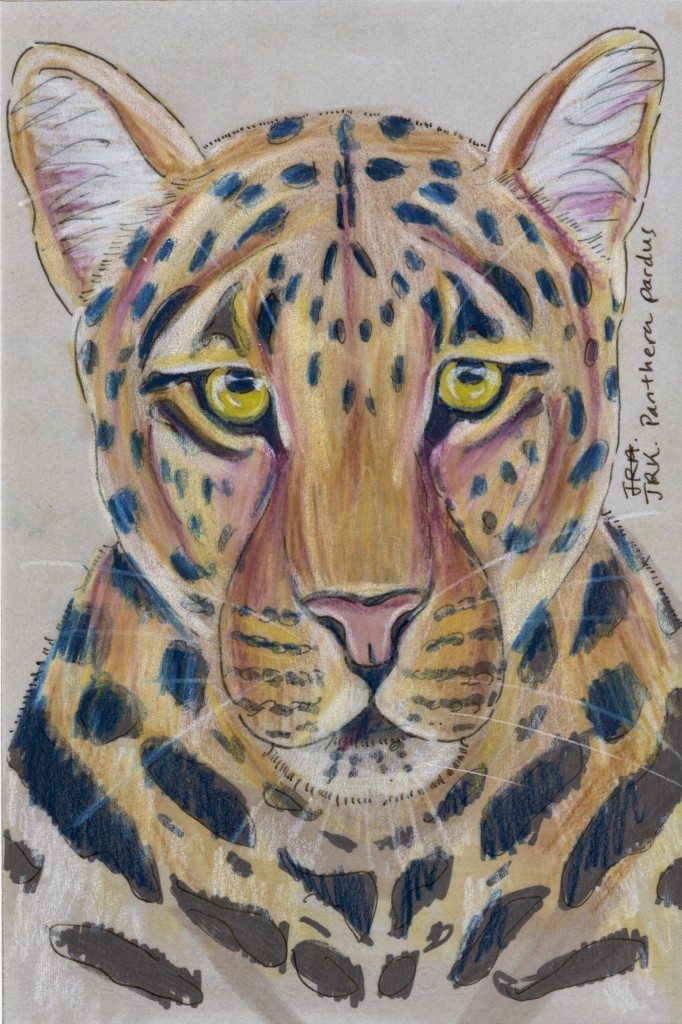
Leopard (click image to enlarge)


0394

Today, we visit the smallest of the big cats at home in Primorye, a fascinatingly diverse region of far eastern Russia that you can read a bit more about in last Monday’s post on the musk deer. In that post, I quoted John Valliant’s The Tiger in saying that only in Primorye, and nowhere else in the world, “can a wolverine, brown bear, or moose drink from the same river as a leopard.” I have no reason to doubt that, but leopards are pretty adaptable. The IUCN says that “the leopard has the widest habitat tolerance of any Old World felid, ranging from rainforest to desert,” and in that range is the “boreal jungle” of Primorye, as well regions ranging from Afghanistan to Zimbabwe.

Leopards are also quite adaptable in terms of what food they’ll eat, not disdaining to eat a beetle, a baboon, or a wildebeest. Walker’s Mammals of the World informs us that when leopards hunt, “larger animals are seized by the throat and killed by strangulation. Smaller prey may be dispatched by a bite to the back of the neck.” Leopards are so strong and so good at climbing trees that they will store carcasses bigger than themselves in trees to eat later.

If you’re wondering about leopards and panthers and whether they’re the same animal, let Ivan T. Sanderson, my favorite mustachioed, swashbuckling naturalist, set you straight with this passage from Living Mammals of the World:

“Before anything else is said about leopards, it is essential to dispose of the age-old argument about the names ‘panther’ and ‘leopard.’ Fairly important men have been challenged to duels for either affirming or denying that there is a difference—i.e., that there are two different animals. There are not: the two names denote the same animal or animals—for they vary greatly—though they may be used to differentiate between large and small, or between light and dark individuals in any one area. All the Great Cats that can roar are now officially panthers, as their technical name implies.”

I wonder if there’s any point in trying to find out just who was involved in those duels.

{ 3 comments }

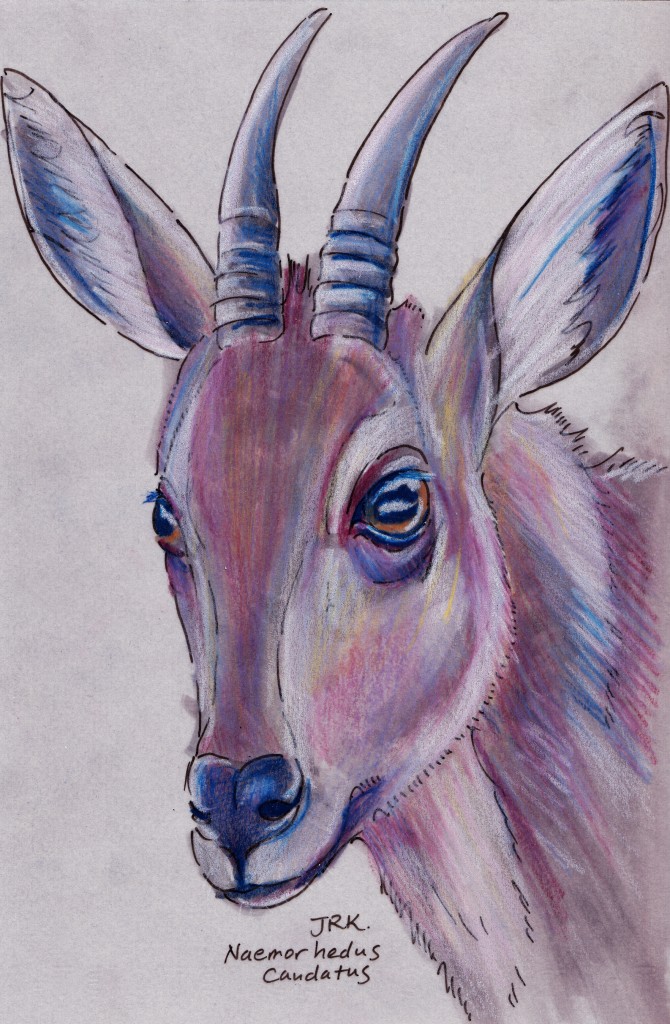
Long-tailed goral (click image to enlarge)


Long-tailed goral by Coco, age 12


0393

Here is a long-tailed goral, another mammal of Primorye, the region in the far east of Russia that we’re visiting this week. If you’d like a brief introduction to the place and why we’re there, check out Monday’s musk deer. The long-tailed goral is a goat that lives in China, Russia, and north and south Korea. It’s rare for a goat to have a long tail, so this goral has something to boast about. There are about 1,300 long-tailed gorals in all the world. Isn’t that remarkable? There are 6 billion of us—just the one species, Homo sapiens—and only 1,300 of this other species. They’re currently classified as vulnerable by the International Union for Conservation of Nature, and they are a natural monument in South Korea.

According to Animal Diversity Web, long-tailed gorals (which are also called Chinese gorals) “communicate with one another in times of emergency with wheezing alarm sounds…During mating season, males attract females with a “zer… zer” or “ze-ze-ze” call. When females approach and are ready to encourage a male, they make a whistling noise.” That is also what I do when I’m ready to encourage a male, coincidentally.

{ 5 comments }

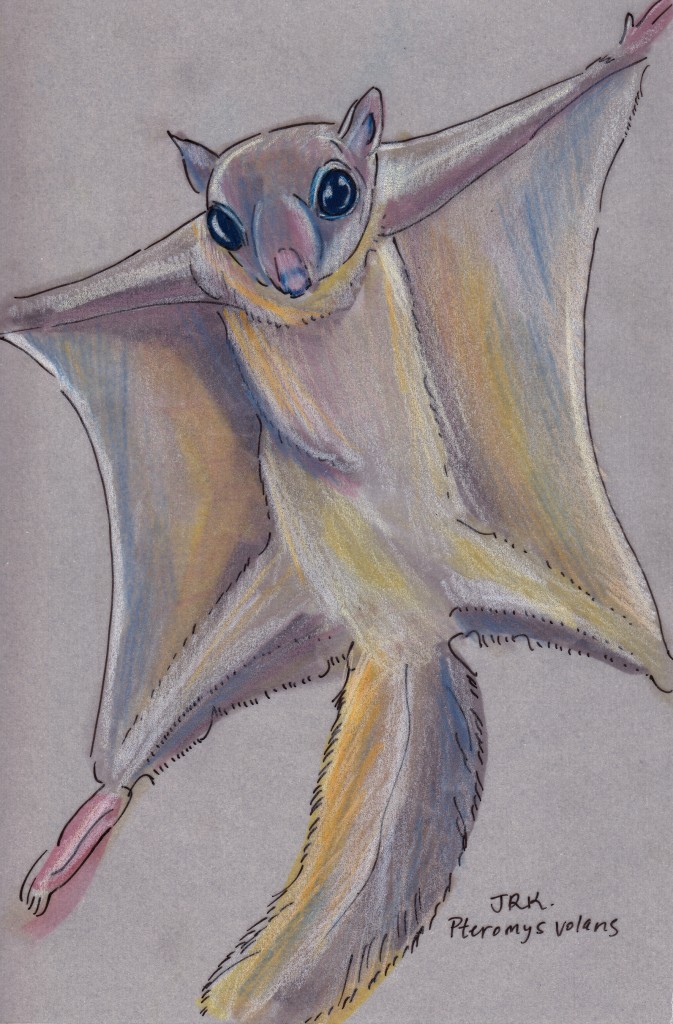
Siberian flying squirrel (click image to enlarge)


Siberian flying squirrel by Coco, age 12

0392

This week, we’re looking at a few mammals from Primorye, a region in the far east of Russia that you can learn a bit more about in my post for Monday’s musk deer. For today, Coco and I drew Siberian flying squirrels. They are quite common throughout the forests of northern Europe and Asia, where they glide through the treetops by night, snacking on seeds, leaves, buds, and catkins, which are downy, flowering spikes on some trees. An idyllic lifestyle to be sure, a lifestyle from a magical story.

{ 4 comments }

Primorye Week: Sable (Martes zibellina)

by JR Kinyak on September 28, 2011

in Carnivores,Theme Weeks

Sable (click image to enlarge)


0391

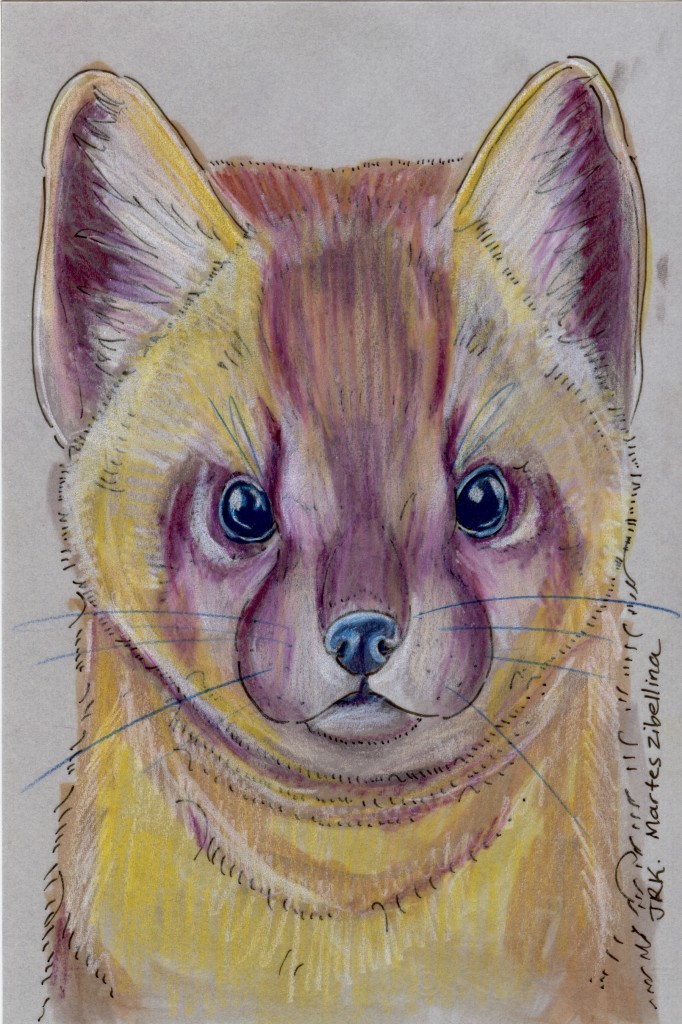
Welcome back to Primorye, an ecologically diverse region in the far east of Russia that we’re visiting this week. (Read Monday’s musk deer post for more about the area.) Today’s mammal is the sable, he of the beautiful coat, prized by rich ladies the world over. Sables are carnivores, related to weasels, skunks, ferrets, and so on, and they live in Finland, China, Japan, North Korea, Mongolia, and Poland, in addition to Russia.

According to a New York Times article called “Behind the $100,000 Sable Coat, a Siberian Hunter,” from 2000, during the Soviet era, most sable fur came from farms, but post USSR, the fur-farming system has given way to hunters, and now (or rather, in 2000), most fur for fur coats comes from wild sables. That article begins, “Wearing a hat made from pelts of hunting dogs that had disappointed him…” Another article, this one from the Japan Times, is headlined “Cuteness belies killers’ true nature,” but the sable is not enough of a killer to make a match for a man with a gun.

{ 4 comments }