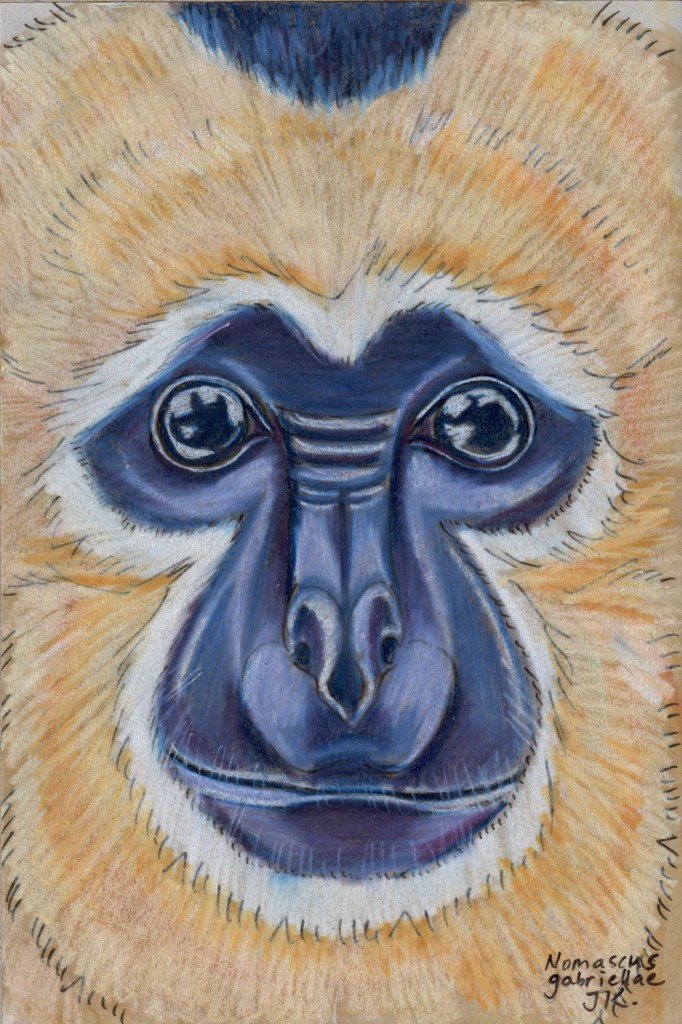
White-Handed Gibbon (Hylobates lar)

by J.R. Atkins on July 21, 2009

in Primates

White-handed gibbon (click image to enlarge)

White-handed gibbon (click image to enlarge)


0279

The white-handed gibbon, also known as the lar gibbon, is an endangered rainforest ape that lives in southeast Asia, from Sumatra and Malaysia to Myanmar, Thailand, and possibly part of China, although they’re likely extinct in that country. These gibbons are endangered because of their popularity in the pet trade, but especially because of deforestation and the disappearing rain forests.

I’m considering adding a small feature to the Daily Mammal sidebar in which I keep a running list of my favorite new-to-me biology words. In addition to crepuscular, fossorial, scansorial, pelage, tragus, and amberat, we now have brachiation: the act of traveling by swinging from branch to branch, something that white-handed gibbons are extremely good at. They are so good at it, in fact, that you should marvel at their brachiatory (I made that one up) skills by watching this video from ARKive. I love how they fall down through the treetops, making a giant crash through the leaves and hooking onto the next branch at the last second.

Just recently, gibbon researcher Thomas Geissmann published a paper in which he described a rare and lovely discovery: a captive female white-handed gibbon had mastered the use of a tool, specifically a musical instrument, or rather more specifically, a slamming door that she used as a musical instrument. White-handed gibbons (and other gibbons) are known for their haunting songs, which they sing in male-female duets. At the same place in her song each time she sang it, this particular gibbon would punctuate the melody with a percussive bang from the wooden door to her sleeping box. She almost never sang the song without the slam, and she almost never slammed the door when she wasn’t singing. You can read more about her and listen to her song (complete with the slam) in this BBC article. (Check out their caption for her portrait: “The all-singing, door-slamming, female white-handed gibbon.” It’s got a rhythm to it.)

{ 7 comments }

American Shrew Mole (Neurotrichus gibbsii)

by J.R. Atkins on July 20, 2009

in Other Orders

American shrew mole (click image to enlarge)

American shrew mole (click image to enlarge)


0278

This smallest of the American moles looks about like how I imagine Mole in The Wind in the Willows: gray, chubby, soft, and blind. The American shrew mole lives in the northwestern United States and southwestern Canada, from British Columbia to central California. The moles zip around in “runways” or trenches that they dig on the earth’s surface, just below the fallen leaves covering the ground. They also make the more classic kind of burrow, too.

American shrew moles only sleep one to eight minutes at a time—but they’re only awake between two and 18 minutes straight. (I picture them running along beneath the leaves and suddenly dropping in their tracks for a little snooze, then starting up just where they left off again. I don’t know if that’s accurate, though.) They use their noses to help them hunt in a rather methodical way. They’ll tap-tap-tap their nose on the ground in front of them, then turn their head to the right and tap-tap-tap again, then to the left with a tap-tap-tap, then take a step forward and repeat the process. They keep doing this until their nose touches a delicious earthworm, which they proceed to devour.

{ 2 comments }

Four pocket gopher species (click image to enlarge)

Four pocket gopher species (click image to enlarge)


0277
0276
0275
0274

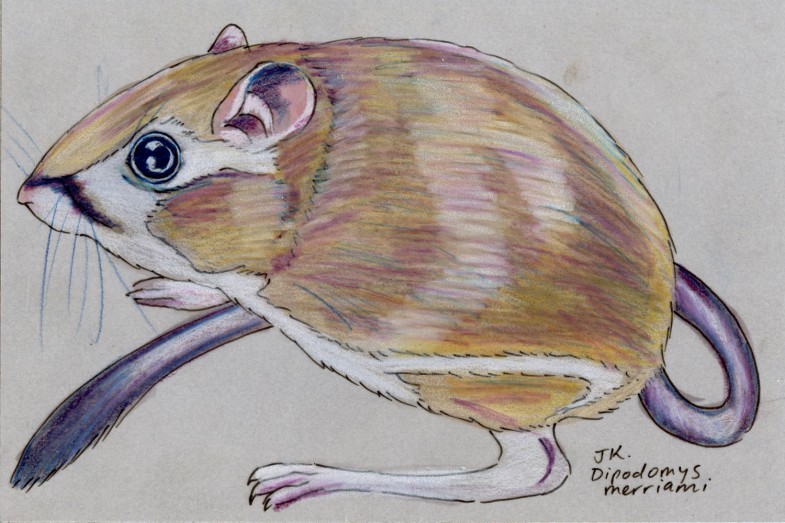
Forty percent of mammals are rodents, but only 25 percent of Daily Mammal drawings are of rodents. So far! Here’s a small step in correcting that imbalance. Top to bottom, please meet Thomomys bottae, Thomomys talpoides, Geomys bursarius, and Thomomys mazama, also known as Botta’s pocket gopher, northern pocket gopher, plains pocket gopher, and western pocket gopher, respectively.

They represent two different genera (Thomomys is the genus of western pocket gophers and Geomys is the eastern pocket gophers), but all of these little guys are from the same family—the pocket gopher family, of course. Chunky little pocket gophers are burrowers with big, curved incisors; long, strong claws; powerful arms; and external, fur-lined pockets that reach from their faces to their shoulders. They use these pockets for carrying food.

Pocket gophers make two different kinds of tunnels. One is just for finding food, like the roots of plants growing above. The other is for living, and they make separate chambers that serve as bedrooms, pantries, and bathrooms. They’re pretty solitary, and youngsters go roaming off when they’re a couple of months old to make a home of their own.

Although gophers get a bad rap as pests, they actually perform several important functions for humans. They aerate the soil, enrich it with the food they bury but don’t end up eating, and catch snow runoff in their burrows, which helps conserve the soil and water around their homes.

{ 2 comments }

Greater Mouse-Deer (Tragulus napu)

by J.R. Atkins on July 13, 2009

in Ungulates

Greater mouse-deer (click image to enlarge)

Greater mouse-deer (click image to enlarge)


0273

The greater mouse-deer is a teeny-tiny little thing, more or less rabbit-sized with legs the size of pencils. (I drew this one’s front legs too big.) The deer, also called chevrotains, live in Brunei, Indonesia, Malaysia, Myanmar, and Thailand. They weigh about 11 pounds, and unusually for deer, they don’t have horns or antlers. They do have big ol’ upper canine teeth, though, that become tusk-like in males.

Here’s an alarming (to me) fact: female greater mouse-deer spend only about two hours between giving birth and becoming pregnant again! They’re pregnant their whole lives. This leads me to ask a question of my biologist readers: are the pregnancies of other mammals as uncomfortable as ours? I’m thinking of morning sickness, varicose veins, hemorrhoids, backache, swollen ankles, etc. Is this unique to humans, and if so, why?

A remarkable thing about greater mouse-deer (which are sometimes called “living fossils” because of how ancient they are as a species) is that they are amazingly good swimmers. Scientists have observed them fleeing predators—say, humans or mongooses—by jumping into the water and staying under for up to five minutes at a time. They’ll swim around for an hour to keep away from a threat. Another Asian mouse-deer species does the same thing, as does an African relative of the species. These observations have lent credence to the idea that whales evolved from deer-like mammals.

Supposedly, greater mouse-deer make good pets. I think they would look particularly cute paired up with an Italian greyhound.

BBC: “Aquatic deer and ancient whales”

{ 2 comments }

Emperor Tamarin (Saguinus imperator)

by J.R. Atkins on July 10, 2009

in Primates

Emperor tamarin (click image to enlarge)

Emperor tamarin (click image to enlarge)


0272

I have two things I’d like to share with you about the emperor tamarin (also known as the emperor marmoset). First, according to Mammals—Their Latin Names Explained by A.F. Gotch,

“A taxidermist, so the story goes, had never seen a live tamarin and twisted the white ‘moustache’ upwards to look like the Emperor of Germany, instead of letting it droop in the natural position. It thus acquired the name Emperor Tamarin as a joke, but the name stuck, and the Latin name became established as Saguinus imperator.”

Second, check out this clip from a BBC series called Clever Monkeys, in which we learn about the mother emperor tamarin’s cunning use of mannies, and then have a good weekend:

{ 2 comments }

Cape fur seal (click image to enlarge)

Cape fur seal (click image to enlarge)


0271

Daily Mammal Now is an occasional Daily Mammal feature in which we meet a topically newsy mammal that I hadn’t previously drawn. Now, let’s meet the Cape fur seal, or more precisely, the Afro-Australian fur seal, of which the Cape fur seal is a subspecies. Afro-Australian seals live, unsurprisingly, off the coasts of Africa and Australia, specifically southwestern Africa and southern Australia. They’re called fur seals because their fur has been used to make coats and such. Baby fur seals have especially prized fur. The genitalia of male seals is sometimes used as an aphrodisiac in traditional medicine.

The largest Cape fur seal colony is on the coast of Namibia. Every year, the Namibian government allows seal hunts. This year the seal season runs from July 1 until November 15. The government is allowing hunters to club 85,000 baby seals and 5,000 adult males. The hunt takes place in relative secrecy so as not to attract attention or scare people.

Namibia is one of only five countries that still allow seal hunts. There is some disagreement among experts about the humaneness of clubbing seals; some maintain that done correctly, it’s more humane than shooting. But because of the perceived cruelty, seal products have long been banned in the United States and other countries, and beginning in 2010, they’ll be illegal in the European Union, too (with the exception of those created by subsistence hunting on the part of native populations).

This year’s Namibian seal hunt has been in the news the past couple of weeks because a South African organization, Seal Alert-SA, has been trying to buy out the only company that deals in Namibian seal pelts. (Coats made by the company supposedly fetch up to US$110,000.) With animal welfare activists claiming that the seal hunt hasn’t started because of the pending deal and the Namibian government saying that it has, it’s unclear what exactly is going on.

The National: “$14m deal to end Namibia’s Seal Cull”

The AP: “Namibian seal hunt to go on, 90,000 to be clubbed”

African Conservation Foundation: “Seal Cull NOT Started, Hang-in There Baby Seals, Help Coming”

Seal Alert-SA’s blog

{ 7 comments }

Iberian Lynx (Lynx pardinus)

by J.R. Atkins on July 8, 2009

in Carnivores

Iberian lynx (click image to enlarge)

Iberian lynx (click image to enlarge)


0270

The Iberian lynx is the most endangered cat species in the world. In fact, it’s in imminent danger of being the first cat to become extinct since the saber-toothed tiger. While the cats once lived in both Spain and Portugal, there’s no sign of them in Portugal anymore, and they’re confined to only two small regions in Spain now. Fewer than 150 Iberian lynx live in the wild. Fewer than 150.

The good news is that a captive-breeding program has been fairly successful; it’s preparing to release its first kittens two years ahead of schedule. Scientists have also made an important, if sad, discovery about the Iberian lynx. Most Iberian lynx litters are made up of three kittens. It turns out that it’s not uncommon for the kittens to fight to the death when they’re between 30 and 60 days old. In most litters, one kitten doesn’t survive, having been killed by a littermate. With fewer than 150 wild lynx in existence, losing one third of them while they’re still babies is particularly poignant.

Why is the Iberian lynx in so much trouble? One of the biggest reasons is that it eats almost nothing but rabbits, and depending on only one food source is never the best strategy. In the latter half of the 20th century, the rabbit population on the Iberian peninsula declined drastically not only because of deforestation, real estate development, and hunting, but also because one French doctor, in 1952, decided to control the rabbits in his garden by introducing myxomatosis, a rabbit disease. By 1954, myxomatosis had killed 90 percent of French rabbits and had spread throughout Europe, where it eventually killed off a significant portion of the Iberian lynx’s all-you-can-eat-as-long-as-it’s-rabbits food supply. Deforestation and other forms of habitat destruction affect the lynx directly, as well.

El Programa de Conservación Ex-Situ del Lince Ibérico (it’s in Spanish)
SOS Lynx, a Portugal-based organization working to save the Iberian lynx

{ 3 comments }