From the category archives:

Rodents

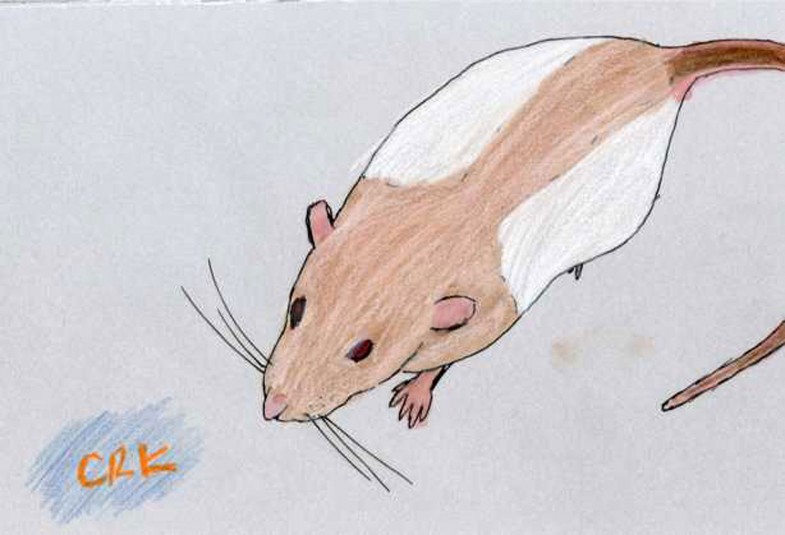
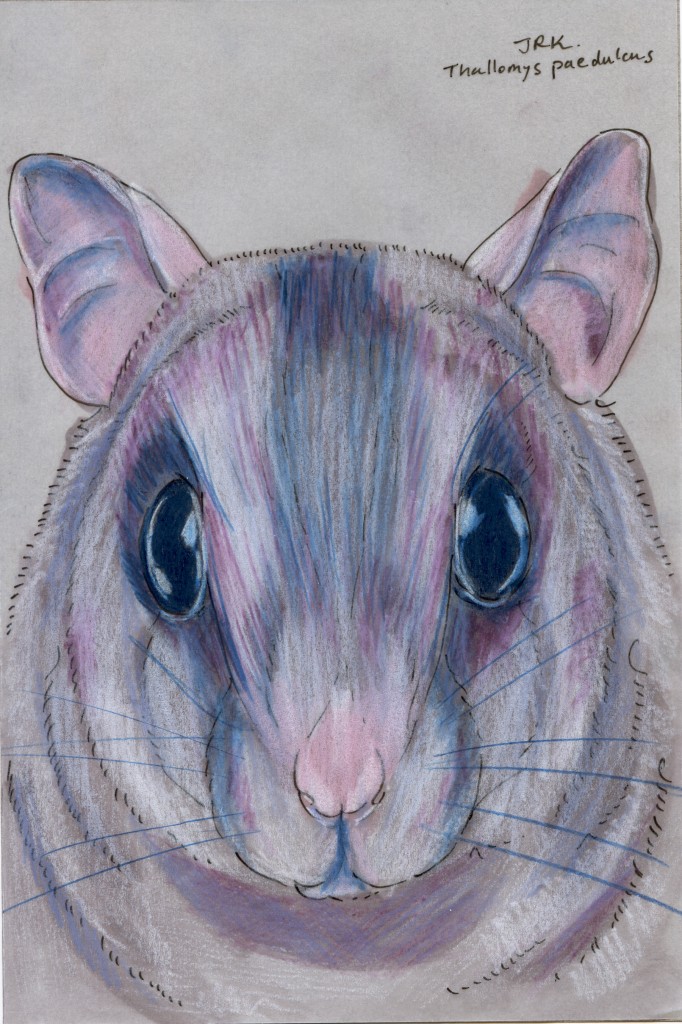
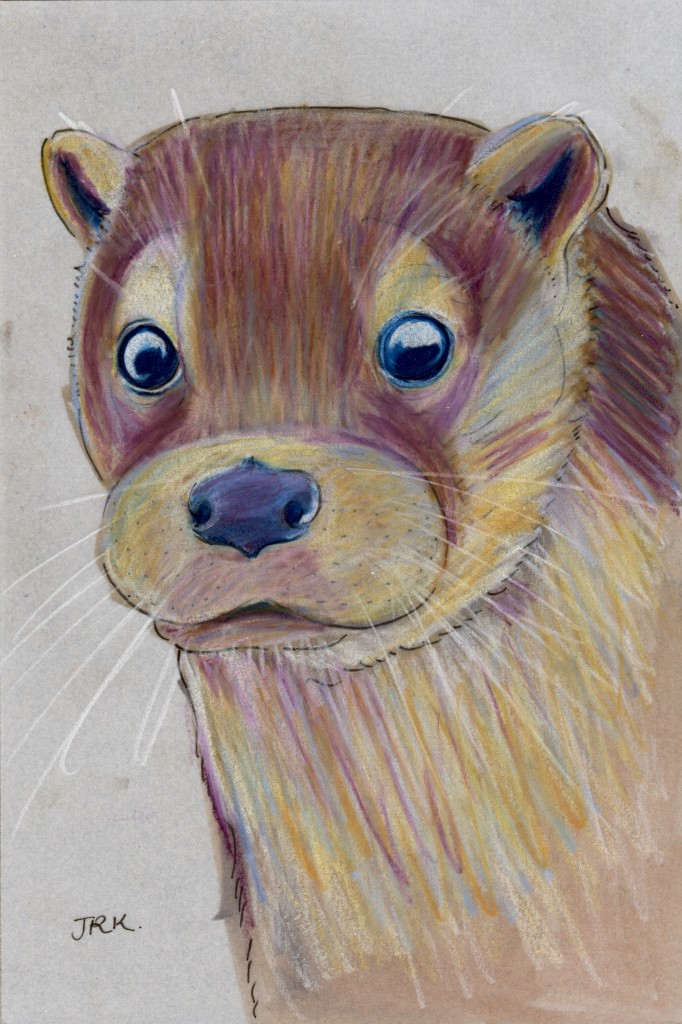
Acacia rat (click image to enlarge)


0397

I know you’ve heard it before, but the rodents are a problem. They account for some 40 percent of the mammals, and nearly all of them are small beige lumps. Many of them have evaded photographers up to now, so I often have to base my drawing on a related rodent but make changes based on the descriptions I can find. It’s often hard to force myself to draw a one of the little guys when I could be drawing a monkey or a carnivore. So every now and then, I’ll be letting random.org choose a rodent for me to draw to add the element of chance.

Today’s mammal, chosen by random.org from all the rodents I have yet to draw, is the acacia rat, which lives in sub-Saharan Africa in trees, likely acacias, wouldn’t you think? According to the IUCN, “Thallomys paedulcus possibly represents a complex of several similar species. Further studies are needed to clarify the taxonomic status of populations currently allocated to this species,” so there’s another taxonomic quandary for us to ignore for now.

Acacia rats apparently make good pets—as good as our fancy rats Earl Grey and Doctor Who, according to some people.

{ 5 comments }

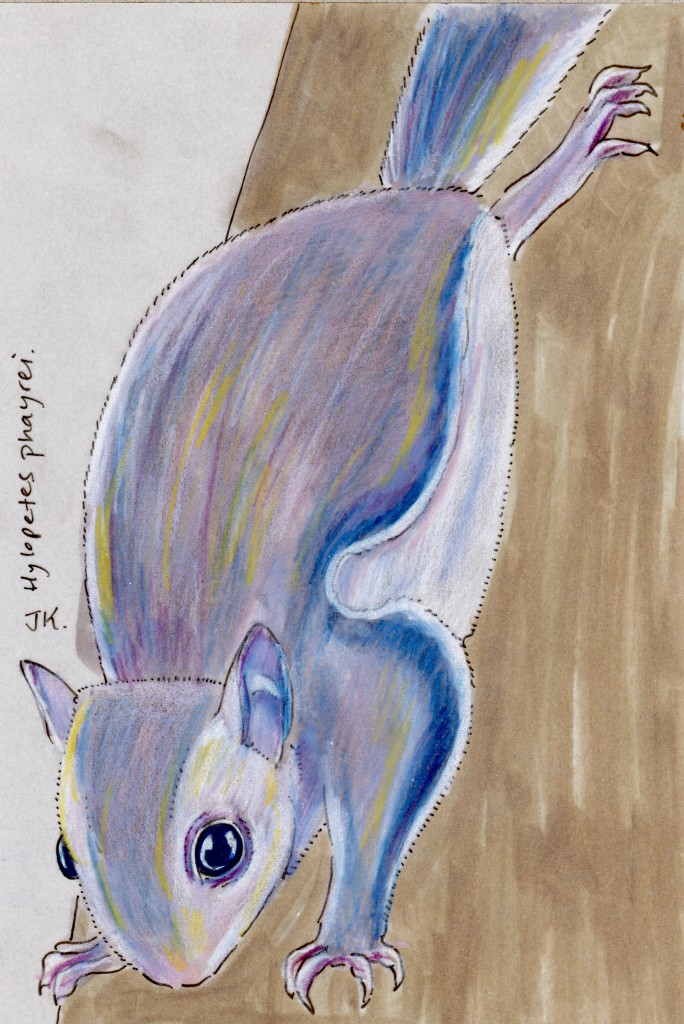
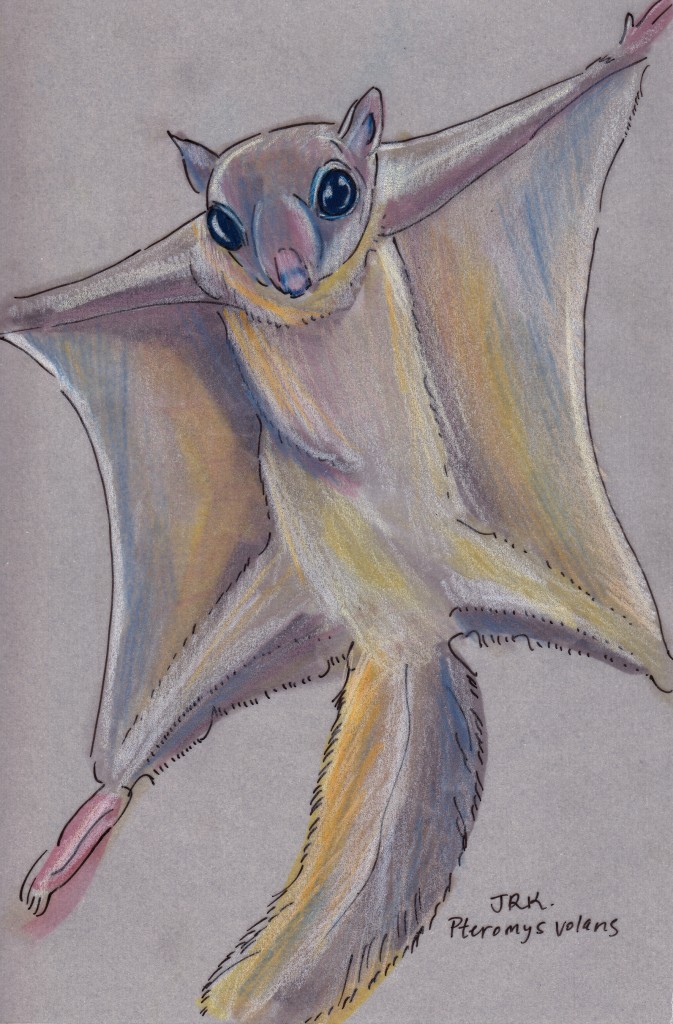
Siberian flying squirrel (click image to enlarge)


Siberian flying squirrel by Coco, age 12

0392

This week, we’re looking at a few mammals from Primorye, a region in the far east of Russia that you can learn a bit more about in my post for Monday’s musk deer. For today, Coco and I drew Siberian flying squirrels. They are quite common throughout the forests of northern Europe and Asia, where they glide through the treetops by night, snacking on seeds, leaves, buds, and catkins, which are downy, flowering spikes on some trees. An idyllic lifestyle to be sure, a lifestyle from a magical story.

{ 4 comments }

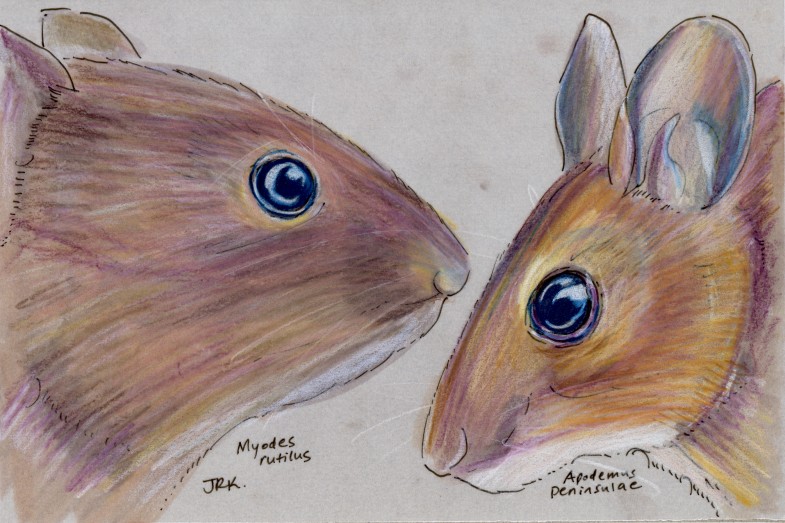
Northern red-backed vole and Korean field mouse (click image to enlarge)


0390
0389

This week, we’re meeting the mammals of Primorye, a region in far eastern Russia. (See yesterday’s musk deer for a little more about that fascinating area of the planet.) Well, it’s late and I’ve had a rough day, so…I don’t have much to say about these two rodents, other than that the one on the left is the northern red-backed vole and the one on the right is the Korean field mouse, and of course they both live in Primorye. Do enjoy the drawing, though, and I will probably be more loquacious on tomorrow’s mammal.

{ 3 comments }

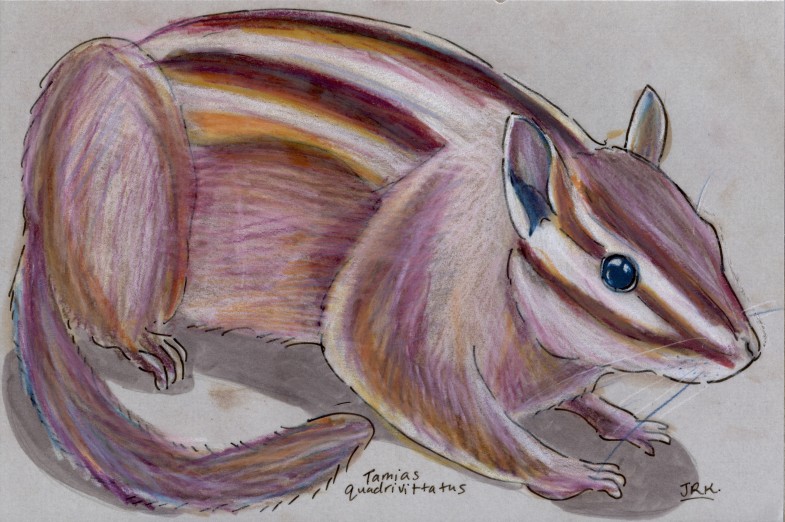
Colorado Chipmunk (Tamias quadrivittatus)

by JR Kinyak on September 23, 2011

in Rodents

Colorado chipmunk (click image to enlarge)


0387

The day after the kids and I drew this chipmunk (I haven’t scanned their drawings—sorry!), we rode the tram to the top of Sandia Peak here in Albuquerque. At the top, we stood on a deck overlooking the mountainside and the city below, and who should we spy skittering on the rocks in front of us but a handful of Colorado chipmunks! At first we thought we might just have Colorado chipmunks on the brain and that these were likely some other kind, but a look at my dad’s Field Guide to the Sandia Mountains helped confirm our identification of the chipmunks.

My Princeton field guide to the mammals of North America says, “CHIPMUNKS—This group of small, striped squirrels is easy to recognize, but it is very difficult to distinguish between the 22 different species. Easterners have it easy, with only one to choose from,” leaving the other 21 to form a chaotic overlapping mass of chipmunkitude for the westerner to tell apart.

Our family has been working on a fantastic naturalist training course (more on that someday soon), and one of our references for the course, Reader’s Digest North American Wildlife, says, “You should have little problem identifying mammals that you’ve had the luxury of observing out in the open for a long period of time. But if one crosses your path only briefly, try to extract from the encounter a general impression of its shape and color, and also a rough estimate of the size of its ears and the length of its tail. With such information at hand, you’ll have a much easier time giving the creature a name.”

Here’s a video of the Colorado chipmunk to help you identify it next time you meet it in the mountains.

{ 2 comments }

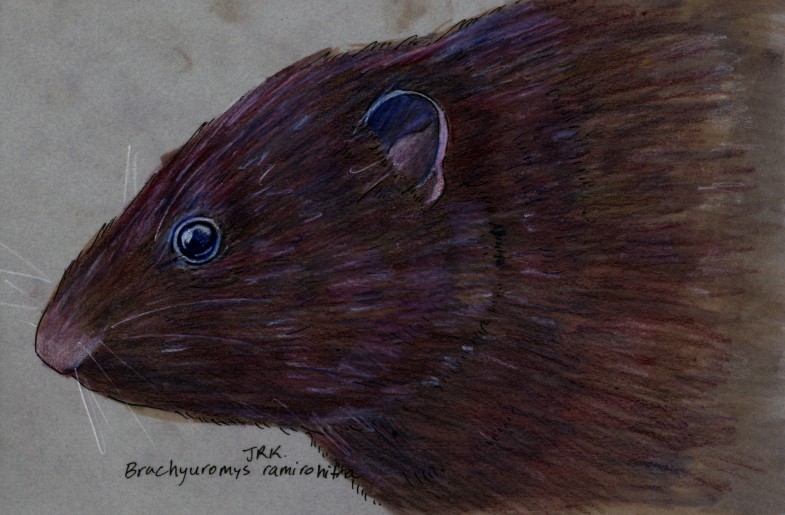
Gregarious short-tailed rat (click image to enlarge)


0383

This week, I’m drawing mammals selected randomly by random.org. Each day, it’s a surprise to me, and this should be a good way to get through some of the mammals that I would be unlikely to choose on my own…like this one, the gregarious short-tailed rat. Nothing against him, but there’s very little information available about him and very few photographs for reference, and those are the ones I usually put off in the hopes that somebody will have taken pictures of them by the time I get around to them again. But picking them randomly doesn’t allow for that. And I have to tell you, it’s satisfying to draw one of the obscure guys, one where I have to really dig to find even a reliable description. It’s a job-well-done, wiping-my-hands-with-pleasure kind of feeling.

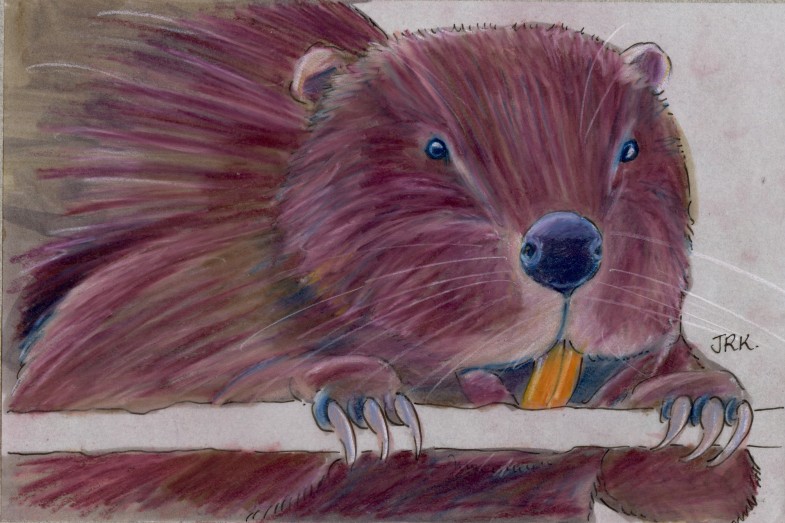
So, here is the gregarious short-tailed rat. He looks friendly enough, doesn’t he? These rats are endemic to eastern Madagascar, where they live in forests and fields, making grassy tunnels and evading capture.

{ 3 comments }

Five Random Rodents

by JR Kinyak on April 8, 2011

in Operations,Rodents

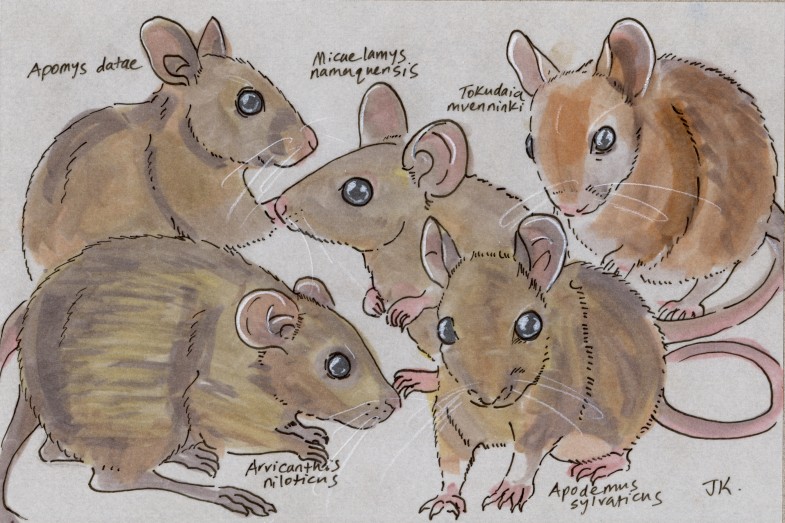
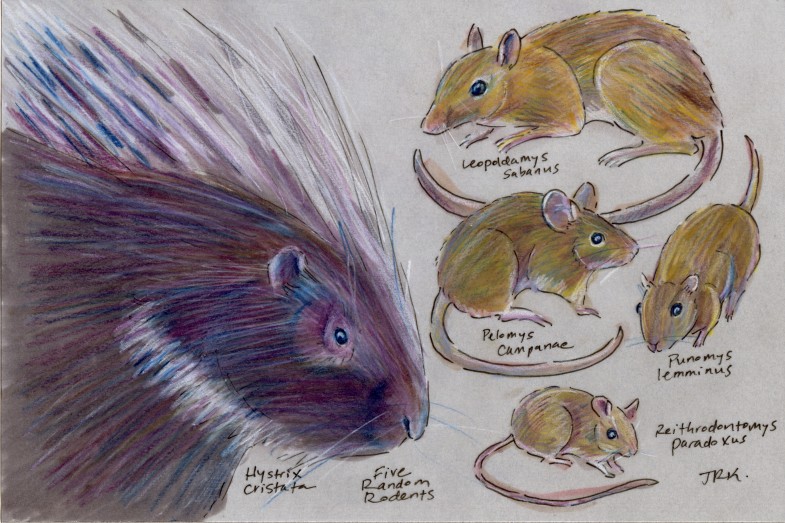
Five random rodents (click image to enlarge)


0379
0378
0377
0376
0380

Rodents keep me up at night. I can hear them scritch-scritch-scritching in the attic and the walls. Their whiskers lightly tickle my skin and their buck teeth gnaw on my bones. Their beady little eyes stare at me from every corner, glinting in the dark. Not because my house is infested—it isn’t—but because of the Daily Mammal Rodent Problem.

Of the 5,000-ish mammal species in the world, 40 percent are rodents: small, toothy, bewhiskered, scurrying, and so nauseatingly beige. Tan. Grayish-brown. Buffy to tawny ochraceous with white underparts, if you want to get technical. In my database (the Smithsonian’s Mammal Species of the World), there are 2,278 ratty little pipsqueak rodents.

So there are thousands of them, but so what? Mammals are mammals, right? Right, but there are no photographs of many of these rodents. None! And they are boring. I would guess that 80 percent of them look alike. In fact, one family of rodents, Muridae, accounts for one sixth of all mammals in the world. Well, depending on how you count and whether you consider Cricetidae part of Muridae or its own family. I think. No rodent has ever been called charismatic megafauna, not even the largest rodent, the capybara, which I drew years ago.

They just aren’t fun to draw, which I could get past if they were at least easy to draw, but the lack of reference images makes it so frustrating. I have to find related species that people have taken photos of and then find descriptions of the species I’m actually drawing—see the above “buffy to tawny ochraceous with white underparts”—and sort of improvise. And I know that I take some liberties in my drawing, I mean, my work is not hyper-realistic and it’s not going down as the definitive record of what any given species looks like, but I still want to be accurate in my own way, and I have wicked perfectionist tendencies that make me uncomfortable when I feel like I’m falsifying anything.

So I’ve been putting the rodents off. My idea of drawing multiple rodents in one go has helped, but if I happen to pick one that appears to be short on reference, I’ll usually skip it, telling myself that maybe someone will take pictures of it in the next few years. I have been trying to draw rodents. I’ve drawn 108 rodents out of 380 mammals total, which means that 28 percent of my drawings have been rodents. It’s not 40 percent, but it’s not too bad. But I am still terrified that if I see this project through, I’ll be drawing nothing but anonymous beige furballs for the last decade.

This all brings me to my new idea, which is: Random Rodents! I went to random.org, which generates random numbers, and told it to pick five numbers between 104 and 2278, which were the numbers of the undrawn rodents in my database when sorted by…whatever, you get it, yes? It picked 1789, 1873, 903, 1565, and 980, I researched the rodents associated with those numbers, and here they are!

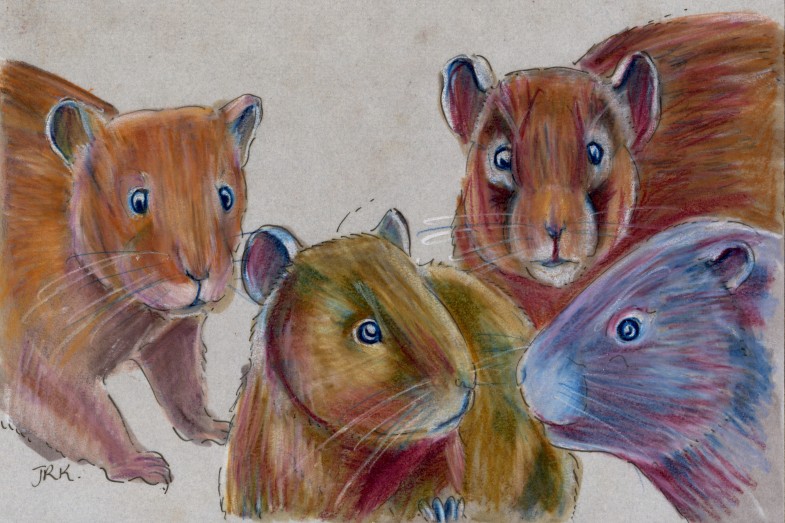
Notice that we got lucky with the porcupine; the other five, although varying from 7 centimeters to 20 centimeters in length, look like quadruplets. Sure, some of them have long tails and some have slightly shorter tails, and some are ochraceous to tawny while others are tawny to ochraceous, but all in all, I could probably just spend a week drawing generic beige mouse-like critters and no one would know the difference.

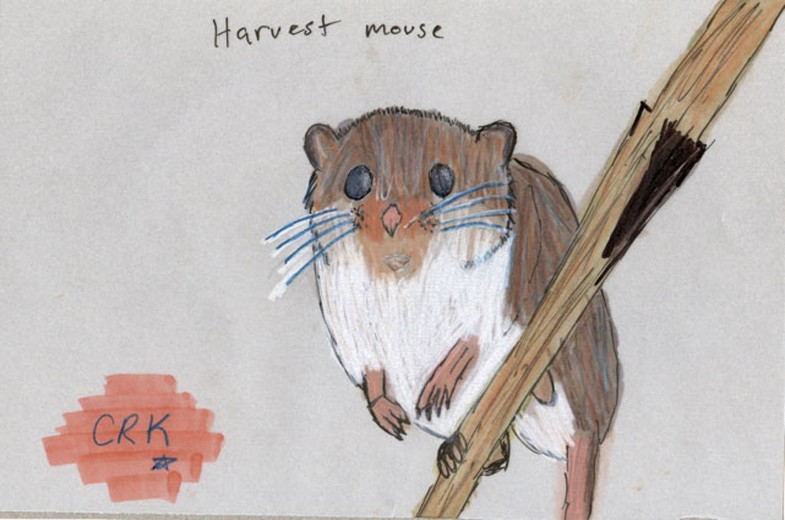
The porcupine is Hystrix cristata, a North African crested porcupine. The others, top to bottom and left to right, are Leopoldamys sabanus, the long-tailed giant rat; Pelomys campanae, the bell groove-toothed swamp rat; Punomys lemminus, the puna mouse; and Reithrodontomys paradoxus, the Nicaraguan harvest mouse. I’ll try to do a Random Rodents drawing once a week and together, we’ll force our way through this rat’s nest.

{ 8 comments }

This week we’re raising money for people and animals in Japan, and you can help! More details in just a moment…

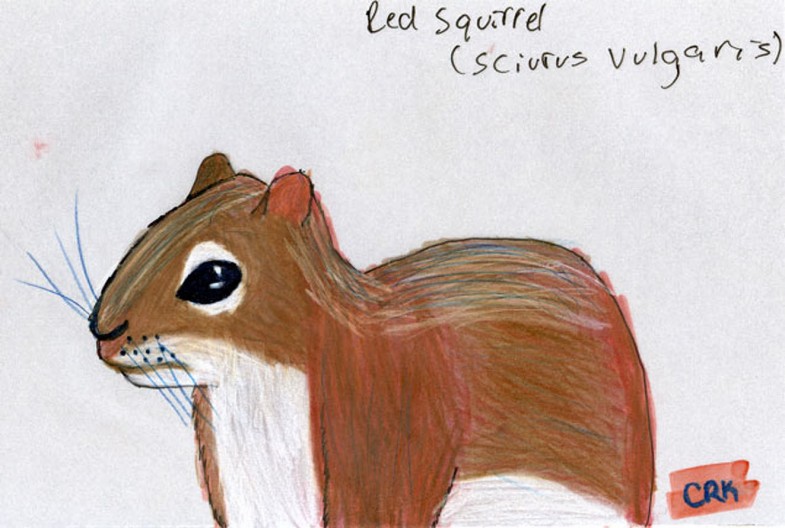
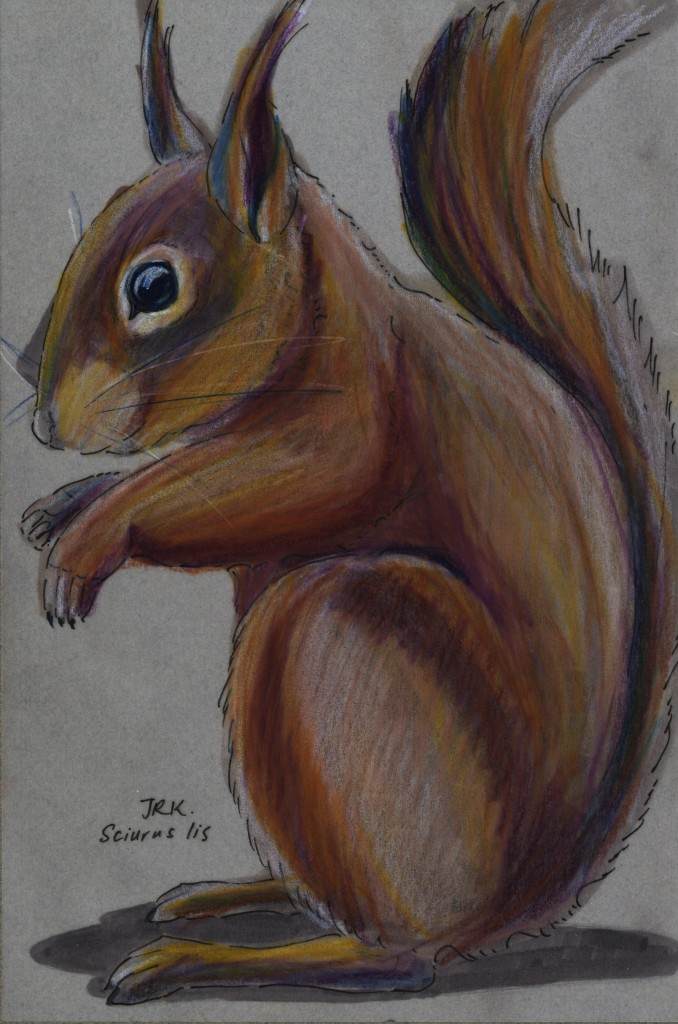
Japanese squirrel (click image to enlarge)

0370

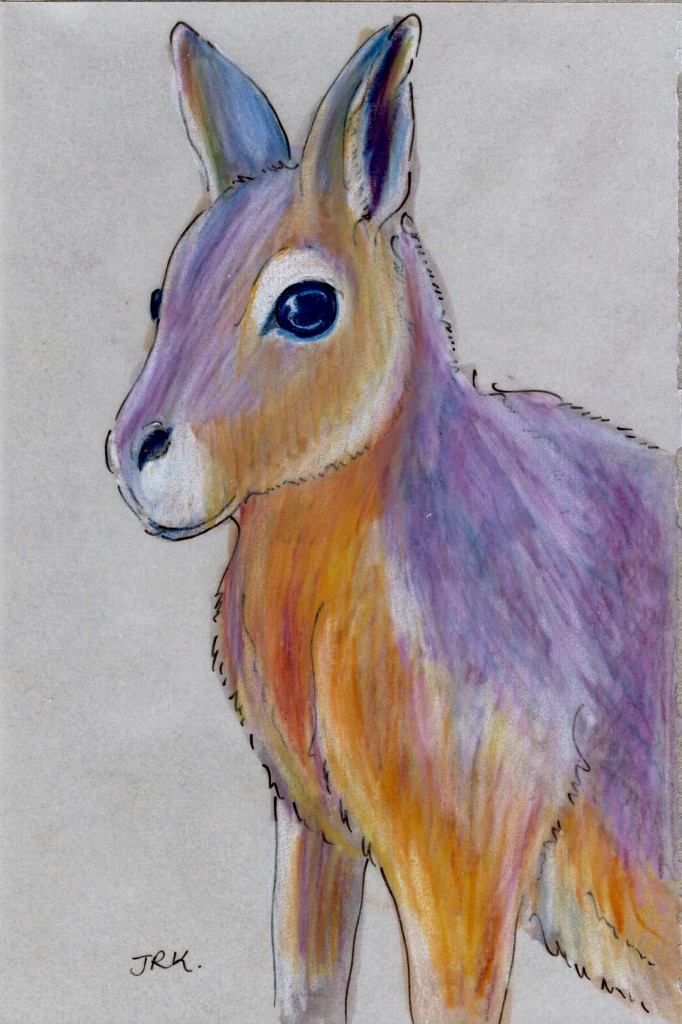
The Japanese squirrel is endemic to Japan, where it is called Nihon risu. It has a red coat in the summer and a grayish-brown one in the fall. This particular fellow looks like he’s getting ready for summer! He’d love to spend his summer with you…

See that yellow “Buy Now” button? If you click it (after selecting a matting option), you’ll be able not only to acquire this original drawing of the lovely Japanese squirrel, but also to help mammals, especially humans, who were affected by the earthquake and tsunami in Japan. I’ll donate your entire purchase price to the American Red Cross and Animal Refuge Kansai.

Here’s Coco’s squirrel. It has already sold, so you’re out of luck if you fall in love with it:

Japanese squirrel by Coco, age 12 (click image to enlarge)

I hope you’ll like the other five mammals we’ll be introducing you to this week! Or maybe you don’t like art? In that case, feel free to donate to our fund by clicking the yellow “Donate” button at the very bottom of this post.

In the meantime, here’s a poem by William Butler Yeats called “To a Squirrel at Kyle-Na-No”:

Come play with me;
Why should you run
Through the shaking tree
As though I’d a gun
To strike you dead?
When all I would do
Is to scratch your head
And let you go.

{ 3 comments }