From the category archives:

Primates

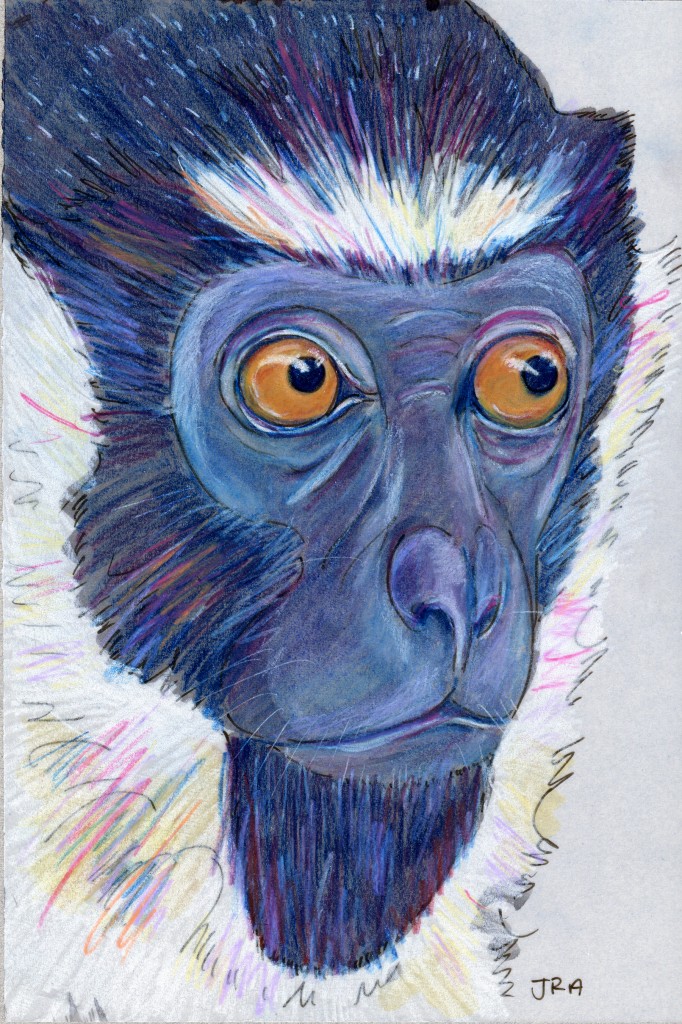
Black-and-gold howler monkey (click image to enlarge)


0333

We are approximately one-third of the way to 1,000 mammals today, which would be in turn one-fifth of the way to all the mammals there are. Let’s celebrate that, as well as the World Cup, with this sad-looking black-and-gold howler monkey from Paraguay! The black-and-gold howler is also called the black howler, but so is at least one other howler monkey species (dang! look how different my drawing was back then!), and since only the males are black anyway, a better common name for this one is the black-and-gold howler. They live not only in Paraguay but in Argentina, Bolivia, and Brazil, as well, but their habitat is a patchwork of forests and not a big solid region. Good news for the black-and-gold howler: they are not endangered, and though their population seems to be decreasing, they’re good at living in disturbed forests and pretty adaptable.

Paraguay has made it to the quarterfinals of the World Cup, and will be playing against popular favorites Spain on Saturday. Most observers thought it was unlikely Paraguay would get this far, especially since one of their best scorers, Salvador Cabañas, was shot in the head in Mexico in January. He survived, but he’s still not well, and with his hospitalization, it seemed, Paraguay’s chances for success were dim. After dedicating their first-round games to their teammate, Paraguay’s team went on to eliminate Japan in the Round of 16 after the previously discussed penalty kick shootout. Also, the dumbest Paraguay World Cup news I keep seeing is that some lingerie model, famous for keeping her cell phone in her cleavage, has pledged to run naked through Asunción if her beloved la Albirroja wins.

{ 1 comment }

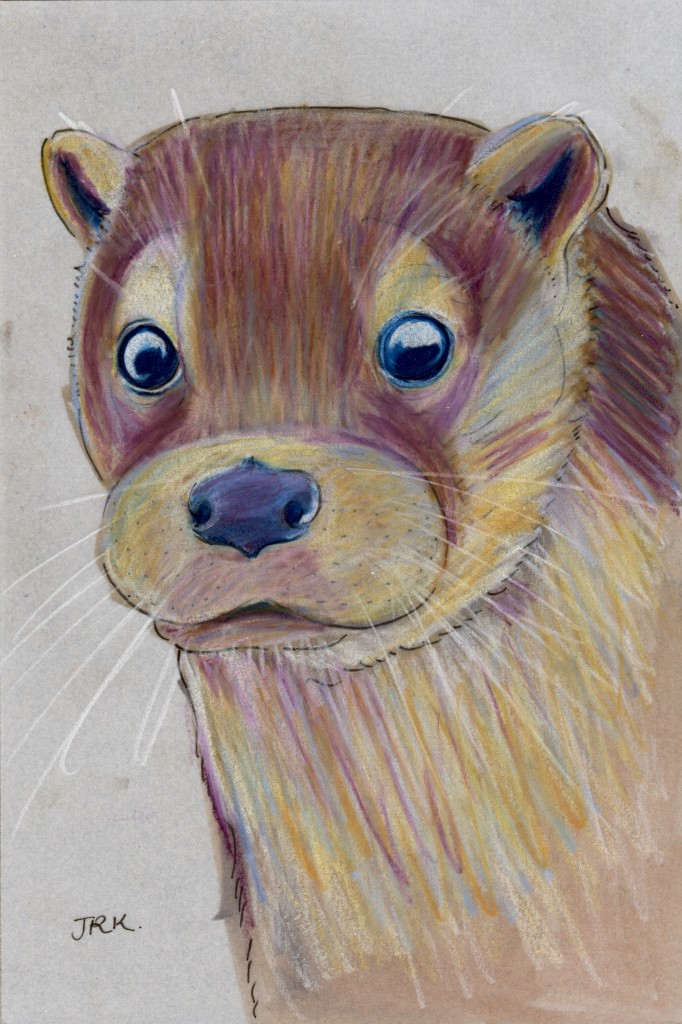
European otter (click image to enlarge)

0328

Hi, mammals! I think I’ll be on track to finish the Mammals of the World Cup on schedule with the actual World Cup if I post all of Group E today and then get back to once-a-day tomorrow. (Whether I will succeed is still unknown, as life has been pretty stressful around here. But I’m trying!) Also, I’m really not doing my best work lately, so dumping four mammals on you at once might distract you from that fact.

Our first mammal is the European otter (Lutra lutra), who is representing the Netherlands, where its numbers had decreased to almost nothing but it has been reintroduced. The Netherlands beat Slovakia (where the Yak part of my name comes from) in the Round of 16 and will be playing Brazil in the quarterfinals on Friday.

Orca (click image to enlarge)

0329

The orca or killer whale (Orcinus orca) is playing for Denmark tonight. Did you know that orcas in groups have been known to take down blue whales? It’s unlikely, I think, that anyone is going to beat the orca in this World Cup. Denmark, on the other hand, didn’t make it out of the group stage.

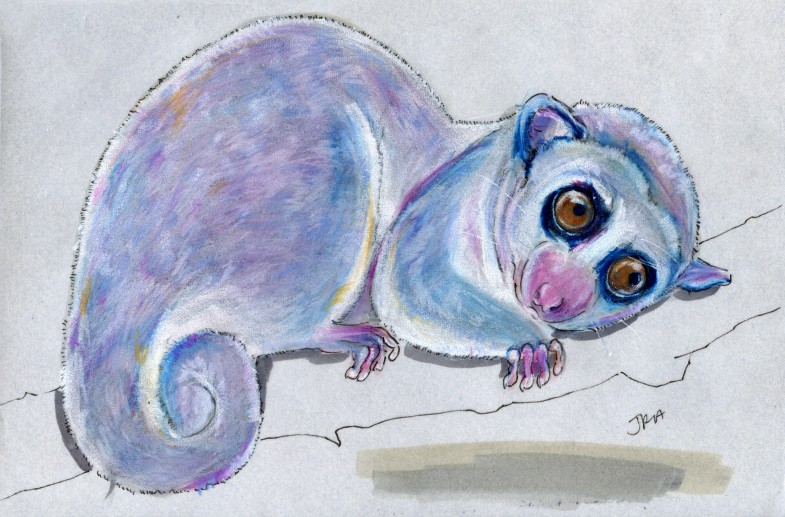
Japanese dwarf flying squirrel (click image to enlarge)

0330

From Japan, the Japanese dwarf flying squirrel (Pteromys momonga), which is also known as the momonga! It’s just too cute to be believed, really, and is also represented on one of my favorite Yu-Gi-Oh! cards, seen below. (I’m very into Yu-Gi-Oh! now. It comes with the 14-year-old son. I have a beast deck. Besides the Nimble Momonga, I also have a Tree Otter, a Sea Koala, a Kangaroo Champ, a Green Baboon Defender of the Forest, and a Rescue Cat.)

A very handy Yu-Gi-Oh! card (click image to enlarge)

Japan made it to the Round of 16 but lost to Paraguay today. After the group stage, they don’t allow ties anymore. First, they have 30 minutes of overtime, and if there’s still a draw, they take turns taking penalty kicks, which are kicks from a spot 12 yards from the goal. Five players from each team try that, and if there’s still a draw after the penalty kicks, they play sudden death. After the 30 minutes of extra time, the Japan-Paraguay game was tied 0-0, and Paraguay won in penalty kicks.

Allen's swamp monkey (click image to enlarge)

0331

This is Allen’s swamp monkey (Allenopithecus nigroviridis), and it’s from Cameroon (as well as Congo and the Democratic Republic of the Congo). Its scientific name means “Allen’s ape, black and green,” and it is indeed kind of black-and-green colored. Cameroon didn’t get out of the group stage at the World Cup.

Group E Results

Well, the killer whale is the killer whale, and none of these guys stand a chance against that apex predator. It moves on to the next round, and I think our mustelid friend in this group, the European otter, could do some damage to the swamp monkey, and obviously the momonga is adorable and tiny and hopeless against any of the other three. So the two mammals continuing on to the Round of 16 from Group E are:

Orca (Denmark)
and
European Otter (Netherlands)

{ 5 comments }

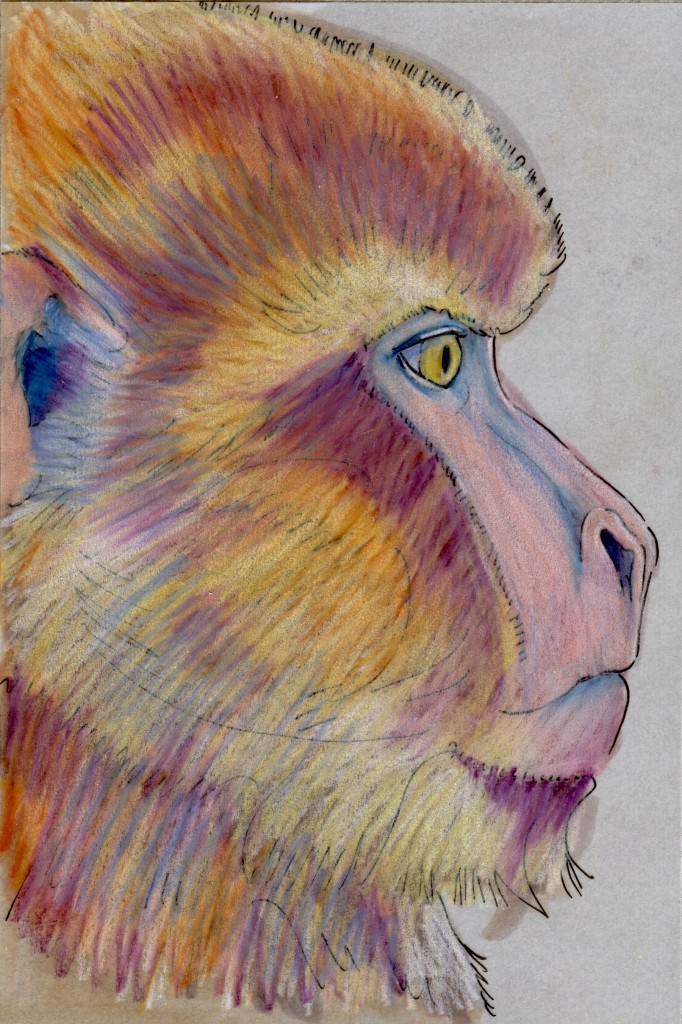
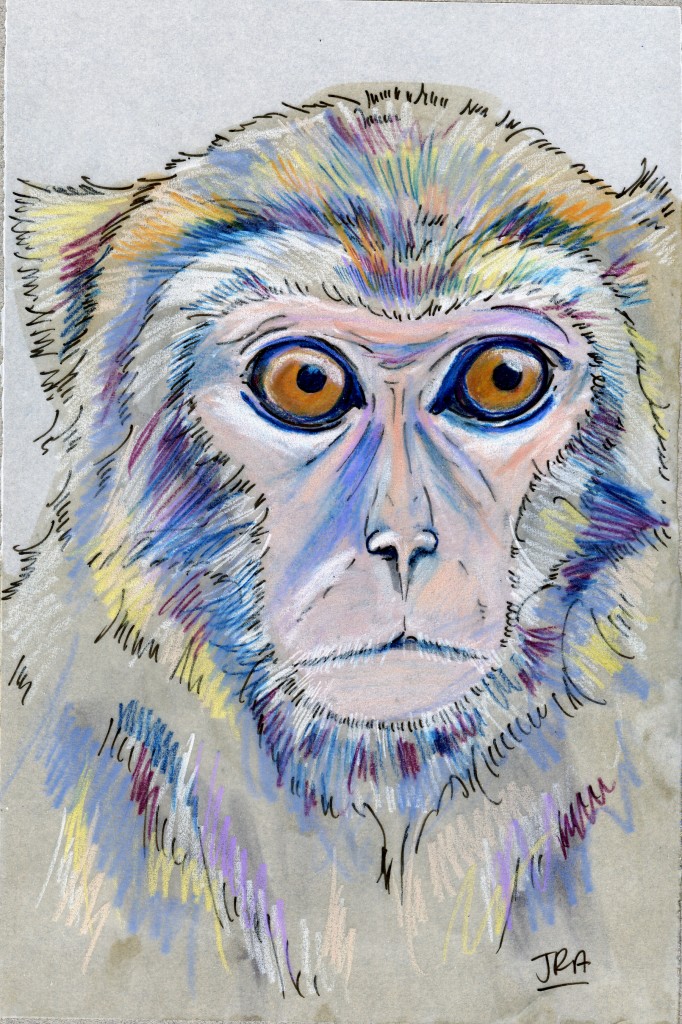
Barbary macaque (click image to enlarge)


0322

The World Cup is swinging right along, and we’re celebrating with a look at the mammals of the 32 countries competing in the tournament. Today we’re in Algeria, where they have these monkeys, see, the Barbary macaques. They live in the forests of Algeria and Morocco, and there’s also a population in Gibraltar, making them the only primates that live freely in Europe other than humans. Male macaques have a most endearing bonding ritual. In order to make friends with other males, a male macaque will cuddle with a baby, his own or someone else’s. When one male is holding a baby, other males will approach him, embrace him, and make googoo faces at the infant alongside him. Males who do it right find that holding a baby can really help their social status. Isn’t that funny? But like human infants, baby macaques can be unrelenting when they cry, and the downside for the baby-holding males is that they experience higher stress levels than males who don’t hold babies.

Today Group C played its final two games in the World Cup. Each group’s last two games are played simultaneously because otherwise, teams that knew the outcome of an earlier game would have incentive to throw their own game in one way or another. FIFA started structuring the World Cup that way in 1986, and Algeria was involved in the events that caused the change. In 1982, Algeria “shocked the world” when they beat reigning champions West Germany. In their group, which also included Austria and Chile, it turned out that in the final game, if West Germany beat Austria, both teams would be guaranteed to continue on to the next round, while a different outcome would have sent Algeria on. So in “the dodgiest game in football history,” West Germany scored a goal very early on and the two teams spent the rest of the game fooling around while their fans booed and even burned a flag. Algeria complained, and while FIFA declined to do anything about it at the time, they did change the rules for the next World Cup.

This World Cup was only the third that Algeria made it to. They had their glory days in the 1980s, qualifying for both the 1982 and 1986 World Cups, but then they endured a long slump known as “the walk through the desert,” coming back into their own in 2008. Today Algeria, whose nickname is the Fennecs, lost to the U.S., and England beat Slovenia, and so the U.S. and England are continuing on to the Round of 16.

Coco drew such an amazing Barbary macaque:

Barbary macaque by Coco, age 11

{ 5 comments }

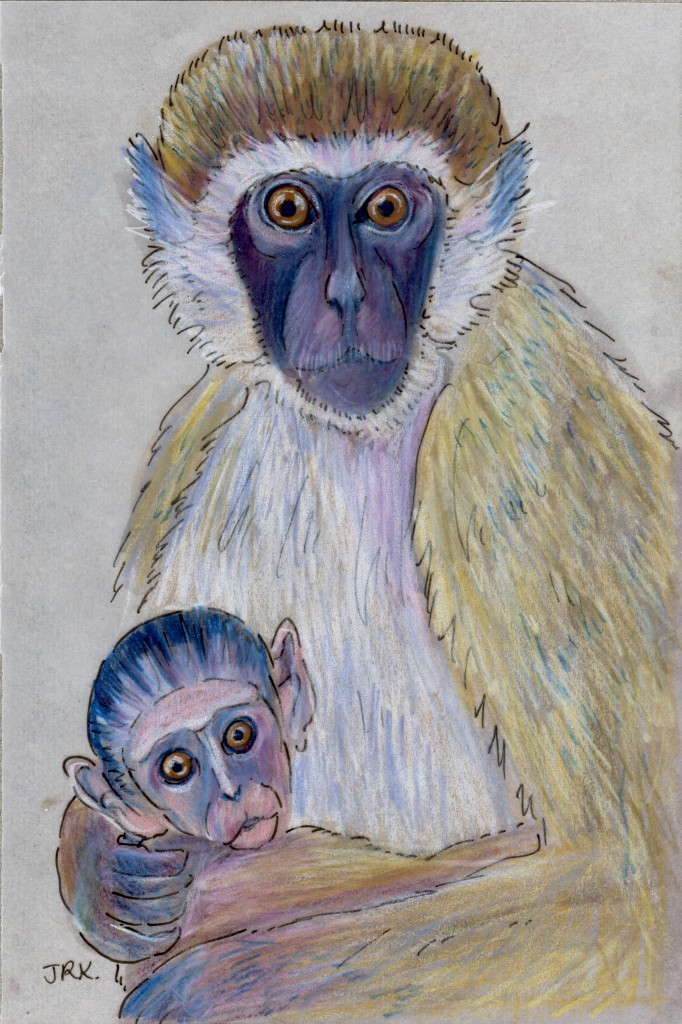
Vervet monkey mother and child (click image to enlarge)

0312

The World Cup started this past Friday, and I’m into it, partly because of this Nike commercial and partly because of this book (Cosmopolitanism by Kwame Anthony Appiah, which I enthusiastically recommend), which has me convinced of the importance of being a true citizen of the world. The international soccer/football tournament happens every four years, and this time, it’s in South Africa—the first time an African nation has hosted. Since I can’t go to South Africa, and I certainly can’t play soccer, what better way to participate than to draw one mammal from each of the 32 countries playing in the World Cup? I’ll be drawing them in the order their countries are playing, starting with our host, South Africa, and its representative, the vervet monkey.

The 32 teams of the World Cup are divided into eight groups, and they play a round-robin tournament after which the top two teams from each group advance to the round of 16. South Africa finds itself in a tough group, with former World Cup champions Uruguay and France, and Mexico, whose team isn’t bad, either. No host country has ever failed to advance to the second round of play—but South Africa, in its two previous World Cup appearances, didn’t get to round two, so this host-country winning streak could be a high-pressure curse.

On Friday, South Africa played Mexico. The game ended in a 1–1 draw, which wasn’t at all bad for South Africa, and the home team’s Sisphiwe Tshabalala scored the first goal of the tournament, a real beaut.

In our World Cup of Mammals, South Africa is represented by the vervet monkey, which lives in southern Africa’s savannas and forests in groups of a couple dozen. The vervet is also called the green monkey, and in Afrikaans, it’s the blou aap, or blue monkey, despite being yellowish-gray. Unfortunately, the old habitat squeeze has forced the vervet into the position of being a nuisance to humans in some places.

    Coco drew the most adorably charming vervet monkey ever.

    Vervet monkey by Coco, age 11

    { 7 comments }

    Bonobo (Pan paniscus)

    by JR Kinyak on June 10, 2010

    in Primates

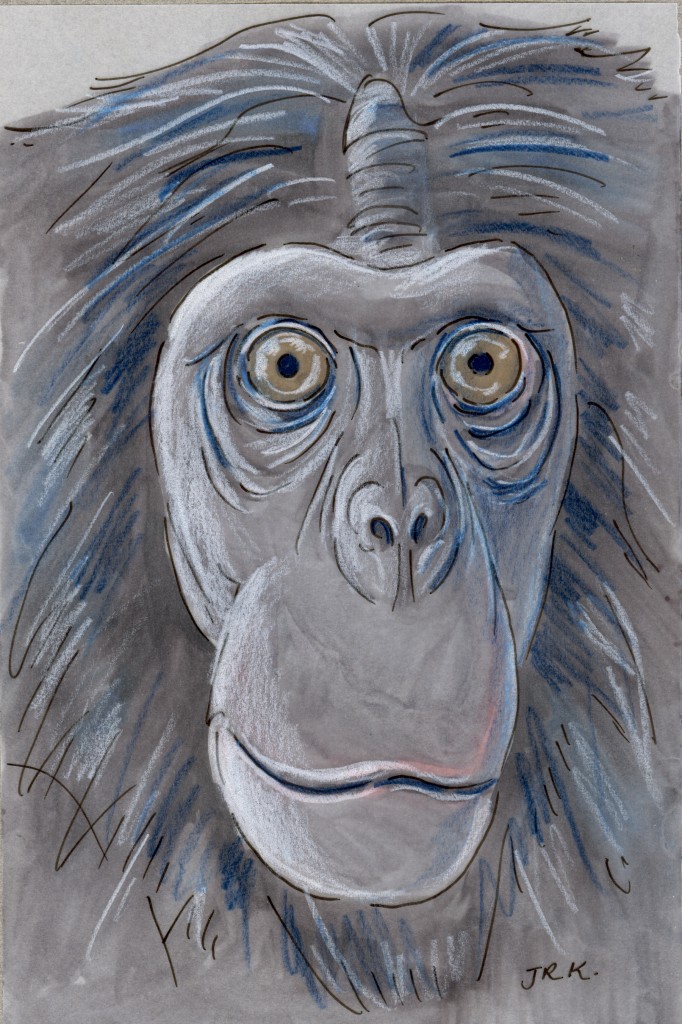
    Bonobo (click image to enlarge)

    0309

    There are two kinds of people: bonobos and chimpanzees. I’m more of a chimpanzee, I think. I’m hostile, territorial, and antisocial, I don’t like rubbing genitals with most other people, and I hate being groomed by others.*

    Bonobos have been called the hippies of the great apes, the Venus to the chimpanzees’ Mars. Like the chimpanzees, bonobos (also called pygmy chimpanzees) share 99 percent of humans’ DNA. We studied chimpanzees first, though, and they’re still more well known among people who don’t live near any of our fellow apes. So it seems that the chimpanzees, with their aggression, homicide, male-dominated societies, and hunting, have helped shape how we see ourselves when we consider our ape lineage. We have been able to justify our own aggression and male dominance by saying, hey, it’s in our DNA! But the bonobos complicated all that with their female-centered societies, peaceful cooperation, mingling with outsiders, and seemingly endless sex. They don’t eat monkeys, they help others, and the females rub their genitals together “to relieve tension,” according to The Princeton Encyclopedia of Mammals.

    Some people have taken all this so far as to hold up the bonobos as an example of how lovely life could be if we learned a little from our free-loving cousins, rejecting our affiliation with the chimpanzee side of the family to live in matriarchal bonobo communes where we braid each other’s hair and have seemingly endless sex. Now, of course I am in favor of most of that, and I’m happy if bonobos help us understand that it isn’t intrinsically human to be warlike bullies. But I find it strange that we are so quick to stereotype the two species as mirroring two dichotomous sides of us and to think we must align ourselves with one or the other, learning from them how to better lead our own lives. I think that the ancestor that humans, chimps, and bonobos shared six million years ago was probably as complex as all three species—and that bonobos and chimps are more complex than they seem, and perhaps not so easily reduced to hippies and rednecks or mods and rockers.

    * I am kidding here. And even if I weren’t, I’m much more bonobo than chimp after all. In an interesting interview, Frans de Waal, a famous primatologist, says,

    “I would say there are people in this world who like hierarchies, they like to keep people in their place, they like law enforcement, and they probably have a lot in common, let’s say, with the chimpanzee. And then you have other people in this world who root for the underdog, they give to the poor, they feel the need to be good, and they maybe have more of this kinder bonobo side to them. Our societies are constructed around the interface between those two, so we need both actually.”

    { 3 comments }

    Verreaux’s Sifaka (Propithecus verreauxi)

    by JR Kinyak on June 6, 2010

    in Primates

    Verreaux's sifaka (click image to enlarge)

    0301

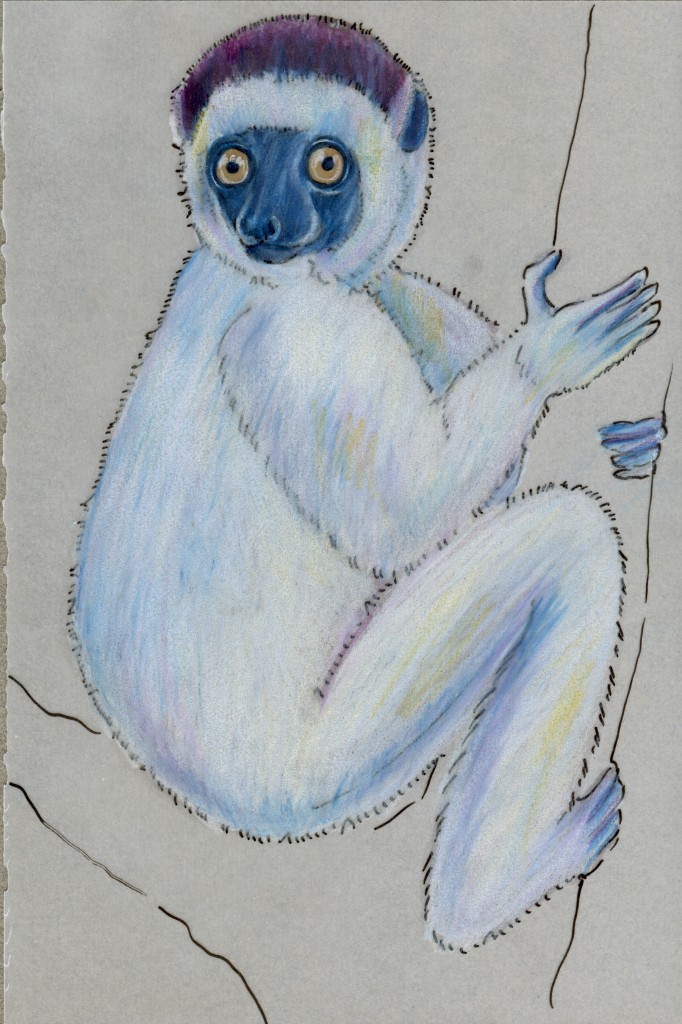
    Oh, Madgascar, oh lemurs. Here is another, the magnificent Verreaux’s sifaka, who performs the most powerful of leaps through the air and the most comical of leaps on the ground. Theo drew one, too, and his shows their incredible speed, but all in all, we’ll let Attenborough do the talking for us. Please watch the video below Theo’s drawing. It’s amazing!

    Verreaux's sifaka by Theo, age 13

    { 3 comments }

    Aye-aye (Daubentonia madagascariensis)

    by JR Kinyak on June 1, 2010

    in Primates

    Aye-aye (click image to enlarge)

    0293

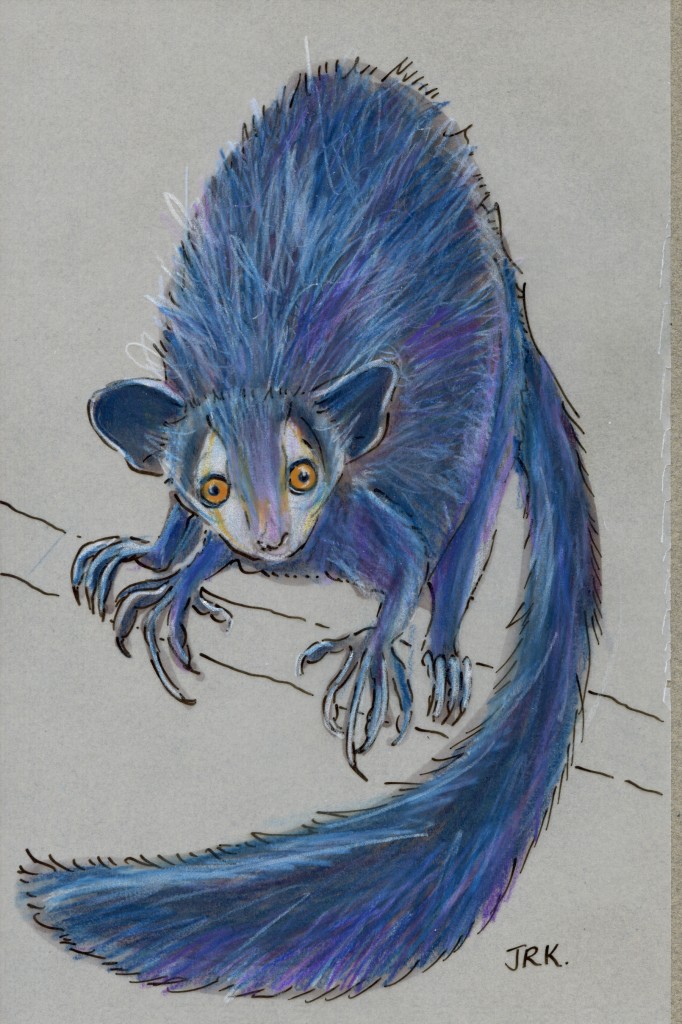
    The aye-aye is the only mammal I can think of that is primarily known for being ugly. Anytime someone writes a think-piece about the primacy of “charismatic megafauna” in conservation efforts, the poor aye-aye comes up as an example of an uncharismatic animal that is nevertheless in need of protection and aid. (People seem to want to donate money to help animals when the animals are cute or otherwise iconic, like pandas, tigers, and polar bears. Those three are classic examples of charismatic megafauna. I think it would be a good name for a band, too.)

    The good (or at least goodish) news for the aye-aye is that it’s not as endangered as we once thought, and in 2008, the International Union for Conservation of Nature downgraded its status from Endangered to Near Threatened—two steps back on the road to extinction. It seems to be both more widespread and more adaptable than we feared. But still, the aye-aye is threatened by the ubiquitous specter of habitat destruction in its native Madagascar. And apparently, a traditional Malagasy superstition holds that the aye-aye is an evil omen that must be killed on sight. This superstition is repeated so often in the aye-aye literature, and in such similar words, that I thought it must be a rampant scientific urban legend, but even my most reliable sources (in other words, not just Ivan T. Sanderson) report it as fact. Poor aye-aye! I love the nocturnal guy just the way he looks tonight.

    Now, the aye-aye is not just strange but unique. It is the only surviving member of its family and one of only two mammals (the other being the long-fingered triok of Indonesia and Papua New Guinea) that occupies the evolutionary niche that the woodpecker holds elsewhere. The aye-aye tap-tap-taps its looooooong middle finger on dead wood to locate insect larvae inside. Then it uses that same looooooong middle finger to extract the delicious bugs from the wood. Sometimes it uses its finger to tap on coconuts, perhaps to assess their ripeness or the amount of milk they contain, before using the finger to get the pulp and milk out.

    Theo drew an aye-aye, too. See?

    Aye-aye by Theo, age 13

    { 3 comments }