From the category archives:

Other Orders

Northern Tamandua (Tamandua mexicana)

by JR Kinyak on May 11, 2009

in Other Orders

northern tamandua (click image to enlarge)

northern tamandua (click image to enlarge)


0260

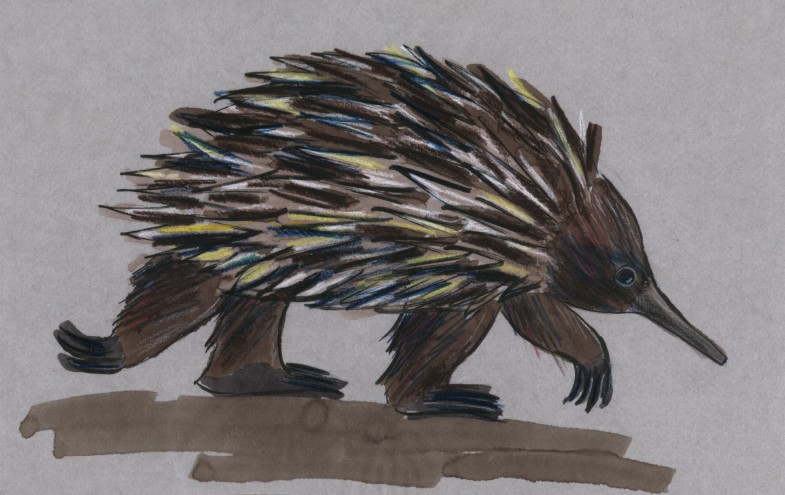
This small anteater lives in the treetops from southern Mexico to northwestern Venezuela and Peru. The opening of its mouth is about the size of a pencil, and since it has not teeth, part of its stomach is a gizzard that grinds its food. It mostly eats termites and ants, picking them up with its tongue that can stick out 30 centimeters, or about 16 inches! It has smelly anal glands, extremely strong arms, and sharp claws, all of which help it defend itself.

{ 5 comments }

Amami Rabbit (Pentalagus furnessi)

by JR Kinyak on May 8, 2009

in Other Orders

Amami rabbit (click image to enlarge)

Amami rabbit (click image to enlarge)


0258

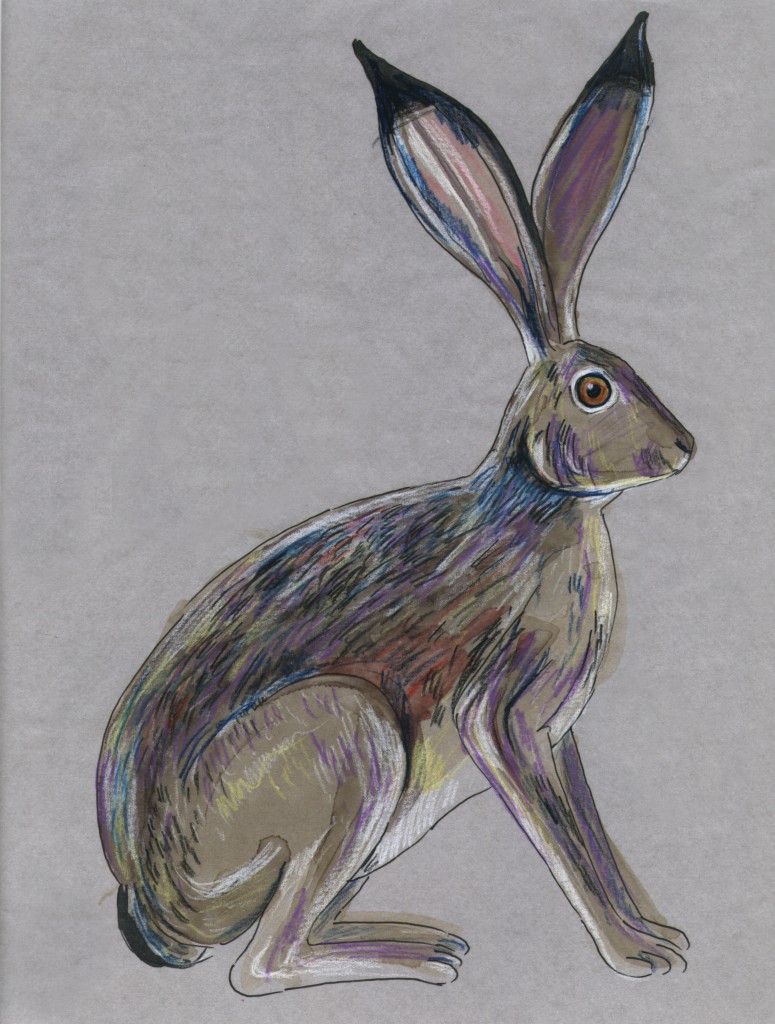
This fuzzy, stout rabbit lives only on the Japanese islands of Amami and Tokuno. It’s endangered, and both its population and its range have been decreasing. There are probably fewer than 5,000 of these rabbits in existence. They’re considered “living fossils” because they are very similar to ancient fossil rabbits and markedly different from other living rabbit species. They have unusually short ears, long noses, sturdy bodies, dark and dense fur, and curved claws.

Because they’re nocturnal and rare, Amami rabbits are still somewhat mysterious to science. One curious habit they have is that of sealing up their nursing burrows. A female Amami rabbit will give birth in a special burrow, then seal it up when she goes out for the night. She’ll come back to nurse the babies once every couple of nights. This goes on for a few months, at which point she ushers the babies out of the house, telling them it’s time to take care of themselves for once.

In addition to ordinary endangered species lists, Japan also designates what it calls natural monuments. These are plants or animals, natural features and structures, minerals, or wilderness areas. To qualify as a natural monument, something must be not only threatened, but also culturally important. Of the almost 1,000 natural monuments, 75 are classified as special natural monuments, and the Amami rabbit is one.

“The Secretive Rabbits of Amami, The Japan Times

Amami rabbit on the EDGE (evolutionarily distinct and globally endangered) website

{ 3 comments }

Desert Shrew (Notiosorex crawfordi)

by JR Kinyak on January 26, 2009

in Other Orders

click image to enlarge

0216

Well, haven’t I learned something today. I use Walker’s Mammals of the World, sixth edition, as a general reference for this project. It’s a huge two-volume work, the most comprehensive in existence, and invaluable to me for sorting out taxonomic questions and getting basic information about species’ habitats and habits. This edition came out in 1999, and the previous editions came out in 1991, 1983, 1975, 1968, and 1964. Looks like we’re about due for a new one, right? And good thing, too! I picked this little shrew out of my Walker’s the other day. It was listed as the only member of the genus Notiosorex. First thing I learn online is that now the consensus seems to be that there are actually four Notiosorex species, not one. Okay, that’s nothing new around here, I can deal with that.

But then I go to look at the Wikipedia pie chart of the distribution of mammalian orders, remembering—I thought—that members of the order Insectivora constituted the third-largest group. Insectivora is one of the 28 orders in Walker’s. It includes shrews, hedgehogs, and moles, shrews being in the family Soricidae. But the Wikipedia pie chart doesn’t even list insectivores. Instead, the third-largest group, behind rodents and bats, is Soricomorpha, shrew-bodies.

It turns out that taxonomically-minded people are coming to a consensus that Insectivora, which Wikipedia calls “a scrapbasket,” is in fact several separate orders—colugos in one, elephant shrews in another, hedgehogs and gymnures over there, etc., etc. Lord have mercy, but this has exploded my mammal-loving world. It’s one of the most interesting things about this project, and biology and actually, I guess, science in general, the way no one even knows how many mammals there are, people can disagree on whether this species is really the same as that species, and it’s always changing, but still, I was not expecting to lose a whole order, and one whose name I just learned to pronounce properly (stress on the third syllable).

Seventh edition of Walker’s, where are you?

This shrew, a member of Soricomorpha, lives in the southwestern United States (including my home state, New Mexico) and in Mexico. They are way smaller than you’d think: only three or four inches long on average, including their tails. They’re so small that they can actually hang out in beehives, entering and leaving through the bees’ doors.

{ 4 comments }

Hispaniolan Solenodon (Solenodon paradoxus)

by JR Kinyak on January 10, 2009

in Other Orders

click image to enlarge

0202

This shaggy, shrewy solenodon lives only on the island of Hispaniola, which comprises Haiti and the Dominican Republic. This species is one of only two in the solenodon genus. The other lives in Cuba.

The word solenodon comes from the Latin for groove-tooth, referring to an unusual feature: solenodons’ lower incisors have a channel connected to a gland, through which they can inject venom. While there are a few other venomous mammals, such as the male duck-billed platypus and a couple species of shrew, only solenodons can actively inject poison with their teeth.

The two solenodon species, genetic research tells us, diverged from all the rest of mammalia some 76 million years ago, during the Cretaceous period, when dinosaurs dominated the earth. This is crazily early. And the two species separated from each other about 25 million years ago, which means they’re not even that closely related. (This is around the time—give or take a few million years—that humans diverged from the Old World monkeys such as this week’s proboscis and Tonkin snub.)

Like other island dwellers, the Hispaniolan solenodon neglected to acquire the adaptations that would give it half a chance to survive against bigger, more intimidating predators. It was used to being a big fish (mammal) in a small pond (island), and so the humans who showed up, along with their accompanying dogs and mongooses, have been able to drive it into a perilously endangered existence.

BBC News, January 9, 2009: “Venomous mammal caught on camera.” (Thanks, Clare!)

EDGE (Evolutionarily Distinct & Globally Endangered) blog, January 9, 2009: “Hispaniolan solenodons—rediscovery and footage!”

{ 7 comments }

click image to enlarge
0189

{ 2 comments }

Ground Pangolin (Manis temminckii)

by JR Kinyak on June 15, 2008

in Other Orders

0177

This walking pinecone is a member of one of Africa’s three pangolin species. Born with soft scales that harden within a few days, baby pangolins ride around on their mother’s tail and start eating termites instead of nursing on pangolin milk when they’re a few months old. Pangolins can’t see very well, but they can hear and smell really well (notice I didn’t say that they smell good). Since they’re covered in hard scales, I’d guess their sense of touch isn’t tops, either, but I can’t tell you about their sense of taste.

Ground pangolins roll in a ball to escape danger, and they’re nearly impossible to unroll. They can move their scales, and in fact they have to move them to clean under them, using their claws to scratch out the gunk and their tongues to eat the delicious bugs they find tucked away under there.

Pangolin scales and skin are used in medicine and in making trinkets and jewelry and cowboy boots. Hyenas and leopards prey on pangolins and sometimes they get caught up in brush fires or zapped by electric fences. They’re shy creatures snuffling through the world, and more vulnerable than they look.

Consecutive days of mammals: 1
Previous record: 16

{ 6 comments }

Rock Hyrax (Procavia capensis)

by JR Kinyak on June 9, 2008

in Other Orders

click image to enlarge

0176

These funny fellows are rock hyraxes, furry little scurrying, jumping guys that live in the desert in Africa and the Middle East. See the teeth on the one on the left? Those are thought to be remants, evolution-wise, of tusks, as the hyrax is related to the elephant (and to manatees).

The rock hyrax lives in herds of several dozen, and they tend to all use the bathroom in the same spot. Well! Their urine is “glutinous,” and when it’s sitting out on a rock in the sun (and, depending on who you ask mixing with their feces), the whole mess becomes kind of stickily crystallized into a solid mass. Then it’s called hyraceum and is used to make medicine and perfume.

Rock hyraxes are mentioned in the Bible, where they’re called conies in many translations. In the book of Proverbs (30:24–28) there’s a list of things that are small but wise. Conies are “creatures of little power, yet they make their home in the crags.”

Consecutive days of mammals: 5
Previous record: 16

{ 4 comments }