From the category archives:

Operations

What I’ve Been Doing

by JR Kinyak on October 27, 2011

in Carnivores,Operations

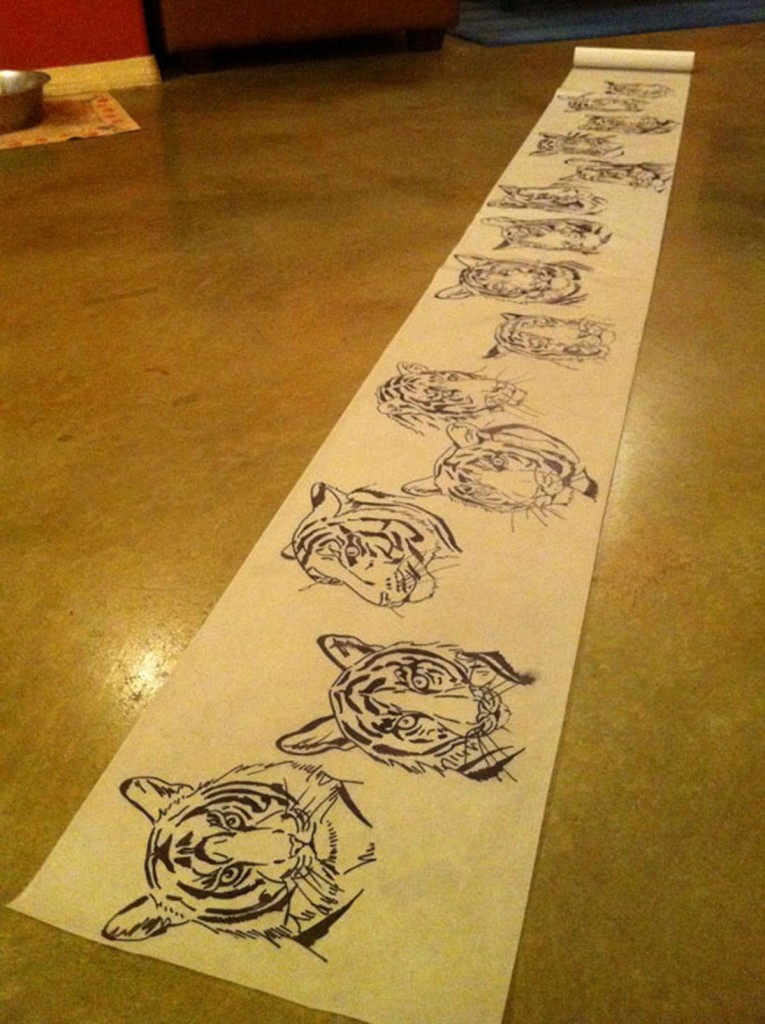
Roll of tigers in progress

I’ve been wanting to write a post about the animals killed near Zanesville, Ohio, last week, but I’m not sure how to say everything I want to say. I did have the idea, though, to draw a tribute to the 49 unfortunate mammals who died, and I’ve been working on it the past several days, which is one reason why there hasn’t been a Daily Mammal for a while.

Tigers in progress

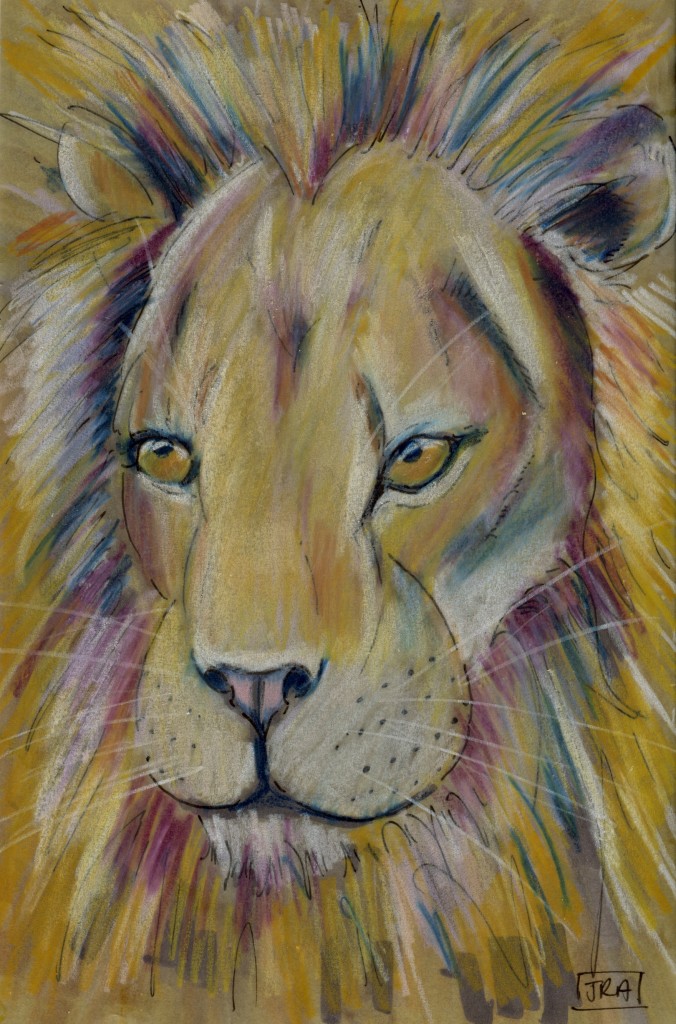
So far, I’ve drawn 14 of the 18 Bengal tigers, though I have yet to color them. I’m not going to color them as elaborately as I do the Daily Mammals, and you can see that I was a lot more general with my line work, too. After the tigers, I’ll draw the 17 lions. Lions are sexually dimorphic and eight of them were lionesses, so they won’t be as monotonous as the tigers. But drawing the tigers has become a bit of a sacred act, in a way, an act of witness and regret.

{ 3 comments }

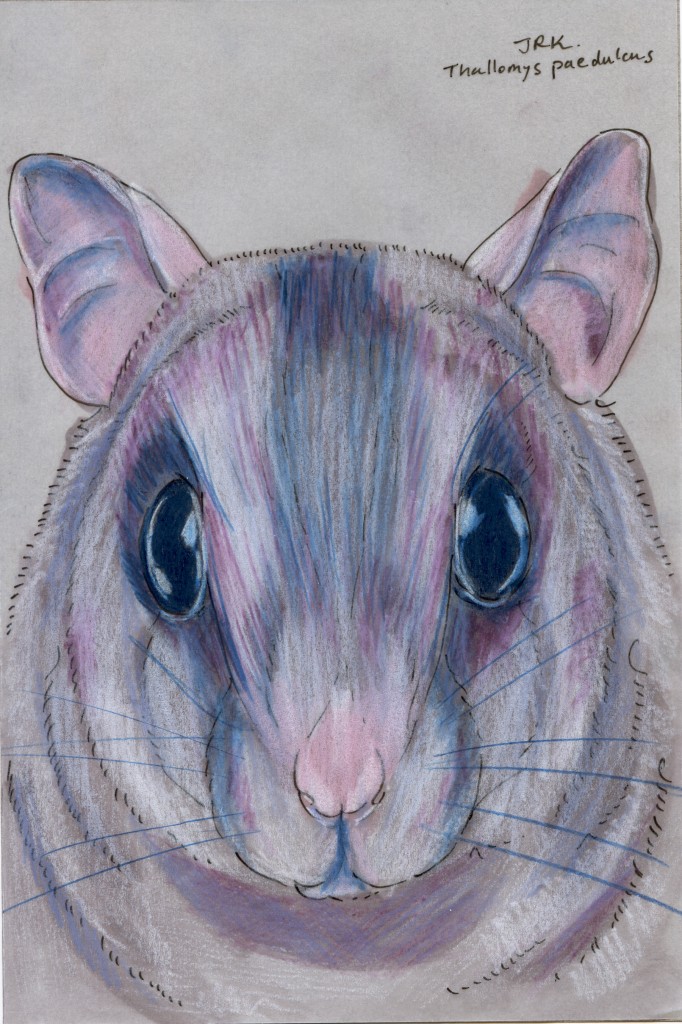
Acacia rat (click image to enlarge)


0397

I know you’ve heard it before, but the rodents are a problem. They account for some 40 percent of the mammals, and nearly all of them are small beige lumps. Many of them have evaded photographers up to now, so I often have to base my drawing on a related rodent but make changes based on the descriptions I can find. It’s often hard to force myself to draw a one of the little guys when I could be drawing a monkey or a carnivore. So every now and then, I’ll be letting random.org choose a rodent for me to draw to add the element of chance.

Today’s mammal, chosen by random.org from all the rodents I have yet to draw, is the acacia rat, which lives in sub-Saharan Africa in trees, likely acacias, wouldn’t you think? According to the IUCN, “Thallomys paedulcus possibly represents a complex of several similar species. Further studies are needed to clarify the taxonomic status of populations currently allocated to this species,” so there’s another taxonomic quandary for us to ignore for now.

Acacia rats apparently make good pets—as good as our fancy rats Earl Grey and Doctor Who, according to some people.

{ 5 comments }

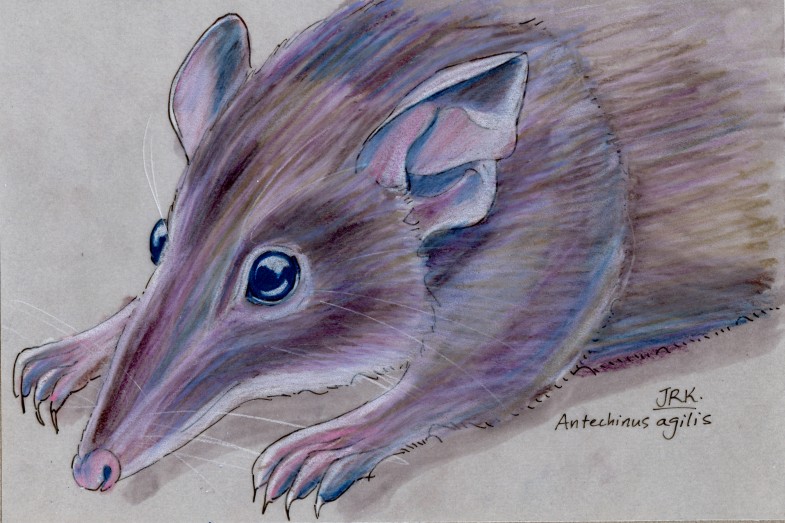
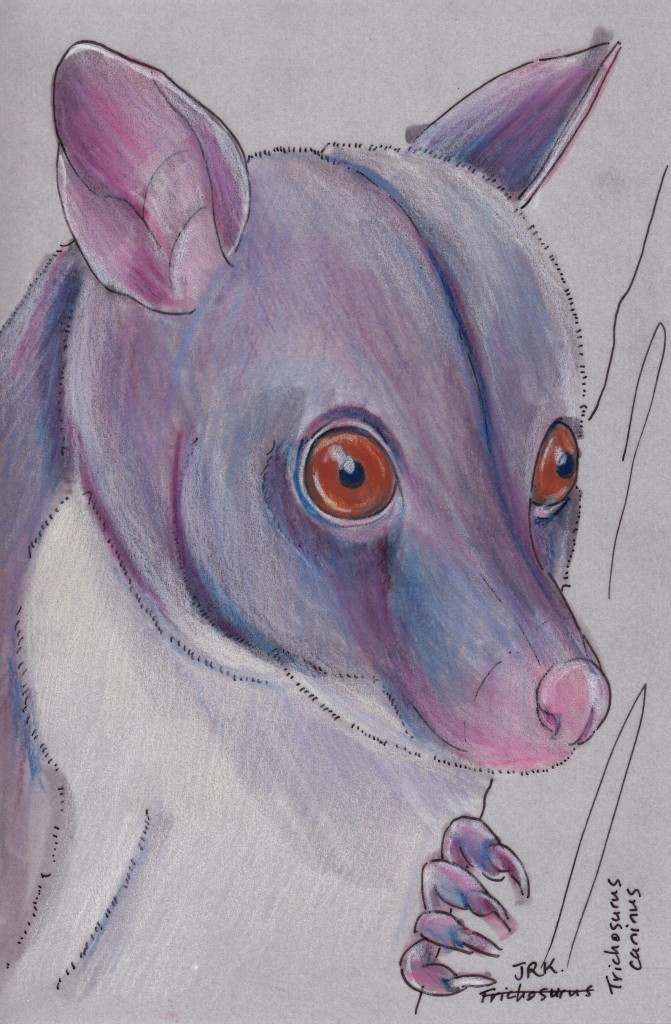
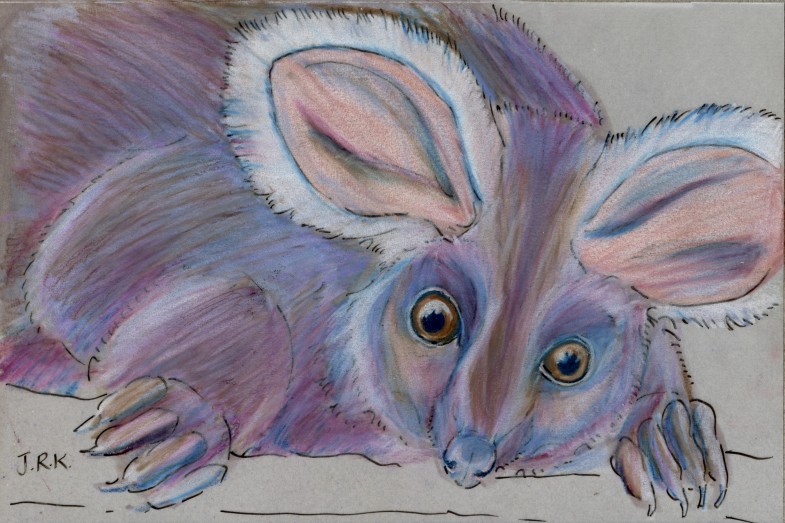
Short-eared brushtail possum (click image to enlarge)

0396

I drew this fellow last week, and just now, sitting down to research him, I ended up tumbling about in my books and online, finding not a lot about the possum—he’s a marsupial who lives in a little-bitty sliver of eastern Australia—but several other bits and pieces somewhat related to the species, which is also known as the bobuck.

For instance, as a spiritual totem, the short-eared brushtail possum could be associated with “mushroom and fungi energy” and both “broadcasting yourself” and “retreating into dark places.” (I don’t mean to sound overly snarky. I’m not into totem animals…at all…well, I don’t know, maybe I am, not in terms of religion or spirituality or trances or deep oneness of the soul, but in terms of affinities and identification, I could get into it. I relate to tree kangaroos and sloths. But I don’t go for the new-agey part of it. Anyway, the woman who runs the above-linked site says she noticed a glut of information about wolves as spirit animals and a lack of attention to marsupial moles, and I love that.) Isn’t the illustration of the possum at that link gorgeous? I quite like it.

Also, I learned that there’s a taxonomic quandary of some kind around this possum. You can read a bit about it at the Australian Museum’s website, but I’m not going to get sucked in. Basically, I just blindly draw the mammals listed in the Smithsonian’s Mammal Species of the World, and that’s that.

Speaking of that list, finding the link to it just now has alerted me that the website has been updated and now has a searchable database. I’ve been working off the spreadsheet they used to have available for download. Now I’ll have to decide whether or not to merge my old list with the new. You think that you can just say, “I know what would be neat—I’m going to draw all the mammals in the world!” But it turns out to be much more complicated than that.

Finally, I picked this possum out of my copy of Furred Animals of Australia, published in the United States in 1947, a book that I’ve referred to often in the past but haven’t thought much about. This time, I decided to Google the author, Ellis Troughton, wondering if he might be a naturalist of the adventurous, tall-tale variety. I don’t think he is, necessarily, but I did learn that he served in World War I in France from 1916 to 1919, and that during World War II he investigated scrub typhus in New Guinea. (I’m not entirely sure what the implications of that fact are.) He was the Australian Mammal Society’s first Honorary Life Member. (Is that a society of mammals? Aren’t they all?) And most perplexing of all, I found a solitary reference, in an interview with a physiologist conducted by the Australian Academy of Science, to Ellis Troughton being nicknamed “Naughty Troughty,” which I guess might rhyme in Australia. Why was he called that? I have no idea. I wish I did, though.

These bits of information inspired me to go through the introductory and…stuff-at-the-end material of Furred Animals of Australia in a quest for more about Mr. Troughton. (What is the word for stuff in the front and back of a book that isn’t the main part of the book? I can’t think of it.) I found, in the back, “Collecting Hints,” in which Mr. Troughton tells us how to preserve the small animals that we may injure in clearing timber or that our cat might bring in. He advises that “every effort should be made to preserve any small mammals accidentally killed about homesteads…The presentation of such specimens to the local museums represents a very material contribution to the knowledge of our unique Australian fauna of mammals.” Even if you’re not in Australia, something to consider, yes?

In the front of the book, Mr. Troughton reprints “A Creed for Nature Lovers” from a 1936 issue of The Australian Museum Magazine, and it’s lovely. It includes “I believe: That we should not harm living things that are harmless to us, as we hope to avoid harmful things ourselves; that even harmful creatures should be controlled with due regard for their zoological heritage and right to survive.” Words to live by, and something I wish I could get my kids to understand when they want to smash every spider that gets into the house.

Speaking of children, in his introduction to the book, Mr. Troughton says:

“Pleading protection’s cause in museum lectures for school children, I have reminded them of Barrie’s Peter Pan, and his friendly fairy kept alive only by the children’s belief in such quaint things. These children will be the grown-ups of to-morrow and both young and old must put their united influence behind any sound movement for the protection of wild life…

“Only by such universal belief in their right to existence can we ensure the survival of most of the fascinating creatures for the delight and instruction of future generations; so that, in the spirit of Kipling’s beautiful ‘L’Envoi’:

Each for the joy of the working,
And each in his separate star,
Shall draw the thing as he sees it,
For the God of things as they are.”

Thanks for joining me while I draw the mammals as I see them.

{ 4 comments }

Mammalthon Donation to the Red Cross

by JR Kinyak on April 12, 2011

in Mammalthons,Operations

I just donated the second half of our Japan Mammalthon proceeds to the American Red Cross’s earthquake and tsunami fund! Thank you again for supporting us and the people and animals of Japan.

{ 2 comments }

Five Random Rodents

by JR Kinyak on April 8, 2011

in Operations,Rodents

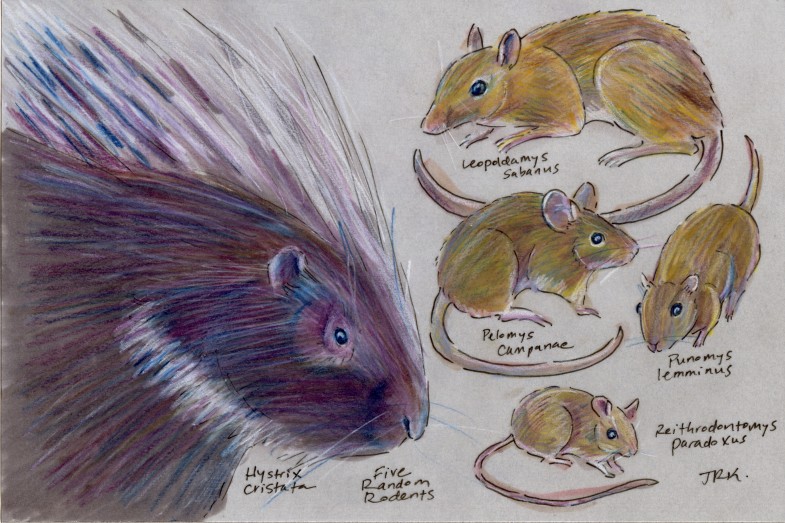
Five random rodents (click image to enlarge)


0379
0378
0377
0376
0380

Rodents keep me up at night. I can hear them scritch-scritch-scritching in the attic and the walls. Their whiskers lightly tickle my skin and their buck teeth gnaw on my bones. Their beady little eyes stare at me from every corner, glinting in the dark. Not because my house is infested—it isn’t—but because of the Daily Mammal Rodent Problem.

Of the 5,000-ish mammal species in the world, 40 percent are rodents: small, toothy, bewhiskered, scurrying, and so nauseatingly beige. Tan. Grayish-brown. Buffy to tawny ochraceous with white underparts, if you want to get technical. In my database (the Smithsonian’s Mammal Species of the World), there are 2,278 ratty little pipsqueak rodents.

So there are thousands of them, but so what? Mammals are mammals, right? Right, but there are no photographs of many of these rodents. None! And they are boring. I would guess that 80 percent of them look alike. In fact, one family of rodents, Muridae, accounts for one sixth of all mammals in the world. Well, depending on how you count and whether you consider Cricetidae part of Muridae or its own family. I think. No rodent has ever been called charismatic megafauna, not even the largest rodent, the capybara, which I drew years ago.

They just aren’t fun to draw, which I could get past if they were at least easy to draw, but the lack of reference images makes it so frustrating. I have to find related species that people have taken photos of and then find descriptions of the species I’m actually drawing—see the above “buffy to tawny ochraceous with white underparts”—and sort of improvise. And I know that I take some liberties in my drawing, I mean, my work is not hyper-realistic and it’s not going down as the definitive record of what any given species looks like, but I still want to be accurate in my own way, and I have wicked perfectionist tendencies that make me uncomfortable when I feel like I’m falsifying anything.

So I’ve been putting the rodents off. My idea of drawing multiple rodents in one go has helped, but if I happen to pick one that appears to be short on reference, I’ll usually skip it, telling myself that maybe someone will take pictures of it in the next few years. I have been trying to draw rodents. I’ve drawn 108 rodents out of 380 mammals total, which means that 28 percent of my drawings have been rodents. It’s not 40 percent, but it’s not too bad. But I am still terrified that if I see this project through, I’ll be drawing nothing but anonymous beige furballs for the last decade.

This all brings me to my new idea, which is: Random Rodents! I went to random.org, which generates random numbers, and told it to pick five numbers between 104 and 2278, which were the numbers of the undrawn rodents in my database when sorted by…whatever, you get it, yes? It picked 1789, 1873, 903, 1565, and 980, I researched the rodents associated with those numbers, and here they are!

Notice that we got lucky with the porcupine; the other five, although varying from 7 centimeters to 20 centimeters in length, look like quadruplets. Sure, some of them have long tails and some have slightly shorter tails, and some are ochraceous to tawny while others are tawny to ochraceous, but all in all, I could probably just spend a week drawing generic beige mouse-like critters and no one would know the difference.

The porcupine is Hystrix cristata, a North African crested porcupine. The others, top to bottom and left to right, are Leopoldamys sabanus, the long-tailed giant rat; Pelomys campanae, the bell groove-toothed swamp rat; Punomys lemminus, the puna mouse; and Reithrodontomys paradoxus, the Nicaraguan harvest mouse. I’ll try to do a Random Rodents drawing once a week and together, we’ll force our way through this rat’s nest.

{ 8 comments }

Hi Mammals,

The fundraiser for the mammals of Japan is over, and I’m proud to say we raised $465.00. I’ve already donated half of it (in Japanese yen!) to Animal Refuge Kansai, and I’ll donate the rest to the American Red Cross when the transfer clears. Thank you again for supporting our work and the people and animals of Japan.

Love,
Jennifer and Coco

{ 2 comments }

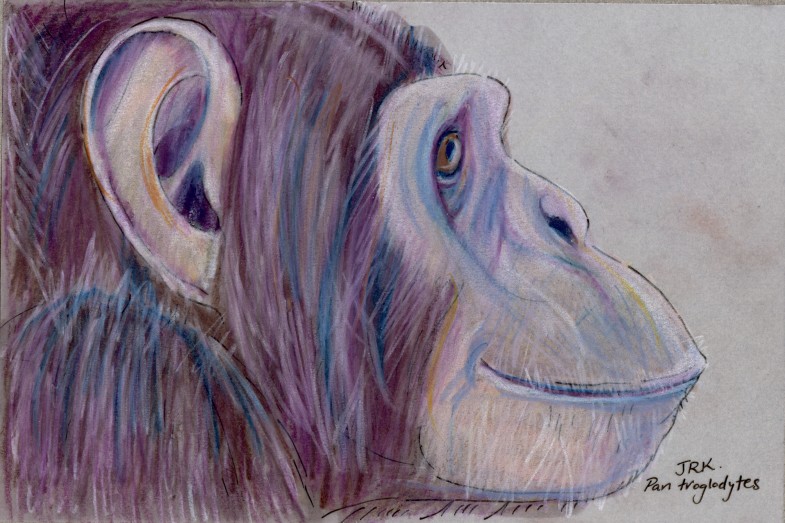
Common chimpanzee (click image to enlarge)

Until February 24, 2011, I hadn’t posted a mammal since July 10, 2010. Why? Well, the kids kept me busy, and that’s an understatement. Most of it was just general exhaustion. But I was also a bit burned out after my World Cup series, a month-long extravaganza of mammals that involved a whole lot of research about soccer and different countries in addition to the standard mammal research I do for each post. And it seems I had reached a tipping point at which I had drawn all of the mammals most people had heard of, so that people say, “Oh, you should draw a giraffe!” or an armadillo or even an aye-aye or pygmy mouse lemur or dog or human, and I always have to say, “I already drew it.” Every time I run across an interesting article about mammals, I’ve already drawn all the mammals mentioned. It seemed I was in for a long—decades-long—slog of obscure rodents and hardly known bats and shrews.

Well, I am still in for that decades-long slog of lowly little furry things, but as I was reading an article in The New Yorker about bushmeat and the spread of viruses, regretting that I had already drawn the common chimpanzee, I decided, so what? Nobody is telling me I can’t draw it again if I want to, except myself, so why not? If it helps me stay interested in this project, I may as well do it, even if it puts off the project’s eventual completion. At this rate, I won’t finish until I’m in my late 80s anyway, so what’s the difference? So here is a chimpanzee (my drawing of which I like much less than my original chimpanzee drawing).

The New Yorker article I mentioned was “The Doomsday Strain” by Michael Specter and appeared in the December 20 & 27, 2010, issue. (The link is to a PDF.) It’s about a scientist named Nathan Wolfe and his organization, Global Viral Forecasting, which seeks to predict and prevent future viral catastrophes. One thing they do is study bushmeat, which is wild animals killed for food, particularly in Africa. I’ve talked on this site before about bushmeat as a threat to animals—see the Bushmeat Crisis Task Force if you’d like more information about that—but it’s an equally dangerous threat to humans. In some parts of Africa—and other continents, but we’re talking about Africa here—bushmeat is the primary protein source that humans eat. Because they don’t have many alternatives, people will kill rodents, elephants, antelopes, monkeys, or apes and bring them home to their families. Sometimes they won’t even kill the animals but just pick up ones that have already died.

The hunting and the preparation of the carcasses are both very bloody enterprises, and nobody wears gloves or masks or protective gear. Through the hunting and eating of bushmeat, many viruses spread to humans, including HIV, which was probably first contracted by a human who killed, prepared, or ate a chimpanzee. Now that humans can travel over oceans and across continents without too much trouble, these viruses can spread out of Africa quickly.

Here is a video from Anderson Cooper that features Nathan Wolfe and a lot of animal carcasses.

{ 7 comments }