From the category archives:

Marsupials

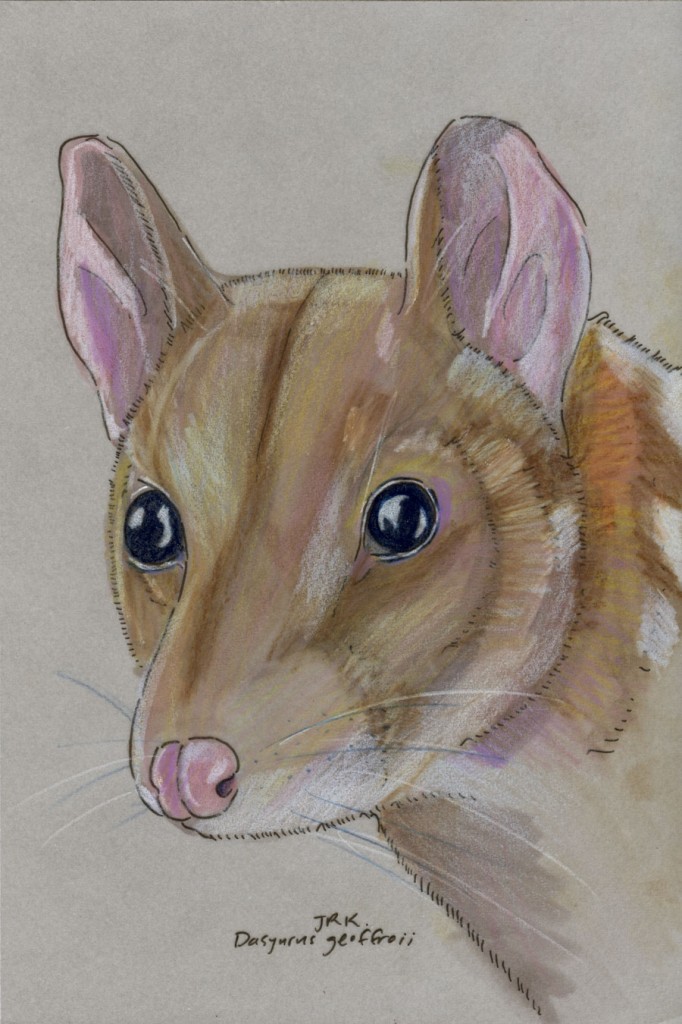
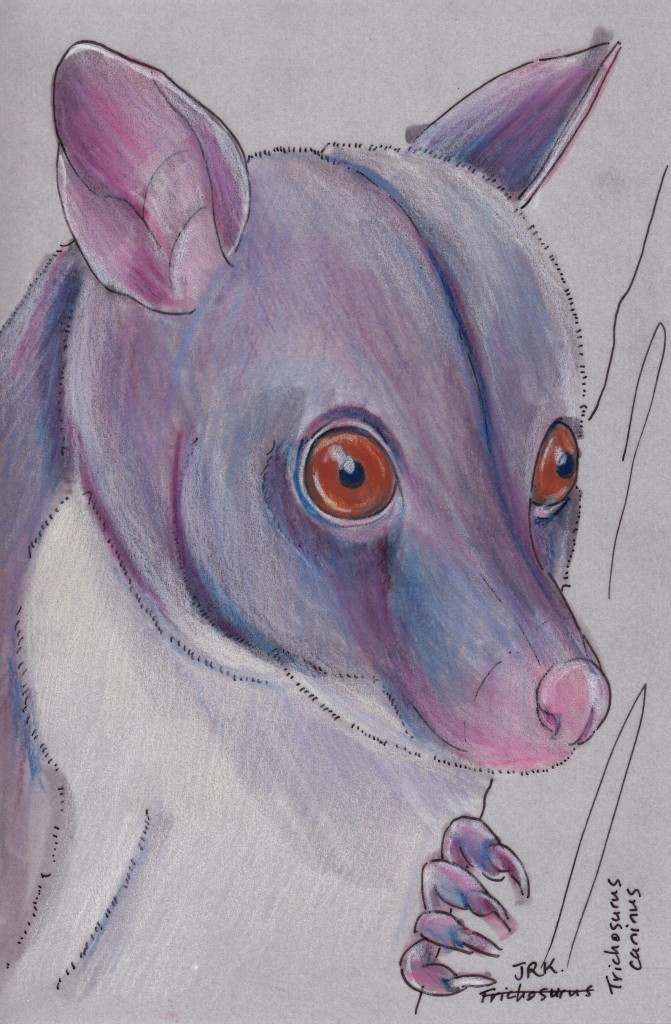
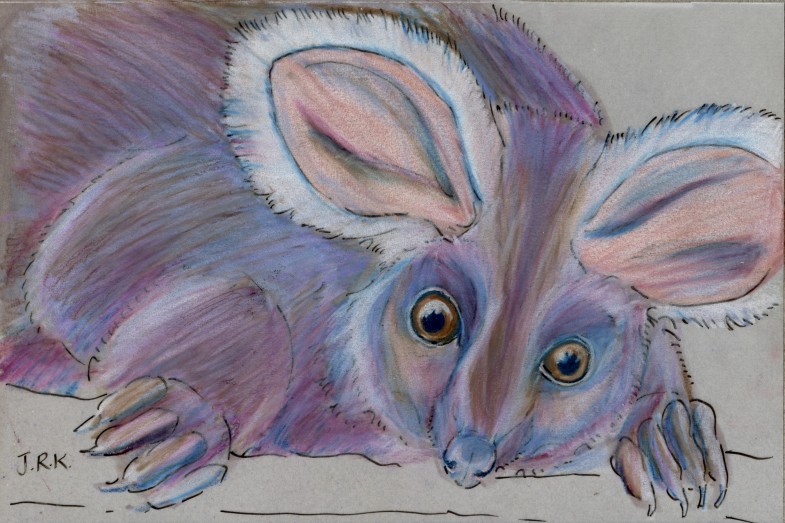
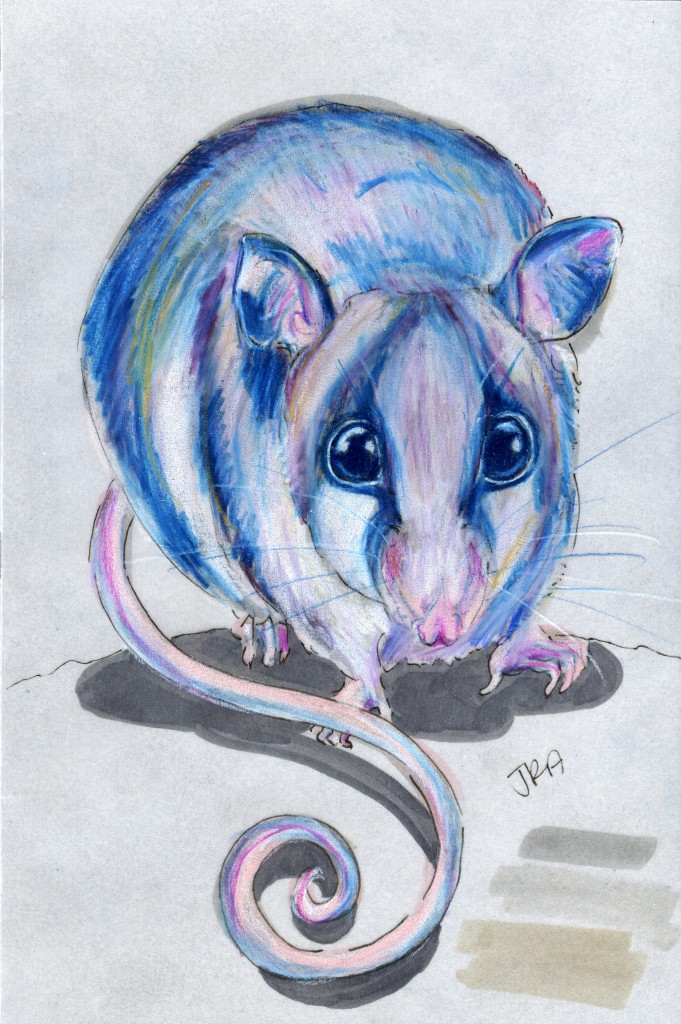
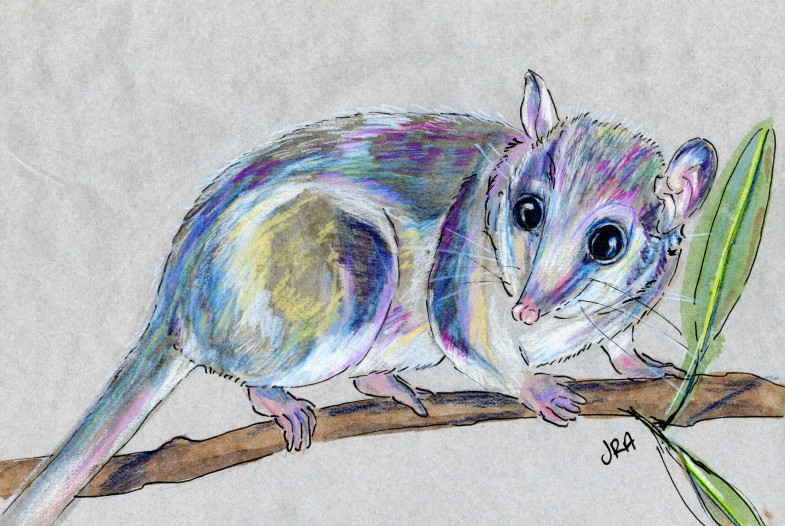
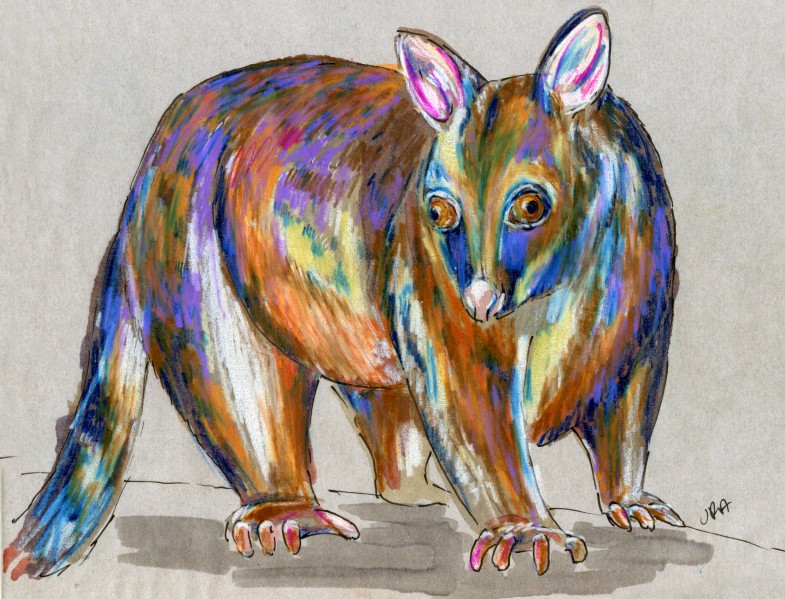
Short-eared brushtail possum (click image to enlarge)

0396

I drew this fellow last week, and just now, sitting down to research him, I ended up tumbling about in my books and online, finding not a lot about the possum—he’s a marsupial who lives in a little-bitty sliver of eastern Australia—but several other bits and pieces somewhat related to the species, which is also known as the bobuck.

For instance, as a spiritual totem, the short-eared brushtail possum could be associated with “mushroom and fungi energy” and both “broadcasting yourself” and “retreating into dark places.” (I don’t mean to sound overly snarky. I’m not into totem animals…at all…well, I don’t know, maybe I am, not in terms of religion or spirituality or trances or deep oneness of the soul, but in terms of affinities and identification, I could get into it. I relate to tree kangaroos and sloths. But I don’t go for the new-agey part of it. Anyway, the woman who runs the above-linked site says she noticed a glut of information about wolves as spirit animals and a lack of attention to marsupial moles, and I love that.) Isn’t the illustration of the possum at that link gorgeous? I quite like it.

Also, I learned that there’s a taxonomic quandary of some kind around this possum. You can read a bit about it at the Australian Museum’s website, but I’m not going to get sucked in. Basically, I just blindly draw the mammals listed in the Smithsonian’s Mammal Species of the World, and that’s that.

Speaking of that list, finding the link to it just now has alerted me that the website has been updated and now has a searchable database. I’ve been working off the spreadsheet they used to have available for download. Now I’ll have to decide whether or not to merge my old list with the new. You think that you can just say, “I know what would be neat—I’m going to draw all the mammals in the world!” But it turns out to be much more complicated than that.

Finally, I picked this possum out of my copy of Furred Animals of Australia, published in the United States in 1947, a book that I’ve referred to often in the past but haven’t thought much about. This time, I decided to Google the author, Ellis Troughton, wondering if he might be a naturalist of the adventurous, tall-tale variety. I don’t think he is, necessarily, but I did learn that he served in World War I in France from 1916 to 1919, and that during World War II he investigated scrub typhus in New Guinea. (I’m not entirely sure what the implications of that fact are.) He was the Australian Mammal Society’s first Honorary Life Member. (Is that a society of mammals? Aren’t they all?) And most perplexing of all, I found a solitary reference, in an interview with a physiologist conducted by the Australian Academy of Science, to Ellis Troughton being nicknamed “Naughty Troughty,” which I guess might rhyme in Australia. Why was he called that? I have no idea. I wish I did, though.

These bits of information inspired me to go through the introductory and…stuff-at-the-end material of Furred Animals of Australia in a quest for more about Mr. Troughton. (What is the word for stuff in the front and back of a book that isn’t the main part of the book? I can’t think of it.) I found, in the back, “Collecting Hints,” in which Mr. Troughton tells us how to preserve the small animals that we may injure in clearing timber or that our cat might bring in. He advises that “every effort should be made to preserve any small mammals accidentally killed about homesteads…The presentation of such specimens to the local museums represents a very material contribution to the knowledge of our unique Australian fauna of mammals.” Even if you’re not in Australia, something to consider, yes?

In the front of the book, Mr. Troughton reprints “A Creed for Nature Lovers” from a 1936 issue of The Australian Museum Magazine, and it’s lovely. It includes “I believe: That we should not harm living things that are harmless to us, as we hope to avoid harmful things ourselves; that even harmful creatures should be controlled with due regard for their zoological heritage and right to survive.” Words to live by, and something I wish I could get my kids to understand when they want to smash every spider that gets into the house.

Speaking of children, in his introduction to the book, Mr. Troughton says:

“Pleading protection’s cause in museum lectures for school children, I have reminded them of Barrie’s Peter Pan, and his friendly fairy kept alive only by the children’s belief in such quaint things. These children will be the grown-ups of to-morrow and both young and old must put their united influence behind any sound movement for the protection of wild life…

“Only by such universal belief in their right to existence can we ensure the survival of most of the fascinating creatures for the delight and instruction of future generations; so that, in the spirit of Kipling’s beautiful ‘L’Envoi’:

Each for the joy of the working,
And each in his separate star,
Shall draw the thing as he sees it,
For the God of things as they are.”

Thanks for joining me while I draw the mammals as I see them.

{ 4 comments }

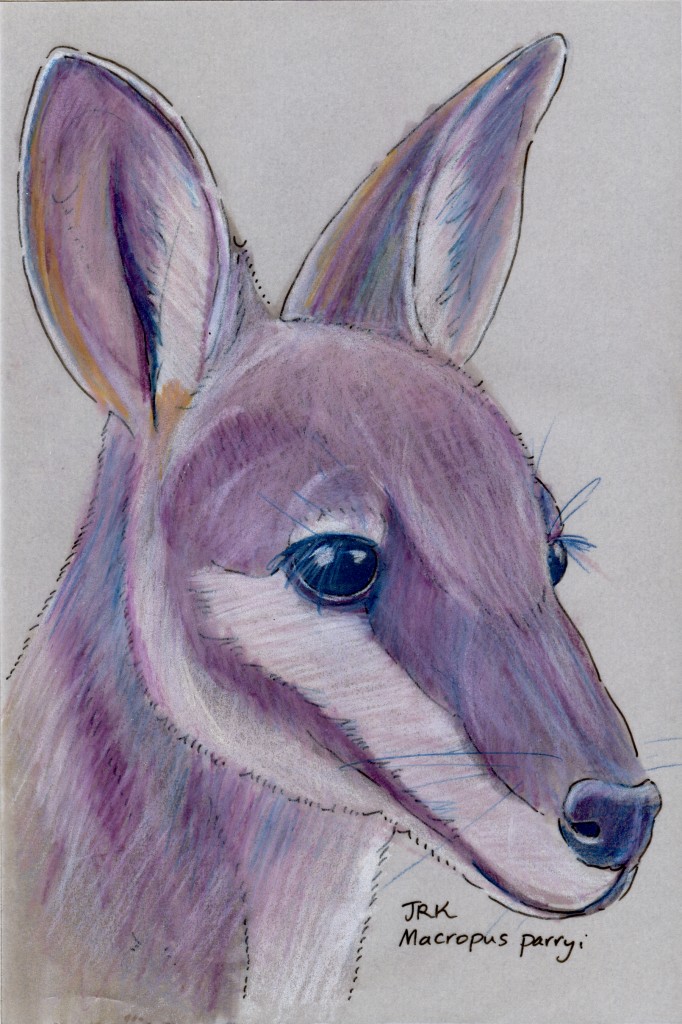
Pretty-faced Wallaby (Macropus parryi)

by JR Kinyak on September 19, 2011

in Marsupials

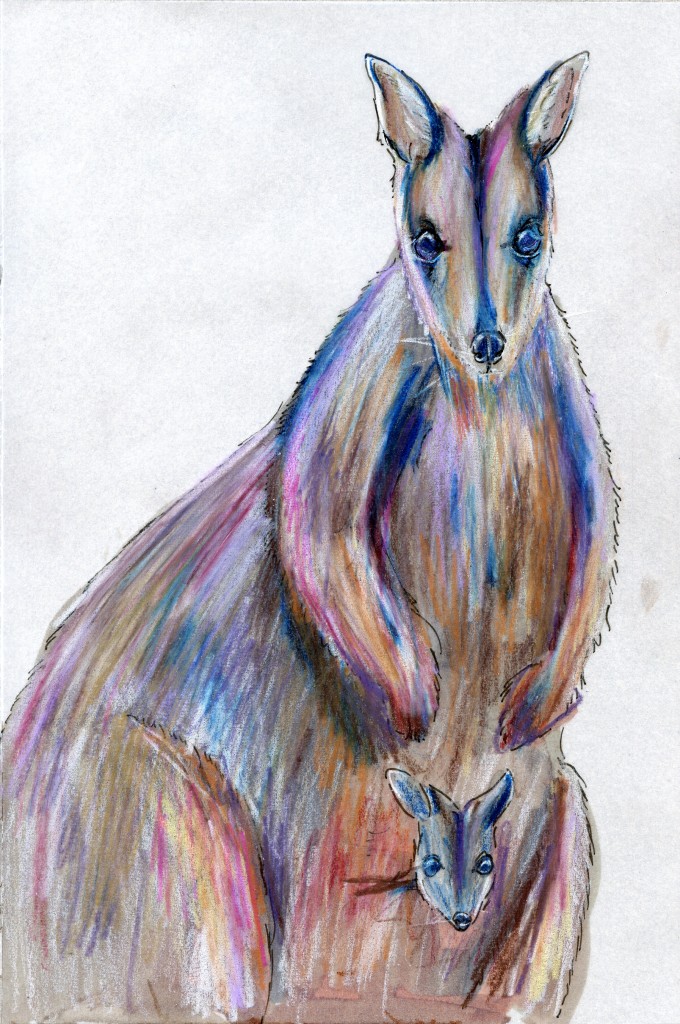
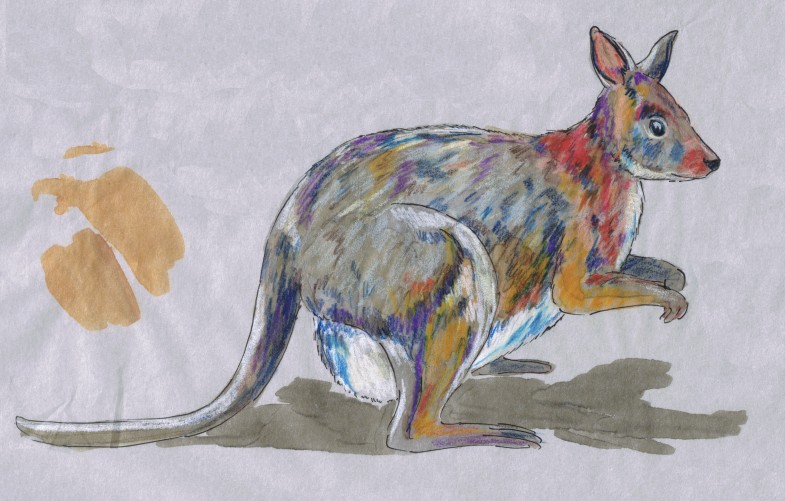
Pretty-faced wallaby (click image to enlarge)

Pretty-faced wallaby by Coco, age 12

0385

Coco did the write-up for today’s mammal, the pretty-faced or whip-tail wallaby. Take it away, Coco!

Pretty-faced wallabies are found in Australia. There are many different kinds of wallabies. They have very strong back legs that are great for traveling long distances. They use their tail for balance as they hop around. Some marsupials have back-opening pouches so the dirt doesn’t get into their pouches when they dig, but wallabies have front-opening pouches.

Wallabies look a lot like kangaroos but smaller. They sleep during the day and are awake during the nighttime. They eat bushes and grass. My mom calls me wallababy and I call her wallamama.

{ 4 comments }

I’m eager to introduce you to an enchanting tree kangaroo, but first let me remind you that starting Sunday, Coco and I will be selling original drawings of the mammals of Japan with all proceeds helping victims of the earthquakes and tsunamis. See yesterday’s post for the details!

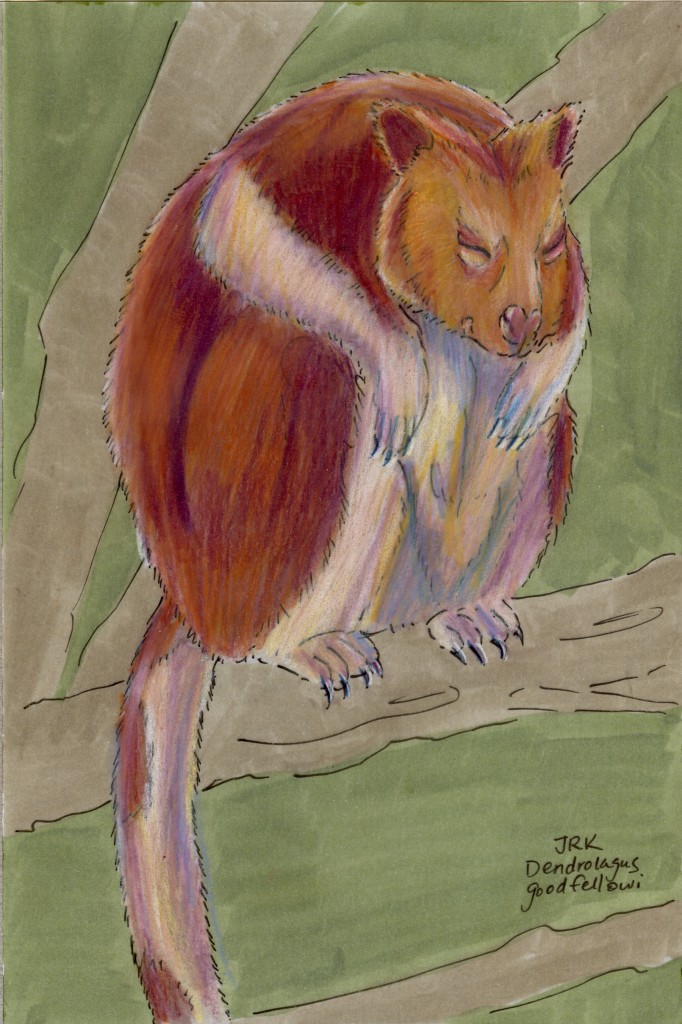
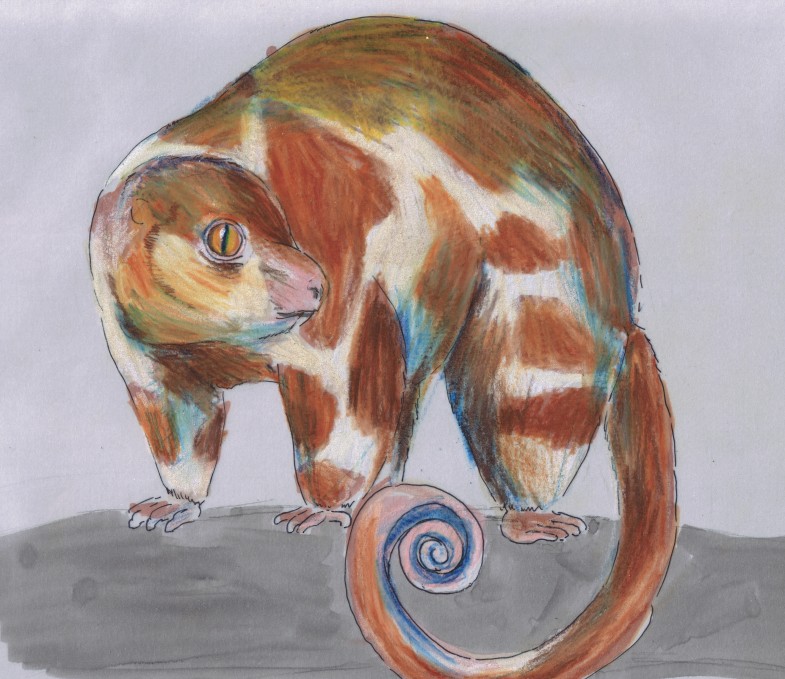
Goodfellow's tree kangaroo (click image to enlarge)


0367

I have fallen in love with tree kangaroos. They are my new favorite animal. They’re magical; they sound like something someone made up for a children’s storybook. Like regular kangaroos, tree kangaroos are marsupials, and the two kinds of animals are related. It seems that all the kangaroos—tree and otherwise—evolved from a common ancestor. According to the 1947 book Furred Animals of Australia by Ellis Troughton (which, incidentally, has a most endearing dedication: “To my mother…to whom any originality of written thought is lovingly dedicated”),

“The tree-kangaroos are of particular interest in having undergone an unusual twist or secondary phase of evolution which is reflected in their appearance and habits. Originally descended like their fellows from primitive tree-dwelling stock, the adoption of a hopping means of progression resulted in marked lengthening of the hind-limb, with a corresponding loss of the possum-like clinging great toe, while the tail changed from a prehensile to a balancing implement. After the long period of terrestrial existence which moulded the kangaroo-like appearance, the animal reverted to the trees again for foraging and safety, with a corresponding reversal in general structure towards the arboreal type.”

In other words, in case you are not a natural at interpreting the words of early-20th-century naturalists like I am, Troughton’s saying that all the kangaroos descended from an early tree-dwelling mammal, then adapted to the plains through the evolution of big ol’ feet for hopping. They didn’t need to grasp trees with their back legs or prehensile tails, so they lost their handy big toes and their tails became big and sturdy—not agile for swinging through the branches but stable for balance. Then, the tree kangaroos re-evolved back into a treetop lifestyle among the branches of the cloud forest. That’s why they look, indeed, like kangaroos incongruously perched in the trees.

Troughton also says that this evolution—from treetops to the ground and back to the treetops—is an illustration of “the irreversible law of evolution wherein features lost owing to disuse cannot be regenerated.” The tree kangaroos’ ancient ancestors had prehensile tails; they evolved to have big balancing tails instead, and there’s no going back. If you’re a regular reader of this site, you know that I’m a fairly new student of evolution, and I believe this is the first time I read this “irreversible law,” or at least the first time it sunk in. What do you think of that idea?

There are 12 species of tree kangaroos, and they live in Australia and Papua New Guinea. This particular species, Goodfellow’s (and another question: why are some possessive scientific names spelled with two Is, like the other day’s finlaysonii and prevostii squirrels, but some only have one I, like today’s goodfellowi? I was expecting it to be goodfellowii) is endemic to Papua New Guinea and is endangered. Tree kangaroos have long been hunted for food by indigenous people, and their pelts are used in traditional ceremonies. Now they’ve been overhunted, and of course their habitats are also being destroyed because whose isn’t?

Another thing I like about tree kangaroos: if they jumped off a measly little boulder in an arroyo, they would not break their calcanea, the way I did two weeks ago. In fact, they routinely jump from the treetops to the ground 60 or more feet below without getting hurt! Isn’t that amazing? Here’s a remarkable video that includes footage of one of those jumps as well as “Crittercam” images from two tree kangaroos wearing cameras around their necks. (The beauties in the video are a different species, the Matschie’s tree kangaroo.)

I tell you, I adore them! I really do! And I’m not the only one. In fact, I found this lovely little story that says that before you judge someone else, think of the tree kangaroo, and remember that the other person loves the tree kangaroo just as much as you do. With that common foundation, can’t you find something else to agree on?

{ 3 comments }

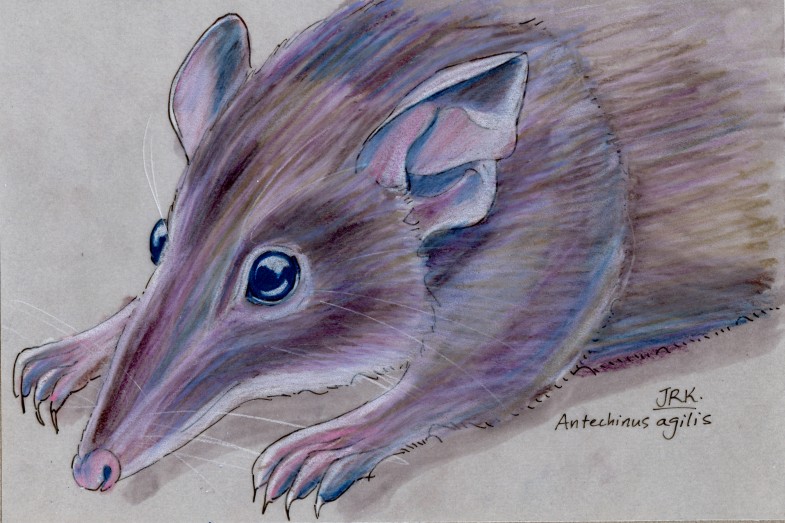
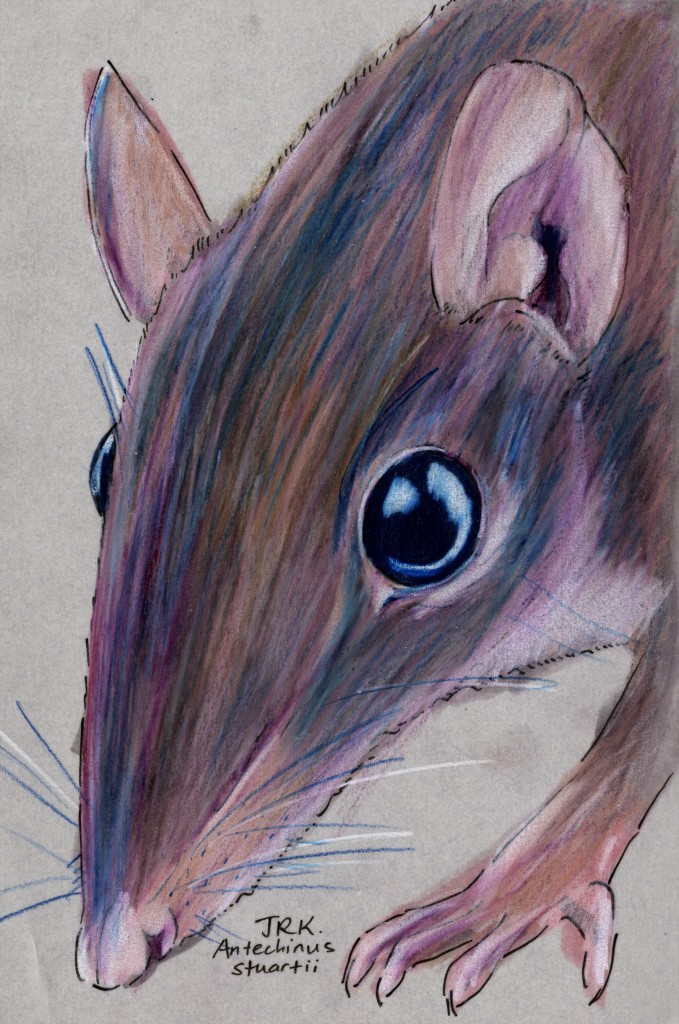
Brown antechinus (click image to enlarge)


0355

Every female wants a good father for her babies. Every male wants a good mother for his babies. That’s what life is all about. The more I study other animals, the more I think the meaning of life is: have sex and have babies, and have sex and babies with a mate or mates of good quality. Is there any other reason that anyone does anything?

But different species have different ways of finding the best mates, and within a species, the two sexes have different methods, too. In most mammals, the males aren’t choosy. They just impregnate everyone they can, and hope that their promiscuity will mean the odds are in favor of their finding at least one good mother for their offspring. Most mammalian females are pickier because they have such a large investment in raising the babies, from gestation to nursing and weaning and carrying their young around on their backs as they swing through the treetops. They can’t produce as many offspring, so they have to make sure the ones they have are good ones. Sometimes this means they look for the male who is best at fighting off other males, or they look for the one who can defend them against predators. Sometimes they look for the one with the most attractive pheromones and the prettiest honking noise, like in yesterday’s Gambian epauletted bat.

Females of the brown antechinus species, a mouselike Australian marsupial, look for the males with the strongest sperm. At least in this species, strong sperm means strong babies—babies who survive infancy, anyway. How do they find the best sperm? They mate with everyone who crosses their path and let the sperm fight it out. A typical brown antechinus litter includes the babies of three or four fathers, and studies have shown that the antechinus fathers who sire the most offspring also sire the strongest offspring—the offspring with the best chance of survival. In the end, according to this 2006 Scientific American article about the brown antechinus, this has the same result as mating with just one really good male.

Some of the males don’t end up actually passing on any of their genes, even though they mate just as much as the others. But they don’t care because they’re dead. You see, the brown antechinus mating system is what’s actually referred to as big-bang reproduction. They engage in two weeks of nonstop sex, some sessions lasting 12 hours or so, and then their poor little systems just give out. The stress of all that mating causes the males to suffer immune suppression and infection and internal bleeding and they all die before their first birthday. The ones with the strongest sperm father babies that will be born after their dads are gone, and the ones with weak sperm die in vain. The females survive long enough to give birth and nurse and wean, but they don’t live much longer than a year themselves. Then the next generation repeats the whole thing the following fall, and so it goes on and on and on.

Coco (age 12) drew a brown antechinus, too:

Brown antechinus by Coco (click image to enlarge)

{ 4 comments }

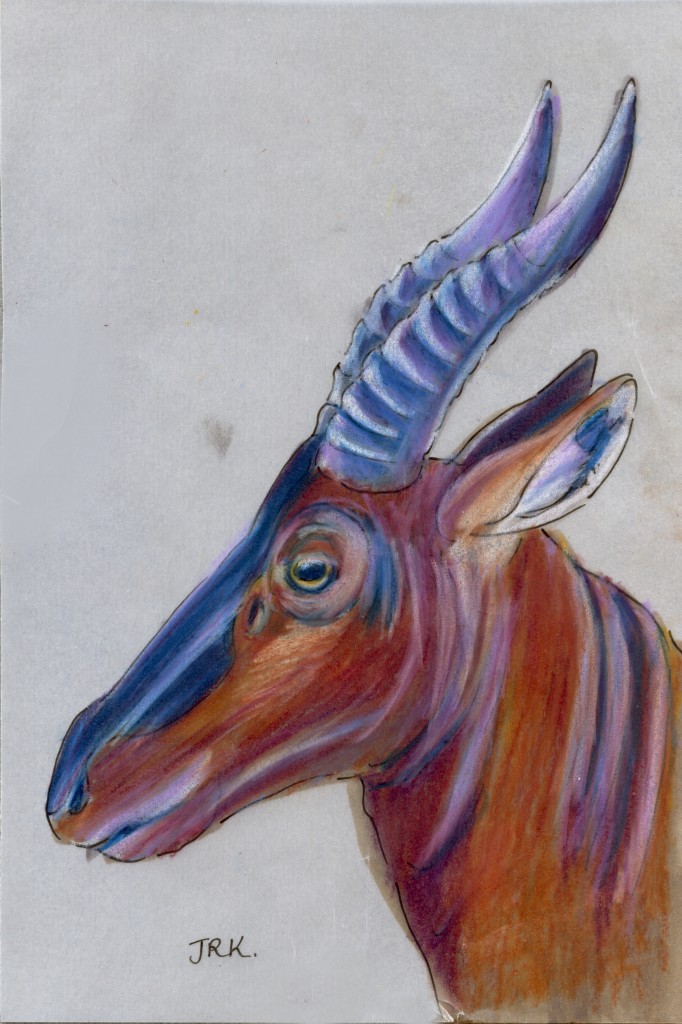
Topi (click image to enlarge)

0325

Because I missed a few days and because if I don’t step on the gas the World Cup will end before the World Cup of Mammals does, tonight I’m posting the final three mammals of Group D (the other being Serbia’s marbled polecat from the other day). This first one is the topi (Damaliscus korrigum), an antelope representing Ghana. Ghana was the only African nation to make it to the Round of 16, in which they beat the USA. Ghana plays Uruguay in the quarterfinals on Friday.

Bechstein

0326

Die Bechsteinfledermaus (Myotis bechsteinii), of course, represents Germany and is known as Bechstein’s bat in English. It was named after a German naturalist named Johann Matthäus Bechstein. Germany beat England in the Round of 16 and is going up against Argentina in the quarterfinals on Saturday.

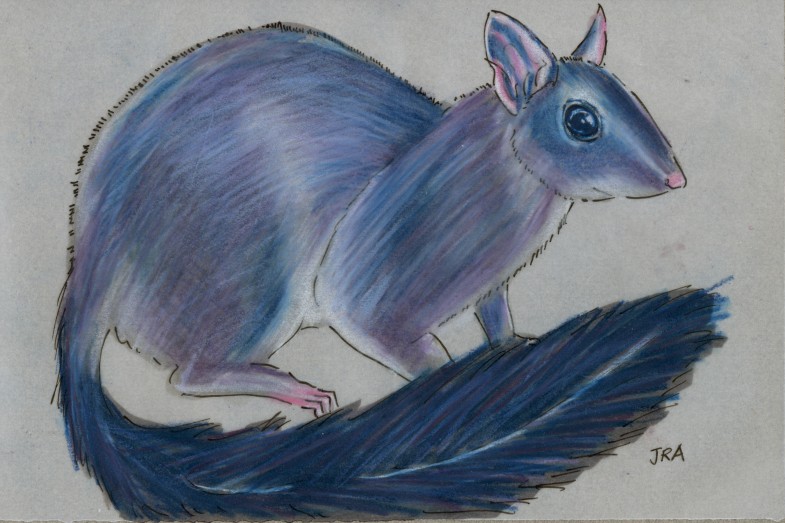
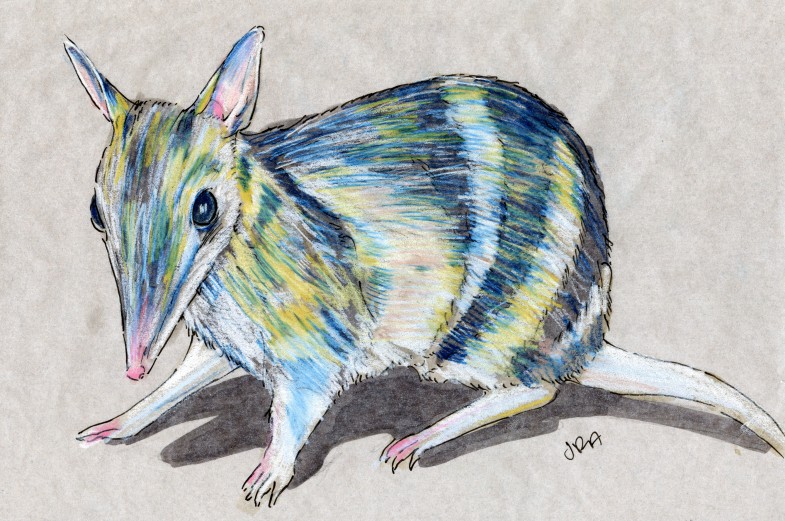
Long-nosed bandicoot (click image to enlarge)

0327

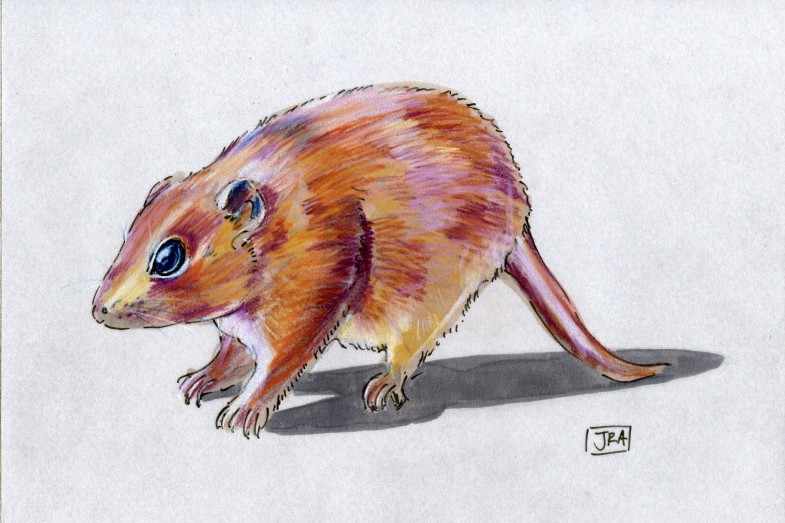
We must have a marsupial to represent Australia, and the long-nosed bandicoot (Perameles nasuta) has volunteered for the task. This bandicoot lives only in western Australia, and right now it’s widespread, but the rate at which its population is declining is a bit disturbing. Australia didn’t make it out of the group stage in the World Cup.

Group D Results

We read about how the marbled polecat is a virtuoso of killing, and there’s no doubt in my mind that it should win this group. Of the others, I think the topi has the edge because of its size and the hardness of its hooves. So the two mammals continuing on from Group D are:

Marbled Polecat (Serbia)
and
Topi (Ghana)

{ 4 comments }

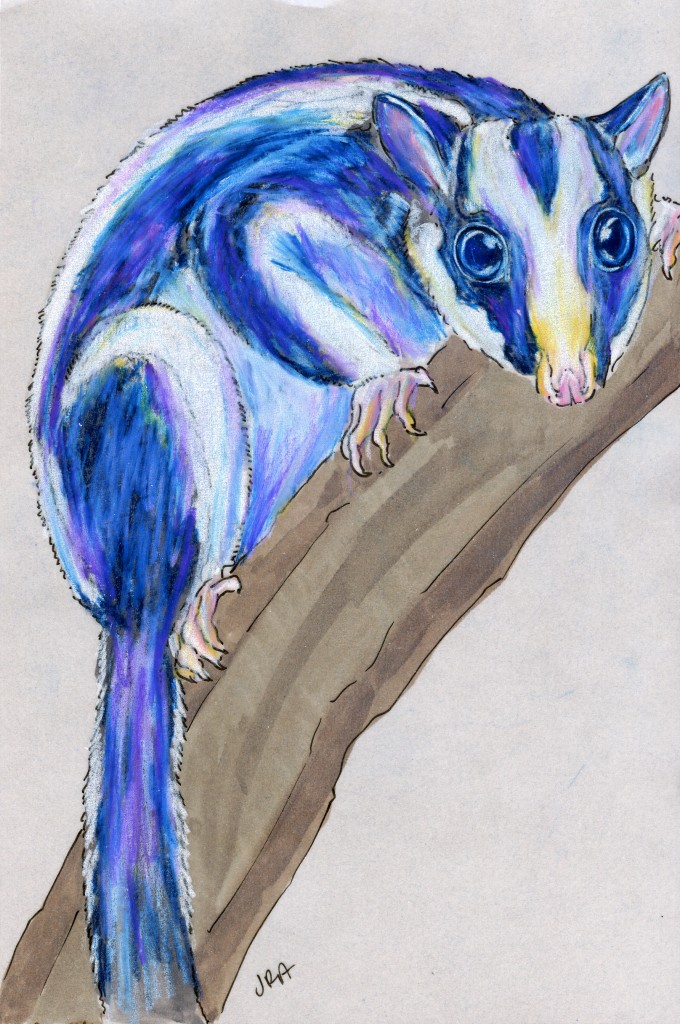
Greater glider (click image to enlarge)


0300

Here’s our 300th mammal! That’s right, in almost exactly three years of drawing mammals, I have less than a year’s worth of drawings to show for it. We could celebrate this milestone or rue its inadequacy: your choice.

By request, here’s the greater glider! This adorable marsupial, which surely has the world’s cutest ears, lives in the eucalyptus forests of Australia. Up in the treetops, it glides by using the membrane that stretches from its elbow to its wrist as a sail. When it gets cold, it uses that same membrane as a built-in blanket. Coco drew one, too.

Greater glider by Coco, age 11

{ 7 comments }

Common Wombat (Vombatus ursinus)

by JR Kinyak on April 10, 2010

in Marsupials

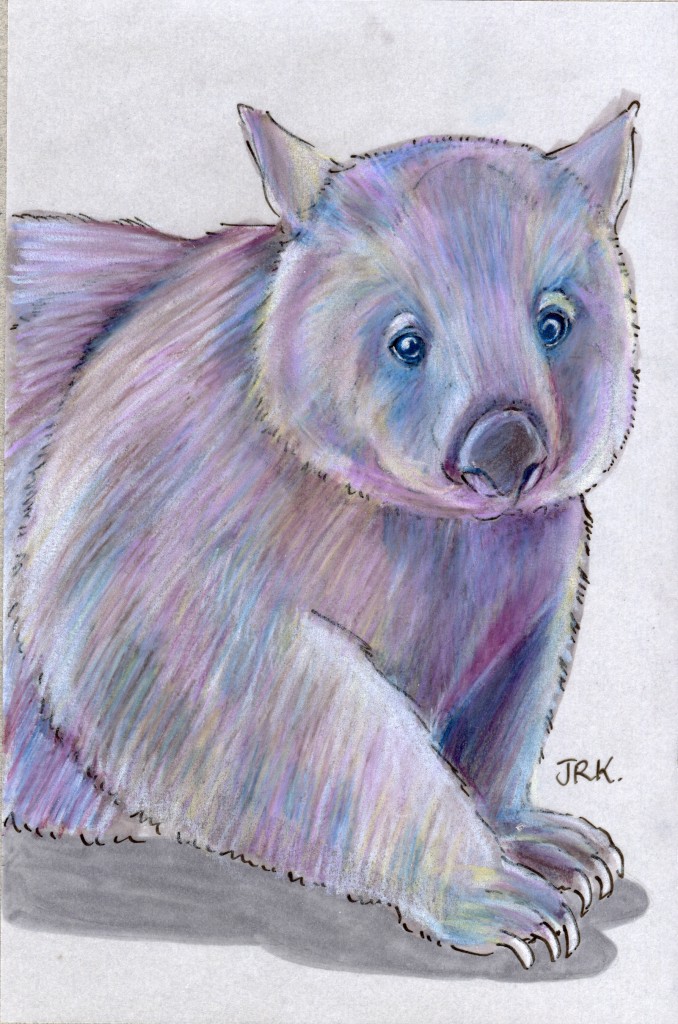
Common wombat (click image to enlarge)

0291

Wombats are Australian marsupials, and the common wombat is, naturally, the most common of the three wombat species. Common wombats live along the coast of southeastern Australia, in alpine areas and sandy places. The wombats’ claim to fame is that they are the only known large, herbivorous burrowing mammals: all the other burrowing herbivores are small, and all the other large burrowers are carnivores or insectivores. That’s because being a herbivore requires a lot of time and energy spent on foraging (don’t I know it), and being a burrower requires a lot of time and energy spent on digging. Large herbivores usually don’t have that kind of free time.

And wombats are large! The common wombat ranges from about 50 pounds to nearly 90, or about the size of a pretty-big dog to about the size of a really big dog. They look like they’d be about rabbit-sized, or at least they do to me, but no, they’re humongous. However, they have extraordinarily slow metabolisms and really don’t need to eat much at all: only about half as much as a kangaroo does, and a kangaroo weighs about the same as a wombat. That means the wombat can nocturnally forage at its leisure and spend most of its time lazing underground.

Coco drew a wombat, too!

Common wombat by Coco, age 11 (click image to enlarge)

{ 5 comments }