From the category archives:

Mammal News

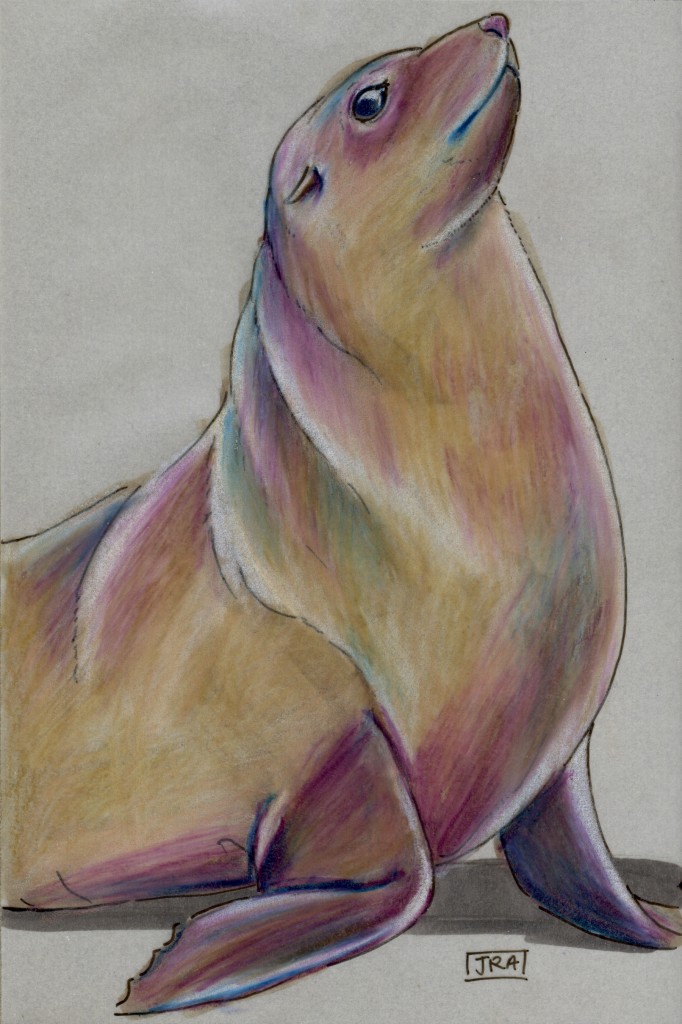
Cape fur seal (click image to enlarge)

Cape fur seal (click image to enlarge)


0271

Daily Mammal Now is an occasional Daily Mammal feature in which we meet a topically newsy mammal that I hadn’t previously drawn. Now, let’s meet the Cape fur seal, or more precisely, the Afro-Australian fur seal, of which the Cape fur seal is a subspecies. Afro-Australian seals live, unsurprisingly, off the coasts of Africa and Australia, specifically southwestern Africa and southern Australia. They’re called fur seals because their fur has been used to make coats and such. Baby fur seals have especially prized fur. The genitalia of male seals is sometimes used as an aphrodisiac in traditional medicine.

The largest Cape fur seal colony is on the coast of Namibia. Every year, the Namibian government allows seal hunts. This year the seal season runs from July 1 until November 15. The government is allowing hunters to club 85,000 baby seals and 5,000 adult males. The hunt takes place in relative secrecy so as not to attract attention or scare people.

Namibia is one of only five countries that still allow seal hunts. There is some disagreement among experts about the humaneness of clubbing seals; some maintain that done correctly, it’s more humane than shooting. But because of the perceived cruelty, seal products have long been banned in the United States and other countries, and beginning in 2010, they’ll be illegal in the European Union, too (with the exception of those created by subsistence hunting on the part of native populations).

This year’s Namibian seal hunt has been in the news the past couple of weeks because a South African organization, Seal Alert-SA, has been trying to buy out the only company that deals in Namibian seal pelts. (Coats made by the company supposedly fetch up to US$110,000.) With animal welfare activists claiming that the seal hunt hasn’t started because of the pending deal and the Namibian government saying that it has, it’s unclear what exactly is going on.

The National: “$14m deal to end Namibia’s Seal Cull”

The AP: “Namibian seal hunt to go on, 90,000 to be clubbed”

African Conservation Foundation: “Seal Cull NOT Started, Hang-in There Baby Seals, Help Coming”

Seal Alert-SA’s blog

{ 7 comments }

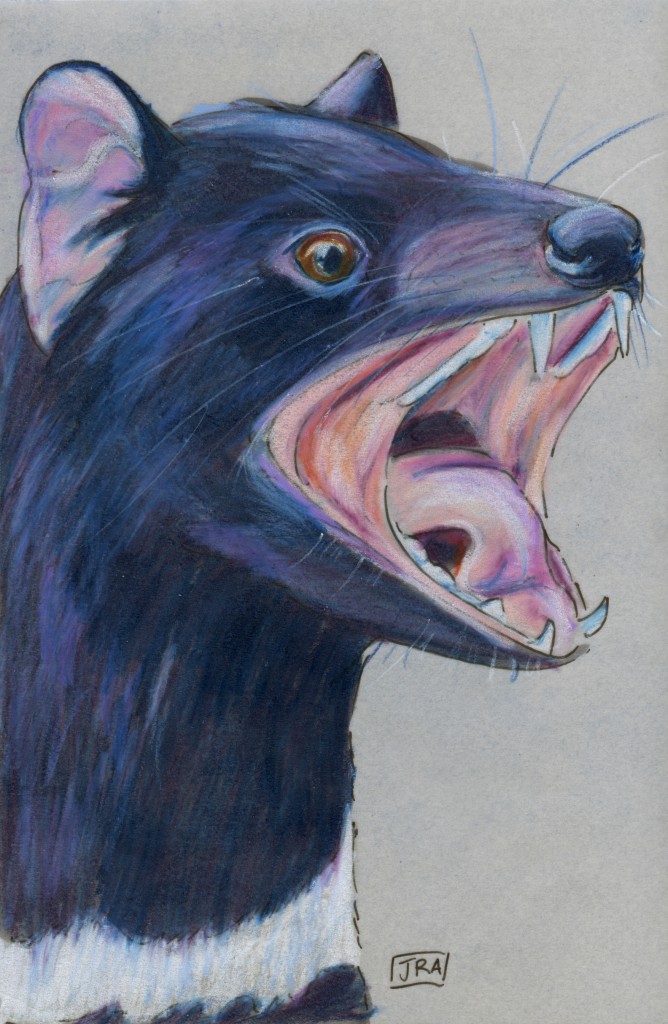
Tasmanian devil (click image to enlarge)

Tasmanian devil (click image to enlarge)


0262

Tasmanian devils are feisty, aggressive guys, with a screech that’s invariably described as bloodcurdling or bone-chilling. They dine on carrion, and they especially love to eat dead wallabies and opossums. They get into scuffles over their food, during which they nip at each other’s faces, and their complicated, violent mating rituals also involve rival males biting each other’s faces. Tasmanian devils have extremely strong jaws, which let them crunch on bones. Their genus name, Sarcophilus, means “flesh lover.” Listen to their screams in this video:

But Tasmanian devils are in big trouble: over the past 13 years, the wild devil population has fallen by 70 percent.

The devils are falling victim to a vicious, communicable cancer called devil facial tumor disease. Their face-biting just helps the cancer spread. The Australian government declared the devils endangered last week, and frantic efforts to save the species include captive breeding programs on the Australian mainland, the quarantine of non-affected populations with devil-proof fences, and the release of breeding pairs on isolated islands, in addition to a search for a vaccine for their cancer. If these attempts don’t work, the Tasmanian devil could be extinct within a decade or two.

  • Save the Tasmanian Devil
  • Tassie Devil Cancer Awareness
  • Tassie Devil Appeal: breed a virtual devil
  • National Geographic: “‘Teen Sex’ Rising for Cancer-Affected Tasmanian Devils”
  • { 0 comments }

    Mammal News Roundup

    by JR Kinyak on January 2, 2009

    in Mammal News

    Hi, Mammals!

    For the new year, let’s get this show back on the road. I want to draw all these critters before I’m 50, after all. I’m going out of town for the weekend, but when I get back, I resolve to draw my little heart out, and I hope you’ll look at my drawings.

    Here are some mammal stories from the past few weeks.

    The Washington Post, in “Acorn Watchers Wonder What Happened to Crop,” reports that acorns are disappearing from the northeastern United States! Seriously, they’re just not there, where they should be. Some botanists are freaking out—and so are squirrels. “Crazy,” “skinny” squirrels are getting into garbage, “demolishing pumpkins,” and getting themselves killed in starving desperation. The epicenter of the acorn mystery seems to be northern Virginia, but reports of missing acorns have also been filed from Maryland and Pennsylvania and as far away as Kansas and Nova Scotia. While this probably won’t be a big problem for the oak trees themselves, it’s a serious issue for our mammal friends the squirrels.

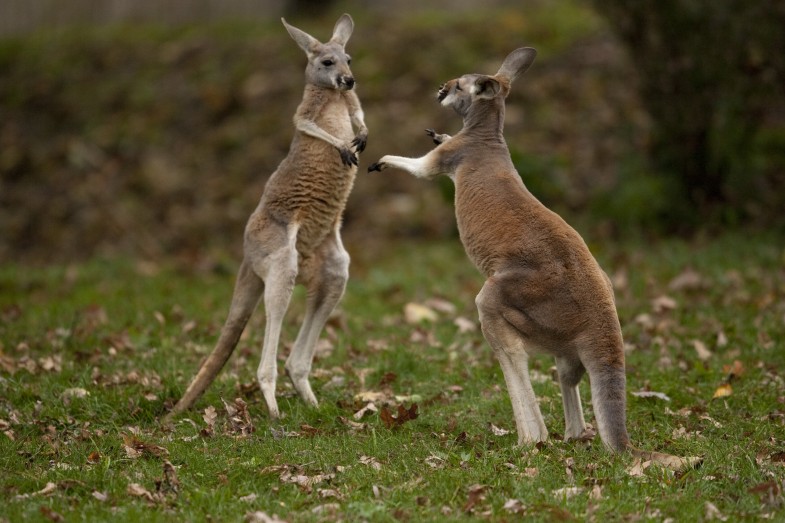
    One of the selections in the New York Times Magazine’s “8th Annual Year in Ideas” issue was “Eat Kangaroos to Fight Global Warming.” You see, cows produce methane, which is a greenhouse gas and a significant contributor to global warming. Kangaroos don’t produce methane because of the enzymes in their digestive systems. I’ve previously read that some scientists are trying to graft those enzymes, somehow, into cows’ systems, and I don’t know how that’s going, but a simpler solution, at least in Australia, is to wean people off of cattle and get ‘em eating more kangaroo meat. (Even better, maybe, would be vegetarianism…)

    In Sizhou, China, a man who trained some monkeys to ride bicycles at a market gave one of the monkeys a beating after it didn’t do what he wanted. Well, the other monkeys turned it around on him, beating him over the head with his own cane. “They may have built up some feelings of hatred toward me,” the man says, according to an article in the Daily Mail.

    A stranded sea lion was wandering around near the runways at the Oakland International Airport, looking at people kind of odd, according to an airport manager quoted in the San Francisco Chronicle’s story on the incident. The sea lion didn’t interfere with airport operations, and it was taken to the Marine Mammal Center in the Marin Headlands.

    Although melting sea ice is causing a disturbing number of polar bears to starve to death, a serendipitous glut of snow geese may prove golden. Polar bears can eat their eggs, which would solve two problems. (I almost said “kill two birds with one stone.”) The movement of polar bears toward land should overlap with the snow geese’s egg-laying cycle beginning in about three and a half years, so we’ll see then how the bears like their huevos rancheros. LiveScience has the story.

    Kangaroos photo by Julian Robinson.

    { 4 comments }

    Good news today! I was planning a post on the study, released this week, finding that almost 50 percent of primate species are in danger of extinction. What else is new? More bad news from the Daily Mammal.

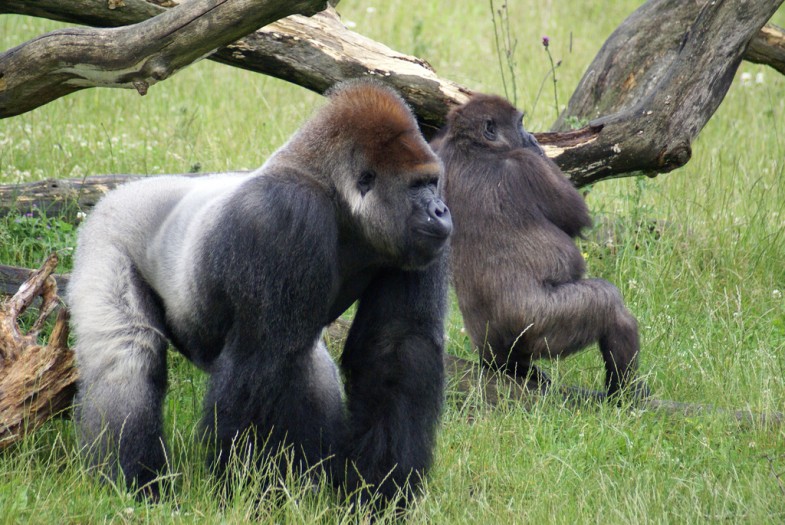
    But! On the heels of Spain’s vote to grant certain rights to the great apes comes more good news for our cousins. The Wildlife Conservation Society announced today that it has found more than 125,000 western lowland gorillas secretly going about their business in a couple of swampy areas in the northern Republic of Congo! What makes this such wonderful news is that’s more than twice the number of western lowland gorillas that we thought were left in the whole world!

    They’re not out of the woods (so to speak) yet, though; they’re still considered critically endangered. Major threats to the western lowland gorilla subspecies (Gorilla gorilla gorilla!) include the Ebola virus and poachers who kill gorillas and sell them on the bushmeat market. (Okay, it’s not all good news…) In fact, it was a hunter who pointed the Wildlife Conservation Society researchers to the gorillas. Don’t you almost wish they hadn’t been found?

    Here’s a video showing the gorillas hanging out—in one case literally—in the swamp.

    More western lowland gorilla info (and pictures and videos) on ARKive.


    Gorilla photograph by Craig Gobler, used under a Creative Commons license.

    { 0 comments }

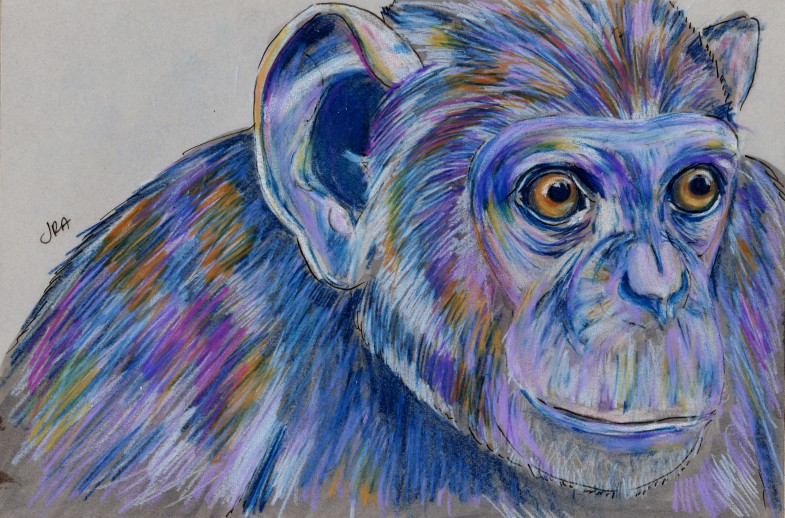
    click image to enlarge

    0191

    Daily Mammal Now is an occasional feature that offers a drawing and discussion of a mammal currently in the news.

    In June of this year, a committee of the Spanish parliament voted to grant limited “human” rights to the other great apes (chimpanzees, bonobos, orangutans, and gorillas). The law, which is expected to go on the books some time in the next several months, will prohibit laboratory testing on great apes, as well as holding them in captivity for entertainment purposes. Zoos can keep their apes, but circuses and the like cannot.

    As far as I can tell, the idea behind this new act has been pushed forward by the Great Ape Project, an organization cofounded by the ethicist and animal rights activist Peter Singer. The Great Ape Project calls for all great apes to be granted freedom from torture, the right to live, and the right to freedom. This includes the right of due process and the right not to be imprisoned without a fair trial. (I’m not sure whether the Spanish act uses the same language as the Great Ape Project or whether the Great Ape Project has just seized the Spanish act as an easy way to get its message out. It’s not clear to me if the act uses the phrase “human rights” or speaks of all great apes—including humans—as equals.)

    I have mixed feelings about this idea. I support a ban on using great apes as laboratory-test subjects, and I support banning cruelty toward animals in all forms. If I were in charge, factory farms would not exist, animal shelters would not euthanize animals just because they’d been there too long, high school students wouldn’t dissect frogs or rats or cats, and almost all animal testing—maybe even all of it—would be illegal.

    What’s with my ambivalence toward the Great Ape Project, then? I support pretty much all of its aims. Where they lose me is with their talk about a community of equals and the right to due process. There’s something condescending about it. If we are declaring ourselves the species that has the ability to grant rights, how can we be equal? Since chimps can’t defend themselves in a court, a human advocate would need to be appointed. Who appoints that person? How do we know that what that person says is truly what the ape wants?

    If all apes are to be granted freedom from imprisonment, where are we going to put the thousands of zoo, circus, and laboratory animals that we’d have to set free? Couldn’t it be crueler to send them out into the wild when all they’ve ever known is captivity? I think it’s shameful to keep apes in cold metal cages, and I’d love to see them in nice sanctuaries where they have social groups and plenty of space, but that’s still captivity, or imprisonment if you want to use the Great Ape Project terminology.

    I guess I just don’t think we are equals. Our species, the great ape called Homo sapiens, has evolved so many capabilities so far beyond even those of our nearest cousins, the chimpanzees. I think that makes us responsible for them, and for all animals, and by accepting that responsibility, we help them far more than we would by calling them our equals and taking away our power to make choices about their treatment. Our dominion over the beasts doesn’t give us the right to abuse, use, or hurt them. It’s the opposite: it gives us the duty to treat them kindly. We don’t need to grant them personhood to fulfill that duty.

    The New York Times came out in favor of Spain’s act: “When Human Rights Extend to Nonhumans.”

    The Wall Street Journal was against it: “Monkey Business.”

    The Chimpanzee Health Improvement, Maintenance, and Protection Act provides for peaceful retirement (as opposed to euthanasia) for “surplus” laboratory chimpanzees.

    The Great Ape Project advocates for “equality beyond humanity.”

    42 Ways to Help Animals in Laboratories: download a nice PDF from the Human Society of the United States on this page.

    The American Anti-Vivisection Society was founded in 1883 and works to stop experimentation on animals.

    Consecutive days of mammals: 1
    Record: 16

    { 0 comments }

    Mammal News Roundup

    by JR Kinyak on June 26, 2008

    in Mammal News

    Well, I was going to post a new mammal drawing today, which would have brought us to six consecutive days! But alas, I decided to pick tonight to try out a new paper (I was going to try to find a more archival replacement for my usual tracing paper) and, well, it’s just not working out for me. So instead, here’s an installment of the Mammal News Roundup.

    May 28, 2008, The Guardian: Jane Goodall, a hero to mammals including me and my friend Tynan, is proposing that the Nobel Prize committee add a new prize, “for advancing medical knowledge without experimentation on animals.” I absolutely agree that, at the very least, we could drastically cut back on how often we experiment on animals now that we have amazing scientific technology and that we should actively recognize and reward new ways of doing science that don’t involve harming animals, but a Nobel Prize for such a niche seems like it would not quite fit in with the others.

    June 23, 2008, CNN.com: The U.S. Supreme Court will hear a case regarding whether or not it’s okay for the Navy to disregard the welfare of whales when it’s performing sonar tests. Despite evidence showing, apparently, that whales, dolphins, and other marine mammals can be injured or killed by military sonar, President Bush tried to create an exemption that would allow the tests to be conducted without an environmental impact assessment. Courts up to the Supreme Court have sided with the whales.

    On the other hand, the court isn’t going to hear a case about the proposed fence along the U.S.-Mexican border, meaning that the law that gives “the secretary of homeland security the power to bypass laws or regulations prohibiting the fence’s construction” stands. A law that gives someone the power to break the law is an interesting law indeed. This is an issue I feel very strongly about, but I’m not going to start ranting about it right now.

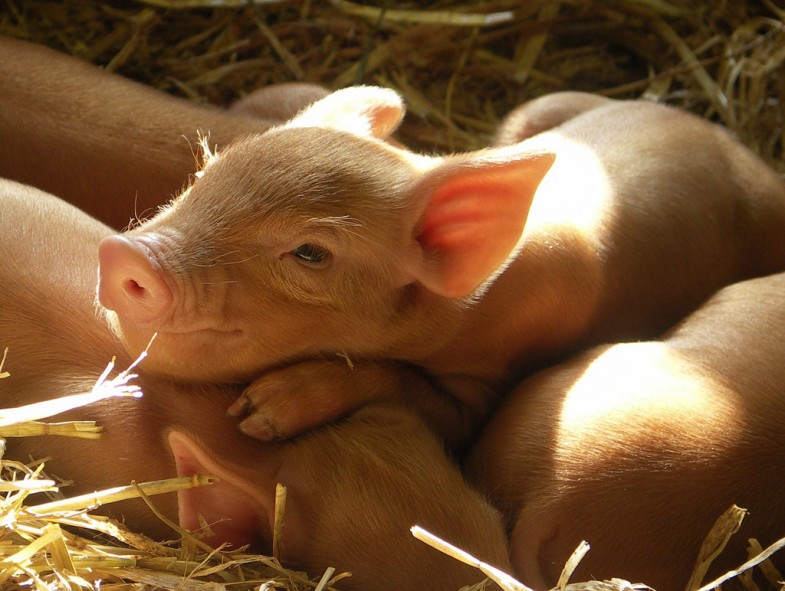
    June 24, 2008, NewScientist.com: A study suggests that piglets—being raised for their meat—who get to listen to music and play in their own rec room are less stressed. The piglets in the study listened to music by Bach and Elgar, chosen for its resemblance to porcine grunts! Less stress for pigs means better pork for humans.

    June 20, 2008, The Guardian: The demilitarized zone between North and South Korea was once farmland. Now that it’s been left to its own devices, endangered animals have been quite successfully making their homes there. But the DMZ isn’t likely to stay natural and wild for long, since development and industry are encroaching, so a group wants to have the zone declared an official nature reserve: the most dangerous nature reserve in the world, according to this article. The article is accompanied by a slide show about the wildlife of Korea’s DMZ.

    Photograph by Scott Bauer, United States Department of Agriculture

    { 2 comments }

    New Feature: Mammal News Roundup

    by JR Kinyak on May 18, 2008

    in Mammal News

    Sometimes I see articles online or in magazines that I think would interest Daily Mammal readers. When they concern mammals I haven’t drawn yet, I can feature them as Daily Mammal Now posts. But when I’ve already drawn them, or just don’t want to or can’t draw them right away for some reason, I don’t have a good vehicle to share them with you.

    That’s why I’m going to start occasionally (weekly? fortnightly? semiweekly? who knows?) pointing you to some very recent news stories and articles that you might want to read, or at least know about. Here’s the first Mammal News Roundup.

    Daily Mail, May 12, 2008: There’s a cow the size of an elephant.
    He was left on the doorstop of an English animal sanctuary when he was an infant. The first picture makes him look especially large; check it out. Note to Americans: swede is what Brits call rutabaga.

    Science Daily, May 13, 2008: Double mammal newsflash: In Brazil, they’re training dogs to recognize the scent of various endangered mammals (like the jaguar and the giant anteater), helping researchers monitor their populations.

    Madison, Wisconsin’s Capital Times, May 13, 2008: They’re still trying to figure out what’s causing white-nose syndrome, the strange ailment that’s devastating some populations of bats in the northeastern United States. (Click on the Daily Mammal Now link above for more.)

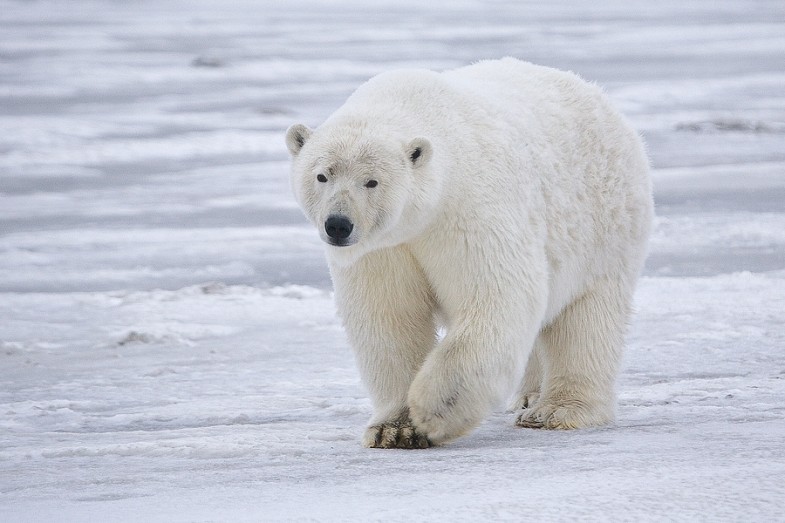
    U.S. Department of the Interior news release, May 14, 2008: Polar bears are now listed as a threatened species under the Endangered Species Act. Since climate change is a major cause of polar bears’ decline, but it’s very difficult, to say the least, to prove how any particular action by Americans influences the climate change that’s harming the bears, it is unclear how much the move will help the bears.

    When I drew the polar bear, I found in my research that some people think that the polar bear is actually the same species as the brown bear. I looked into that a little more today and learned some interesting things. It seems polar bears, which are recognized as a distinct species by most anyone without an ax to grind, evolved from the brown bear pretty recently, some 200,000 years ago. And they were still developing adaptations as recently as 40,000 years ago.

    I wonder how you would decide when the species was still the brown bear and when it had become the polar bear. Maybe there’s a bare minimum of changes and differences that must be present? Or a certain number of DNA markers that should be present or absent? Or is it a case of “you know it when you see it”?

    Some people, evidently regarded as nuts by some other people, think that melting ice in the Arctic will force the polar bear to evolve back into the brown bear, but it seems pretty likely to me that they’re endangered enough that we can’t expect them to be around long enough for that to happen with no intervention. Being an amateur biologist, though, I can just speculate.

    BBC News, December 10, 2007: An Icelandic (yay!) scientist found the most ancient polar bear jawbone we have,
    a 150,000-year-old specimen. The article discusses, in brief, the evolutionary history of the polar bear.

    (Polar bear photograph by Scott Schliebe, USFWS)

    { 3 comments }